49 works in this view — arrow keys or swipe to move between them.
Dance in Art · 1877
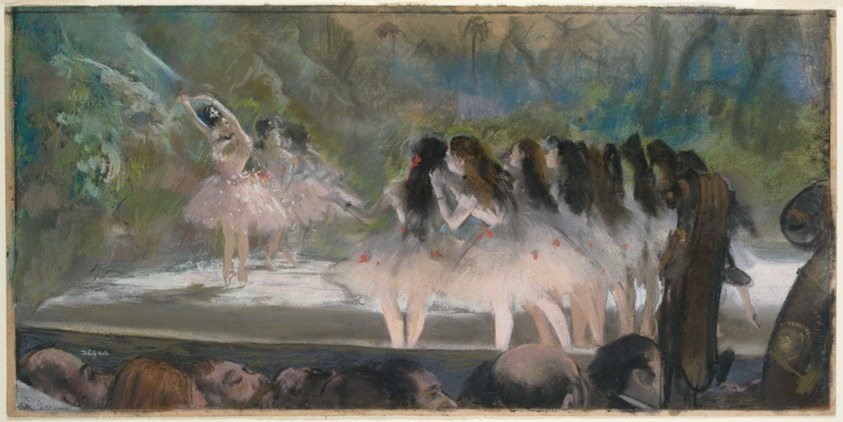
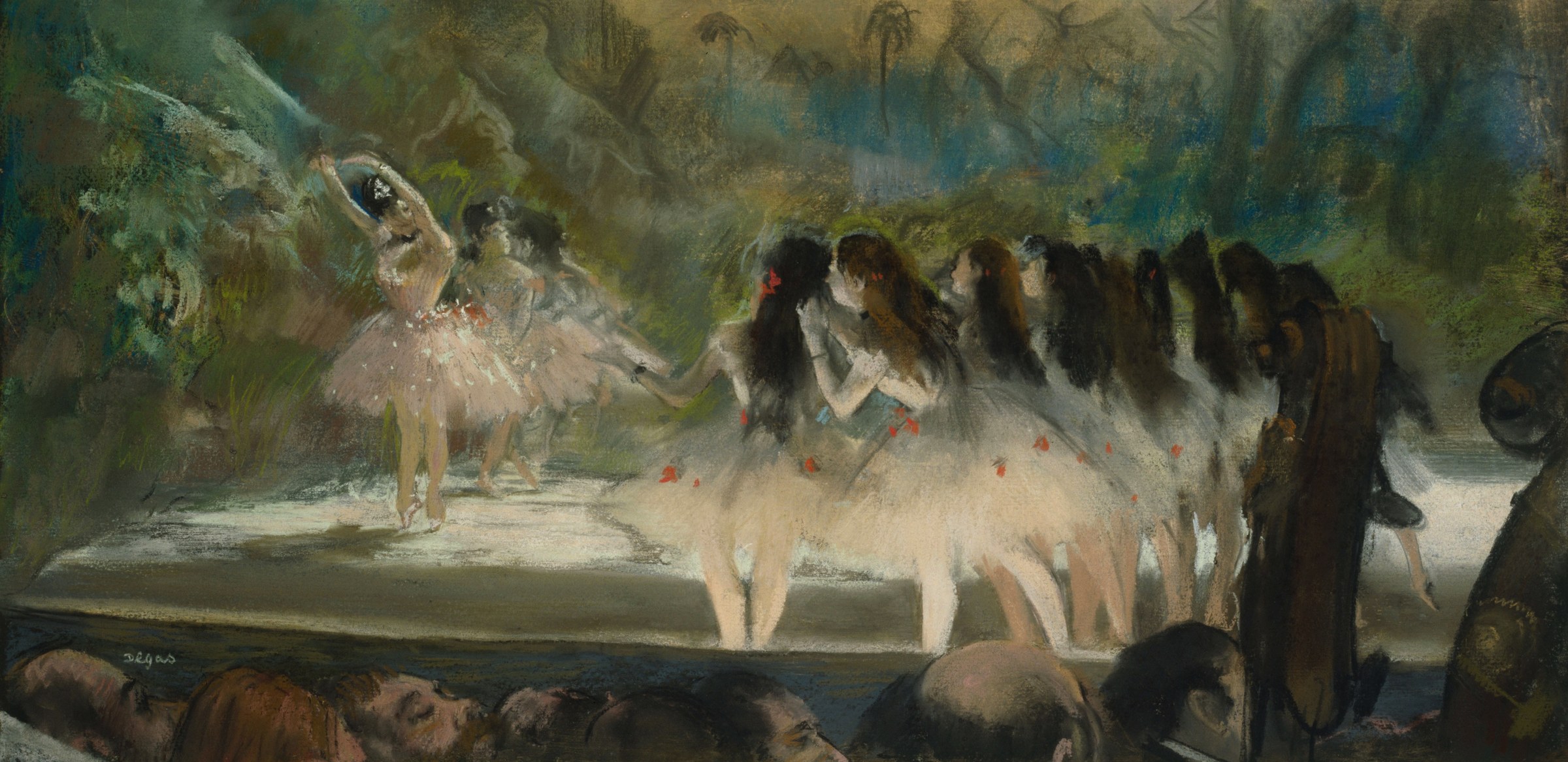
Edgar Degas - Ballet at the Paris Opéra
Edgar Degas
- Medium:
- Oil Painting
- Dance:
- Ballet
- Era:
- Late 1800s (Victorian Ballroom)
- Source:
- Wikimedia Commons
- Rights:
- Public domain — free to use, share and adapt.
- Recorded as:
- Public Domain
Degas is the primary visual chronicler of ballet in the 19th century, and his paintings, pastels, and drawings are among the most historically valuable sources for understanding how ballet was performed and staged during this period. This work captures the Romantic aesthetic—the ethereal female body, the supernatural narrative, the corps de ballet as atmospheric ensemble—that continued to define prestigious ballet at the Paris Opéra even as new virtuosic and realistic styles were emerging. For dancers and historians, Degas's work is essential evidence of repertory, costume, staging, and the lived experience of the ballet theater.
What you are looking at
A theatrical ballet scene set in a lush, shadowy forest interior. In the foreground, a solo female dancer in a pale tutu stands en face, one arm raised overhead in a classical pose, her body caught in an attitude of lyrical grace. Behind her, a line of roughly a dozen corps de ballet dancers recedes into the misty, green-toned depth, their bodies angled and their long dark hair visible against their pale costumes. The setting suggests a Romantic-era narrative—a forest glade or enchanted woodland. Overhead, hints of palm fronds or exotic foliage are sketched into the darker upper register of the canvas. In the extreme foreground, dark-toned male spectators in formal dress are dimly visible, their heads and shoulders silhouetted, watching the stage action. The lighting is theatrical, with the dancers emerging from shadow into a soft spotlight that models their forms and emphasizes the ethereal quality of the scene.
The dancing
The soloist adopts a classical ballet frame: standing in apparent turnout, her weight centered, one arm raised to fifth position en haut or en couronne, the other extended. Her posture is upright and dignified, the body aligned in the academic convention. The corps dancers are arranged in a staggered diagonal line receding stage-left, their bodies tilted forward slightly and their limbs held in loose, naturalistic positions rather than strict geometric alignment—a common Romantic convention for ethereal or supernatural corps. The relationship between soloist and corps is hierarchical and narrative: the principal figure holds the viewer's attention while the ensemble provides atmospheric context.
The dance depicted
This is Romantic ballet, most likely from the mid-to-late 19th century French or Continental repertory. The pale tutu, the forest setting, the supernatural or sylphid corps de ballet, and the soloist's classical vocabulary all point to the tradition established by works like *La Sylphide* (1832) and developed through the 1860s–1870s. The image captures a key motif of Romantic ballet: the mortal dancer (or fairy/sylph) framed against an otherworldly ensemble. The technical content is classical—turnout, raised arm positions, upright carriage—performed within a narrative context that privileges beauty, mystery, and the feminine ideal rather than virtuosic display.
How it was made
Oil on canvas. Degas's handling is characteristically atmospheric: he builds the scene through layered, broken color and soft transitions rather than hard outlines. The forest background is suggested through gestural brushwork in greens, browns, and blues, with little botanical specificity. The figures are rendered with greater definition, but the overall effect is one of theater lighting and atmospheric haze. This technique—impressionistic in its color treatment but precise in its rendering of the dancers' poses and dress—was Degas's signature approach to ballet subjects. The oil medium allowed him to work and rework the composition and to capture the ephemeral quality of stage light on moving bodies.
About this work
This is a study of ballet performance at the Paris Opéra, painted by Edgar Degas in 1877 at the height of his engagement with dance subjects. It depicts a moment from a Romantic ballet—a solo set against a corps de ballet in a forest or supernatural setting—captured from the auditorium perspective. The painting exemplifies Degas's interest in the theatrical spectacle of ballet, the bodies of the dancers, and the play of stage light; it is also a record of the Romantic ballet tradition still in circulation on the Paris stage in the 1870s, decades after its initial heyday. The presence of spectators in dark silhouette in the foreground anchors the viewer in the theater and reminds us that we are watching an image of watching—a meta-theatrical gesture characteristic of Degas's ballet paintings.
How to look at it
The composition is a study in framing and perspective. Note how Degas positions us in the auditorium, so we see the stage through the heads and shoulders of spectators—a literal theater-within-the-frame device that implicates the viewer as a member of the audience. Attend to the soloist's pose: she is captured in a moment of stillness or suspension, not mid-movement, which was Degas's preferred strategy for freezing the ephemeral. The corps de ballet line recedes in a staggered diagonal, creating depth and a sense of ensemble rather than unison. The color temperature shifts from the cool, misty background to the warmer flesh tones and pale tulle of the dancers, drawing the eye forward. The handling of light is crucial: the stage light illuminates the dancers while leaving the rest of the theater in shadow, creating a sense of theatrical concentration and magic.
The artist
Edgar Degas (1834–1917) was obsessed with ballet from the 1860s onward. He attended rehearsals at the Paris Opéra, made countless sketches and studies, and produced paintings, pastels, prints, and sculptures of dancers in performance, rehearsal, and repose. He was fascinated by the ephemeral moment—the body caught mid-movement, in backstage rest, or under stage light—and by the formal and informal structures of ballet technique and theater. His ballet subjects are not sentimental idealizations but sharply observed records of bodies at work, rendered with the same intensity he brought to racehorses, café scenes, and laundresses. By the 1870s, Degas had established himself as the painter of the Paris ballet world, and his work was exhibited and collected with recognition of its documentary as well as aesthetic value.
The period
In 1877, Romantic ballet was in its mature phase: *La Sylphide* and *Giselle* were canonical works, regularly revived, and the supernatural, fantastical, and melancholic themes of Romanticism continued to shape ballet aesthetics. However, the 1870s also saw the rise of a more spectacular, virtuosic ballet, pioneered by choreographers like Marius Petipa and dancers like Ekaterina Vazem and later Anna Pavlova. The Paris Opéra was in competition with the Russian Imperial Ballet for prestige and innovation. Degas's paintings of this period capture ballet at a moment of transition: he records the Romantic tradition (the sylph, the forest, the ethereal corps) while also documenting the technical and material realities of a living, changing art form. In the visual arts, 1877 was the year of the Third Impressionist Exhibition; Degas contributed works and was increasingly recognized as a modernist painter whose subjects were contemporary Paris—including its theaters and dancers.
Where it lives
The work is catalogued as an oil painting dated to 1877 and is sourced from Wikimedia Commons. The holding collection is not recorded in the catalogue entry, and no accession number, current location, or exhibition history is provided.
Dance in this work
Questions about this work
Is this a real ballet or Degas's invention?
The scene is typical of Romantic ballet—a soloist framed against a corps de ballet in a supernatural setting—but Degas did not identify the specific work. It may represent an actual Paris Opéra production that Degas attended, or it may be a composite image synthesizing elements from multiple ballets. Degas's practice was to work from memory and sketches made at rehearsals and performances, so he was free to reorder or generalize his observations.
Why is Degas important for understanding ballet history?
Degas was an obsessive, skilled observer of ballet technique, costume, and staging. He attended rehearsals, made detailed studies, and produced hundreds of works depicting dancers. His paintings and pastels are among the most reliable visual records of how ballet was performed, costumed, and staged in Paris during the 1860s–1890s. He documented the bodies, the theater, the social hierarchies, and the aesthetics of ballet with an intensity that no other visual artist matched.
What does the pale tutu tell us?
The pale, full tutu was the standard costume for the Romantic ballerina—the ethereal, otherworldly female dancer, whether a sylph, a sprite, or a ghost. The length, shape, and pale color (usually white or off-white) became iconic signifiers of the Romantic ballet aesthetic and remained in use throughout the 19th century, including in Degas's own time. It was worn for roles that required weightlessness, mystery, or supernatural status.
Why are the spectators shown in silhouette?
Degas often included spectators, musicians, stage crew, and other figures that remind us that ballet is a theatrical event experienced in a specific social and architectural space. By showing them in shadow, he emphasizes the hierarchy of the stage—the dancers are the focus of light and attention—while also creating a sense of immersion. The viewer becomes aware of their own position as an observer within the theater.
More Ballet artwork