49 works in this view — arrow keys or swipe to move between them.
Dance in Art · 1875
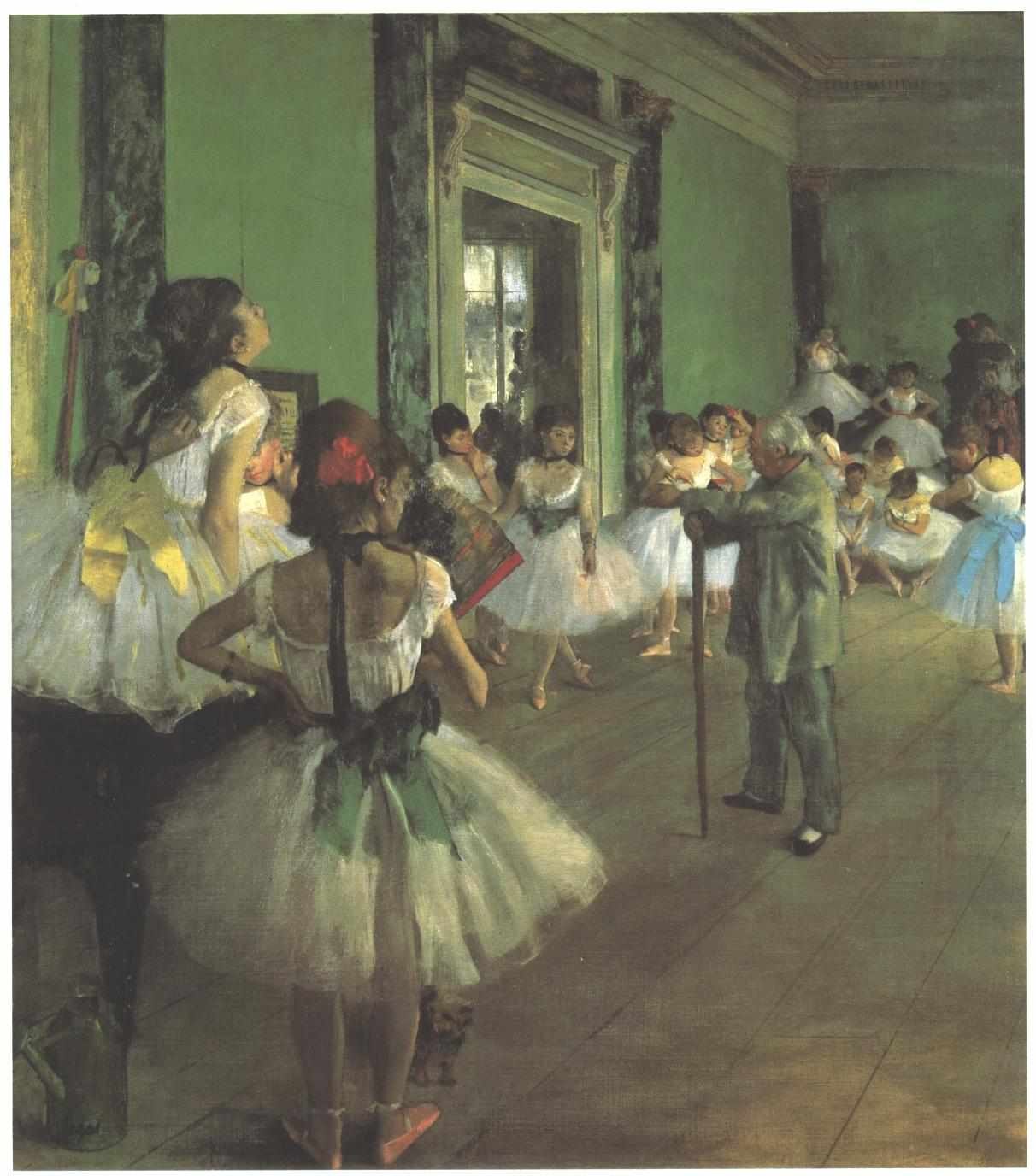
Degas - Tanzklasse
Edgar Degas
- Medium:
- Oil Painting
- Dance:
- Ballet
- Era:
- Late 1800s (Victorian Ballroom)
- Source:
- Wikimedia Commons
- Rights:
- Public domain — free to use, share and adapt.
- Recorded as:
- Public Domain
This work is vital evidence for understanding how ballet was taught and practiced in the 19th century, offering insight into the pedagogical structures, class composition, and studio environments that trained dancers for the stage. For historians and dancers, it documents the reality of ballet training distinct from the finished spectacle of performance—the unglamorous, disciplined, hierarchical work of the academy. The work also exemplifies a major strand of 19th-century visual culture: the fascination of European artists with behind-the-scenes theatrical and dance spaces as subjects worthy of serious artistic attention.
What you are looking at
A ballet class in progress in a high-ceilinged studio with pale green walls and ornate architectural details—tall mirrors or doorways with gilded frames visible in the background. The floor is polished wood. A group of young female dancers in white tutus of varying lengths are scattered throughout the space, some in profile, others turned toward the viewer or the instructor. An older man in dark clothing, recognizable as the ballet master, stands at the right holding a stick or cane, his posture commanding. The dancers range from standing poses with arms raised to sitting or bending positions, suggesting a working class interrupted mid-exercise. The lighting is warm and diffuse, falling from windows or skylights to illuminate the tutus and catch the figures in poses of study and correction rather than performance. The composition is asymmetrical, with the densest group of dancers toward the right and more open space to the left, creating a sense of movement and natural classroom arrangement.
The dancing
The dancers exhibit the foundational positions and poses of ballet training: several stand with arms extended, others bend forward with legs straight or bent, and at least one sits on the floor with legs extended. Their bodies are relatively upright and controlled, showing the posture demanded by ballet training. The tutu lengths vary considerably—some are long, classical tutus reaching the ankle, others shorter—suggesting dancers at different levels or stages of training. The ballet master's posture is erect and authoritative, the cane held as both prop and teaching tool, creating the hierarchy of a formal class structure. The dancers are not in closed holds or partnered formations typical of social dance; instead they occupy individual space, attending to the instructor's direction.
The dance depicted
This is a ballet class, specifically a rehearsal or training session in the academic ballet tradition of the 19th century. The setting and structure indicate a professional or semi-professional dance academy where young dancers receive instruction from an established master. The ballet master's central position and commanding posture, combined with the dancers' individual focus on positions and poses, are characteristic of the pedagogy of ballet training in the 1870s–80s. The variety of tutu lengths and the informal scatter of bodies suggest this is not a performance but a working moment within training—students correcting form, trying movements, or waiting for individual instruction. This was the standard structure of European ballet academies of the period.
How it was made
This is an oil painting, worked with loose, atmospheric brushwork that prioritizes light and atmosphere over precise detail. The artist has layered transparent and opaque passages to suggest depth and movement within the studio space, with warmer tones in the foreground and cooler, hazier tones receding. The technique—particularly the treatment of the tutus as luminous white forms and the soft modeling of the figures—allows the artist to convey the transient moment of rehearsal, the bodies caught in mid-action rather than posed. This approach to capturing movement and light in a studio setting was characteristic of artistic practice in the mid-to-late 19th century, when painters were increasingly interested in depicting scenes of modern urban life and leisure, including theatrical and dance spaces.
About this work
This painting depicts a ballet class in a Paris studio, likely from the 1870s, shown as a moment of work and instruction rather than performance. The ballet master presides over a group of young dancers in various positions and poses, their white tutus glowing in the warm studio light. The work belongs to the tradition of dance imagery that emerged as European artists, particularly those connected to the Paris Opera, began documenting the theaters, studios, and rehearsal spaces that shaped 19th-century ballet. It presents ballet not as spectacle but as craft—a discipline of bodies, poses, and hierarchical instruction. The painting captures a particular visual and social world: the formal academy, the authority of the master, the standardized training of the corps de ballet, and the gendered nature of professional dance in the 19th century, where male instruction typically governed female bodies.
How to look at it
Look first at the poses and positions the dancers occupy: they are static or slow-moving, held for study and correction, not flowing through a sequence. Notice how varied the tutu lengths and the degrees of undress—some dancers have removed jackets or are in simpler practice dress—indicating this is a working class, not a performance or formal rehearsal. Observe the light: it pools and softens across the tutus, making the dancers' legs and torsos glow against the more muted walls and floor. The ballet master's posture and central position create a visual hierarchy that mirrors the actual power structure of the class. The painting captures not a moment of dance but a moment within the process of becoming a dancer—the unglamorous, repetitive, corrective work that made performance possible.
The artist
Edgar Degas (1834–1917) was a French painter and sculptor with a decades-long engagement with the world of Paris dance, particularly the Opera and its ballet school. He spent countless hours in studios, rehearsal rooms, and theaters, making drawings, pastels, and paintings of dancers in training, rehearsal, and performance. His interest was not in the glamour of the stage but in the physical work of dance—the repetitive exercises, the ungainly moments between poses, the relationships of power and instruction between masters and pupils. Degas approached dance with the analytical attention of a figure painter, studying anatomy, movement, and the geometry of the body in space. His dance works form a substantial and influential body within his oeuvre and have shaped how the 19th-century ballet world is visually understood.
The period
The 1870s in Paris saw the consolidation of academic ballet training at the Paris Opera and the emergence of a cohort of younger dancers trained in the rigorous methods of the school. Ballet was in transition: the Romantic era's emphasis on ethereal, costumed femininity was giving way to more technically demanding and athletically rigorous performance. The studio and rehearsal space, previously hidden from artistic representation, became of interest to painters seeking to document modern urban life and work. At the same time, ballet itself was being formalized as a discipline—classes had standardized structures, exercises had codified names and positions, and the role of the ballet master as arbiter of technique was firmly established. Degas's images of the ballet class participate in both trends: they document the visible infrastructure of a major cultural institution and they aestheticize the ordinary labor of training.
Where it lives
The work is recorded as sourced from Wikimedia Commons, with no specific holding collection identified in the available catalogue record. This suggests the image may be in a public collection or has been digitized for broad access.
Dance in this work
Questions about this work
Who is the older man with the stick?
He is the ballet master, the senior instructor responsible for teaching and correcting the dancers. The stick (called a cane or stick) was a standard teaching tool in 19th-century ballet academies, used to point out corrections, tap the floor to mark rhythm, or touch a dancer's body to adjust position. His central position and posture of command are the visual markers of his authority in the class.
Why are the tutus so different lengths?
The variety likely reflects different levels or ages of students—younger or less advanced dancers often wore shorter practice tutus, while senior or more accomplished dancers wore longer classical tutus. It may also indicate that this is a mixed-level class or that dancers were in different states of dress as they awaited individual instruction or correction.
Is this a real class or imagined?
This depicts the actual structure and appearance of ballet classes in Paris during the 1870s, when the artist made many studies in the studios and rehearsal rooms of the Opera. The poses, clothing, studio architecture, and the presence of the ballet master all reflect documented practice. Whether this particular painting represents a specific observed class or a composite of many observations is uncertain, but the details accord with historical records of ballet training in the period.
Why paint a class instead of a performance?
For Degas and other painters of the period, the rehearsal and class held different aesthetic interest than the finished spectacle: they offered access to the body at work, the play of light on flesh and fabric in an interior space, the relationships between instructor and pupil, and the unglamorous truth of labor. Ballet training was a subject newly available to artistic attention and representation in the mid-19th century.
More Ballet artwork