49 works in this view — arrow keys or swipe to move between them.
Dance in Art · 1871
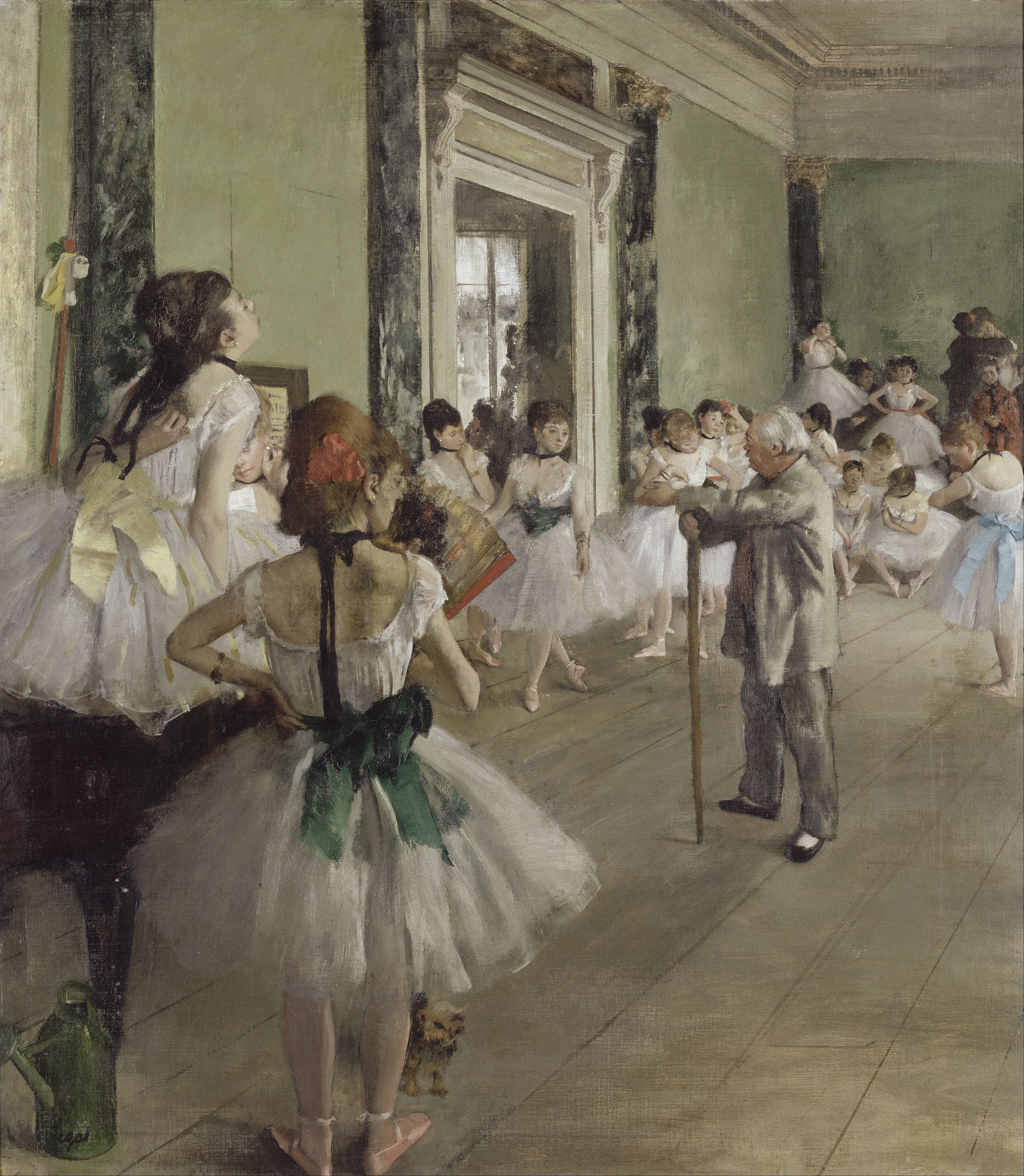
Edgar Degas - The Ballet Class
Edgar Degas
- Medium:
- Oil Painting
- Dance:
- Ballet
- Era:
- Late 1800s (Victorian Ballroom)
- Source:
- Wikimedia Commons
- Rights:
- Public domain — free to use, share and adapt.
- Recorded as:
- Public Domain
Degas virtually invented the subject of the ballet studio in art; this work and its companions established the backstage and rehearsal space as a legitimate subject, displacing the fantasy of the stage itself. For historians and dancers, the painting is evidence of how ballet training was actually conducted in the 1870s—the studio layout, the dress, the pedagogical method. The painting also asks what we look at when we look at dance: not the performed moment, but the discipline, repetition, and bodily knowledge that make performance possible.
What you are looking at
A ballet class in progress in a large, austere studio with pale green walls and dark pilasters. An elderly instructor in a beige suit stands near the center-right, observing dancers scattered across the wooden floor. In the foreground, a dancer in a white tutu with a green bow stands en attitude, her body aligned with the lesson; others in white practice dresses occupy the deep space, some at the barre (visible on the left), others in the middle and background of the room. The light is cool and even, entering from tall windows visible through the doorway at the far end, creating a sense of weightlessness despite the severity of the setting. The composition emphasizes the discipline and isolation of individual practice within a formal institutional space.
The dancing
The foreground dancer exhibits classical alignment: one leg supporting with apparent turnout, the other raised in attitude derrière, arms positioned in a controlled port de bras. Her posture is upright and elongated—the hallmark of academic ballet training. Surrounding figures show varied positions: some stretch or hold the barre, others stand at rest or walk between exercises. The instructor's stance is observational, his body angled toward the working dancer, suggesting the corrective gaze that structures a ballet class. The distributed spacing of the pupils suggests the class is pausing between combinations or awaiting correction.
The dance depicted
This is unambiguously a classical ballet class, most likely at the Paris Opéra or a comparable academy, circa the 1870s. The pedagogical setting, the white practice costumes, the wooden studio, the barre work, and the formal instruction all confirm academic ballet training of the Second Empire period. The artist has captured not performance but the disciplined, repetitive work of training—the moment when a dancer holds a position for correction. This is not Romantic ballet as spectacle but ballet as craft, the daily institutional labour that produced the dancers for the stage.
How it was made
Oil on canvas, executed with loose brushwork that suggests rapid notation rather than finish. Degas has prioritized the spatial and compositional study over precise detail: the figures are summarily rendered, with thin washes of paint defining form and movement. The cool palette—greens, grays, whites, ochres—contributes to the institutional coldness of the space. The painting technique allows Degas to capture transient moments of class work and to suggest the visual experience of an observer (or instructor) scanning the room, a mobility of attention that would be impossible in more laboured media.
About this work
This is Degas's *Ballet Class* (sometimes titled *The Dance Class*), one of several studies he made of the Paris Opéra ballet school in the 1870s. The painting depicts the structural reality behind Romantic ballet spectacle: the repetitive, exhausting training that produced the ethereal bodies on stage. Degas was fascinated by ballet as a subject not for its narrative or romantic associations but for its formal geometry—the way bodies in motion compose space, the relationship between individual effort and collective discipline, the geometry of the studio itself. The work belongs to a tradition of observational art-making that privileges the mundane over the heroic.
How to look at it
Watch the foreground dancer first: her body is frozen mid-lesson, not mid-performance. Her position—attitude derrière—is a teaching position, held for examination and correction. The spatial depth of the studio is crucial: Degas has arranged the canvas so that our eye travels from the immediate corrective moment in the foreground into the studio's depths, where other dancers wait or work. The light from the distant windows is cool and institutional. Notice how the instructor's body angle and the dancer's upright spine create a vertical axis around which the composition is organized. The painting asks you to see what a teacher sees: not the beauty of the pose, but its formal and anatomical correctness.
The artist
Edgar Degas (1834–1917) was a French painter and sculptor who made ballet one of his principal subjects over five decades. He had access to the Paris Opéra through friends and family connections, and he visited rehearsals and classes repeatedly, filling sketchbooks with compositions and studies. Unlike most artists of his era, Degas was interested in ballet not as a romantic or exotic subject but as a technical and physical practice. His practice in the 1870s and 1880s established the rehearsal studio and the ballet class as canonical subjects in modern art. He worked across media—oil, pastel, charcoal—often combining them to capture the fluidity and movement he observed.
The period
In the 1870s, ballet was transitioning between the waning Romantic era and the rise of Academic ballet. The Paris Opéra Ballet School was a rigorous, hierarchical institution training girls from modest backgrounds for careers in the corps de ballet or, rarely, as soloists. The pedagogy was standardized, based on the codified technique that would later be named Cecchetti and Russian Imperial methods. Meanwhile, in the visual arts, Impressionism was challenging academic conventions; Degas, though often grouped with Impressionists, was more interested in the structure and artifice of modern leisure and labour than in landscape or light effects alone. His ballet paintings belong to a broader interest in the backstage and the offstage—the spaces where social performance is constructed.
Where it lives
The work is dated to 1871 in the catalogue record and is attributed to Degas. The medium is recorded as oil painting. The current holding institution is not specified in the provided record, and the source is listed as Wikimedia Commons, indicating it is likely in public collections. Degas painted multiple versions and studies of ballet classes in the 1870s, and similar works are held in major museums including the Louvre, the Metropolitan Museum of Art, and the Musée d'Orsay.
Dance in this work
Questions about this work
Is this a real ballet school or an imagined one?
It depicts the Paris Opéra Ballet School, which Degas visited repeatedly. The studio is recognizable from his other ballet paintings and from historical accounts. However, Degas composed and rearranged figures across multiple studies and paintings, so while the setting is based on observation, the specific arrangement of dancers in this canvas is his artistic construction.
What is the dancer in the front doing?
She is executing an attitude derrière—one of the fundamental positions in classical ballet technique—held for correction by the instructor. She is not dancing a choreographed phrase but demonstrating a single position under scrutiny. This is the pedagogical moment that Degas wanted to capture.
Why are all the dancers women?
In the nineteenth-century Paris Opéra Ballet, the corps de ballet and most of the school were female. Male dancers held fewer positions and lower status. Degas focused on the female dancers, both because they filled the institution and because their bodies and movements fascinated him as a formal problem.
Is this the same ballet school that appears in other Degas paintings?
Very likely. Degas returned to the Paris Opéra studio repeatedly across the 1870s and 1880s, treating it almost as a laboratory for studying movement, light, and composition. Multiple paintings and pastels show variations of the same space and similar moments of instruction and rehearsal.
More Ballet artwork