49 works in this view — arrow keys or swipe to move between them.
Dance in Art · 1875
Edgar Germain Hilaire Degas 021
Edgar Degas
- Medium:
- Oil Painting
- Dance:
- Ballet
- Era:
- Late 1800s (Victorian Ballroom)
- Source:
- Wikimedia Commons
- Rights:
- Public domain — free to use, share and adapt.
- Recorded as:
- Public Domain
The image documents the actual pedagogical practice of ballet at a formative moment in its history, when the standards of technique and training that still govern classical ballet were being codified. It also shows how ballet had become a subject of serious artistic and social interest—worthy of large-scale oil painting and museum display—suggesting the art form's rising cultural status in the second half of the 19th century. For dancers and historians, it offers concrete evidence of studio practice, dress, spacing, and the role of the instructor in a tradition that remains fundamentally unchanged.
What you are looking at
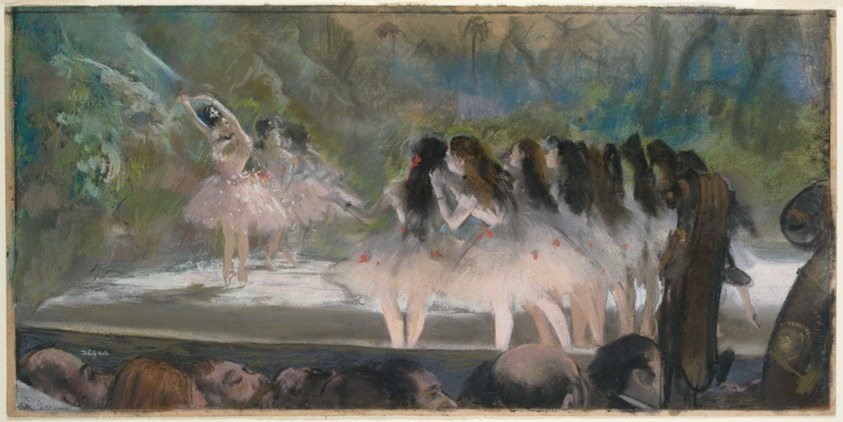
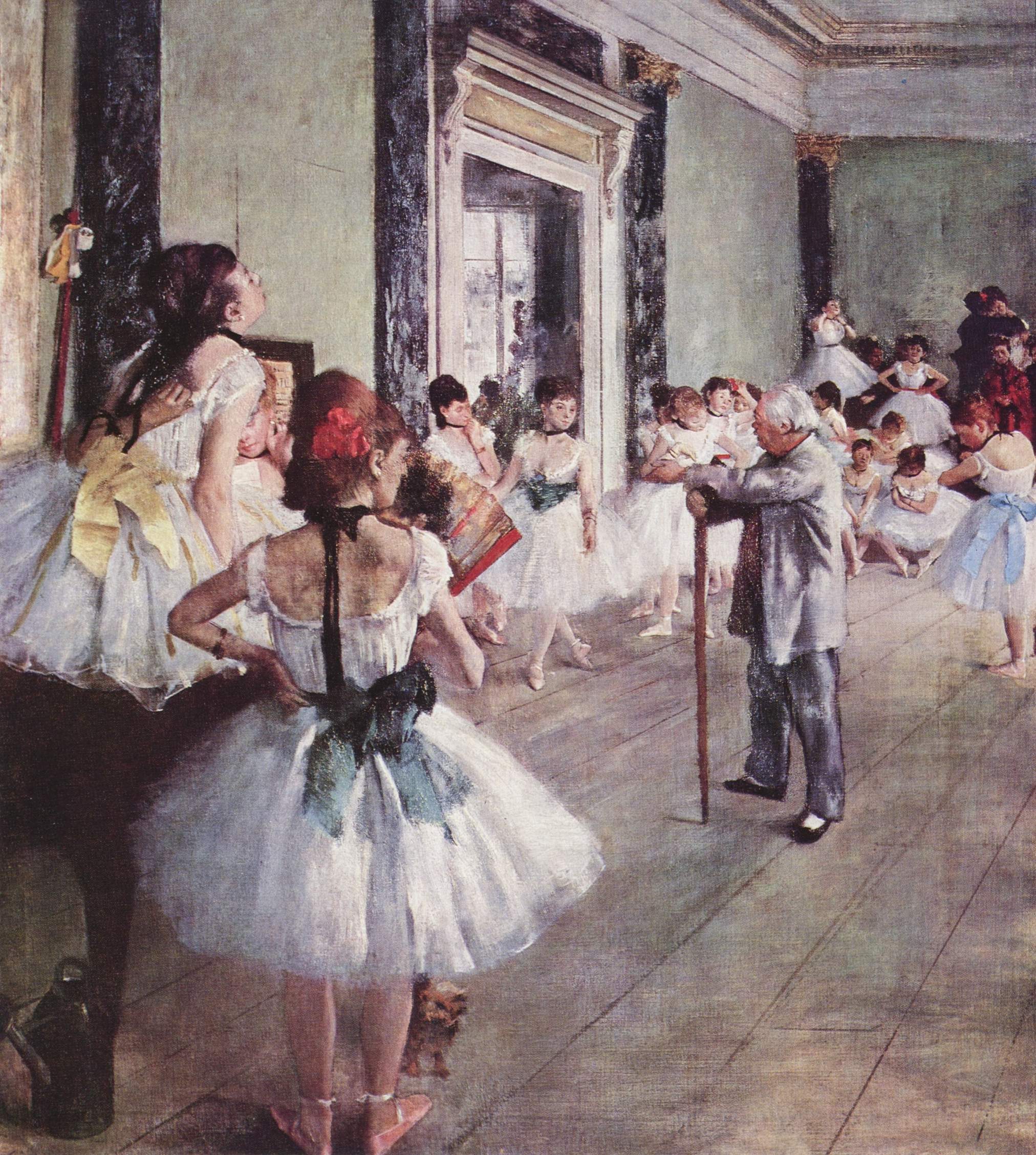
A ballet class or rehearsal in a spacious studio with cream and pale green walls, divided by dark supporting columns. Afternoon light falls across the wooden floor from tall windows set into the far wall. A group of young female dancers in white or pale pink practice dresses and ballet pointe shoes are distributed across the space in various poses and attitudes. Some stand at or near a barre (visible as a dark rail on the left); others occupy the center of the floor in formation or scattered arrangement. An older man in a dark suit—the ballet master or instructor—stands at the right, watching and gesturing. The scene captures a moment of active work: some dancers are in extended positions, others seem to be waiting their turn or recovering. The composition emphasizes the depth of the studio and the varied energy states within a single lesson.
The dancing
The dancers display the formal carriage and turned-out legs characteristic of classical ballet training. Several are en équilibre or in arabesgue and attitude positions, with the clean vertical alignment of the spine and lifted port de bras typical of the period. The ballet master's posture—upright, authoritative, with raised hand—conforms to the role of instructor observing and correcting from outside the movement. The dancers' youth, their uniform pale practice dress, and their scattered but orderly arrangement across the floor all indicate a professional or serious amateur class rather than performance or social dance.
The dance depicted
This is unquestionably a ballet class, most likely a rehearsal or lesson in classical academic ballet. The pointe shoes, the turned-out positions, the studio setting with barre, the uniformity of dress, and the presence of the maestro all confirm this. The style appears consistent with late 19th-century Vaganova or Italian Cecchetti pedagogy—schools of thought then establishing themselves as the foundation of professional ballet training. The image documents the working method rather than a performance, showing ballet as a systematic discipline taught in a formal space.
How it was made
This is an oil painting executed with considerable refinement in the handling of light and spatial recession. The artist has captured the soft, diffused quality of afternoon studio light with great sensitivity, using pale washes in the background and careful gradation to suggest the depth of the room. The brushwork in the dancers' figures is relatively loose—dresses rendered in broad strokes—which allows movement and the shimmer of fabric without rigidity. This technique was well suited to circulation as a reproduction; the painting could be engraved or lithographed for wider distribution, and its subject matter—the respectable, orderly world of professional ballet instruction—would have appealed to middle-class and aristocratic audiences.
About this work
This is a scene from a 19th-century ballet studio, painted to document both the physical reality of the teaching method and the aesthetic appeal of the young dancers in motion. The work belongs to a tradition of dance imagery that emerged in the 18th and 19th centuries as ballet professionalized and became a subject worthy of serious artistic attention. The painting values observation and light as much as movement, treating the studio as a space of work and discipline rather than spectacle. For a gallery of dance in art, it represents a crucial moment in European culture: the moment when ballet became not just a performance art but a reproducible, teachable system worthy of being memorialized and studied.
How to look at it
Attend first to the distribution of light and the play of shadow across the floor—the painting is fundamentally about how light reveals form and space. Then trace the positions and poses: notice how the artist has varied the dancers' attitudes to avoid monotony while maintaining the uniform clarity of classical line. Look at the ballet master: his position and gesture structure the entire scene, his eye directing the viewer's attention even as he directs the dancers. Finally, observe the absence of narrative or drama—there is no story here, no climactic moment, only the steady accumulation of repetition and correction that constitutes ballet training. The painting asks us to find beauty and meaning in work itself.
The artist
The catalogue attributes this work to Edgar Degas (1834–1917), the French Impressionist painter whose interest in ballet was sustained and deep. Degas made dance—particularly ballet rehearsal and the working lives of dancers—central to his artistic practice from the 1870s onward, producing hundreds of works in pastel, oil, and monotype. He was fascinated not by the glamour of performance but by the disciplined, often unglamorous labor of training and repetition. His studio scenes are studies of movement, light, and the human body in work, and they reflect his conviction that ballet embodied the principles of form and composition he valued as a painter. Degas had access to the Paris Opéra and maintained relationships with dancers and choreographers, allowing him to observe rehearsals firsthand. His ballet paintings were widely exhibited and reproduced, and they established dance as a legitimate subject for serious fine art.
The period
In the 1870s, ballet in Europe was undergoing a crisis and transformation. The Romantic era of the early 19th century—dominated by works like *La Sylphide* and *Giselle*, with their emphasis on the ethereal and supernatural—was giving way to the demands of spectacle and national traditions. The Paris Opéra, where much of this activity was centered, was a state institution and a focus of cultural prestige. At the same time, artists and writers were developing a new interest in the ordinary, behind-the-scenes aspects of professional life, influenced by Realist and Impressionist aesthetics. Degas's ballet works emerged in this context: they refuse the theatrical spectacle in favor of the studio, the rehearsal, and the individual body in training. In painting and printmaking more broadly, the 1870s saw the rise of large-scale exhibition paintings documenting contemporary life and labor, often with a mixture of aesthetic refinement and sociological interest. Degas's ballet paintings sit at this intersection.
Where it lives
The work is recorded as an oil painting dated 1875, attributed to Edgar Degas. The source is listed as Wikimedia Commons; the holding collection is not recorded. The painting is among Degas's most characteristic works and is well known in the scholarly and museum literature on his practice.
Dance in this work
Questions about this work
Is this a real ballet class or posed for the painting?
Degas worked from observation and memory, often sketching dancers in actual rehearsals and combining studies into composed paintings in his studio. This scene is constructed—the arrangement and lighting are the artist's invention—but based on direct knowledge of ballet pedagogy. The accuracy of detail suggests he understood the practice intimately.
What type of ballet is this, and when was it danced?
This represents academic classical ballet of the late 19th century, likely the methods taught at the Paris Opéra and spreading across Europe. The pointe work, turned-out positions, and formal studio setting are consistent with what became known as the Cecchetti method and the Russian Imperial school. These methods remain the foundation of classical ballet training today.
Who were the dancers Degas painted?
Degas did not typically name individual dancers in his paintings. The figures here represent types and moments from the Paris Opéra ballet school. Some of his dancers were professionals or students; others were invented or composites. The focus is on the activity and the body in motion, not on celebrity or portraiture.
Why did Degas care so much about ballet?
Degas was interested in the human figure in motion and in the underlying geometry and discipline required to create the illusion of effortless beauty. Ballet offered him both: bodies trained to extreme precision, and compositions that balanced order with apparent spontaneity. He also valued the behind-the-scenes world as more authentic and artistically rich than public performance.
More Ballet artwork