49 works in this view — arrow keys or swipe to move between them.
Dance in Art · 1878
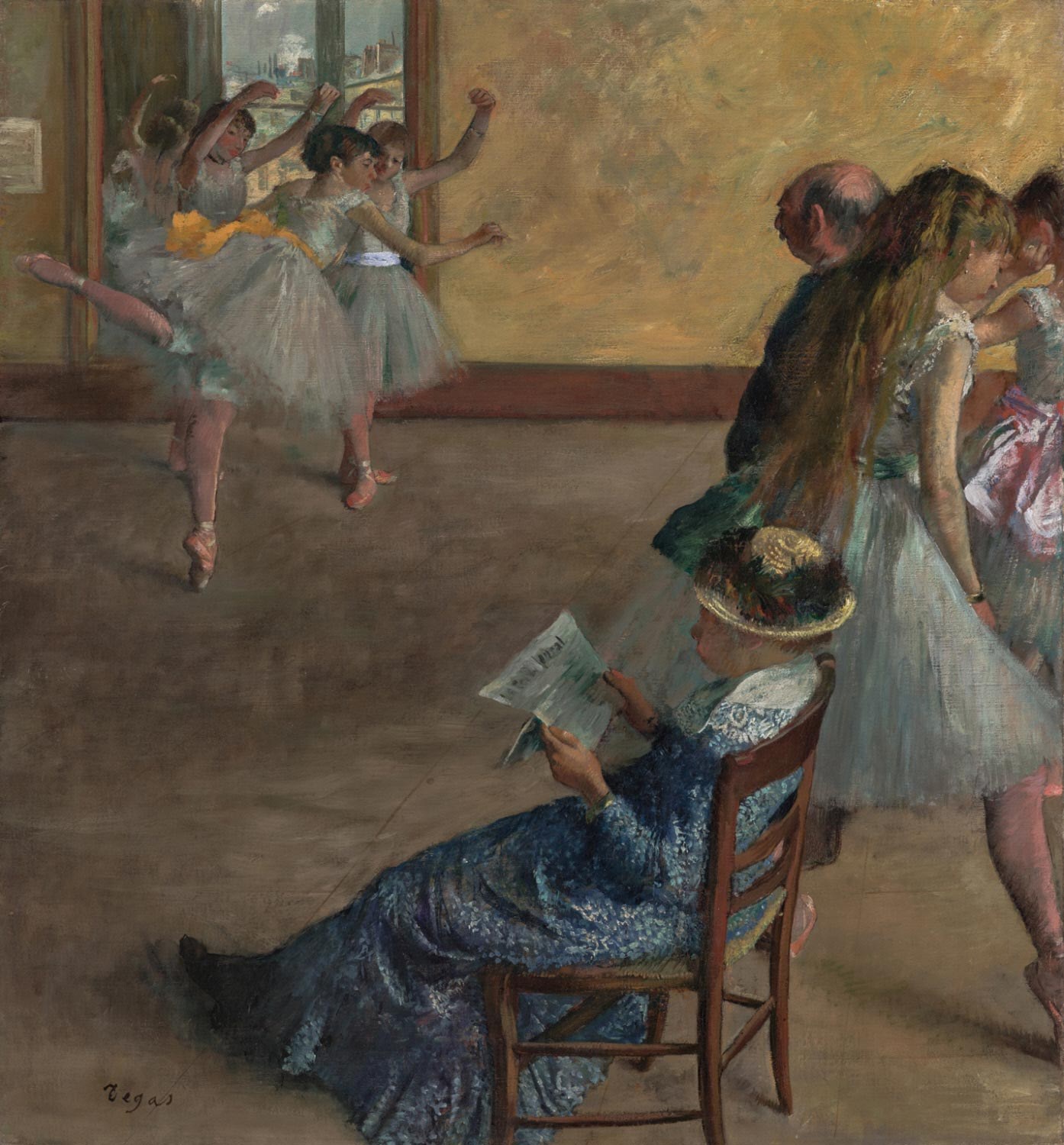
Degas - The Ballet Class, 1880-1881
Edgar Degas
- Medium:
- Oil Painting
- Dance:
- Ballet
- Era:
- Late 1800s (Victorian Ballroom)
- Source:
- Wikimedia Commons
- Rights:
- Public domain — free to use, share and adapt.
- Recorded as:
- Public Domain
This work established the ballet rehearsal as a legitimate subject for fine art, shifting focus from the romantic fantasy of the stage to the disciplined labor of the studio. For dance historians and practitioners, it is one of the most valued visual records of how ballet training was organized and executed in the nineteenth century, and it reveals the centrality of the ballet master's authority and gaze in shaping dancers' bodies.
What you are looking at
This is a ballet class in progress, set in a studio with pale ochre walls and a wooden floor. The composition divides into two spaces: in the foreground at right, a seated woman in a dark dress with a feathered hat and long hair watches from a chair, holding what appears to be sheet music or a program. Standing beside and behind her are several girls and young women in white tutus and pointe shoes, their bodies angled toward the action. On the left side of the canvas, two young dancers in gauze tutus are captured mid-movement—one raises her arms overhead in an arabesque or similar lifted position, the other beside her with arms also raised. A tall figure in dark formal dress (likely the male instructor or ballet master) stands among the students, observing. The lighting is soft and diffused, creating warm amber tones across the walls. The scene captures a moment of instruction or rehearsal rather than performance—the casual grouping, the seated observer, and the varied attention of the students all signal a working session.
The dancing
The two active dancers on the left are rendered with elongated limbs and raised arms suggesting classical ballet vocabulary—one figure's leg appears extended, the weight lifted onto relevé or full pointe. Their posture shows the upright, elongated torso and lifted ribcage characteristic of academic ballet. The standing students maintain the turned-out stance and vertical alignment of ballet training. The male figure's formal posture and central placement suggest he is directing or observing the dancers' work. The seated woman provides a secondary focus, her stillness and downward gaze contrasting with the activity around her.
The dance depicted
This depicts a ballet class, most likely in the Romantic or early modern classical tradition based on the tutus, pointe work, and academic setting. The ballet class as a formal instructional structure became codified in the nineteenth century, and this image captures the typical hierarchy and ritual—the instructor/ballet master positioned to observe, students arranged in informal grouping, and the repetitive work of technique. The presence of a female observer (possibly a parent or accompanist) was common in Parisian ballet studios. The poses and dress place this squarely within academic theatrical ballet training of the late nineteenth century.
How it was made
Oil on canvas, likely completed c. 1878–1881, using loose brushwork and soft transitions of color typical of Impressionist technique. The artist employs muted ochre, soft gray, and pale flesh tones with touches of bright color (yellow waistbands, pink ribbons) that draw the eye without dominating. The technique allows for capturing of light and atmosphere, and the painterly approach softens the formal hierarchies of the scene, giving it immediacy and intimacy. This work circulated as a canvas painting rather than print, placing it in a more rarified art market than reproductive engravings.
About this work
This is a ballet class by Edgar Degas, a painter obsessed with the Paris Opéra ballet and the lives of dancers and students in training. Degas painted this subject repeatedly over decades, finding in the rehearsal studio (rather than the stage) the most revealing subject matter. The scene is neither narrative nor dramatic—it is documentary in its attention to the repetitive, unglamorous work of ballet training, the teacher's authority, and the concentration required. The painting belongs to Degas's broader project of depicting modern urban labor and leisure in late nineteenth-century Paris, with dance as a privileged window onto the body, light, and social structure.
How to look at it
Notice the hierarchy of attention in the composition: the ballet master's authority is established by his formal dress and central placement, yet the active dancers on the left draw the eye. Observe how Degas captures a split second of movement—not a pose held for the viewer, but a moment in the midst of instruction when bodies are in transition. The seated woman's passive gaze provides a point of identification for the viewer; we are invited to watch as she does. Pay attention to how the artist has rendered the pointe work: the dancers' feet and legs suggest the turned-out position and lifted weight of classical ballet, details that would be meaningful to a dancer and invisible to a casual viewer.
The artist
Edgar Degas (1834–1917) was a French painter and printmaker who devoted much of his mature career to the subject of dance, particularly the Paris Opéra Ballet. He visited rehearsal studios, attended performances, and executed hundreds of drawings, pastels, and paintings of dancers. Unlike his Impressionist contemporaries, Degas maintained a classicist's interest in anatomy, line, and composition, using the moving body as a vehicle for exploring light, space, and the human figure in action. His dance paintings were not sentimental or idealized; instead, they emphasized the physical discipline and unglamorous effort behind the art form.
The period
In the 1870s–80s, ballet in Paris was undergoing a transition from Romantic ballet (with its emphasis on ethereal, otherworldly female forms) toward a more technical, athletic mode influenced by Italian and Russian training methods. The ballet class itself was becoming formalized as an institution with standardized technique, particularly under the influence of the Cecchetti method spreading from Italy. Degas's paintings coincide with a shift in aesthetic interest: away from narrative spectacle toward an interest in modern labor, the body as machine, and the processes of cultural production. His work reflects both the actual conditions of ballet training and the late-nineteenth-century artistic fascination with 'behind the scenes' views of modern life.
Where it lives
The work is documented in Wikimedia Commons as sourced from an unspecified collection or museum. The catalogue record provides no accession number or current holding institution.
Dance in this work
Questions about this work
Is this a scene from a ballet performance?
No. This is a rehearsal or class in a studio, not a stage performance. The informal arrangement of students, the presence of the instructor, and the casual dress of the observers all indicate an instructional session. The ballet class was not typically a public event, so Degas was documenting a private, working space rather than theatrical spectacle.
What is the seated woman doing?
She appears to be observing the class, possibly as a parent, chaperone, or accompanist. She holds what may be sheet music or a program. Her presence was typical in Parisian ballet studios of the period; women and girls of respectable families were often supervised in professional or semi-professional training.
How does this painting reflect the reality of ballet training?
Degas painted the ballet studio many times, and this work captures the actual conditions of nineteenth-century training: the wooden floor, the plain walls, the mixture of students of different levels, and the commanding presence of the male ballet master directing and observing. Unlike romantic paintings of ballet, this one emphasizes work, repetition, and discipline rather than fantasy or narrative.
Why did Degas paint ballet so often?
Degas was fascinated by the moving human body, particularly the female form in disciplined action. The ballet studio offered him unlimited access to study anatomy, light, and movement. He was also interested in modern Paris—the ballet was a commercial industry with distinct social hierarchies, and painting it allowed him to explore themes of labor, the body, gender, and authority.
More Ballet artwork