49 works in this view — arrow keys or swipe to move between them.
Dance in Art · 1878
Edgar Germain Hilaire Degas 083
Edgar Degas
- Medium:
- Oil Painting
- Dance:
- Ballet
- Era:
- Late 1800s (Victorian Ballroom)
- Source:
- Wikimedia Commons
- Rights:
- Public domain — free to use, share and adapt.
- Recorded as:
- Public Domain
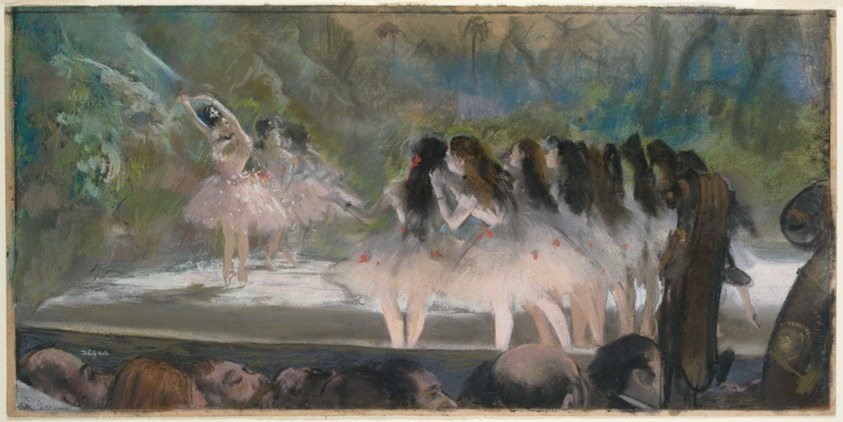
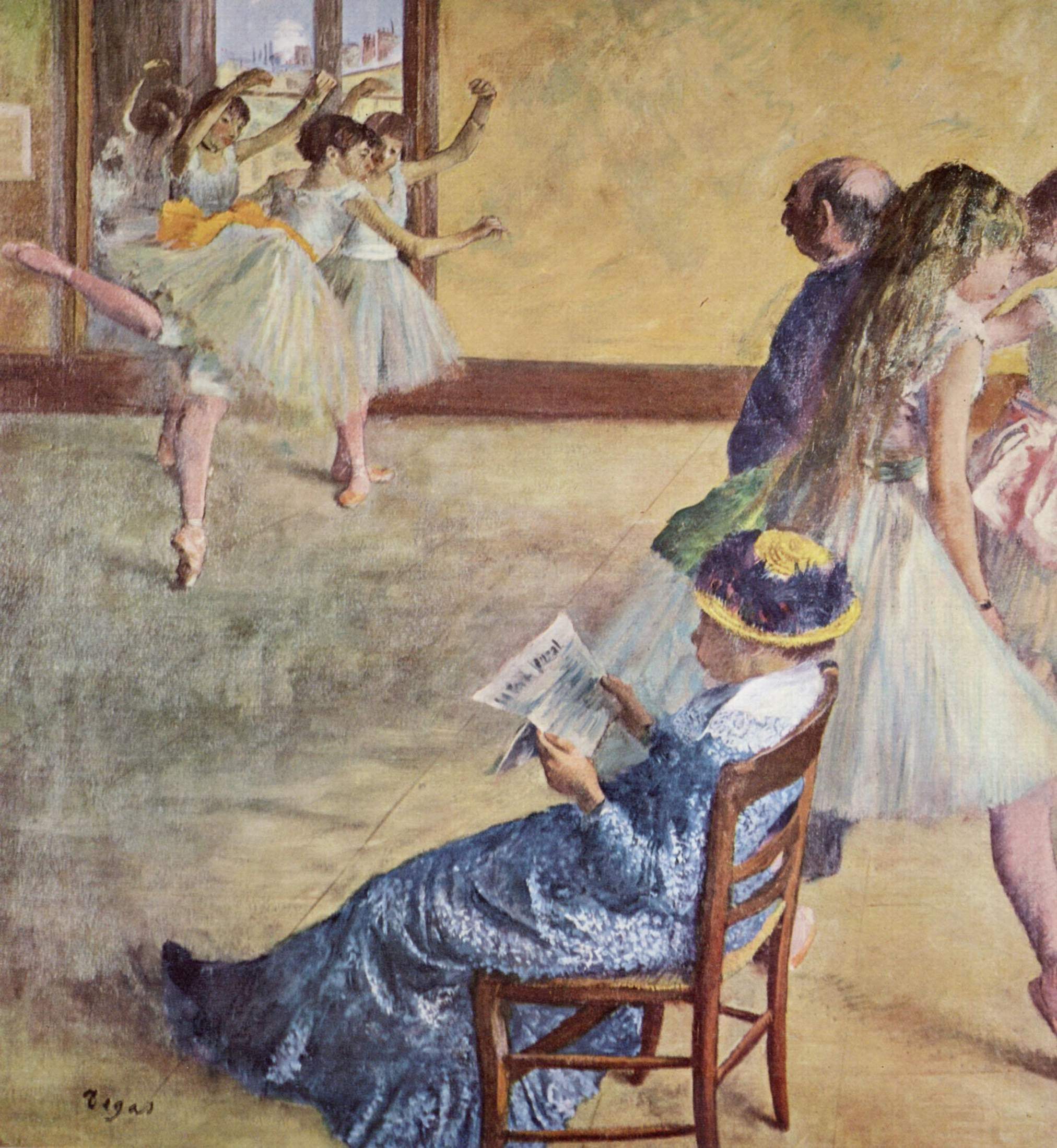
Degas is the principal visual documenter of professional ballet practice in the 19th century, and his repeated choice to paint rehearsals rather than performances fundamentally shaped how we understand the history of dance. This work shows the social reality of ballet training—a practice attended by family members, often unglamorous, conducted in ordinary daylight rather than gaslit theaters.
What you are looking at
A ballet rehearsal or class is underway in a sunlit studio with pale yellow walls and tall windows framing a cityscape. In the foreground, a seated older woman in dark blue dress and a distinctive feathered hat reads a newspaper while observing the dancers—likely a mother, chaperone, or rehearsal observer. Behind her, younger women and girls in white practice tunics and pointe shoes move across the wooden floor, their bodies angled toward the windows. One dancer in the middle distance executes a turn or relevé movement, arms raised; others stand at rest or in conversation. The light is warm and diffuse, casting soft shadows and emphasizing the informality of the moment—not a performance but the daily work of dance.
The dancing
The dancers visible are in soft ballet postures: one figure in the background-left appears to be in a relevé or turning position with raised arms; several others stand in casual stance or conversation. Pointe work is suggested by the dancers' feet and the context of their dress. The viewer in the foreground is stationary, providing compositional contrast to the dancers' fluid movement. The group is loosely arranged across the studio space rather than in formal line, consistent with a work session.
The dance depicted
This depicts a rehearsal of academic ballet, likely Romantic-era ballet practice given the plain white practice costumes and the era of the image. The casual, observational framing suggests this is documentary of dance as a working practice rather than performance spectacle. The presence of an older woman reading while observing is characteristic of 19th-century rehearsal practices where family members, sometimes mothers or paid chaperones, attended to young dancers in training.
How it was made
Oil on canvas, executed with Degas's characteristic loose brushwork and muted palette. The technique allows for soft rendering of light and fabric that gives the scene intimacy and immediacy; the paint is worked delicately in the flesh tones and tutus. This finish and scale suggest a work made for exhibition rather than reproduction, and reflects Degas's practice of the 1870s–1880s in treating dance as a subject worthy of high art treatment.
About this work
This is a ballet rehearsal or class scene painted by Edgar Degas in 1878, showing dancers at work in a sunlit studio. The composition centers on the contrast between the casual observer in the foreground and the disciplined movement of the dancers behind—a compositional strategy Degas used repeatedly to show ballet as labor and instruction, not just spectacle. The work belongs in a dance archive both for what it shows of 19th-century ballet practice and for what it reveals about how artists chose to see dance when they were not commissioned to idealize it.
How to look at it
Look first at the woman in the foreground: her stillness and her reading establish the pace of the image as one of waiting and observation, not performance. Her body is heavy and dark against the pale dancers and walls. Then move to the dancers: Degas has caught them at rest and in motion simultaneously, their poses uncertain and candid. The light from the windows is the painting's subject as much as the dancers—it defines the studio as a work space, not a stage. Notice how few of the dancers face the viewer or strike a dramatic pose; most are angled away, immersed in their own activity.
The artist
Edgar Degas (1834–1917) was a French Impressionist painter whose fascination with dance began in the 1860s and became a defining subject of his practice. He attended rehearsals at the Paris Opéra, made repeated studies of dancers in training, and produced paintings, pastels, prints, and sculptures exploring every angle of dance as physical practice. Unlike many of his contemporaries, Degas showed little interest in the narrative ballet or the idealized spectacle; instead, he treated dancers as working professionals engaged in the hard discipline of their art, often caught in ungraceful or vulnerable moments.
The period
By 1878, Romantic ballet—the ballet of sylphs, supernatural heroines, and ethereal femininity—was giving way to more elaborate spectacle and the emergence of Russian Imperial Ballet. Academic ballet training in Paris was rigorous and stratified by age and ability. Young dancers in the Opéra ballet were largely from working-class families; rehearsal and training were visible, observable practices. The 1870s were the height of Degas's engagement with dance subject matter, coinciding with renewed investment in ballet as entertainment and the rise of photography, which was also beginning to document movement and rehearsal.
Where it lives
The work was sourced from Wikimedia Commons; no holding collection is recorded in the catalogue entry. The title "Edgar Germain Hilaire Degas 083" suggests this is a catalogue entry from a larger corpus.
Dance in this work
Questions about this work
Is this a performance or a rehearsal?
This is clearly a rehearsal or class. The informal groupings, the casual dress, the daylit studio, and the presence of an observer reading a newspaper all point to working practice rather than performance. Degas rarely painted actual stage performances; he preferred the unguarded moments of training.
What era of ballet is this?
The style and dress suggest mid-to-late 19th-century academic ballet. The white practice tutus are characteristic of the Romantic era and the period immediately after. The work is dated 1878, placing it in the later 19th century when Russian and French ballet were developing the codified technique we recognize today.
Who was Degas and why did he paint so many dancers?
Degas (1834–1917) was a French Impressionist painter who became obsessed with dance as a subject. He had access to rehearsals at the Paris Opéra and used that access to paint dancers at work hundreds of times. For Degas, dancers were not symbols of beauty or entertainment but skilled workers whose bodies revealed the discipline and effort behind the art form.
Why is the woman in the foreground so prominent?
The woman reading in the foreground may be a mother, chaperone, or rehearsal observer—a common presence at ballet training in the 19th century. Her stillness and her inward focus (she is reading) create a compositional anchor and a counterpoint to the dancers' movement. She represents the world of family, responsibility, and waiting that surrounded young dancers' training.
More Ballet artwork