49 works in this view — arrow keys or swipe to move between them.
Dance in Art · 1874
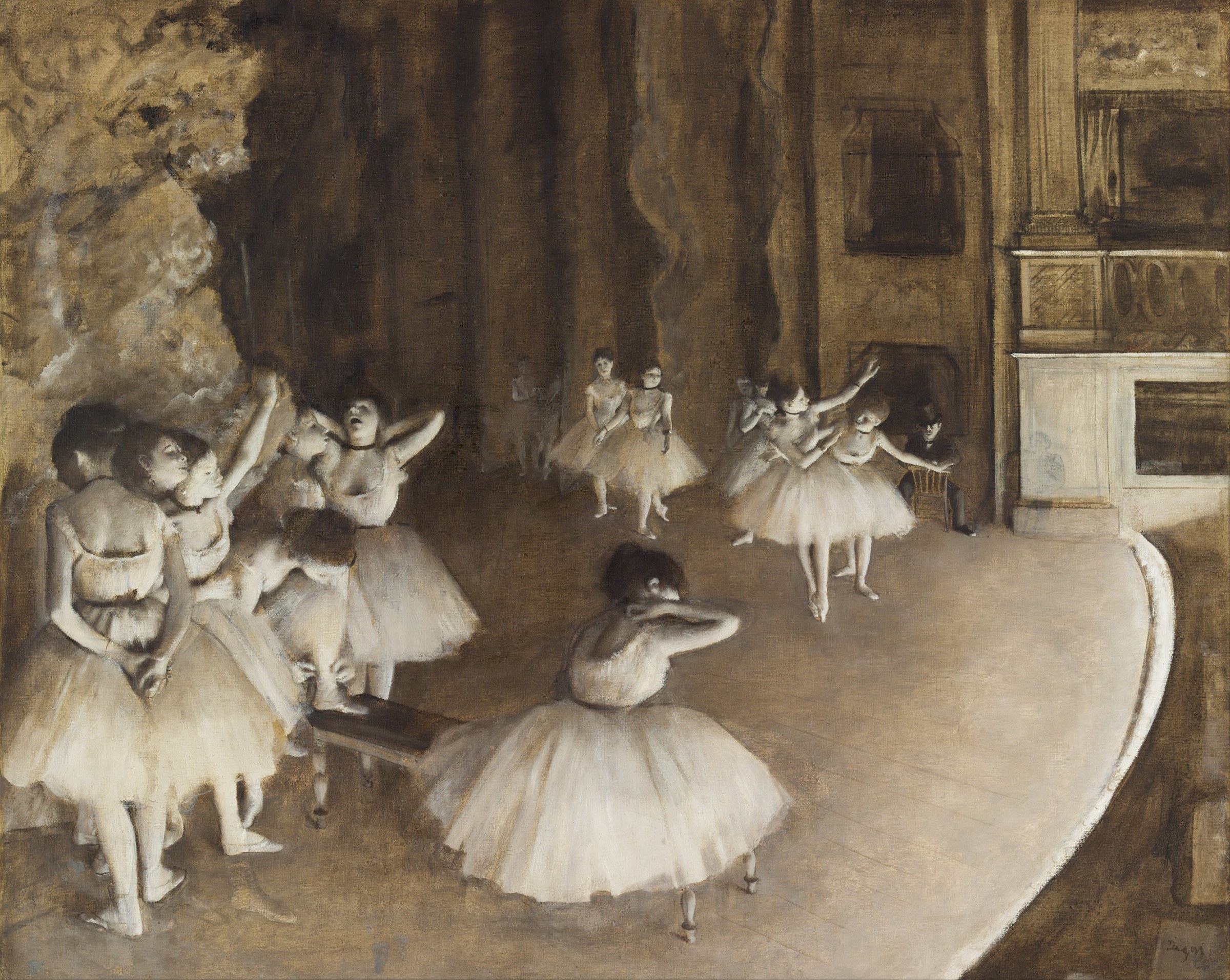
Edgar Degas - Ballet Rehearsal on Stage
Edgar Degas
- Medium:
- Oil Painting
- Dance:
- Ballet
- Era:
- Late 1800s (Victorian Ballroom)
- Source:
- Wikimedia Commons
- Rights:
- Public domain — free to use, share and adapt.
- Recorded as:
- Public Domain
This work is significant as both a document of mid-nineteenth-century ballet practice and as an example of the modernist painter's interest in capturing transient effects and everyday moments of work. It demonstrates that ballet, by this date, had become a subject for serious painters; its depiction here in a moment of unglamorous rehearsal rather than performed spectacle suggests a shift in how artists and audiences thought about dance as a subject—as a physical practice with its own intrinsic interest, not merely as entertainment.
What you are looking at
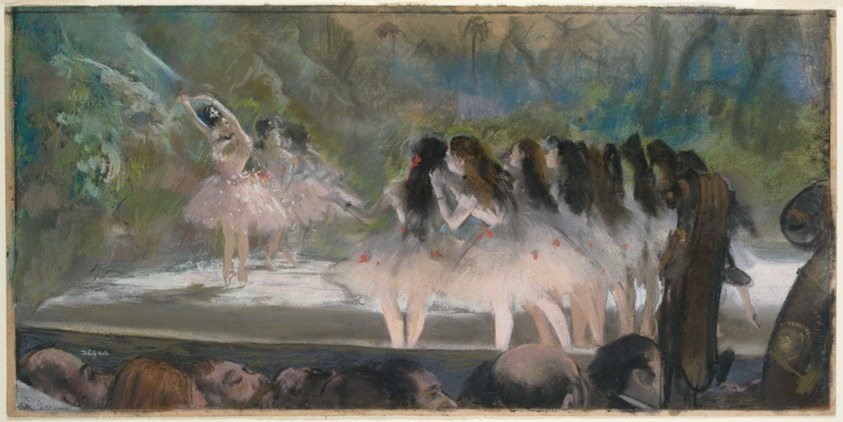
A ballet rehearsal on the stage of a nineteenth-century theatre, rendered in monochromatic and sepia tones that create a sense of movement and shadow. Multiple dancers in pale tutus occupy the space in varied poses and groupings—some standing or walking, others captured mid-leap or in attitudes of rest. The architectural setting is distinct: a large sculptural or architectural element (possibly a statue or decorative feature) dominates the left foreground, while the receding stage space shows theatrical wing flats and doorways at right, suggesting depth and the infrastructure of theatrical space. The composition is unusual in its perspective: the viewpoint is elevated and angled, almost as though we are watching from a position above the stage floor, which gives the scene an intimate, documentary quality. The lighting is dramatic and theatrical, with warm brown-gold tones pooling in some areas while deep shadow suggests the overhead stage lights.
The dancing
The dancers display the characteristic postures of classical ballet: several are en pointe or preparing positions, with arms in various positions from extended arabesques to resting poses. A central dancer in the foreground is captured in a moment of weight-bearing stillness, while others around the stage occupy a range of attitudes—some standing upright, others bending or stretching. The bodies are articulated with anatomical specificity; the artist understood the mechanics of the turned-out legs and lifted spines of trained dancers. No couple dancing or formal partnering is evident; rather, this is a scene of individual rehearsal within a shared space, with dancers separated by considerable distance across the stage floor.
The dance depicted
This depicts classical ballet practice, most likely in the Paris Opéra or a similar major European ballet institution in the mid-nineteenth century. The setting—a working rehearsal space rather than a finished performance—and the informal groupings of dancers at different stages of preparation suggest this is an exercise or rehearsal session rather than a staged moment. The dancers' dress (pale tutus, pointe shoes, hair pulled back) and the turnout-based positions are consistent with the Romantic ballet conventions of the 1860s–1870s. The work captures the unglamorous reality of ballet training and preparation, a moment of work rather than spectacle.
How it was made
Oil on canvas, executed with loose, impressionistic brushwork that prioritizes the effect of light and atmosphere over precise detail. The artist has used a limited palette of browns, tans, and pale creams to create unity and depth, with darker glazes establishing shadow and architectural form. This technique—particularly the fluidity of the handling and the emphasis on transient light effects—is characteristic of late nineteenth-century painting approaches to theatrical subjects. The loose execution allows the viewer to read the composition at a glance while maintaining a sense of spontaneity and movement.
About this work
This is a rehearsal scene from the working world of professional ballet, painted from an unusual vantage point that privileges the stage space itself over the dancers. Rather than depicting a performance or a moment of theatrical spectacle, it shows dancers at rest, moving, and preparing—the quotidian reality of training and rehearsal. The work belongs to a tradition of nineteenth-century art concerned with the backstage and working spaces of dance and theatre, revealing the labour that performance obscures. It is also an early example of the treatment of ballet as a subject worthy of serious artistic attention.
How to look at it
Look first at the composition and viewpoint: the elevated, angled perspective that makes us feel we are intruding on a working rehearsal rather than watching a performance. Notice how the dancers are scattered across the space at different distances and in different states of activity—not arranged for visual effect but simply present as bodies at work. Pay attention to the play of light across the stage and how it models the forms of the dancers; the artist has captured the effect of theatrical stage lighting on pale fabric and pale skin. Finally, observe the architectural elements and spatial recession that anchor the work as a document of an actual place—the stage of a theatre, with its infrastructure visible.
The artist
Edgar Degas (1834–1917) was a French painter, draughtsman, and sculptor profoundly engaged with the subject of dance, particularly ballet. He made hundreds of studies and finished works depicting rehearsals, performances, and dancers at rest, visiting the Opéra and its rehearsal spaces repeatedly throughout his career. Unlike many of his contemporaries, Degas was interested in the mechanics of movement and the labour of training; he studied dancers in every attitude and setting, often from unusual vantage points that emphasize the viewer's position as an observer in a working space rather than a positioned spectator. His approach to ballet was analytical and unsentimental, focused on the body in motion and repose.
The period
In the 1870s, when this painting was likely made, ballet in France was in transition. The Romantic era of the early nineteenth century had given way to a new emphasis on technical virtuosity and visual spectacle, accelerated by the introduction of new techniques and the dominance of the Paris Opéra. This same period saw the rise of Impressionism and a broader shift in artistic practice toward capturing light, atmosphere, and fleeting moments rather than finished, monumental subjects. Degas's rehearsal paintings belong to this moment: they reflect both the professional world of ballet as it existed and the modernist painter's interest in capturing unposed, ephemeral moments of human activity.
Where it lives
According to the catalogue record, this work is held in an unspecified collection and was sourced from Wikimedia Commons. No accession number or holding institution is recorded.
Dance in this work
Questions about this work
Is this a finished painting or a study?
The work appears to be a finished painting in its own right, not a preparatory study. The composition is coherent and complete, and the handling of paint suggests a work executed with care to capture a specific effect. However, Degas made many studies of similar subjects, and the loose brushwork and limited palette suggest a work more concerned with capturing light and movement than with fine detail.
Why is the viewpoint so unusual?
The elevated, angled vantage point was deliberate on Degas's part and reflects his interest in modern ways of seeing—influenced by photography and Japanese prints. This angle, as though we are watching from above the stage, gives the scene an immediacy and intimacy that a frontal view would not. It also emphasizes the stage space itself as the subject, rather than the dancers as performers.
What does this tell us about ballet in the 1870s?
The work documents the physical training and rehearsal practices of professional ballet dancers, showing the everyday reality of what was then a major art form. The dancers' dress, technique, and the theatrical setting all point to the conventions of mid-nineteenth-century classical ballet as practiced at institutions like the Paris Opéra.
Why did Degas paint ballet so often?
Degas was fascinated by the ballet as a subject that allowed him to explore the human body in motion, the effects of light on form, and the reality of work and practice. His repeated visits to rehearsals and performances allowed him to develop a deep understanding of how dancers moved and to experiment with unusual compositions and viewpoints.
More Ballet artwork