49 works in this view — arrow keys or swipe to move between them.
Dance in Art
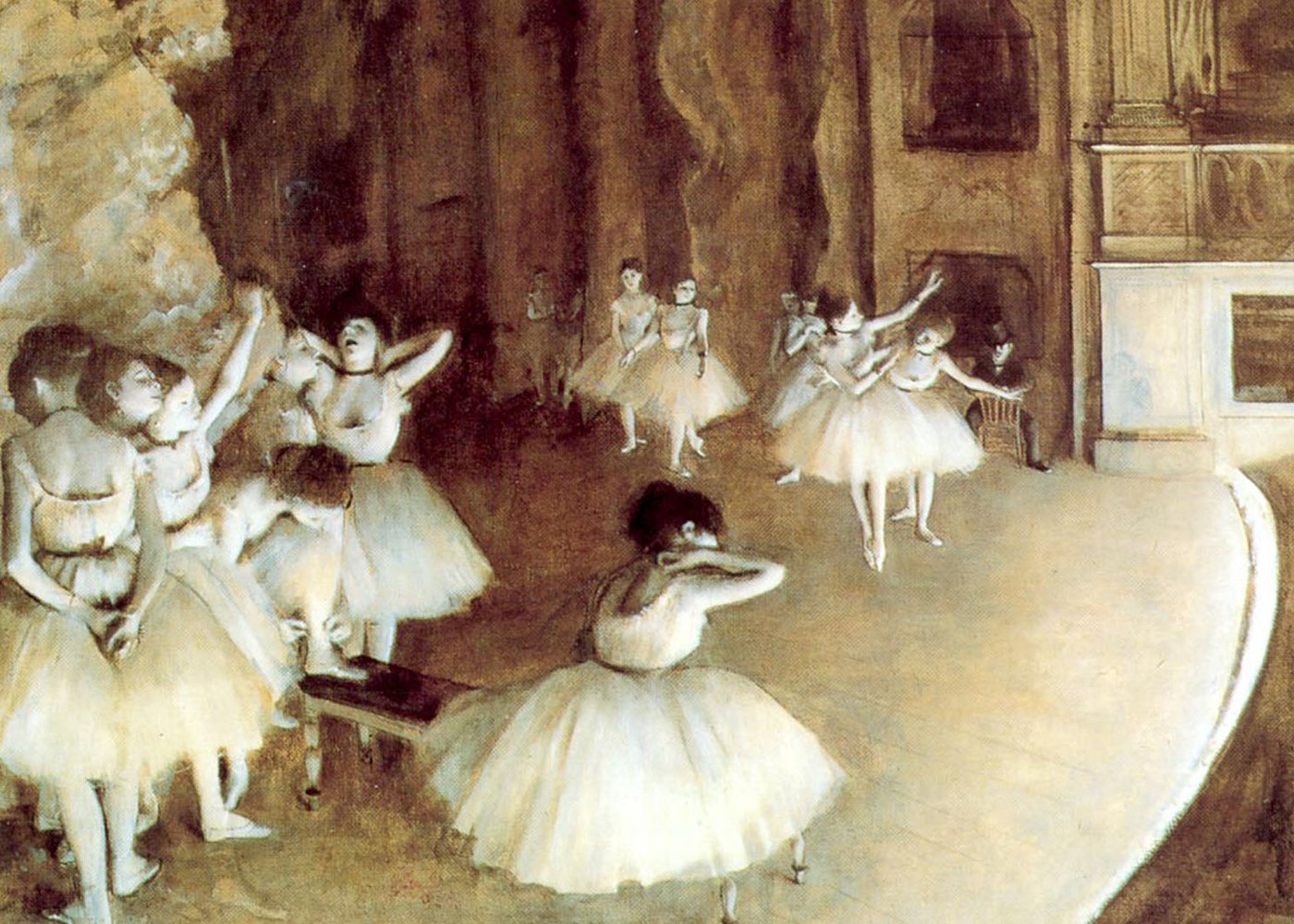
Edgar Degas - Rehearsal on Stage
Edgar Degas
- Medium:
- Oil Painting
- Dance:
- Ballet
- Era:
- Late 1800s (Victorian Ballroom)
- Source:
- Wikimedia Commons
- Rights:
- Public domain — free to use, share and adapt.
- Recorded as:
- Public Domain
Degas was one of the few major visual artists to document the actual working lives of dancers rather than their performance personas. This rehearsal scene is rare documentary evidence of how ballet was trained and how dancers inhabited space outside the theatrical frame. For dance historians and dancers themselves, it offers insight into studio practice, the physical syntax of classical training, and the psychological reality of repetitive, demanding labor that popular culture typically obscures.
What you are looking at
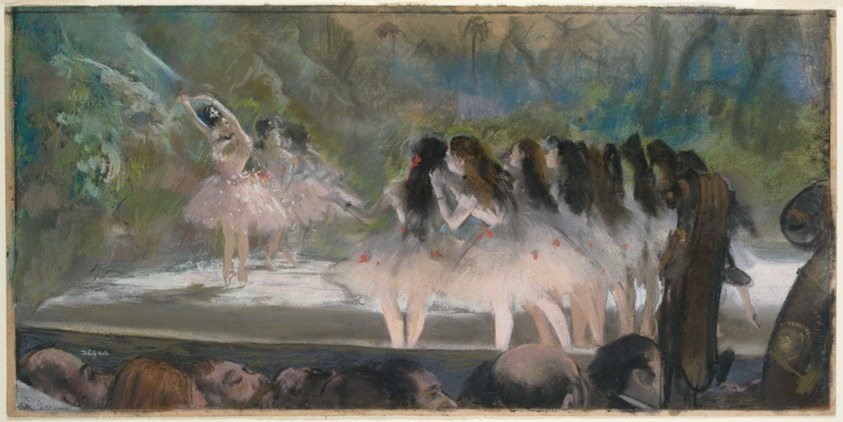
A ballet rehearsal in progress on an indoor stage, viewed from a high vantage point that emphasizes the depth and scale of the space. The stage interior is rendered in warm ochres and deep browns, with architectural details—paneling, doorways, a pilaster—suggesting a grand institutional or aristocratic setting. Multiple dancers in pale tutus are distributed across the stage at various distances: some clustered on the left in animated conversation or preparation, others isolated in the middle distance, and a group on the right engaged in what appears to be active choreography. A single figure in the immediate foreground, seen from behind, commands attention—seated or crouching with an arched back in an attitude of absorption or fatigue. The lighting is soft and diffuse, casting gentle shadows that model the dancers' bodies and create a sense of rehearsal-room informality despite the formal setting. The composition suggests a moment of pause or transition rather than polished performance.
The dancing
The dancers wear classical ballet tutus and pointe shoes, their bodies disposed in postures ranging from the upright and alert to the collapsed and introspective. The foreground figure's hunched back and downward gaze convey physical exhaustion or emotional intensity. Those in the middle distance stand or move with the upright carriage and turned-out legs characteristic of ballet training. The clusters on either side show varied engagement: some appear to be watching or conversing, others executing or preparing steps. The frame captures the full body language of rehearsal—not the synchronized precision of performance, but the scattered focus and individual effort of working dancers.
The dance depicted
This is unmistakably a ballet rehearsal, most likely from the Romantic era or early modern ballet tradition. The tutus, pointe work, and turned-out positions are classical ballet grammar. The setting and informality suggest a studio or rehearsal space rather than a performance, a rare and valued subject in visual art—artists typically depicted finished performances, not the work behind them. The scattered arrangement of dancers and the emotional intensity of the foreground figure suggest the artist (Degas, who obsessively documented the Paris Opéra ballet) was interested in capturing the inner life of dancers: their fatigue, focus, and the moments of vulnerability rehearsal exposes.
How it was made
Oil painting allows Degas to render the soft modeling of flesh and fabric, the subtle play of studio light, and the complex spatial relationships across the deep stage. The warm tonality and loose, suggestive handling of the background architecture convey atmosphere rather than precise detail—a technique suited to capturing the ephemeral moment of rehearsal rather than the formal clarity of performance portraiture. The medium also permitted the high viewpoint and asymmetrical composition Degas favored, techniques borrowed from photography and Japanese prints that were revolutionary in ballet imagery.
About this work
This is a ballet rehearsal scene, a rare and intimate subject in art historical documentation of dance. Degas depicted the Paris Opéra ballet repeatedly across his career, and his studio rehearsal scenes are among his most psychologically complex works. Unlike theatrical portraits of prima ballerinas in costume, this image captures the ordinary, unglamorous labor of training: scattered dancers in various states of preparation and fatigue, the geometry of instruction and repetition, the emotional and physical toll of the work. The painting is a record of what rehearsal looked like in the 19th-century Opéra, but also a meditation on concentration, exhaustion, and the human cost of aesthetic perfection. It challenges the ethereal, otherworldly image of ballet by showing the earthbound, effortful reality behind it.
How to look at it
Attend to the foreground figure first: what gesture or emotion is Degas capturing in that hunched back? Compare it to the upright, more formal carriage of dancers deeper in the space. Notice the play of light across the stage—how it models the tutus and bodies, how it creates spatial recession. Look at the composition: the high viewpoint, the off-center placement of figures, the asymmetry. This is not a symmetrical, balanced theatrical composition; it is a snapshot or stage view, the kind of vantage point a director or observer might have occupied. Ask yourself what Degas chose to exclude: there is no orchestra, no footlights, no audience—only the bare apparatus of instruction and repetition. The beauty in this image is in the ordinary, not the extraordinary.
The artist
Edgar Degas (1834–1917) was obsessed with the Paris Opéra ballet throughout his mature career, creating hundreds of paintings, pastels, drawings, and prints of dancers. He had privileged access to rehearsals and backstage spaces—rare for a visual artist of his standing—and used that access to capture moments other artists ignored: dancers stretching, adjusting pointe shoes, resting between repetitions, studying choreography. Degas was not himself a dancer, but he studied ballet with the rigor of an anatomist, attending classes and rehearsals repeatedly to understand the movement from the inside. His ballet works are part of a larger project to depict modern Paris and the labor of ordinary people (including women), but dancers held a special fascination for him as subjects that allowed him to explore human form, light, and the psychology of focused effort.
The period
The late 19th century saw a transformation in both ballet and in visual art. Romantically-era ballet (mid-1800s) had valorized supernatural, ethereal femininity; by the 1870s–80s, when Degas was most active, the Paris Opéra was moving toward more technical, athletic, contemporary work. Simultaneously, Impressionist and early modern visual artists were rejecting academic history painting in favor of scenes from modern life, including labor and leisure. Degas occupied the intersection: a formally trained academic painter who embraced modern subjects and techniques (asymmetrical composition, unusual viewpoints, pastel and mixed media) to depict dancers in their working lives. His ballet works document a specific institution (the Paris Opéra) at a moment of aesthetic and social transition, capturing both the classical vocabulary of ballet and the modernity of its artistic environment.
Where it lives
The work is catalogued as held in the Metropolitan Museum of Art, New York City, and is known from that record. The source is Wikimedia Commons, a public digital collection.
Dance in this work
Questions about this work
Why did Degas paint so many ballet scenes?
Degas had both aesthetic and material reasons. Visually, ballet offered him the human form in motion and repose, complex spatial arrangements, and the effects of artificial light on bodies and fabric. Practically, he had nearly unique access to the Paris Opéra—he could attend rehearsals and backstage spaces where other artists could not go. But he was also genuinely interested in dancers as workers and as subjects of modern life; he approached their labor with the same sociological curiosity he brought to laundresses and milliners.
Is this a finished painting or a sketch?
The handling is loose and suggestive, especially in the architecture and background, but that is characteristic of Degas's mature style. He valued the impression of a moment over labored finish. Whether it was exhibited or intended for exhibition in his lifetime is not established by the current record.
What ballet is being rehearsed?
The catalogue record does not identify the specific work or choreography. The image alone cannot tell us which ballet this is; we can only say it is a rehearsal of classical ballet at the Paris Opéra in the late 19th century.
How accurate is Degas's depiction of ballet technique?
Degas studied ballet seriously and was generally accurate in anatomy and positioning, though his primary interest was in the emotional and compositional truth of a moment rather than technical precision. His dancers have the correct turned-out stance and carriage, but he was willing to distort or obscure details for artistic effect.
More Ballet artwork