49 works in this view — arrow keys or swipe to move between them.
Dance in Art
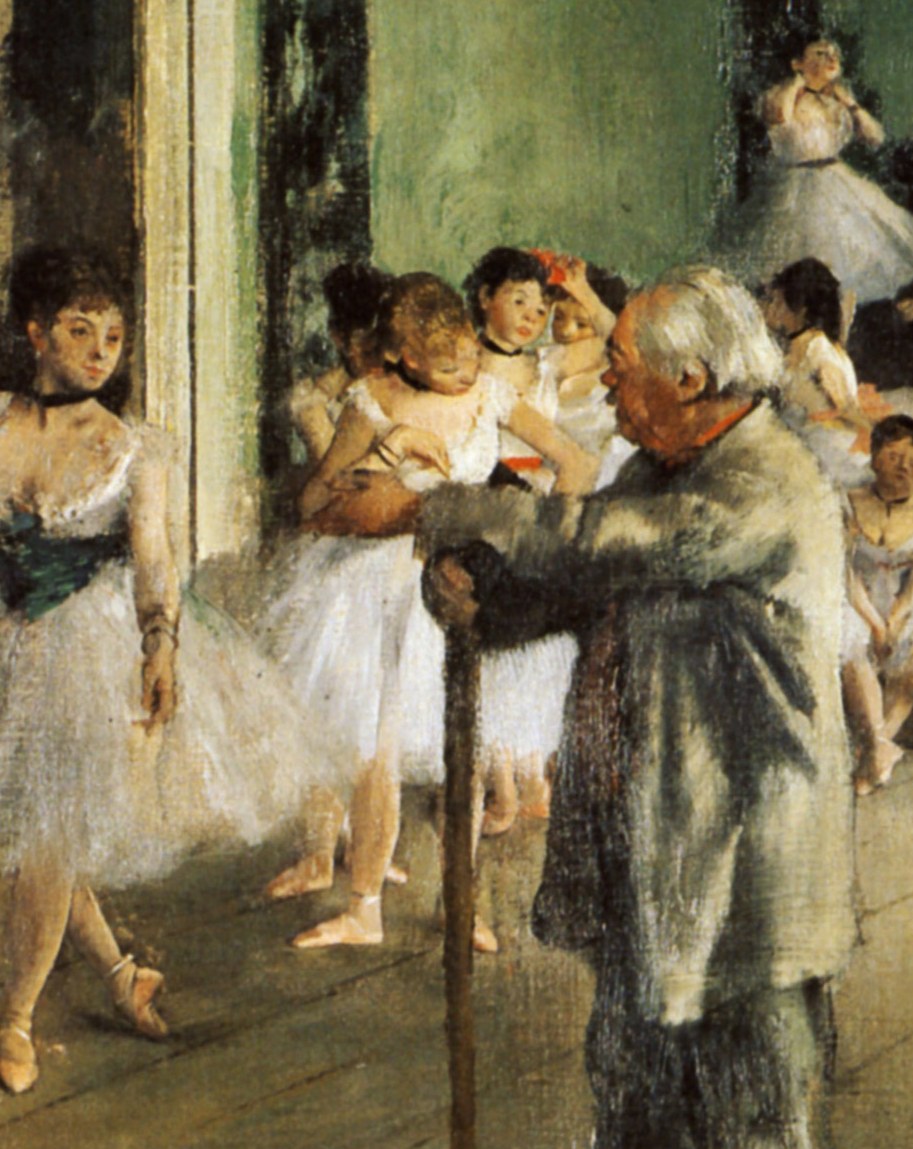
La Classe de danse, Degas, detail n. 2
Edgar Degas
- Medium:
- Oil Painting
- Dance:
- Ballet
- Era:
- Late 1800s (Victorian Ballroom)
- Source:
- Wikimedia Commons
- Rights:
- Public domain — free to use, share and adapt.
- Recorded as:
- Public Domain
For dancers and teachers, this image documents the hands-on, body-to-body transmission of ballet technique in the 19th century—showing how alignment and carriage were taught through manual correction and demonstration. For historians, it is evidence that Degas understood ballet not as spectacle but as craft, and that he was interested in the unglamorous daily work of training that produced the bodies audiences admired on stage.
What you are looking at
A ballet instructor, an older man with white hair wearing a dark suit, bends to adjust the posture of a young female student in the center of a studio interior. The student wears the characteristic white muslin dress of a 19th-century ballet pupil. Around them, other young dancers in similar white costumes wait their turn, some standing at the barre visible on the left, others seated or standing in the background observing the lesson. The studio walls are rendered in soft greens and grays; light enters from above, creating a contemplative atmosphere. The composition captures a moment of instruction mid-class—the teacher's hands guide the student's arms and torso into proper position while her peers witness the correction, a common pedagogical practice in ballet academies.
The dancing
The central student stands with her body elongated and turned out, her arms raised and extended as the instructor manually corrects her frame. Her weight appears to be held upward through her torso, consistent with ballet's demands for vertical lift. The instructor uses both hands to position her shoulders and arm carriage, a hands-on teaching method. Several other dancers stand or sit in attendance—some in profile, some three-quarter view—suggesting this is a group class where individual corrections are demonstrated. The scale and positioning of the figures, with the teacher at full height and the student slightly smaller, establishes the hierarchy of authority and attention.
The dance depicted
This is undoubtedly a ballet class, most likely from the Romantic or late 19th-century academic tradition. The white muslin practice dresses and the structured studio setting with barre are diagnostic of ballet pedagogy in this period. The teacher's method of manual correction—positioning the arms, shoulders, and torso—reflects the hands-on approach to training classical technique that was standard in academies of the era. The presence of multiple students at rest suggests this may be a *adagio* section of class, where slow, controlled movements and alignment were emphasized. The informal yet serious atmosphere captures ballet as a disciplined craft learned through repetition and correction rather than performance.
How it was made
This is an oil painting executed with loose, impressionistic brushwork characteristic of late 19th-century French practice. The artist has rendered the scene in soft, diffused color—pale greens, warm flesh tones, and white costumes—allowing light and shade to define form rather than hard outlines. This technique allows the eye to move fluidly across the composition and emphasizes the momentary, informal quality of the lesson over documentary precision. The painting's soft focus and intimate scale suggest it was created for exhibition in Paris's art market rather than as an official academy record.
About this work
This is a studio scene from the heart of French ballet training in the late 19th century, depicting the moment of individual correction within a group class. The painting captures the physical and pedagogical relationship between master and student at the core of classical ballet transmission—the teacher's hands guiding the student's body into alignment while peers observe and learn. The work belongs to a broader tradition of dance imagery in French Impressionism and Post-Impressionism, where the backstage and studio life of the ballet became a subject of fascination for artists interested in modern Parisian leisure and labor.
Degas was drawn repeatedly to scenes of ballet instruction, creating dozens of works on this theme across drawings, pastels, and paintings. This particular detail suggests the artist's deep interest in the mechanics of training—the asymmetrical poses, the manual correction, the hierarchy of attention—rather than the glamour of performance. The work records a moment of pedagogy that would not be visible to an audience, revealing how classical technique was actually constructed.
How to look at it
Notice the teacher's hands and how they are positioned on the student's body—this detail is the point of the painting. The artist has frozen the moment of correction, when instruction passes from master to pupil through touch. Look at the student's face: it shows concentration and submission, not performance. The background figures are painted more loosely, keeping focus on the central pair. The soft, diffused light and muted color palette create an intimate, almost private atmosphere, as though we are observing a moment not meant for public view. The composition suggests that the work of art lies not in the spectacle of performance but in the patient, repetitive work of making a dancer's body.
The artist
Edgar Degas (1834–1917) was a French painter and sculptor who made ballet his subject more consistently than any other major artist of the 19th century. He frequented the Opéra Garnier in Paris, developing friendships with dancers and gaining access to rehearsals and classes. His engagement with ballet was both visual—he was fascinated by the geometry of bodies and movement—and social. Unlike Romantic-era artists who depicted ballet as spectacle, Degas showed the physical discipline, repetition, and labor behind performance. He worked primarily in pastel, oil, and monotype, techniques that allowed him to capture movement and the effects of artificial light. His ballet works number in the hundreds and remain unsurpassed in their anatomical specificity and psychological insight.
The period
By the 1870s–1890s, when this work was likely painted, French ballet was undergoing a transition. The great age of Romantic ballet (1830s–1850s) had passed, and ballet was becoming increasingly professionalized and codified within institutional academies. The Opéra Garnier, opened in 1875, became the center of French ballet life. Simultaneously, the Impressionist movement was transforming French art, and scenes of modern leisure—including ballet—became subjects of serious investigation. Degas's ballet paintings emerged within this moment: they are modern in technique and subject, depicting not the supernatural worlds of Romantic ballet but the actual bodies and spaces of training and rehearsal. His work coincided with the establishment of ballet pedagogy as a systematic, documented discipline.
Where it lives
The work is recorded as a detail from *La Classe de danse* (The Dance Class) by Edgar Degas, a composition of which multiple versions and studies exist. The source is listed as Wikimedia Commons, suggesting the image is in the public domain or freely licensed, though the original painting's current location is not recorded here.
Dance in this work
Questions about this work
Did Degas paint many ballet class scenes?
Yes. Degas returned to the ballet class theme throughout his career, creating drawings, pastels, and paintings from the 1870s onward. He was obsessed with capturing the geometry of dancers' bodies in training and the relationship between teacher and student. These works were among his most celebrated and influential subjects.
How did Degas gain access to ballet studios and rehearsals?
Degas was a regular at the Opéra Garnier and developed relationships with dancers, choreographers, and the opera's administration. He obtained permission to attend classes and rehearsals, giving him an insider's view of ballet life that few artists possessed. This access was crucial to the specificity and intimacy of his dance imagery.
What does the white dress tell us about ballet in this period?
The white muslin practice dress was standard for female ballet students in the 19th century. It was simple, unadorned, and practical, allowing freedom of movement during training. Its plainness contrasts sharply with the elaborate costumes worn for performance, emphasizing the distinction between the work of training and the spectacle of the stage.
Is the teacher correcting the student in a specific position?
Yes. The student appears to be in an *adagio* position—slow, controlled work with the arms extended and the body held in vertical alignment. The teacher is adjusting her arm carriage and shoulder position, a correction that would have been repeated hundreds of times over a dancer's training. This represents the essence of classical ballet pedagogy: the repeated refinement of basic positions and movements.
More Ballet artwork