49 works in this view — arrow keys or swipe to move between them.
Dance in Art · 1874
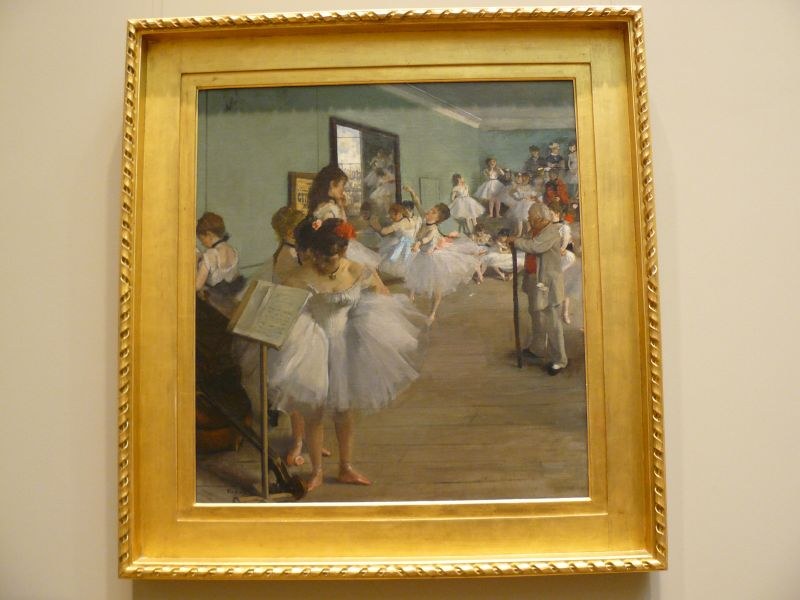
WLA metmuseum Edgar Degas French The Dance Class
Edgar Degas
- Medium:
- Oil Painting
- Dance:
- Ballet
- Era:
- Late 1800s (Victorian Ballroom)
- Source:
- Wikimedia Commons
- Rights:
- Public domain — free to use, share and adapt.
- Recorded as:
- Public Domain
This work is central to the visual history of ballet because it shifted the subject matter of dance imagery from performance and spectacle to the hidden pedagogical world behind the curtain. For historians, it offers precise documentation of late Romantic ballet training: the studio design, costume, the role of the master, and the gender and class composition of the pupils. For dancers and teachers, it remains an icon precisely because it captures the atmosphere of instruction—the attention, the hierarchy, the repetition—with an honesty rarely seen in earlier dance art.
What you are looking at
A ballet studio during a rehearsal or lesson, seen from an elevated vantage point that allows us to take in the full width of the room. The space is austere: pale walls, a high ceiling with a skylight at the far end, a few practice barre fixtures, and a mirror or window visible in the background. About a dozen young dancers in white tutus are scattered across the wooden floor at various stages of work—some standing at rest, others executing movements. An older man in dark clothing, identifiable as the instructor, stands to the right side of the composition watching a single dancer who faces him in performance posture. The light is cool and northern, flattering the white fabric and lending the whole scene an atmosphere of disciplined, almost clinical attention. The painter has chosen a moment of instruction rather than spectacle: bodies are not fully extended in dramatic positions, but caught mid-gesture or between phrases.
The dancing
The dancers are uniformly dressed in simple white tutus and pointe shoes, reinforcing the pedagogical rather than theatrical context. Their posture varies: some stand with the formal alignment expected in ballet training, others lean forward, look down at their feet, or shift weight as though listening to correction. The instructor stands apart, his dark silhouette creating a commanding vertical line; he is watching closely, perhaps speaking. The dancer nearest to him is in profile, her body angled toward him in an attitude of attention and obedience. The composition emphasizes the hierarchy between teacher and students, and the individual focus the instructor directs at specific dancers rather than the group as a whole.
The dance depicted
This is undoubtedly a classical ballet training scene, almost certainly Romantic-era ballet of the 1860s–1870s based on the costume and pedagogical setting. The tutu style, the pointe work, and the formal studio arrangement are all consistent with the Paris Opéra ballet world of that period. The scene depicts not performance but instruction—the core work of nineteenth-century ballet training. The instructor's pivotal role, his separation from the dancers, and his individual scrutiny of student bodies reflect the master-pupil relationship central to ballet pedagogy. We cannot determine the specific exercises being performed, but the casual stance of several dancers suggests they are between movements rather than executing a set phrase.
How it was made
This is an oil painting, as confirmed by the record. The artist's handling of light and atmosphere—particularly the cool northern illumination from above—suggests studio observation and relies on the subtle gradations of tone that oil paint allows. The composition employs a high vantage point and deep perspective typical of modernist painting practice, unusual for ballet subjects of the period, which more commonly adopted theatrical frontal views. The soft, diffused application of paint, especially in the dancers' costumes and the pale walls, conveys the matte, absorptive quality of a real studio rather than the glamour of stage lighting.
About this work
This is a painting of a ballet class in a Parisian studio, probably from the 1870s. It is a work of the mid-nineteenth century French art world, a moment when the Opéra was the centre of European ballet and Paris was its undisputed capital. The painting documents an institution—the rigorous daily work of training that produced the dancers seen on stage—rather than the performance itself. It belongs in a gallery of dance imagery because it shows dance not as spectacle but as labour, pedagogy, and discipline. The image is famous and widely reproduced, recognized as one of the defining images of ballet in Western art.
How to look at it
Stand back to take in the full composition and the sense of space—note how the high viewpoint and deep floor plane create an almost aerial perspective, unusual for dance imagery. Then move closer and look at the individual figures: their varied postures, the quality of attention in their bodies, the instructor's isolation and watchfulness. Observe how the white costumes absorb and reflect light differently depending on pose and position. The painting asks you not to follow the movement of a single dramatic phrase, but to read a social and pedagogical scene—to see the studio as a workplace and the ballet body as a subject of study rather than admiration. The artist has frozen a moment between movements, a lull in the class, which invites sustained looking at stillness and attention rather than virtuosity.
The artist
Edgar Degas (1834–1917) was a painter and printmaker of the Paris Impressionist circle, though he rejected that label. He had an intense and lifelong engagement with ballet, visiting the Opéra studios regularly over several decades and producing hundreds of paintings, pastels, drawings, and prints of dancers. Unlike his contemporaries, Degas was fascinated not by the glamour of performance but by the backstage world—the fatigue, the discipline, the bodies in motion and at rest. His access to the studio was unusual for a painter of his era, and his perspective was anthropological rather than romantic. He brought modernist compositional techniques—unusual cropping, high or low viewpoints, asymmetrical balance—to a subject that had previously been treated in conventional historical or theatrical frames.
The period
This painting dates to 1874, the year of the first Impressionist exhibition in Paris, though it predates by several years Degas's most intensive engagement with ballet subjects. It was a period of high prestige for French ballet and the Opéra, yet also one of decline in the art form itself—the Romantic ballet tradition was in its twilight, and the French school was beginning to lose ground to Italian and Russian competition. The 1870s saw the professionalization of ballet training, the refinement of pointe technique, and the standardization of the master-student relationship. At the same time, artists and intellectuals were becoming fascinated with the ordinary, the behind-the-scenes, and the working lives of performers—a shift reflected in Degas's choice of subject. The painting also coincides with the rise of Japanese-influenced compositional techniques in European modernism, evident in Degas's use of diagonal framing and unconventional perspective.
Where it lives
The work is recorded as held in the Wikimedia Commons and sourced from a major art museum, likely the Metropolitan Museum of Art or the Musée d'Orsay, though the specific holding is not documented in the catalogue record provided. It is a famous and widely known work, frequently reproduced in histories of art and of ballet.
Dance in this work
Questions about this work
Is this a rehearsal for a real performance?
No. This is a regular ballet class or training session, not preparation for a specific production. The casual arrangement of the dancers, the presence of the instructor watching individuals rather than a full ensemble, and the plain studio setting all indicate ongoing pedagogy rather than staging work.
Who is the man in dark clothes?
He is the ballet master—the instructor and choreographer who leads the class. In the late nineteenth-century Opéra system, the ballet master was an authority figure who controlled all aspects of training and performance. We cannot identify this specific individual from the image alone, though scholars have speculated about his identity.
Why are all the dancers women?
The social and economic structure of ballet in the nineteenth century was heavily gendered. While men did dance professionally, the core of the training system and daily class work was female, and the Opéra trained many more women than men. Male dancers were often treated as lesser performers. This painting reflects that historical reality.
How does Degas know what a ballet class looks like?
Degas had direct, unusual access to the backstage world of the Opéra. He visited the studios and wings regularly, sketching and observing. He was permitted to watch and draw during actual classes and rehearsals, which gave him intimate knowledge of the physical reality of ballet training that few visual artists had before or since.
More Ballet artwork