49 works in this view — arrow keys or swipe to move between them.
Dance in Art · 1874
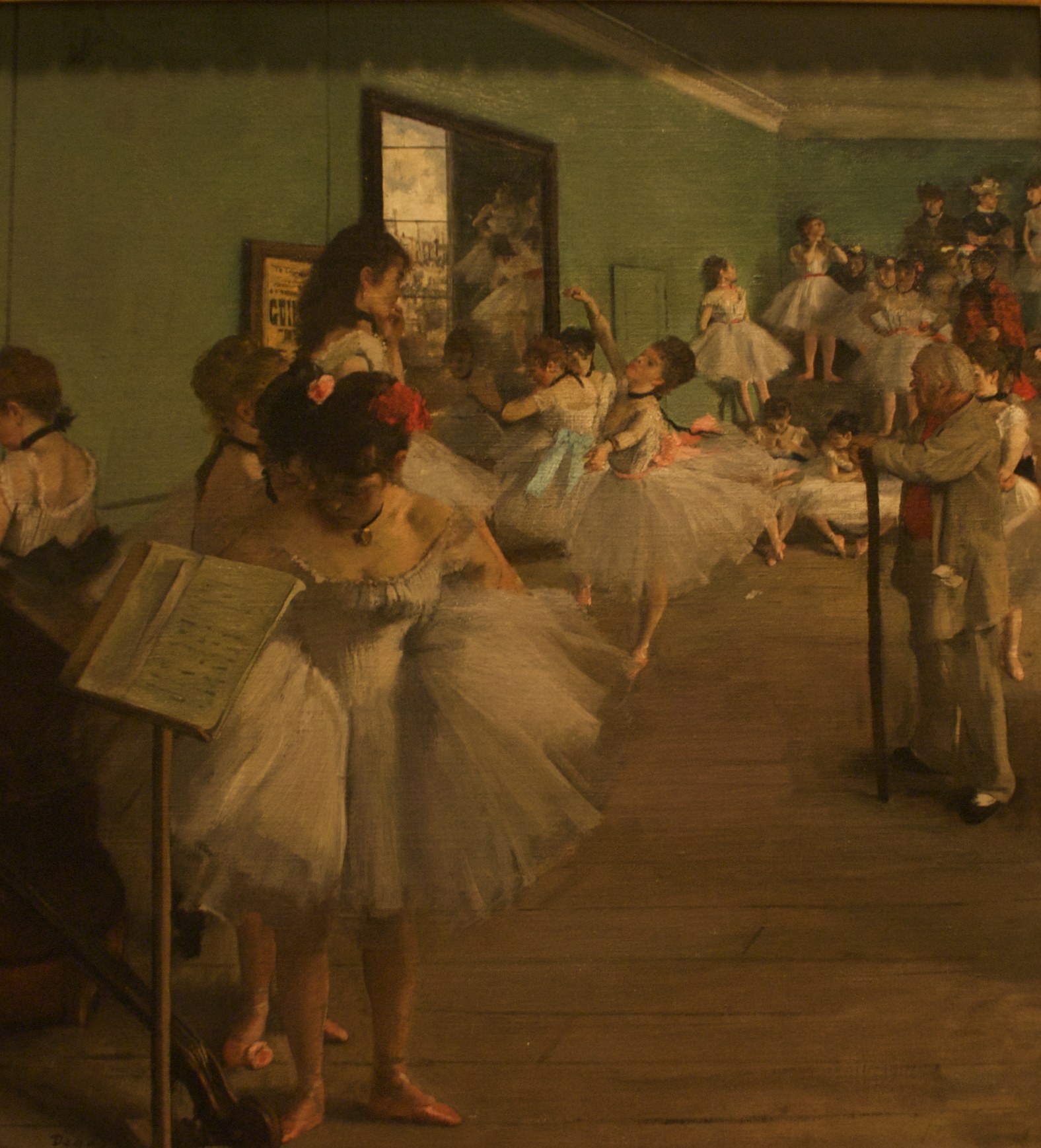
WLA metmuseum Edgar Degas The Dance Class
Edgar Degas
- Medium:
- Oil Painting
- Dance:
- Ballet
- Era:
- Late 1800s (Victorian Ballroom)
- Source:
- Wikimedia Commons
- Rights:
- Public domain — free to use, share and adapt.
- Recorded as:
- Public Domain
For dancers and teachers, this painting is a visual archive: it shows the exercises, the postures, the studio conditions, and the hierarchies of ballet training in its classical period. For art historians, it is a pivotal work in the dialogue between Realism and Impressionism, and a meditation on labour, pedagogy, and the female body in sport and art. The subject—the unglamorous truth behind spectacle—challenged the romantic mythology of ballet that dominated visual culture.
What you are looking at
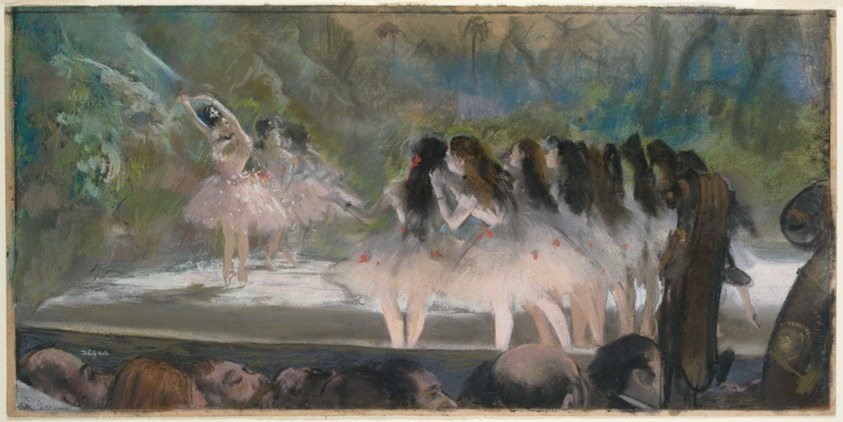
A ballet class in a sunlit studio, likely Paris, circa the 1870s. The room has pale green walls and a wooden floor; tall windows or doors in the background admit golden light. A dozen young dancers in white tutus occupy the space—some at the barre on the left, others in the centre and right, standing, stretching, or in motion. An older man in dark clothes, presumably the ballet master, stands at the centre-right, observing. The composition is informal and candid, capturing the working moments of rehearsal rather than performance: some dancers attend to their positions, others adjust their clothing or rest between exercises, and the group has the loose assembly of a real class rather than a staged tableau.
The dancing
The dancers show the posture and bearing of trained ballet students: upright spine, turned-out legs, and the controlled grace expected of the form. Those at the barre maintain the proper hold, their free arms extended. Several dancers in the centre are in or near first or fifth position, with the characteristic turnout from the hip visible in their stance. The tulle of the tutus creates soft, layered silhouettes that would have been fashionable in the 1870s. One dancer in the immediate foreground on the left holds a piece of sheet music or instruction, suggesting she is awaiting her turn or preparing to perform a combination.
The dance depicted
This is unambiguously a classical ballet class, the daily work of ballet training in the late nineteenth century. The tutorial structure is visible: the barre work on the left, the open-floor combinations in the centre, and the close attention of the male instructor suggest the hierarchical Romantic ballet system of the era. The dancers appear to be young women—likely students or members of a corps de ballet—performing the standardised exercises that formed the basis of training and conditioning in schools affiliated with major opera houses such as the Palais Garnier in Paris. The informality of the moment—the scattered positions, the waiting, the adjustment of costume—tells us that this is a working rehearsal, not a performance or final preparation.
How it was made
Oil painting on canvas, executed in a warm, ochre-dominant palette with loose, impressionistic brushwork, particularly in the treatment of light and shadow. The artist uses layered, translucent paint to suggest the softness and movement of the tutus and the atmospheric quality of the studio light. This technique—working directly from observed life with emphasis on the effects of light rather than precise detail—is characteristic of the Impressionist movement of the 1870s, though the composition and subject matter are more closely aligned with Realism. The painting would have been exhibited in galleries or salons and was likely known through reproduction; it has become one of the canonical images of ballet in Western art.
About this work
This painting documents the private, daily life of ballet training in the late nineteenth century—the studio work that made performance possible. It is a work of Realist observation translated through Impressionist technique: the artist chose to paint not the spectacle of the stage but the unglamorous, methodical labour of the classroom. The male instructor, the careful postures, the scattered informality of the moment, and the modest dress of the dancers (modest by stage standards, though scandalous by street standards of the era) all signal the professional ballet world of the Parisian Opéra. The work is historically significant because it preserves a faithful record of how ballet was actually taught and practised, filtered through the aesthetic sensibility of modern art.
How to look at it
Attend to the spatial composition: the figures are scattered asymmetrically across the canvas, many cropped at the edges, in the manner of a snapshot rather than a posed group. Notice how Degas positions you not as a spectator in the audience but as an observer in the studio—the viewpoint is intimate and casual. Look at the light: it is golden and directional, falling from the upper left, creating soft shadows and illuminating the white tutus with warm, peachy tones. The brushwork in these light-struck areas is loose and suggestive rather than precise, which creates a sense of movement and fleeting time. Finally, observe the hierarchy implicit in the spatial arrangement: the male instructor in dark clothes, centrally placed, commands attention; the young women in white are scattered around him, attending, waiting, performing. This composition encodes the power structures of the institution, even as it records its daily operations.
The artist
Edgar Degas (1834–1917) was a founding member of the Impressionist group, though he resisted the label, preferring to call himself a 'realist' or 'painter of modern life.' He was obsessed with dance—particularly ballet—from the 1870s onward, producing hundreds of paintings, pastels, prints, and sculptures of dancers in rehearsal, performance, and private moments. He had privileged access to the rehearsal studios of the Opéra and cultivated friendships with dancers and choreographers. His approach was radically unsentimental: he drew dancers from above, below, and at odd angles; he captured them mid-movement, mid-yawn, mid-adjustment; he was interested in the mechanics of training and the unglamorous body at work. His dance paintings are among the most influential images of ballet ever made, establishing a visual language for depicting dancers that persists to this day.
The period
The 1870s were a transformative moment for both ballet and visual art in Paris. The Paris Opéra, completed in 1875, had become the centre of European ballet, and the spectacle of ballet was intensely fashionable among the wealthy and the middle class. Simultaneously, Realist and Impressionist painters were challenging Academic art by insisting on the dignity of ordinary life, fleeting moments, and effects of light over historical grandeur. Degas's decision to paint the classroom rather than the stage—labour rather than luxury—was a radical move: it asserted that the real subject of ballet was not the fantasy on stage but the discipline, training, and collective effort of the institution. The painting also captures a moment when ballet was undergoing stylistic change, moving from the ethereal Romantic ballet of the mid-century toward the more technical, virtuosic classical ballet that would dominate the twentieth century.
Where it lives
The work is held in the Metropolitan Museum of Art, New York. It was catalogued in the museum's open-access collection via Wikimedia Commons, making it one of the most widely circulated images of ballet in digital culture.
Dance in this work
Questions about this work
Is this a real class or a posed scene?
It is a painted composition, not a photograph, but Degas worked from sketches and memory of actual rehearsals at the Opéra. The scattered, informal arrangement of the figures and the candid quality of many of the poses suggest he was capturing observed reality rather than inventing a theatrical tableau. However, the arrangement of figures, the light, and the overall composition are all carefully orchestrated by the artist for pictorial effect.
What is the man in dark clothes doing?
He is the ballet master or instructor, the authority figure who teaches, corrects, and trains the dancers. His central position and dark costume distinguish him from the students. In the ballet world of the 1870s, these instructors were typically older men, often retired dancers or choreographers, who held considerable power over the dancers' careers and reputations.
Why are the dancers wearing tutus in a rehearsal?
Tutus were the standard rehearsal costume as well as performance costume in classical ballet. Dancers needed to train in the actual garment they would perform in, to understand how it moved and how it affected their balance and line. The tutus Degas shows here are somewhat shorter and less voluminous than the most dramatic stage tutus, reflecting the evolution of ballet costume in the 1870s.
What does this painting tell us about women and ballet in this period?
It documents a world of intensive physical labour and rigid institutional discipline, though one open primarily to young women of modest means. The dancers are shown as workers and students, not only as spectacles. Their youth, the informality of some of their poses, and the evidence of physical exertion (one dancer stretches; another waits) humanise them as individuals engaged in serious training, rather than abstract symbols of grace or beauty.
More Ballet artwork