49 works in this view — arrow keys or swipe to move between them.
Dance in Art · 1873
Edgar Germain Hilaire Degas 004
Edgar Degas
- Medium:
- Oil Painting
- Dance:
- Ballet
- Era:
- Late 1800s (Victorian Ballroom)
- Source:
- Wikimedia Commons
- Rights:
- Public domain — free to use, share and adapt.
- Recorded as:
- Public Domain
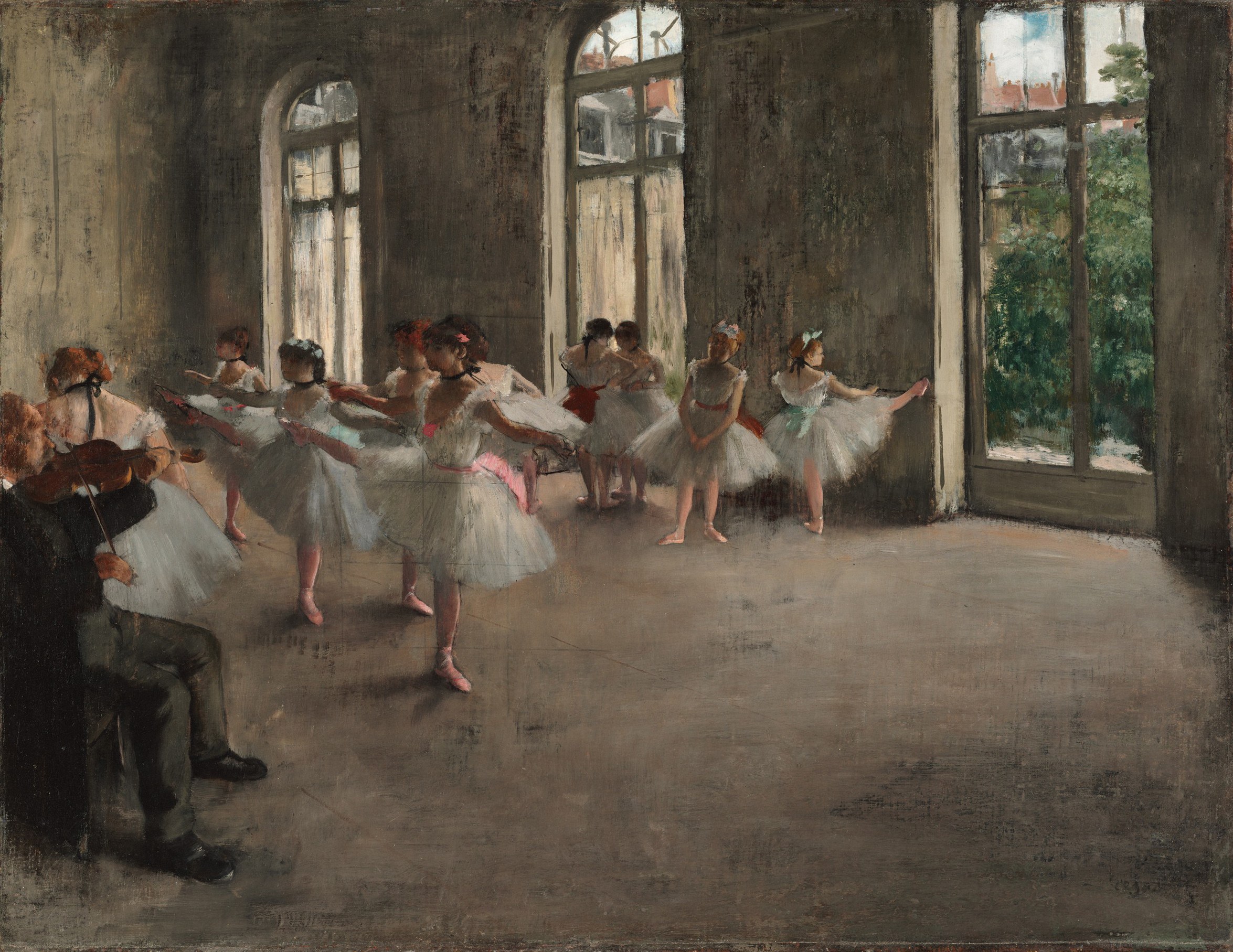
This work is one of the foundational images of the ballet studio in modern art, establishing the studio itself—not the stage—as a subject worthy of aesthetic attention. For dancers and dance historians, it is a precious document of how ballet was actually taught and rehearsed in the 1870s: the clothing, the proportions of the space, the role of live music, the informality of the moment. For art historians, it exemplifies a crucial shift in how artists engaged with dance: not as narrative spectacle, but as a modern practice of discipline, training, and bodily culture.
What you are looking at
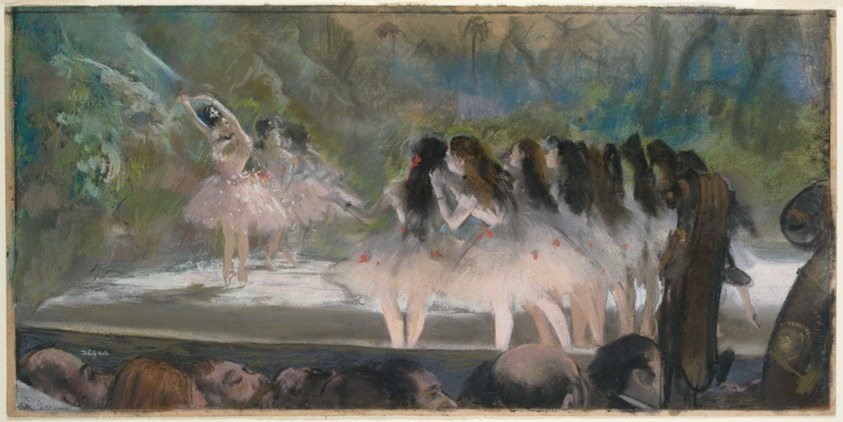
A ballet class or rehearsal in a large, austere studio with soaring arched windows that flood the space with cool natural light. The room's grey-green walls are bare and weathered, giving it the institutional character of a Parisian dance academy. A violinist sits to the left, partially in shadow, providing live accompaniment. In the center and right of the space, twelve or more young dancers in pale pink and white practice tutus stand, turn, and pose in various attitudes and arabesques—some in profile with one leg extended behind them, others facing forward in a gathered group. The dancers occupy the floor at different depths and angles, creating a sense of natural, unposed movement caught mid-rehearsal rather than in formal alignment. The afternoon light creates soft shadows that emphasize the volume of their skirts and the elongation of their bodies; the strongest light pours through the tall window on the right, catching the nearest dancers with particular clarity.
The dancing
The dancers are uniformly dressed in ballet practice clothes: pale pink tights and short white tutus or skirts. Their poses display the core vocabulary of classical ballet—multiple arabesques with the working leg extended behind in a long line, attitudes with bent back legs, and standing poses with turned-out legs. Their arms are positioned in various classical port de bras positions: some raised and curved overhead, others extended to the side or lowered. Several dancers show the characteristic turnout from the hip and the upright carriage of the torso that defines academic ballet. The bodies are slender and elongated; the artist has captured the effect of sustained turnout on the silhouette. One dancer near the left foreground is bent forward in a preparatory or stretching position. The presence of the musician indicates this is a live class with musical direction, not a static pose session.
The dance depicted
This is a scene of classical ballet pedagogy and rehearsal, almost certainly from the Paris Opéra Ballet or a similar grande institution of the period. The costumes, poses, and the very setting—a vast academic studio with live violin accompaniment—are hallmarks of late-19th-century ballet training in the French tradition. The dancers are executing the fundamental positions and movements of what would later be codified as the Cecchetti method or the style taught at the Opéra. The informality of the arrangement (dancers at different stages of the same exercise, or perhaps a rehearsal rather than a formal class) and the artist's focus on candid rather than heroic poses suggest this is a working moment rather than a performance. The emphasis on the architecture of the studio and the ambient light indicates the artist's interest in the conditions of dance-making itself, not merely the dancers' beauty.
How it was made
This is an oil painting, executed with the broken, impressionistic touch characteristic of the 1870s. The artist has used a limited palette of ochres, greys, greens, and pale pinks, with white highlights used to suggest the volume and reflectivity of the tutus and the strong studio light. The paint is applied loosely and sketchily, particularly in the architectural background and the shadows, which creates atmosphere and atmosphere rather than detail. This technique—the rapid, painterly approach—allowed the artist to capture transient gestures and the fleeting effects of natural light in a way that academic finish would not. The loose handling also suggests this may have been executed quickly, either from life in the studio or from memory and observation, rather than as a finished studio work.
About this work
This painting documents the conditions of ballet training and rehearsal at a major Parisian academy in the early 1870s. It is not a portrait of a performance or a narrative moment, but rather a study of dancers at work—a subject that fascinated many artists of the period as ballet shifted from being primarily a spectacle for audiences to being understood as a craft with its own discipline, pedagogy, and social world. The painting's significance lies in its insistence on the unglamorous reality of the studio: the bare walls, the hard floor, the repetitive work, the live musician, the informal arrangement of bodies in various stages of the same exercises. This is ballet as labor and education, not as fantasy or spectacle. The artist's choice to paint this scene in oils with impressionistic technique brought the aesthetic and technical concerns of avant-garde painting to bear on a subject—the ballet studio—that was only beginning to interest serious artists.
How to look at it
Look first at the spatial arrangement: the studio recedes dramatically, and Degas has positioned the viewer as if standing at one end, a participant or observer in the space rather than a distant spectator. Notice how the dancers are caught mid-movement at different stages—some extending, others turning, others pausing—which creates a sense of unscripted time rather than choreographed sequence. The light is crucial: observe how the artist uses the tall arched windows and the streaming sun to organize the composition and to differentiate between the lit and shadowed faces and bodies. Finally, note the musician: the violinist is as important to the composition as the dancers, a reminder that ballet is a collaborative art form that depends on music, and that the studio is a place of rehearsal and instruction, not performance.
The artist
Edgar Degas (1834–1917) was a French painter, sculptor, and printmaker whose sustained investigation of movement, modern labor, and the human body made him one of the most innovative artists of the 19th century. He was obsessed with the ballet studio and the backstage world of the Opéra, visiting repeatedly over several decades and creating hundreds of works—paintings, pastels, sculptures, prints—of dancers in class, rehearsal, and performance. Degas had no interest in the romantic or fairy-tale content of ballet narratives; instead, he treated dancers as workers and the body in motion as a subject requiring the same analytical attention he gave to laundresses, milliners, and café singers. His practice combined academic draftsmanship with impressionistic color and composition, and his radical cropping and unusual viewpoints (often from above or from the wings) were influenced by photography and Japanese prints. The ballet studio became almost a laboratory for his explorations of modern vision.
The period
In the early 1870s, ballet was undergoing significant change. The Romantic era (characterized by ethereal, supernatural narratives) was giving way to a more eclectic, aesthetically experimental period; Degas was painting during the height of Impressionism's challenge to academic painting. At the same time, ballet was becoming increasingly professionalized and systematized: the Cecchetti method was codifying technique, and the Opéra was establishing itself as an institution with rigorous training. Degas's turn to the studio rather than the stage was partly a response to these shifts—he was interested in how modern bodies were disciplined and trained, a preoccupation shared with other artists and writers of the period who saw in labor and repetition a new form of modernity. His work also reflected the growing accessibility of backstage spaces; by the 1870s, artists and photographers had greater freedom to observe rehearsals and classes.
Where it lives
The work is held in a public collection, though the specific holding institution is not recorded in the current catalogue. It is known through reproduction and scholarly literature on Degas's dance subjects.
Dance in this work
Questions about this work
Is this a painting of a real ballet class?
Almost certainly. Degas was a regular visitor to the Opéra's studios and rehearsal spaces, and he based his paintings on direct observation and rapid sketches made on the spot. However, he also combined observations and arranged the figures in the composition for pictorial effect. This is not documentary in the sense of a photograph, but it is rooted in real observation of how ballet training actually happened.
Why did Degas paint so many ballet subjects?
Degas was drawn to the ballet studio as a place where he could study the human body in motion, under conditions of discipline and repetition, with strong natural light. The studio also allowed him to explore the social world of work, labor, and instruction—themes central to modern art of the period. He treated dancers not as romantic figures but as professionals engaged in physical and artistic practice.
What is the violin player doing?
The musician is providing accompaniment for the class or rehearsal. In 19th-century ballet academies, a pianist or violinist would attend classes and rehearsals, playing études or musical phrases to structure the lesson and help the dancers maintain rhythm and phrasing. This was standard practice in professional training.
How can you tell this is the Opéra Ballet and not another academy?
The scale of the studio, its architectural features, and the number of dancers, combined with Degas's known focus on the Paris Opéra, make this identification likely. However, it could be a rehearsal space of another major Parisian academy. The painting is not formally documented to a specific location.
More Ballet artwork