49 works in this view — arrow keys or swipe to move between them.
Dance in Art · 1873
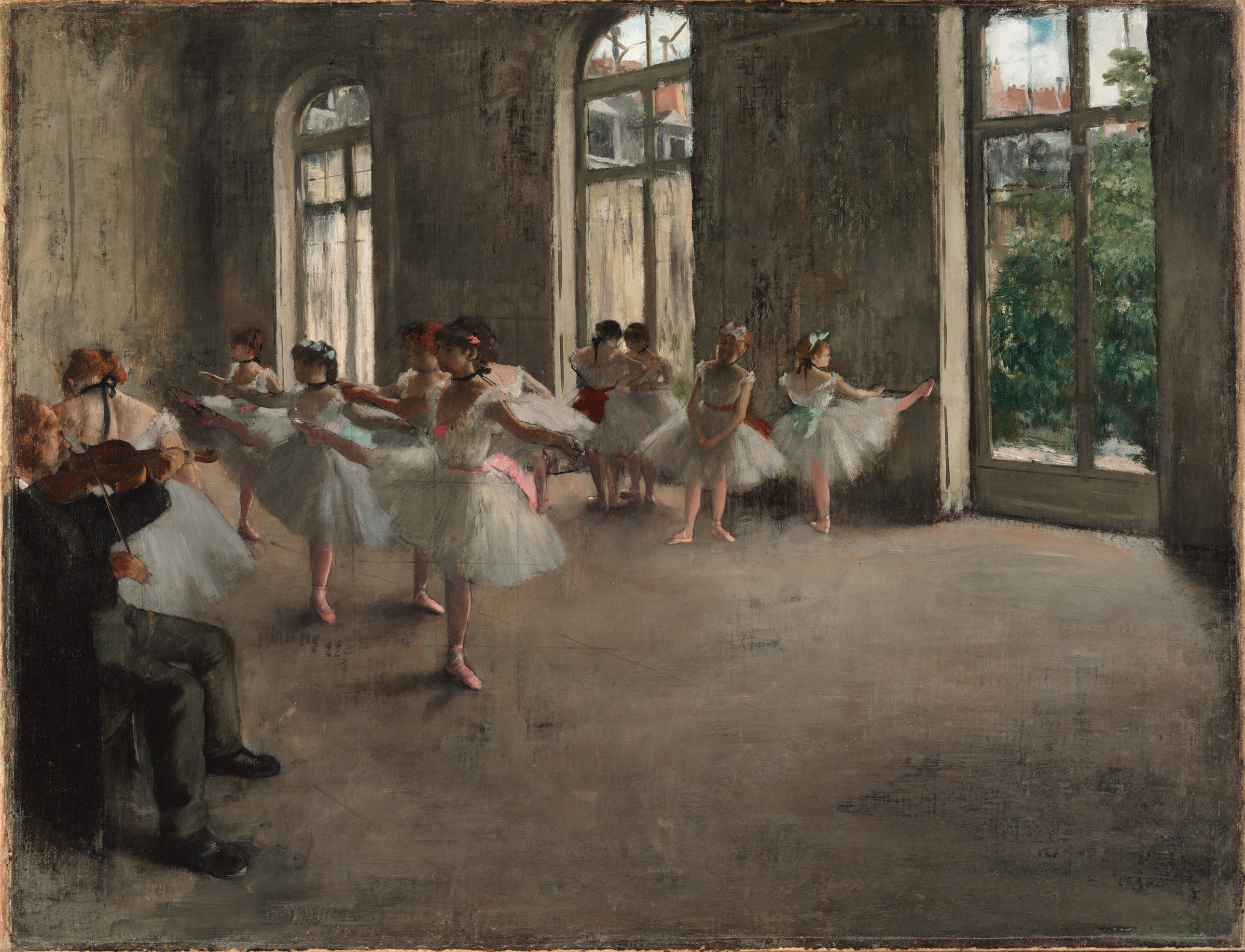
Hilaire-Germain-Edgar Degas - The Rehearsal - 1951.47 - Fogg Museum
Edgar Degas
- Medium:
- Oil Painting
- Dance:
- Ballet
- Era:
- Late 1800s (Victorian Ballroom)
- Source:
- Wikimedia Commons
- Rights:
- Public domain — free to use, share and adapt.
- Recorded as:
- Public Domain
This work is foundational to how ballet has been seen and understood in visual culture. Degas's repeated return to the rehearsal studio—his choice to paint the unglamorous work rather than the glamorous performance—shifted the paradigm of dance imagery and influenced how dancers, choreographers, and audiences came to value the work of dance itself. For historians and practitioners, it is evidence of 19th-century ballet pedagogy: what the studio looked like, how dancers trained, what music accompanied them, how the body was shaped and controlled.
What you are looking at
A ballet rehearsal in a large, austere studio with peeling plaster walls and tall arched windows admitting cool light. Eight female dancers in white tutus and pointe shoes are scattered across the floor in various attitudes of practice—some standing, some bent, all engaged in the vocabulary of classical ballet. On the left, a seated violinist in dark clothes plays for the dancers, his instrument silhouetted against the light. The composition emphasizes the dancers' bodies and the geometry of their poses against the monumental emptiness of the room. The palette is muted: grays and tans of the walls and floor, cream of the tutus and window panes, with touches of coral and red in ribbons and accents. The light is cool and even, rendering the scene with neither drama nor sentiment—this is work, not performance.
The dancing
The dancers display the turned-out legs, lifted spines, and held arms characteristic of classical ballet training. Several stand on pointe in attitudes or arabesques; others appear to be in preparation or transition. The poses suggest the deliberate control and extension of academic ballet rather than dramatic gesture or narrative mime. Arm positions vary from port de bras to positions of support or balance. The weight is consistently lifted upward, the bodies elongated and composed. No two dancers occupy the same pose or face the same direction, suggesting a moment during an exercise or combination where individuals are at different stages of the movement phrase.
The dance depicted
This is a rehearsal of ballet, likely Romantic-era or academic classical ballet given the sylph-like tutus, pointe work, and studio setting. The presence of a violinist indicates a live accompaniment, standard practice in 19th-century ballet training where musicians accompanied each rehearsal. The composition captures a moment of pedagogical work—dancers drilling technique, building strength and precision in isolation from the artifice of costume and theater lighting. This was the daily reality of ballet training, unglamorous and focused, far removed from the spectacle of the opera house stage.
How it was made
Oil painting with a muted, naturalistic palette that emphasizes form over color. Degas works at a large enough scale to render individual dancers with character while maintaining the spatial architecture of the studio. The technique allows him to capture light diffusing through tall windows and to render the worn materiality of the studio walls—details that reveal a painter interested in the actual conditions of labor rather than the theatrical fantasy of ballet. The loose handling of the background and the precise rendering of the figures suggest this was worked from memory and observation rather than from life, consistent with Degas's practice of collecting sketches and working in the studio.
About this work
This is Hilaire-Germain-Edgar Degas's oil painting of a ballet rehearsal, dated 1873, now in the Fogg Museum. It is one of a series of works in which Degas documented the daily work of dancers at the Paris Opera Ballet, moving away from the narrative spectacle of stage ballet toward the discipline and repetition of training. The painting locates ballet in the actual world—not as fantasy but as labor, as pedagogy, as the embodied work of young women in a institutional setting. It marks a decisive turn in how dance was represented in fine art: away from the romantic imagining of the dancer and toward the anatomical and psychological reality of the practice itself.
How to look at it
Notice the spatial composition: Degas has positioned the violinist in deep space on the left, making the act of accompaniment central to the scene even though the musicians' role was usually invisible in the theater. Follow the vectors of the dancers' bodies—they do not form a unified group or corps de ballet, but instead occupy the floor in scattered focus, each pursuing her own rehearsal task. Look at the light coming through the windows on the right: it is cool, indifferent, without the warmth or drama of theatrical lighting. The painter has frozen a moment that contains no narrative climax, no penultimate gesture—the dancers are simply practicing, which is the point. Notice too the materiality of the studio: the worn plaster, the scuffed floor, the industrial scale of the windows. This is a working space, not a fantasy space.
The artist
Edgar Degas (1834–1917) was a founding member of the Impressionist circle who diverged sharply from Impressionist practice in his insistence on drawing, studio work, and the human figure. From the 1860s onward, he became obsessed with the Paris Opera Ballet, attending rehearsals, collecting sketches, and making the ballet studio a laboratory for studying human movement, light, and compositional structure. His ballet works—numbering over 250 paintings, pastels, and drawings—constitute a visual archive of 19th-century dance practice and a meditation on the relationship between labor, beauty, and the body. He was indifferent to the narrative or emotional content of ballet as performed; what compelled him was the geometry of the moving body and the conditions under which movement was made and refined.
The period
In the 1870s, ballet in Paris was entering a period of transition. The Romantic ballet of the previous generation—Giselle, La Sylphide—had given way to a new emphasis on technical virtuosity and spectacle, associated with dancers like Emma Livry and later Mariquita Zouganetz. The Paris Opera Ballet was the institutional engine of European ballet, training dancers from childhood and maintaining a rigorous system of classical technique. Degas's choice to paint rehearsals rather than performances was countercultural: it privileged the everyday over the ceremonial, and the body at work over the body in spectacle. In fine art, this coincided with Realism and Naturalism, with the move to paint actual social conditions rather than historical or mythological fantasy.
Where it lives
The work is held in the Fogg Museum at Harvard University, accession number 1951.47. It is one of the major ballet rehearsal paintings by Degas in an American collection.
Dance in this work
Questions about this work
Why did Degas paint ballet so many times?
Degas was fascinated by the ballet studio as a space where the human body was systematically studied, shaped, and refined. He attended rehearsals repeatedly and gathered sketches over decades. For him, ballet was not primarily a narrative or theatrical form but a visual problem: how the body moves, how light plays across form, how composition could capture a moment of sustained action. The ballet studio also offered him access to an almost exclusively female working world, which he represented with unusual seriousness and specificity.
Is this painting a finished work or a study?
This is a finished painting, executed in oil on canvas at a substantial size. However, Degas's method was unusual: he would sketch from life in the studio, then return to his own studio to compose and paint from memory and accumulated sketches. This painting shows that composite method—the poses are accurate, the observation precise, but the spatial arrangement and lighting are the painter's invention, not a transcription of a single moment.
What kind of ballet was being performed and trained in 1873?
By the 1870s, French ballet had moved decisively away from Romanticism toward technical display and spectacle. Dancers trained in the strict classical system, with an emphasis on turnout, elevation, and precision of line. The white tutus visible in the painting were standard for rehearsal and for classical roles; the system was hierarchical, with dancers entering as children and advancing through ranked positions. The Paris Opera Ballet maintained the most prestigious training in Europe.
What is the role of the violinist in this painting?
The violinist provides live musical accompaniment, which was standard practice for ballet rehearsals in the 19th century. A musician would attend rehearsals to play for each exercise and combination, helping dancers develop musicality and responding to the choreographer's or master's direction. Degas's inclusion of the musician emphasizes that ballet training was not silent or purely mechanical; it was embedded in musical time and practice.
More Ballet artwork