49 works in this view — arrow keys or swipe to move between them.
Dance in Art · 1922
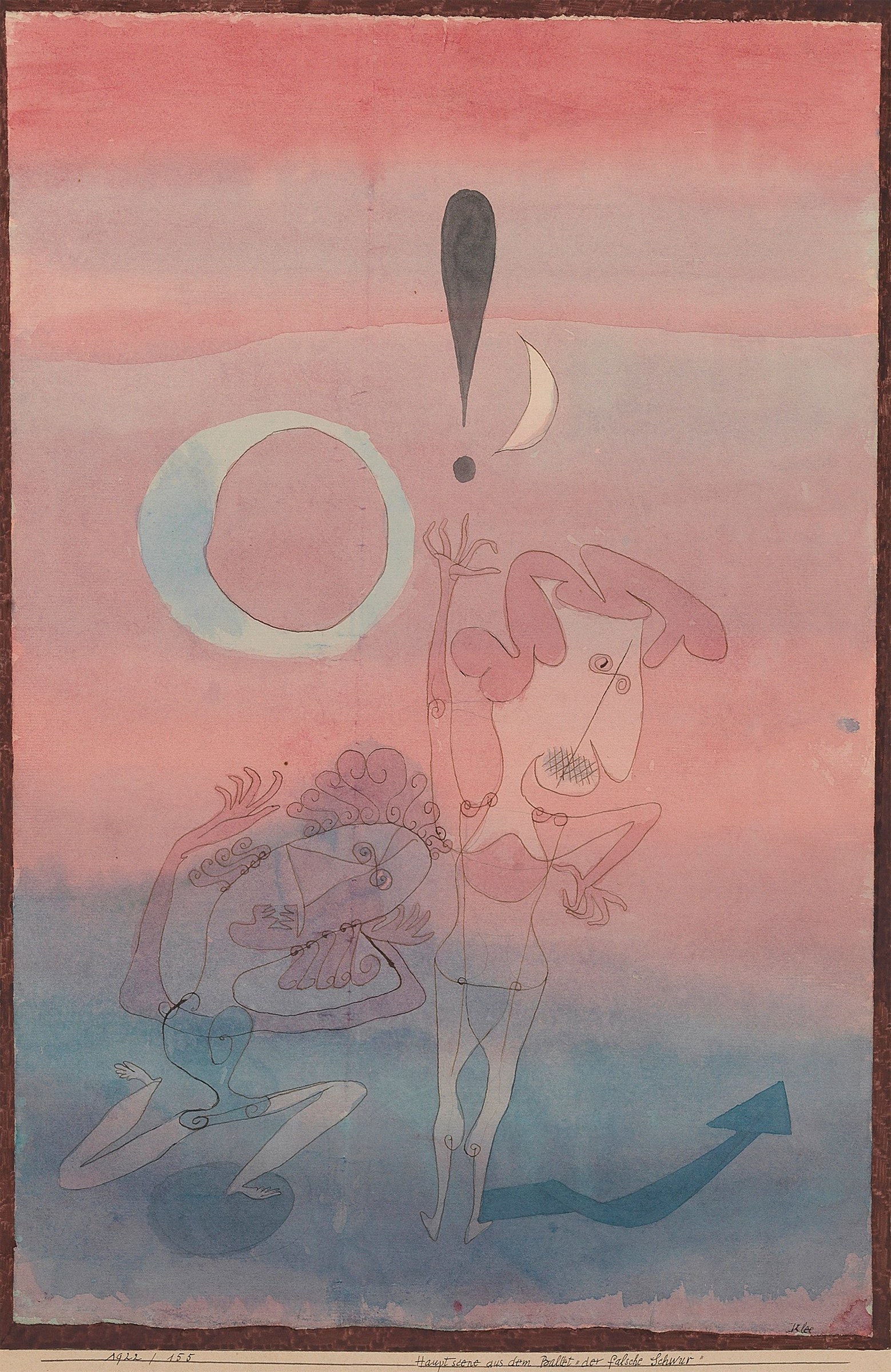
Main Scene from the Ballet 'The False Oath' by Paul Klee, 1922
Paul Klee
- Medium:
- Watercolor
- Dance:
- Ballet
- Era:
- 1920-1950 (Swing Era)
- Source:
- Wikimedia Commons
- Rights:
- Public domain — free to use, share and adapt.
- Recorded as:
- Public Domain
Klee was not primarily a dance artist, but his engagement with *The False Oath* reveals how seriously visual modernists of the 1920s took dance as a subject. The work shows a painter translating movement and narrative costume into a language of line, wash, and chromatic atmosphere—techniques that no photograph could capture. For historians of dance and design, this image documents the Weimar avant-garde's commitment to total theatre and the collaboration between visual arts and performance.
What you are looking at
A dreamlike composition in watercolor and pencil dominated by a pink-to-grey tonal gradient rising from cool blue-grey at the base to warm coral-pink at the top. Two figures occupy the center: a dancer at right with an elongated body, arms stretched in stylized extension, one leg lifted in a pose of dynamic suspension; and at left a crouching or seated figure in a voluminous, intricately patterned garment rendered in flowing linear marks suggesting fabric folds and decorative detail. Between them floats a pale crescent moon and a dark teardrop or spear shape. At the upper left a large pale circle—possibly representing the sun or a spotlight—sits near the horizon line. The standing figure's pose reads as balletic; the seated figure's elaborate costume and gestural language suggest a second dancer or dramatic character. The composition tilts between figuration and abstraction, with the lower portion more densely marked in graphite and the upper region dissolving into atmospheric wash.
The dancing
The principal dancer at right displays an extended, linear silhouette characteristic of early modernist ballet representation: a narrow torso, one leg lifted high and pointed, the opposite arm reaching upward with fingers splayed. The pose suggests a moment of sustained lift—possibly an arabesque or similar extension. The second figure at left is compressed and inward-turning, rendered in cursive pencil lines that suggest elaborate costume detail: patterned sleeves, layered garments, possibly a headdress or crown. The two bodies do not interact; they occupy separate visual and gestural worlds.
The dance depicted
The title identifies this as the main scene from the 1922 ballet *The False Oath* (*Der falsche Eid*), a work not widely documented in standard ballet histories, suggesting it may have been a minor or experimental production. The standing figure's extended pose and ethereal presentation align with Romantic and early modern ballet idiom. The second figure's exotic, densely decorated costume points either to a narrative character (a sultan, ruler, or fantastical being) or to Klee's interest in non-European performance traditions and elaborate dress. Without access to the ballet's scenario or choreography, the specific steps cannot be named, but the image emphasizes balletic line and a staged, theatrical encounter.
How it was made
Watercolor and pencil on paper mounted on board. The technique creates a distinctive effect: broad washes of color establish mood and spatial recession, while fine pencil hatching and linear marks define the figures and costume detail with precision. This mixed approach was characteristic of Klee's graphic practice in the 1920s. The paper's texture and visible edge suggest a work on paper valued as a finished artwork rather than a study—consistent with its scale and exhibition history. The medium allowed Klee rapid chromatic modulation and the layering of gestural mark-making beneath translucent color.
About this work
This watercolor and pencil work documents Klee's engagement with theatrical design and ballet during the Weimar period. Created in 1922, at the peak of avant-garde interest in dance as a modernist art form, it represents a painter's translation of choreographic action into visual form. The composition balances two distinct figures—one animated by balletic extension, the other defined by narrative costume—across a stage lit by celestial or artificial light. The work belongs to a moment when visual artists across Europe were collaborating with dance companies, designing sets and costumes, and treating choreography as a subject worthy of formal investigation. Klee's approach here is characteristically poetic: the figures are simplified and stylized, psychological rather than documentary, and the setting is dreamlike rather than literal.
How to look at it
Attend to the two figures' contrasting geometries: one open and extended, reaching toward the upper edge of the frame; the other closed, compacted, and inward-focused. The artist has frozen a moment of spatial and emotional separation, despite the two sharing a stage. Notice how color—the warm pink dissolving into cool grey-blue—structures space more powerfully than perspective or ground line. The palette moves from the theatrical warmth of the spotlight above to the cool uncertainty of the lower zone, suggesting something of the mood Klee perceived in the ballet's scenario. The minimal detail and stylization ask the viewer to complete the narrative imaginatively.
The artist
Paul Klee (1879–1940) was a Swiss-born painter, printmaker, and teacher central to European modernism. He worked in Weimar Germany from 1921 to 1931, first at the Bauhaus and later at the Düsseldorf Academy. During this period, Klee maintained a broad engagement with theatrical and musical subjects, informed by his own training as a violinist and his friendship with dancers and performers. His graphic output was prolific: he worked simultaneously in watercolor, ink, pencil, and mixed media, often combining them on a single sheet. Klee's formal vocabulary—simplified figures, expressive line, poetic color—made him a natural choice for theatrical designers seeking an avant-garde aesthetic.
The period
In 1922, European modernist dance and visual art were in close dialogue. The Bauhaus, where Klee taught from 1921, explicitly integrated dance into its curriculum under Oskar Schlemmer. Russian avant-garde artists collaborated with ballet companies; Picasso, Matisse, and Braque were designing for Diaghilev's Ballets Russes. Across Germany, experimental theatres were embracing abstraction, geometric form, and non-narrative choreography. The work's title, *The False Oath*, suggests a narrative ballet—perhaps a tragedy or literary adaptation—but Klee's treatment strips it of plot detail, emphasizing instead the poetry of the staged body and the enchantment of theatrical light.
Where it lives
The work is documented in catalogue records with dimensions (48 x 31 cm) and medium. The source given as Wikimedia Commons suggests it is held in a public collection, though the specific holding institution is not recorded in the materials provided.
Dance in this work
Questions about this work
Is this a costume design or a scene from the ballet itself?
It appears to be both: a visual record of the choreography and costumes as Klee interpreted them, rather than a working design for production. Klee was documenting or responding to a ballet he had seen or learned about, not designing for a premiere. The work is more poetic vision than practical blueprint.
What is The False Oath ballet, and who choreographed it?
Details of the original production are not well recorded in standard dance histories. The ballet's scenario, choreographer, composer, and performance history remain obscure—a reminder that much experimental and regional work from the Weimar period has been lost to documentation. Klee's image may be one of the few surviving records of it.
Why does one figure look so much more elaborate than the other?
The contrast likely reflects narrative hierarchy: the standing dancer at right may be the principal character, rendered with balletic clarity; the seated figure in elaborate costume may be a secondary or symbolic character—a ruler, enchanter, or supernatural being. Their visual separation mirrors a dramatic or emotional distance.
What do the moon and spear shape represent?
These floating elements are characteristically Kleeian: symbolic or atmospheric rather than literal. They may reference the ballet's narrative (an oath sworn by moonlight, a betrayal, a weapon), or they may simply evoke the dreamlike, theatrical space. Klee often used such floating forms to set emotional or spiritual tone.
More Ballet artwork