49 works in this view — arrow keys or swipe to move between them.
Dance in Art · 1796
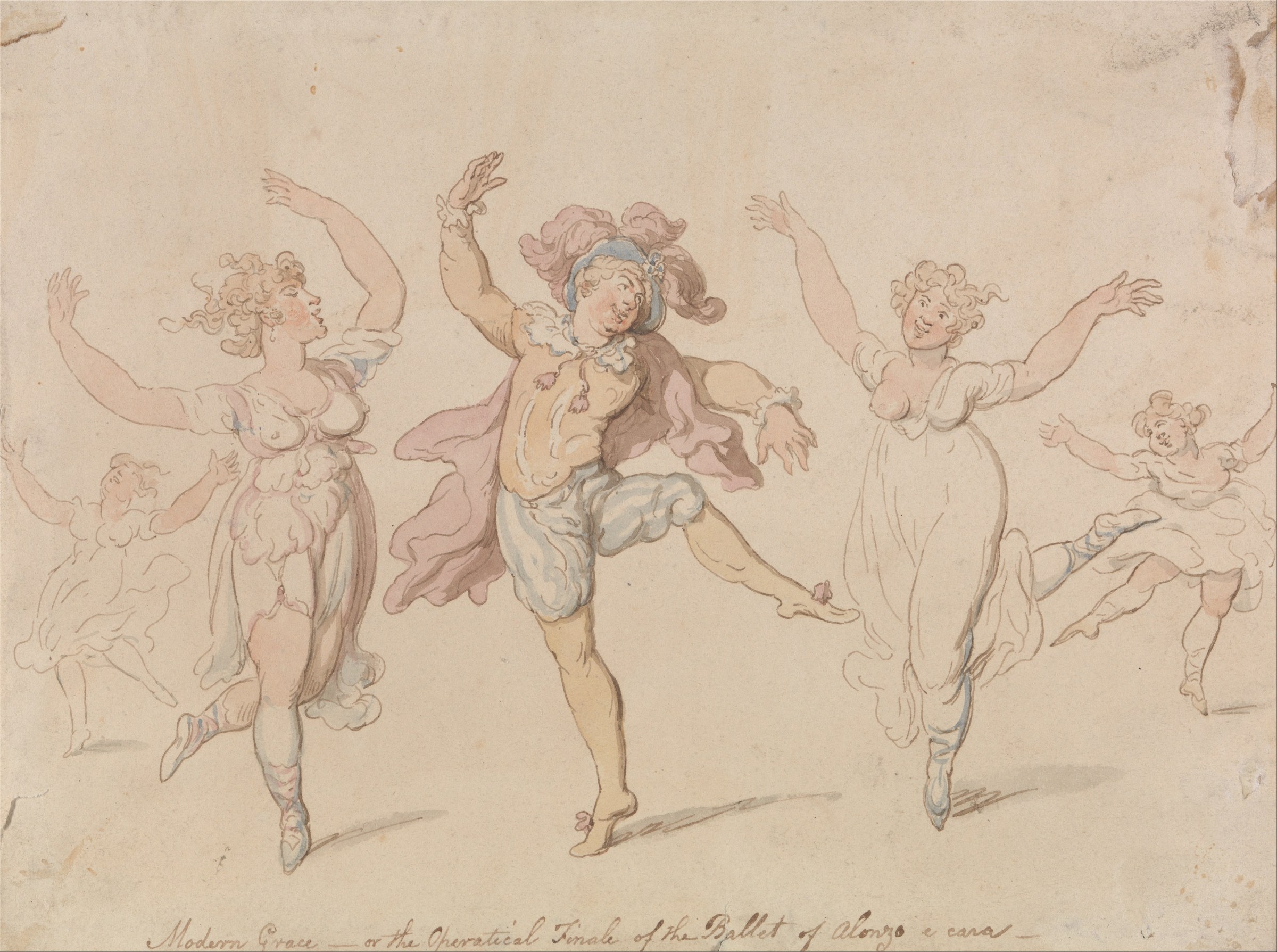
Thomas Rowlandson - Modern Grace...The Ballet of Alonzo e Cara
Thomas Rowlandson
- Medium:
- Oil Painting
- Dance:
- Ballet
- Era:
- 1700s (Enlightenment/Minuet Era)
- Source:
- Wikimedia Commons
- Rights:
- Public domain — free to use, share and adapt.
- Recorded as:
- Public Domain
This image captures the visual and kinetic language of eighteenth-century French theatrical ballet at a moment when ballet was undergoing significant technical and aesthetic development toward the neoclassical and Romantic styles of the next era. For historians of dance and the visual arts alike, the sketch serves as a primary record of how male elevation and female serpentine grace were understood and valued as signs of courtly refinement and theatrical sophistication.
What you are looking at
A lively scene of multiple figures in motion against a plain background, rendered in brown ink wash with selective color tinting. At center stands a principal male dancer in a flesh-colored tunic or breeches, his body in a pronounced contrapposto with one leg extended, arms raised overhead in an exuberant gesture. He wears a blue headwrap or turban. Around him dance four female figures in diaphanous white or pale dresses; the nearest two flank him at middle distance, their bodies twisted in spiraling attitudes with arms extended in curves. Two smaller winged putti or cherubs float or leap at the periphery. All figures display the weightless, elongated proportions and the flying poses characteristic of Rococo decoration. The composition emphasizes diagonal energy and rhythmic repetition of graceful limbs rather than grounded social contact.
The dancing
The central male figure displays an elevated, turned-out contrapposto stance with hips thrust to one side and an arm arc overhead—the posture of an accomplished male soloist of the era, possibly showing the pirouette or an aerial moment. The surrounding female figures adopt curved, lifted attitudes with elongated limbs and tilted heads, their torsos twisted and arms extended in expressive curves. None shows a grounded stance or close hold; all appear caught in weightless, spiral movement. The scale and proportion are elongated and stylized rather than anatomically exact, consistent with Rococo draftsmanship. The putti are rendered in the same elevated, airborne vocabulary.
The dance depicted
The style and costume suggest theatrical ballet of the mid-to-late eighteenth century. The male's elevated position, turned-out legs, and overhead arm frame indicate he is a trained dancer of rank—likely a premier danseur of the period. The surrounding female figures, in their diaphanous dress and serpentine curves, appear to be nymphs or supernatural attendants rather than social dancers, suggesting an allegory or theatrical divertissement rather than a ballroom scene. The title references 'Ballet of Alonzo e Cara'—likely a court ballet or stage work performed for aristocratic audiences. The pose and grouping are consistent with the male-centered, elevated vocabulary of French ballet under Louis XV, though the specific identities of Alonzo and Cara and the provenance of this ballet remain unclear from the image alone.
How it was made
The work is executed in pen and brown ink with watercolor or gouache tinting, a common technique for theatrical or choreographic design and record-keeping in the eighteenth century. The loose, confident line work and the selective use of warm and cool tones (blue headwrap, white drapery against flesh tones) are characteristic of Rococo drawing practice. This technique was economical, rapid, and well-suited to circulation in manuscript form or as single sheets passed among performers, choreographers, and patrons. The style of execution suggests a preparatory or commemorative sketch rather than a finished exhibition work.
About this work
This is a theatrical sketch depicting a moment from a French Rococo ballet, likely dating to the mid-eighteenth century. The central male dancer in an elevated, turned-out posture is surrounded by four female figures in graceful, serpentine attitudes, their bodies rendered with the weightless elongation and expressive line-work typical of Rococo dance imagery. The work documents both the vocabulary of court ballet at the time—the raised positions, the turned-out frame, the allegorical female attendants—and the aesthetic conventions of the period, which prized elegance, elevation, and a vocabulary of refined sensibility. As a sketch, it offers insight into how choreographers and artists understood and recorded movement before the era of photography.
How to look at it
Observe first the pose of the central male dancer: his elevated stance, the twist of his hips, and the overhead arm position indicate a moment of climactic energy or display. Notice how the surrounding figures are arranged radially around him, their arms and bodies creating a frame of elegant curves. The artist has chosen a moment of peak extension and rhythmic unity rather than a static position—a snapshot of virtuosity rather than a courtship or social moment. The Rococo convention at work is the use of weightlessness and spiritual or mythological content to elevate the dancers above ordinary life; the elaborate dress and the allegorical aura signal that this is theatre for the refined eye.
The artist
Thomas Rowlandson (1757–1827) was a prolific English draftsman and caricaturist, celebrated for his satirical social commentary and his ability to capture movement and character in rapid pen-and-wash technique. Though best known for biting social and political satire, Rowlandson also produced theatrical scenes, architectural studies, and allegorical works. His technique—confident line combined with expressive wash—allowed him to work quickly and circulate drawings widely in manuscript form. He frequently depicted the fashionable life of London and continental Europe, and his theatrical works often documented the manners and movements of performers and audiences.
The period
The mid-to-late eighteenth century saw a transformation in ballet from a court social practice to a professional theatrical art. The vocabulary of elevation, turnout, and ethereal female figures aligns with the transition toward Romantic ballet, which would valorize the weightlessness and supernatural qualities of the female body. Rococo aesthetics, dominant in visual art and performance across Europe, emphasized grace, sensibility, and the representation of aristocratic leisure and refinement. Court ballets and theatrical divertissements performed at court or in aristocratic contexts often featured allegorical narratives and mixed casts of trained male dancers and female nymphs or attendants. The sketch's style and subject suggest it was made for or in response to performance culture in London or Paris during this period of high fashion in dance.
Where it lives
The work is attributed to Thomas Rowlandson and dated to 1796 based on stylistic evidence. It is recorded as an oil painting in the catalogue, though the medium appears to be ink and watercolor on paper. The current holding collection is not recorded. The work is accessible via Wikimedia Commons.
Dance in this work
Questions about this work
Who were Alonzo and Cara?
The title references a 'Ballet of Alonzo e Cara,' but the specific identities of these characters or performers are not documented in the catalogue record or visible in the image. They may have been characters in a court ballet or theatrical work performed in London or Paris in the late eighteenth century, or the names may refer to dancers known to Rowlandson's circle. Further research into contemporary ballet records and Rowlandson's connections to the theatre would be needed to identify them.
What kind of dance is this?
This is theatrical ballet of the mid-to-late eighteenth century, likely a court ballet or aristocratic divertissement rather than a social dance. The elevated positions, turned-out legs, and allegorical female attendants are consistent with French ballet of the period under the influence of masters like Jean-Georges Noverre, who championed the elevation and technical virtuosity of male dancers.
Why are there winged figures?
The small winged putti or cherubs are characteristic of Rococo allegorical decoration, signaling that this is a mythological or supernatural scene rather than a naturalistic one. They reinforce the theme of grace, elevation, and refined sensibility central to Rococo performance aesthetics.
Is this a finished painting or a sketch?
The sketch-like quality of the line work, the economical use of wash, and the lack of detailed background or setting suggest this is a preparatory or commemorative sketch rather than a finished exhibition work. Such drawings were commonly used in the theatre to record choreography, preserve the memory of a performance, or circulate images among patrons and performers.
More Ballet artwork