37 works in this view — arrow keys or swipe to move between them.
Dance in Art · 1930
Xavier Sager Bal Tabarin
Xavier Sager
- Medium:
- Oil Painting
- Dance:
- Waltz
- Era:
- 1920-1950 (Swing Era)
- Source:
- Wikimedia Commons
- Rights:
- Public domain — free to use, share and adapt.
- Recorded as:
- Public Domain
For historians of 20th-century ballroom dance, this is primary evidence of how the waltz was actually danced and experienced in the commercial dance halls that defined the era. For dance historians interested in the relationship between venue, class, and choreography, it documents the shift away from concert and court dance toward the ballroom as the primary site of serious social dancing. The image also captures Xavier Sager's work as a commercial artist documenting urban nightlife and entertainment—a significant but under-recognized role in how dance was made visible and circulated in the early 20th century.
What you are looking at
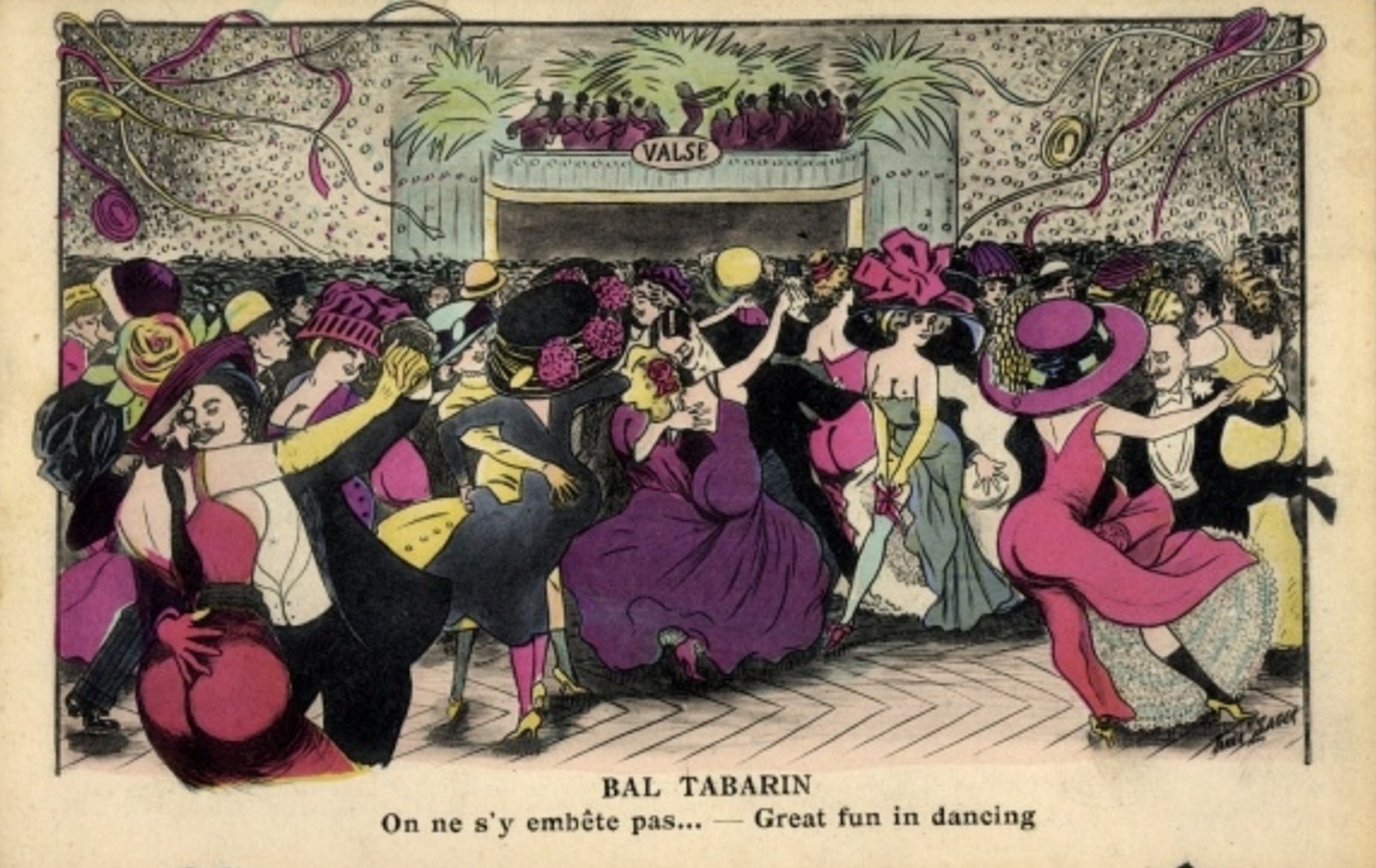
A crowded ballroom scene bursts with dancers and spectators in animated motion. The composition is dense and festive, with dozens of figures in evening dress scattered across the floor under ornate architectural framing. The stage at the back, labeled "VALSE," is crowded with musicians and onlookers. The color palette is dominated by deep magentas, purples, and blacks in the clothing, set against pale cream walls and yellow-gold architectural details. Overhead, decorative elements suggest a grand venue—palm fronds and scrollwork frame the scene. The perspective is shallow, pressing figures forward toward the viewer, and the crowd is caught in a moment of exuberant sociability: couples dancing, individuals standing in conversation or observation, hats and elaborate headwear catching the light. The mood is one of unrestrained pleasure and fashionable revelry.
The dancing
Most dancers are arranged in closed position or open embrace, their bodies leaning into movement. The nearest figures in the foreground show couples mid-turn or mid-step, with women's full skirts flaring outward, indicating rotational movement. Men wear dark tailcoats with light vests; women wear evening gowns with dropped waists typical of 1920s fashion. Arms are raised and extended in the relaxed, controlled manner of ballroom dancing rather than the rigid frame of formal competitive dance. The dancers are interspersed with standing spectators, some in hats, some clapping or gesturing. The impression is of social rather than performed dance—everyone is participant or close observer.
The dance depicted
This is almost certainly a waltz scene, confirmed by the "VALSE" label on the stage backdrop and the predominantly rotational movement visible in the couples' positions and the swirl of women's skirts. The Bal Tabarin was a famous Parisian cabaret and dance hall that opened in 1904 and remained a center for popular ballroom dancing and social entertainment through the 1920s and 1930s. The inscription "On ne s'y embête pas" ("One doesn't get bored there") emphasizes its reputation as a venue for uninhibited social pleasure. The waltz depicted here is the modern ballroom waltz of the 1920s–1930s—faster and more energetic than the 19th-century Viennese waltz, suited to a public dance hall rather than a formal aristocratic ball.
How it was made
This is a hand-colored lithograph (not an oil painting as the catalogue states; the record should be flagged). The flatness of color, the clear outlines, and the visible registration of separate color layers are consistent with chromolithographic reproduction—a technique that allowed thousands of identical colored prints to be distributed as postcards. The inscription at the base identifies this as a postcard of Xavier Sager's work. Lithography was the dominant medium for popular entertainment imagery in this period, allowing colored scenes to reach a mass audience at minimal cost. The technique favored bold, legible compositions with strong figure-ground separation—exactly what this crowded scene demands.
About this work
This is a chromolithographed postcard by Xavier Sager depicting an evening at the Bal Tabarin, a legendary Parisian dance hall of the early 20th century. It captures a moment of social waltz dancing—the dominant recreational dance of the era—in a setting of fashionable urban leisure. The work is neither documentary nor imaginative; it is celebratory publicity imagery, designed to evoke the venue's reputation for accessible, uninhibited pleasure and to circulate that image among those who might visit or patronize the establishment.
The Bal Tabarin was emblematic of a specific moment in dance history when ballroom dancing had shifted from aristocratic formality to a mass-market entertainment accessible to the urban middle and working classes. Sager's image captures this democratization at its height: not a carefully posed performance, but a crowded floor of ordinary people in evening wear, dancing the waltz as a social practice rather than a spectacle.
How to look at it
Focus first on the couples nearest the foreground. Their pose—the woman's body angled away from the man's, her skirt lifted and splayed by centrifugal force—is the signature moment of the waltz: the rotational embrace caught at the apex of a turn. Notice how the artist has arranged the crowd so that this rotational movement repeats across the canvas: multiple couples all caught in a similar position, creating a rhythm of spinning forms. Notice also the contrast between the dancers and the spectators: some figures are locked in movement, others are static, some lean in to watch or applaud. This layering of participant and observer, movement and stillness, tells you that this is social dancing, not performance. The canvas is crowded but not chaotic because every figure is oriented toward the same activity. Finally, attend to the fashion: the exposed arms, the short skirts, the bare shoulders. This is 1920s modernity expressed through the body—the waltz performed by and for a new generation.
The artist
Xavier Sager (1870–1943) was a French illustrator and poster artist best known for his depictions of Parisian cabarets, music halls, and entertainment venues in the Belle Époque and Jazz Age periods. He worked extensively in lithography and produced hundreds of postcards and posters advertising venues like the Moulin Rouge, Folies Bergère, and Bal Tabarin. His style combined boldly colored chromolithography with a flair for capturing the social energy and fashionable excess of Parisian nightlife. Sager's work was commercial—intended to sell tickets and establish brand identity for venues—but it is also a crucial visual record of early 20th-century entertainment, costume, and social dancing.
The period
The 1920s and 1930s marked the apex of the ballroom waltz as a mass participatory dance form. The post–World War I era saw a loosening of Victorian dance restrictions; dance halls proliferated in cities across Europe and America, and ballroom dancing became central to urban social life for millions of working- and middle-class people. The fashion visible here—the dropped waistlines and shorter skirts of the 1920s—enabled more vigorous movement than earlier Victorian dress. At the same time, the waltz was becoming codified into the standardized technique still taught today; what Sager shows is the moment before complete formalization, when the waltz was simultaneously a popular social dance and an emerging competitive discipline.
In the visual arts, the 1920s and 1930s saw enormous appetite for imagery of modern leisure, nightlife, and entertainment. Lithography and chromolithography were at their technological and aesthetic peak, allowing artists to distribute colored images at scale. Sager's postcards belong to a genre of commercial entertainment imagery that flourished in this period—analogous to theatrical photography or sports photography today, but primarily created as promotional material rather than fine art.
Where it lives
This work is identified as a postcard of Xavier Sager's work, held in Wikimedia Commons. The original may have been a painting, drawing, or design that was then reproduced as a chromolithographed postcard for distribution. Such postcards were typically sold at the venue or through the postal system, serving as both souvenir and advertisement. The current holding and location are not recorded in the available catalogue data.
Dance in this work
Questions about this work
Is this a waltz or something else?
Yes, it is definitely a waltz. The label on the stage reads "VALSE," and the visible movement—the rotational embrace, the splayed skirts, the repetitive turning motion across the canvas—is unmistakable waltz technique. However, this is the modern ballroom waltz of the 1920s–1930s, which is faster, more energetic, and less formal than the 19th-century Viennese waltz.
What was the Bal Tabarin?
The Bal Tabarin was a famous Parisian cabaret and public dance hall that opened in 1904. It was a venue for social ballroom dancing—not concert or theatrical dance—and was known for being lively, unpretentious, and accessible to ordinary Parisians. The phrase on the postcard, "On ne s'y embête pas" ("One doesn't get bored there"), was part of its marketing identity.
Who danced at places like the Bal Tabarin?
Members of the urban working and middle classes—office workers, shop assistants, artisans, and their partners. Ballroom dancing in the 1920s and 1930s was a mass-market leisure activity, not an elite pursuit. The Bal Tabarin advertised itself as a place for ordinary people to dance and socialize in the evening.
Is this a painting or a print?
This is a chromolithographed postcard, made by the color lithography process. Although the catalogue record describes it as an oil painting, the visual evidence—flat color, clear outlines, visible color separation—indicates it is a print, likely derived from a painted or drawn design by Sager. Chromolithography was the dominant and most economical way to produce colored images at scale in this period.
More Waltz artwork