49 works in this view — arrow keys or swipe to move between them.
Dance in Art · 1899
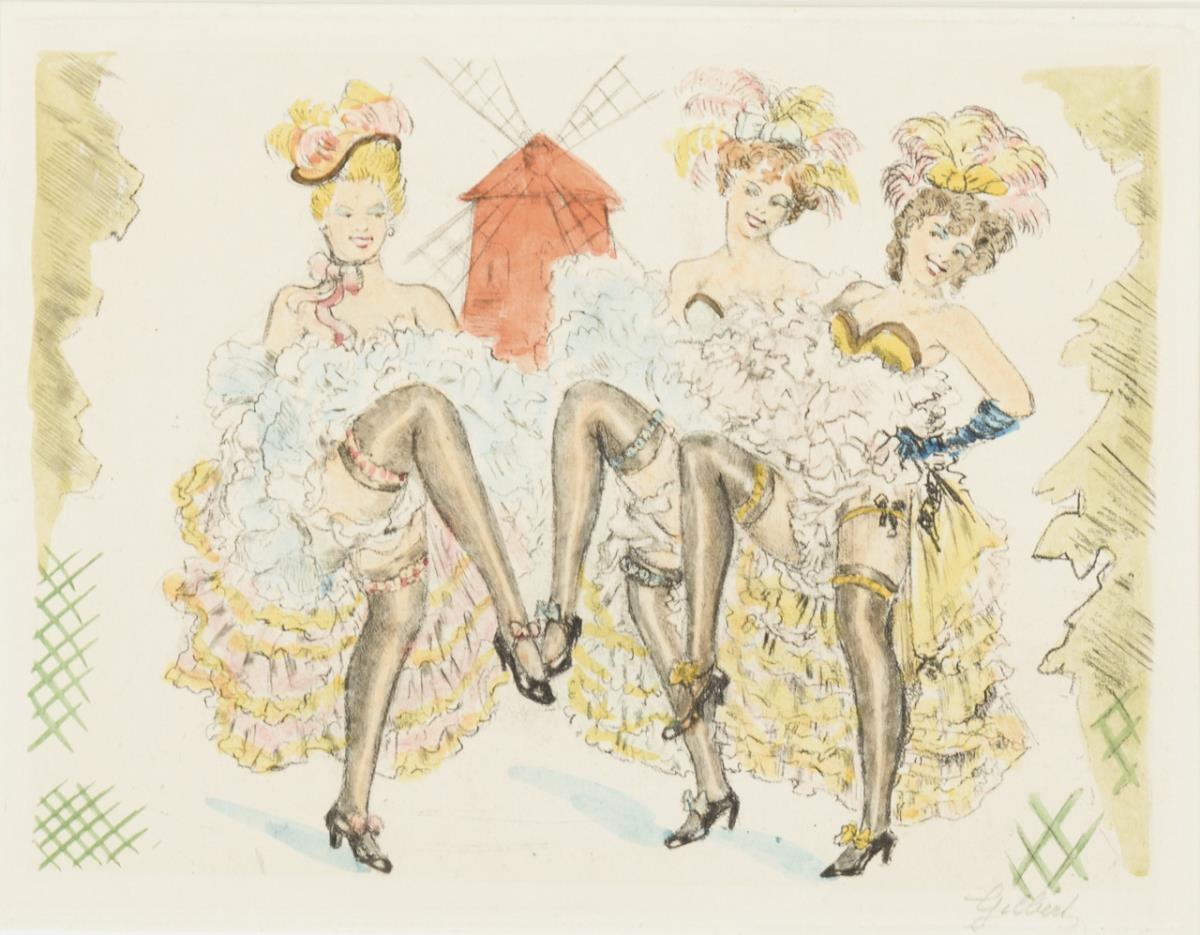
Achille Isidore Gilbert Danseuses Moulin Rouge
Achille Isidore Gilbert
- Medium:
- Oil Painting
- Era:
- Late 1800s (Victorian Ballroom)
- Source:
- Wikimedia Commons
- Rights:
- Public domain — free to use, share and adapt.
- Recorded as:
- Public Domain
This work documents the can-can at a pivotal moment: the transition from street dance to theatrical commodity under the Moulin Rouge brand. For dance historians, it provides primary visual evidence of how professional can-can was costumed, performed, and marketed to audiences in the 1890s—information that shapes understanding of both the dance itself and the period's gender, class, and entertainment politics. For theater practitioners, it illustrates how commercial printmaking functioned as advertising and visual documentation of performance simultaneously.
What you are looking at
Three women in elaborate stage costumes perform a high-energy can-can dance. They wear voluminous tutus trimmed with yellow ruffles and pink accents, paired with white feathered boas that create a sense of expansive movement around their torsos. Their hair is styled in high blonde curls crowned with decorative headpieces. All three have lifted one leg high, their bodies captured mid-kick in the characteristic can-can pose, with legs extended and weight distributed dynamically. The setting is minimal—a simple stage suggested by the pale background—which keeps focus on the dancers themselves. A distinctive red windmill structure rises at the center top of the composition, unmistakably identifying this as a scene from the Moulin Rouge cabaret in Paris. The drawing style employs quick, confident linework in pencil and watercolor wash, giving the figures a sense of spontaneous movement and theatrical glamour.
The dancing
Three female dancers occupy the composition in overlapping positions, all captured in a synchronized high-kick pose with legs extended upward at approximately 90 degrees to the body. Their torsos remain relatively upright despite the energetic leg lift, a fundamental can-can technique. The dancer on the left faces slightly toward the viewer; the center figure and right dancer turn in profile, creating a sense of rotation and rhythmic repetition across the frame. Arms are positioned with some variation—some bent, some extended—suggesting a moment of unison choreography. The dancers' weight appears to be on their standing legs, with heels visible on the raised feet, indicating pointed extension rather than flat-footed kicking.
The dance depicted
This depicts the can-can, the high-kicking social dance that became synonymous with the Moulin Rouge cabaret from its founding in 1889. The Moulin Rouge brought the can-can—originally a working-class street and ballroom dance—into the theatrical spectacle of Belle Époque Paris, where it was performed by professional dancers in increasingly elaborate costumes. The synchronized high kicks, revealing legs, and theatrical presentation shown here are characteristic of the Moulin Rouge's performance version, which transformed the dance into a spectacular entertainment form. The deliberate visibility of the dancers' legs was provocative for the period and central to the can-can's fame and notoriety.
How it was made
The catalogue record identifies this as an aquarellierte Lithografie (watercolor-tinted lithograph) with pencil signature, measuring approximately 20 × 25 cm. This was a popular commercial print technique of the late 19th century, combining lithographic image production with hand-applied watercolor washes. The technique allowed for both mass production and individual tinting, making these works affordable prints for collectors and suitable for advertising purposes. The pencil line is visible throughout, suggesting either direct drawing on the stone or a transferred design. The speed and economy of the linework, combined with the bright but loosely applied watercolor, conveys theatrical energy and was well-suited to promoting cabaret entertainment.
About this work
This is a commercial print documenting the can-can as it was performed at the Moulin Rouge in Paris, circa 1899. The work captures the moment when this dance—originally a working-class social form—had been transformed into high theatrical spectacle. The artist, Achille Isidore Gilbert, was among the illustrators documenting Parisian nightlife during the Belle Époque, and his practice centered on theater, cabaret, and entertainment subjects. The image is valuable precisely because it records a moment in the dance's history when its meaning, context, and audience were actively being redefined through commercial theatrical presentation.
How to look at it
Attend to the moment of the high kick—the artist has chosen to freeze the movement at the moment of maximum lift and extension, which reads as the most visually spectacular pose. Notice how all three dancers are synchronized in this pose, which communicates both the choreographed nature of the performance and the discipline required. The visibility of the legs and the decorative costumes were the defining features of Moulin Rouge spectacle, and the artist emphasizes both by positioning the dancers to maximize the silhouette of limb and fabric. The minimal setting forces the eye entirely onto the performers' bodies and their costumes, which was the point: the Moulin Rouge sold the visual spectacle of the dance itself.
The artist
Achille Isidore Gilbert (active late 1800s) was a commercial illustrator and printmaker specializing in Parisian entertainment subjects. His works document the cabaret, theater, and music hall culture of the Belle Époque, often focusing on performers and dancers. He worked in lithography and watercolor, media well-suited to the rapid documentation and marketing of entertainment subjects. While biographical information is limited, his surviving work shows consistent interest in capturing moment, gesture, and the visual spectacle of commercial entertainment—particularly the female performers who were central to cabaret publicity and appeal.
The period
The Moulin Rouge opened in 1889 and immediately became famous for its can-can performances, which were simultaneously celebrated as entertainment and condemned as scandalous. In the 1890s, as the Moulin Rouge established itself as the preeminent cabaret, the can-can was professionalized, choreographed, and transformed from a participatory social dance into a spectacle watched by paying audiences. Simultaneously, Belle Époque artists (Toulouse-Lautrec most famously) were documenting the cabaret and its dancers, establishing a tradition of visual documentation of Parisian entertainment. Commercial color lithographs like this one served as both souvenirs for attendees and advertisements for the venue itself, distributing images of the Moulin Rouge's dancers throughout Europe. The can-can itself was undergoing a transformation from its earlier, looser street versions into the more codified, high-kicking theatrical form shown here.
Where it lives
The work is held in Wikimedia Commons and appears to be catalogued as a commercial print or advertising image. The small size (approximately 20 × 25 cm) and production method (lithograph with watercolor) are consistent with souvenir or promotional prints distributed at the Moulin Rouge or sold separately as entertainment memorabilia. No holding collection is recorded in the available catalogue data.
Dance in this work
Questions about this work
What is the red windmill at the top of the picture?
That is the Moulin Rouge—literally 'red mill'—the famous Paris cabaret where this dance was performed. The windmill was a functional part of the building's original design and became the venue's most recognizable symbol. It appears prominently in advertising and images of the cabaret, making it instantly identifiable to anyone familiar with Parisian entertainment culture.
Did women really dance like this in the 1890s?
Yes, but with important context: the can-can as a social dance existed before the 1890s and was performed more loosely. The Moulin Rouge formalized and elevated the kick into a high, controlled, synchronized movement performed by trained dancers in costume. This version—what you see here—was a theatrical adaptation designed to be spectacular and profitable. The high kick and the visible legs were shocking for the period and central to the Moulin Rouge's notoriety and success.
Who was Achille Isidore Gilbert?
Gilbert was a commercial illustrator and lithographer working in Paris during the Belle Époque, with a specialty in theater and cabaret subjects. Biographical information is scarce, but his work shows he was part of the network of artists documenting Parisian entertainment for commercial purposes. His prints served both as souvenirs and as advertising, distributing images of the Moulin Rouge's glamorous performers to a wide audience.
Was this an expensive print or a cheap souvenir?
Lithographs with hand-applied watercolor were moderately priced commercial prints—more affordable than original paintings or high-quality engravings, but still requiring skill and labor. They functioned as both souvenirs for tourists and theater-goers and as promotional materials for the Moulin Rouge itself. Their small size and portability made them practical for distribution and collection.
More dance artwork