49 works in this view — arrow keys or swipe to move between them.
Dance in Art · 1905
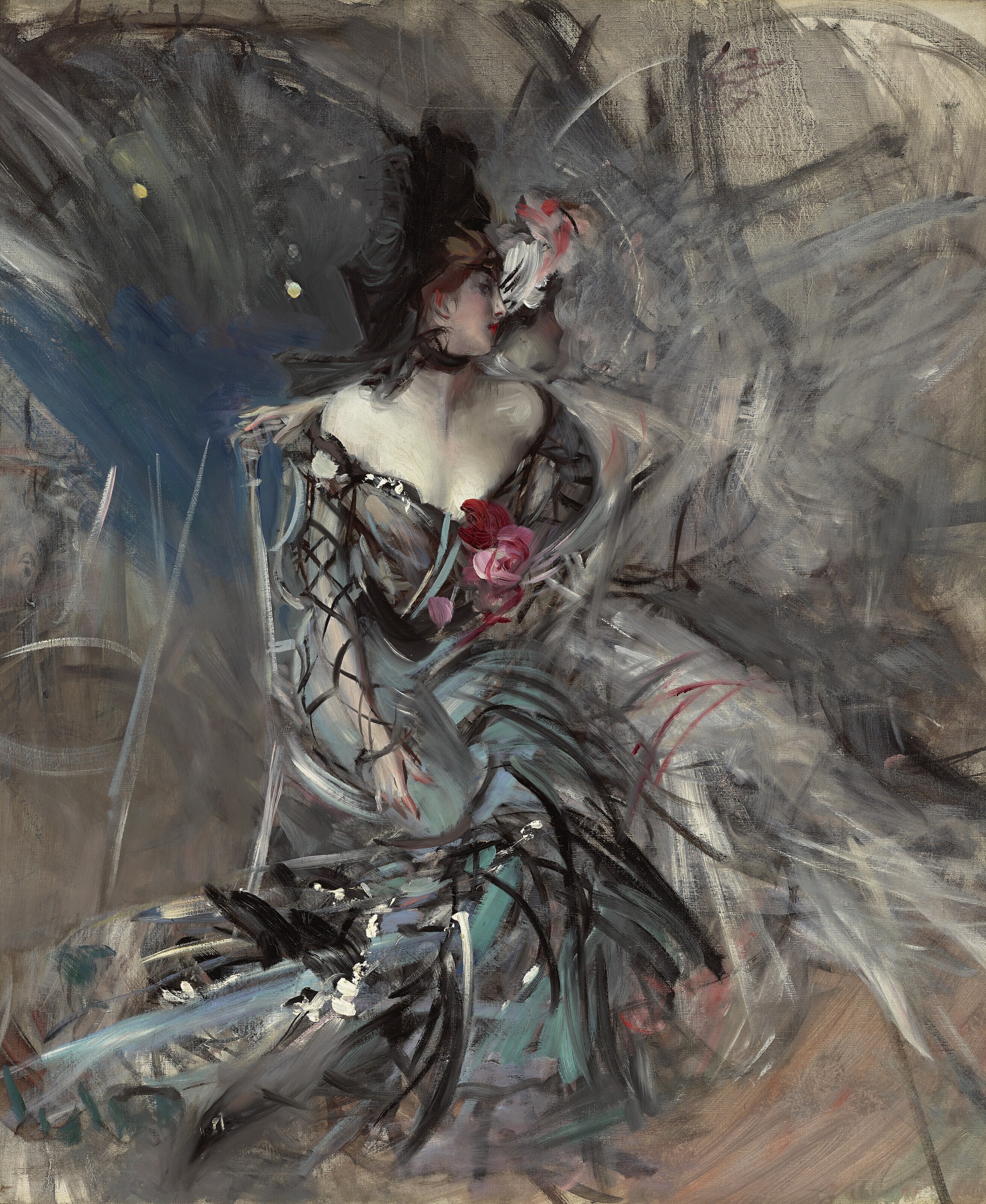
Giovanni Boldini La española del Moulin Rouge
Giovanni Boldini
- Medium:
- Oil Painting
- Era:
- 1900-1920 (Ragtime/Early Jazz)
- Source:
- Wikimedia Commons
- Rights:
- Public domain — free to use, share and adapt.
- Recorded as:
- Public Domain
The work documents how non-Western and regional dance traditions were reframed, performed, and consumed in European commercial venues during the early 20th century—the 'españolada' as Parisian cabaret rather than Spanish cultural practice. For historians of modern dance, cabaret, and the gendered performance of exoticism, the image reveals the theatrical codes and visual conventions through which dance was marketed and understood in this period.
What you are looking at
A woman in elaborate fin-de-siècle dress reclines or collapses languidly across the composition, her body tilted at an acute angle against a darkened interior setting rendered in loose, rapid brushwork. She wears a white chemise or corset exposing her décolletage, over which is draped a gossamer black skirt or train with deep teal and seafoam undertones; the fabric billows and swirls around her legs, caught mid-movement. Her dark hair is crowned with a headdress adorned with pink-red roses and white trim, and she gazes upward or away. Red roses are pinned or held at her bodice. The background is heavily worked in grey, brown, and black tones with loose, gestural strokes suggesting an interior space—possibly curtains, drapery, or architectural elements. The overall effect is one of movement, drama, and the intoxicating abandon associated with Parisian cabaret culture of the 1900s.
The dancing
A single figure dominates the composition, her weight thrown backward or to one side in an exaggerated, theatrical posture—the body elongated and sinuous, with her right arm extended and the torso twisted. This is not a held ballroom position but rather a moment of collapse or ecstatic swoon, with the head thrown back and the body's center of gravity deliberately unstable. The gesture reads as performed abandon rather than natural repose: her frame is deliberately shaped for visual effect, the limbs arranged to emphasize fluidity and the dramatic sweep of her costume.
The dance depicted
This is titled as a Spanish dancer at the Moulin Rouge, and the image records something of the theatrical performance aesthetic of cabaret dance in 1900s Paris—but not a specific recognizable dance form. The pose and costuming suggest an evocation of Spanish or exoticized femininity performed for Parisian audiences, rather than an authentic folkloric or theatrical style. The gestural language is that of theatrical display and seduction, with the body used to suggest intoxication, abandonment, or erotic availability. The roses and mantilla-like headdress gesture toward Spanish visual codes without depicting a coherent dance technique or folk tradition.
How it was made
Oil on canvas, painted with loose, fluid brushwork that suggests rapid execution and prioritizes the effects of movement and fabric over sculptural form. Boldini was known for his fashionable society portraits painted in this broad, gestural style, allowing the paint itself to suggest the shimmer and drape of expensive textiles. The technique—with its visible brushstrokes, abbreviated background, and focus on the play of light and shade across the figure—was suited to commercial reproduction and appeal to collectors of modern life subjects. The painting style itself communicates modernity and immediacy rather than classical finish.
About this work
Giovanni Boldini's painting of a Spanish dancer at the Moulin Rouge captures the aesthetic of fin-de-siècle Parisian cabaret—a space where Spanish and exotic performance merged with modern urban entertainment. The work dates to 1905, at the height of the Moulin Rouge's fame as a venue for café-concert and can-can performance, yet it depicts not the high-kicking precision of the cancan but rather a more theatrical, seductive pose of apparent swoon or ecstasy. The painting records less the technical content of a specific dance than the cultural fantasy of Spanish femininity as consumed and performed in Paris: a moment of theatrical display dressed in the visual codes of exoticism and designed to convey intoxication and erotic appeal to the viewer. Boldini's loose, fashionable painting technique reinforced the work's modernity and its appeal as a commodity—a prestigious record of fashionable leisure and entertainment culture.
How to look at it
Attend to the exaggeration of the pose: the backward tilt of the head and the elongation of the torso are not naturalistic but performative, designed to convey a mood of theatrical swoon or ecstatic display. The brushwork itself—loose, rapid, visible—does not describe the figure's form precisely but instead suggests the shimmer and movement of the costume and the intoxicated atmosphere of the venue. Notice how the face is less clearly articulated than the costume and the roses: the painting prioritizes the visual spectacle of dress and fabric over portraiture. The darkness of the background and the isolation of the figure against it emphasizes her as an object of display, framed as if by spotlights or the proscenium of a stage.
The artist
Giovanni Boldini (1842–1931) was an Italian society portraitist and painter of modern life who achieved enormous commercial success in Paris from the 1870s onward. He was known for his fashionable, loosely brushed society portraits of wealthy patrons, and for his depictions of Parisian leisure and entertainment—music halls, theaters, and the demimonde. His style was rapid and assured, prioritizing the effects of movement, light, and expensive fabrics over classical form, and made him one of the most sought-after portrait painters of the Belle Époque. He painted numerous canvases of cabaret performers and theatrical subjects, often capturing the glamour and theatricality of Parisian night life.
The period
The Moulin Rouge opened in 1889 as the flagship venue of Montmartre's emerging entertainment district. By 1905, when this work was painted, it was famous internationally for the can-can and for its display of exotic and colonial performers catering to elite and bourgeois audiences. Flamenco and Spanish dance enjoyed a particularly intense vogue in Paris during this period, associated with Carmen narratives, Orientalism, and the eroticization of Spanish and Mediterranean femininity. This cultural moment coincided with the height of both belle époque theatrical modernism and the imperial moment of European colonialism. Boldini's loose, gestural painting style was itself the modern aesthetic of the period—rejected academic finish in favor of immediacy and the appearance of spontaneity.
Where it lives
The work is recorded as held in an unspecified collection. It appears on Wikimedia Commons, suggesting it may be in a public institution or collection that permits reproduction. The title in the catalogue record is given in Spanish—'Bailarina española con mantón de Manila'—suggesting the work is held in or catalogued by a Spanish or Spanish-language institution.
Dance in this work
Questions about this work
What is a mantón de Manila?
A mantón de Manila is a large, fringed silk shawl originating in the Philippines and adopted into Spanish folk costume, particularly associated with flamenco and regional Spanish dance. It became a iconic prop of Spanish dance performance in European commercial venues, often used to frame and enhance the theatrical effect of movement and to evoke exoticism and Spanish cultural identity.
Was the Moulin Rouge a place where Spanish dancers performed?
Yes. While the Moulin Rouge is primarily known for the can-can, it featured many styles of entertainment and performers, including Spanish dancers, in its early decades. The venue was a showcase for international and exotic performance catering to Parisian audiences, and Spanish and flamenco-inspired dance were fashionable attractions of the period.
Is this a portrait of a real dancer?
The catalogue record does not identify the specific performer. Boldini painted many cabaret subjects, some of them identifiable and some theatrical types or commissioned fantasies. Whether this represents a specific performer at a specific moment or a type-study of the Spanish dancer as a cabaret figure cannot be determined from the image alone.
Why does she look like she's swooning?
The pose reflects the theatrical conventions of fin-de-siècle performance and Parisian taste. The backward tilt and apparent abandonment conveyed intoxication, erotic availability, and a romanticized Mediterranean passion—all codes through which Spanish and exotic femininity was marketed to European audiences. The gesture is performative, not documentary.
More dance artwork