48 works in this view — arrow keys or swipe to move between them.
Dance in Art · 1850
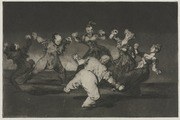
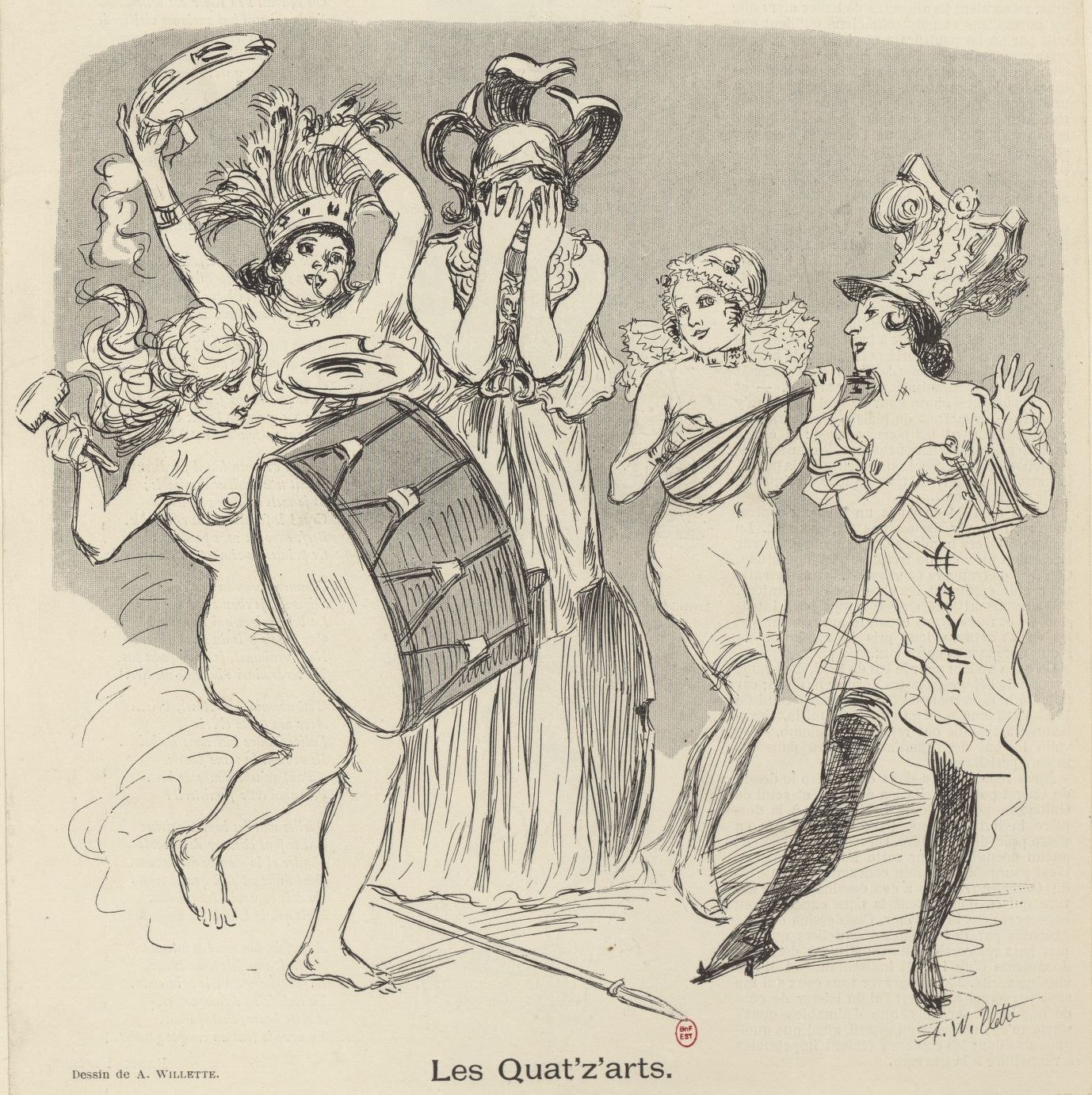
Les Quat'z'arts. Lithographie de Willette
Adolphe Willette
- Medium:
- Lithograph
- Era:
- Mid 1800s (Polka Era)
- Source:
- Wikimedia Commons
- Rights:
- Public domain — free to use, share and adapt.
- Recorded as:
- Public Domain
This lithograph is a primary visual source for understanding bohemian performance culture and student life in fin-de-siècle Paris—a subculture that influenced and was influenced by developments in theater, cabaret, and dance throughout the period. It shows how dance functioned not as a formalized technique but as a mode of social transgression and artistic identity-formation among young artists and performers.
What you are looking at
A lively interior scene populated by figures in various states of undress and theatrical costume, centered on a large bass drum being struck by a nude female figure with raised arms. To the left, a winged cherub-like figure and a partially draped woman hold aloft a plate or platter. To the right, two costumed female figures—one wearing an elaborate feathered hat and classical drapery, the other in striped stockings and a theatrical costume—strike dynamic poses. The setting is crowded and celebratory, with swirling cloud-like forms suggesting an ethereal or Bacchanalian space. The composition is energetic and deliberately chaotic, rendered in ink with expressive linework and areas of cross-hatching that create volume and shadow. The tone is satirical and erotic, typical of French fin-de-siècle illustration.
The dancing
The figures display exaggerated, disarticulated poses typical of 19th-century caricature and comic illustration. Bodies are elongated and twisted; limbs are splayed with little anatomical restraint. The central drummer has both arms raised overhead in an emphatic downward strike, torso arched. The flanking figures adopt theatrical freeze-frames: one leans backward with legs extended, another stands with weight on one leg and arm extended. There is no ballroom hold or partner connection; each figure occupies its own gestural space, suggesting a pantomime or comedic performance rather than structured social dance.
The dance depicted
This is not a representation of an actual dance technique or social dance form, but rather a satirical scene of revelry and artistic bohemia. The title *Les Quat'z'arts* ('The Four Arts') refers to the École des Beaux-Arts in Paris and its student culture, particularly the anarchic student balls and carnivals that were legendary for excess and transgression. The drum, the nakedness, the theatrical dress, and the absence of decorum point to carnival, masquerade, and burlesque rather than any codified dance genre. The image documents attitude toward performance and the body in late-19th-century avant-garde bohemian circles more than it documents dance practice.
How it was made
This is a lithograph, a process that allowed rapid commercial production and wider distribution than engraving. The artist worked with crayon and ink on stone, creating fluid, gestural lines that could capture movement and caricature with immediacy. Lithography's accessibility and speed made it the preferred medium for satirical prints, theatrical advertisements, and cultural commentary in 19th-century Paris. The technique's warmth and expressiveness suited the subject matter and contributed to the print's popularity among bohemian and student audiences.
About this work
Adolphe Willette's *Les Quat'z'arts* is a satirical lithograph documenting the carnivalesque culture of Parisian art students in the late 19th century. Rather than depicting a recognizable dance form, it captures the visual and behavioral excess of student balls—events that mixed nudity, theatrical costume, music, and transgressive revelry as acts of artistic and social rebellion. The work sits at the intersection of illustration, caricature, and social commentary, and serves as a visual record of bohemian attitudes toward the body, performance, and propriety during a period of intense artistic ferment in Paris.
For dance history, the image is valuable not as documentation of technique but as evidence of how dance, music, and embodied performance functioned within bohemian subculture. The drum, the naked bodies, and the theatrical costumes show dance and performance as tools of transgression and community formation among artists. The work also documents the gender dynamics and eroticism that characterized these spaces—a culture in which female performers and participants occupied highly visible but precarious social positions.
How to look at it
Attend to the composition's crowding and disorder: there is no single focal point or narrative line, but rather a cacophony of simultaneous gestures. This mirrors the chaos and sensory overload of the event itself. Notice how Willette uses nudity and costume together—the contrast between bare flesh and elaborate hats and stockings—to create visual comedy and to suggest the theatrical nature of the performance. The energetic linework and cross-hatching convey movement and spontaneity; the medium's immediacy suits the subject. Look at how each figure gestures outward and upward rather than toward others: the lack of connection or mutual regard reflects the narcissistic and exhibitionist character of such events.
The artist
Adolphe Willette (1848–1927) was a prolific French illustrator, painter, and printmaker known for satirical and erotic works. He was deeply embedded in Parisian bohemian circles and produced illustrations for major newspapers and journals, including the satirical press. His work spanned book illustration, advertising posters, gallery paintings, and prints; he was particularly skilled in capturing caricature, social satire, and the comic potential of contemporary life. Willette's output reflects late-19th-century attitudes toward art, the body, sexuality, and social convention, and his work circulated widely among educated Parisian audiences.
The period
The 1880s–1890s were a period of explosive artistic ferment in Paris. Impressionism, Symbolism, and emerging modernist aesthetics were challenging academic conventions. Simultaneously, bohemian subcultures—including cabaret, café-concerts, and artist-student societies—offered alternative spaces for performance and community. The École des Beaux-Arts was central to this landscape; its students were notorious for lavish, anarchic balls that mixed high art pretension with deliberate transgression. These balls were sites of sexual performance, gender play, and the public display of the body in ways that scandalized bourgeois Paris. Dance, music, theater, and visual performance merged in these spaces. The image also reflects fin-de-siècle anxieties about decadence, femininity, and the corruption of youth by bohemian excess.
Where it lives
The work appears in Wikimedia Commons, a digital repository of public-domain and openly licensed cultural materials. No permanent holding collection is recorded in the catalogue. The lithograph was likely produced for commercial sale or publication and would have circulated among Parisian audiences interested in satire, illustration, and cultural commentary.
Dance in this work
Questions about this work
What were the Quat'z'arts balls?
The Quat'z'arts balls were legendary student celebrations at the École des Beaux-Arts in Paris, held several times a year in the late 19th and early 20th centuries. They were anarchic, transgressive events mixing music, performance, dancing, drinking, and nudity, staged as acts of artistic rebellion against bourgeois propriety. They became iconic sites of bohemian culture and were frequently documented in illustrations and memoirs.
Is this about a specific dance style?
No. The image documents bohemian revelry and theatrical performance rather than a codified dance form. While music and movement are clearly present, the artist's focus is on satire, excess, and transgression rather than on technique or choreography. The scene is closer to cabaret, pantomime, and carnival than to ballet or social dance.
Why are the figures so distorted and exaggerated?
Willette uses caricature and exaggeration as tools of satire and social commentary. The elongated limbs, twisted poses, and chaotic composition mock the excesses and pretensions of bohemian culture while also celebrating its energy and transgression. The distortion is not naturalistic but intentionally comic and critical.
More dance artwork