34 works in this view — arrow keys or swipe to move between them.
Dance in Art · 1930
Xavier Sager Moulin Rouge Grand Chahut
Xavier Sager
- Medium:
- Oil Painting
- Era:
- 1920-1950 (Swing Era)
- Source:
- Wikimedia Commons
- Rights:
- Public domain — free to use, share and adapt.
- Recorded as:
- Public Domain
The Grand Chahut and Moulin Rouge are foundational to modern dance history and to the cultural history of Paris. This image is among the most recognizable visual documents of early 20th-century popular dance and testifies to the global reach of Parisian performance culture. For dancers and historians, it provides concrete evidence of the aesthetic ideals of the form—the height of the kick, the straightness of the leg, the participation of men as aerial acrobats, the visual grammar of synchronized chaos—at a moment when the dance was at peak international visibility and influence. The work also demonstrates how dance imagery functioned as commercial art and mass media in the pre-photographic era.
What you are looking at
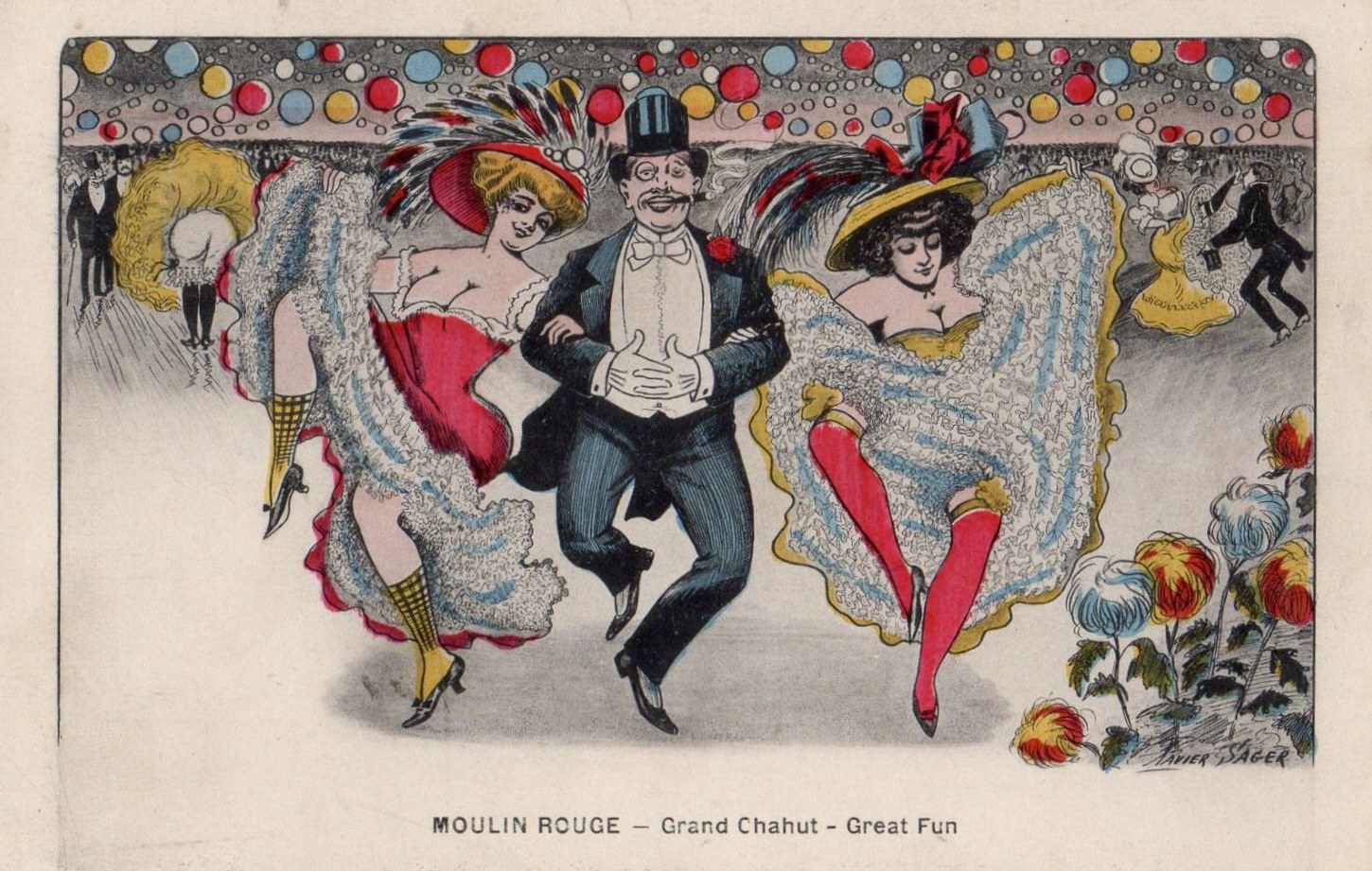
A jubilant music-hall scene set at the Moulin Rouge, rendered in the chromolithographic style of early 20th-century entertainment advertising. At center, a man in full evening dress—top hat, tailcoat, and white shirt front—executes a high-spirited leap or jump, his body suspended with legs extended and arms spread in uninhibited exuberance. He is flanked by two women in elaborate period costume: one to the left wears a shocking-pink strapless dress with a red and gold feathered headdress, her leg extended in a high kick; the other to the right mirrors this pose in an identical silhouette but with different coloring. Both women display the characteristic leg-forward posture and high-kicking extension of the can-can. The background is a softly rendered crowd of formally dressed spectators in black and white, with orchestral musicians visible at the edges. The top of the composition features an art deco border of colored circles—red, gold, blue, and cream—suggesting theater lights or stage decoration. The overall mood is one of exuberant, uninhibited revelry and sexual license that was the Moulin Rouge's international brand.
The dancing
Three dancers occupy the center. The man's pose is one of complete physical abandon—legs kicked high, torso upright, arms outstretched—suggesting the unbridled male energy of cancanteurs who competed with the women for attention. The women execute identical high-kicks from the hips with extended legs, bodies held upright and proud, displaying the characteristic silhouette and technical precision of can-can dancers. Their arms are held to the sides or slightly raised. The composition is symmetrical, with the man as pivot point between the two women, creating a tableau of coordinated exuberance rather than interaction. All three bodies are in full extension and lightness, emphasizing the jump and kick rather than ground contact.
The dance depicted
This is the Grand Chahut (Great Galop or Great Uproar), the signature high-energy finale number of the Moulin Rouge, which emerged in Paris in the 1890s and became the defining image of Parisian café-concert culture through the 1920s and 1930s. The can-can itself was already several decades old by this date, having originated in the 1840s as a saloon dance, but the Moulin Rouge (opened 1889) made it world-famous through the work of performers like La Goulue and Jane Avril. The Grand Chahut specifically refers to the climactic ensemble numbers performed by professional dancers (les Chahuteurs), usually in groups, executing synchronized high kicks and acrobatic leaps in a spirit of calculated chaos and physical display. Men participated in these numbers, adding their own aerial maneuvers to the spectacle. The image captures the essential grammar of the form: high extension, explosive energy, and the theatrical collision of restraint (the men's formal dress) with release (the jumping and kicking).
How it was made
This is a chromolithograph or hand-colored lithograph, a mass-production printing technique that allowed vibrant, multi-color theatrical imagery to be distributed as postcards, posters, and illustrated supplements. The medium is evident from the characteristic color separation, soft halftoning in the crowd background, and the bold outline drawing of the figures. Chromolithography was the dominant method for advertising and documentary images of live performance in the 1890s–1930s, before photographic reproduction became standard. The technique required skilled stone preparation and color registration but allowed editions of thousands, making the work accessible and reproducible—consistent with the postcard format noted in the source record. The hand-coloring visible in variations of tone suggests this may be hand-finished rather than pure mechanical color separation, a common practice for higher-quality editions.
About this work
This is a chromolithographic postcard or poster celebrating the Grand Chahut, the flagship attraction of the Moulin Rouge in Paris. Painted or drawn by Xavier Sager, a prolific illustrator of French entertainment and nightlife in the early 20th century, it captures the public face of one of the era's most famous and most exported dance forms. The can-can itself was controversial—condemned by moral reformers, celebrated by artists and intellectuals, and consumed as high fashion by middle-class tourists and bohemians—and the Moulin Rouge's version, with its professionalism, stage lighting, and strict choreography, had become a global brand by 1930. This work serves as documentary evidence of how the dance looked, how it was framed for commercial consumption, and what values—energy, spectacle, sexual display, transgression, joy—it was sold to represent. The postcard format suggests it was distributed to audiences and tourists as a souvenir, a way of taking home the experience of Parisian nightlife.
How to look at it
Attend to the frozen moment of the jump—the man's suspension in air with extended legs, the women's high kicks at their peak extension. This is not a moment of contact or partnering but of individual display and synchronized spectacle. The formal dress of the man (top hat, tailcoat) against the semi-nude display of the women's bodies sets up the era's sexual politics of the gaze. The composition—three figures centered and equidistant—mimics theatrical staging and the proscenium view. The crowd in the background is rendered soft and indistinct, focusing all attention on the three performers. The color palette is deliberately artificial and bright, signaling theater and spectacle rather than realism. Notice how the artist has chosen the moment of maximum extension and uplift, not the moment of descent or any transition—this is performance frozen at its most flattering and energetic.
The artist
Xavier Sager (1859–1927) was a prolific French illustrator and printmaker specializing in theater, cabaret, and entertainment subjects. He worked extensively for the Moulin Rouge and other Parisian nightclubs and music halls, producing posters, postcards, and magazine illustrations that documented and promoted the performers and shows. His style was well-suited to chromolithography—bold outlines, bright colors, clear composition—and his work circulated widely as postcards and theatrical ephemera. Sager was part of a generation of illustrators (alongside Toulouse-Lautrec, Jane Avril, and others) who made Parisian nightlife visually synonymous with modernity and transgression in the eyes of the international public. His work is less artistically celebrated than Toulouse-Lautrec's but far more prolific and widely distributed, making it a more accurate record of how the Moulin Rouge brand was actually consumed.
The period
The Moulin Rouge opened in 1889 as a new type of venue: the café-concert or music hall combined with dance theater. The can-can had existed since the 1840s but was controversial and lower-class; the Moulin Rouge professionalized and sanitized it while keeping its transgressive energy, turning it into a respectable spectacle for tourists and the wealthy. By the 1920s, the can-can was a global brand; the Moulin Rouge brand was licensed, imitated, and exported worldwide. In visual art, the 1920s–1930s were the height of chromolithographic theater and cabaret imagery; photography was increasingly available but colored lithography remained the preferred medium for commercial entertainment imagery because it allowed stylization and idealization. The work dates to 1930, the late flowering of this technology and aesthetic before photographic reproduction and cinema marginalized illustrated theatrical prints.
Where it lives
The work is recorded as a chromolithographic postcard (carte postale) by Xavier Sager, sourced from Wikimedia Commons, with no institution or collection identified. Postcards of this type were mass-produced and distributed to thousands of tourists and collectors; individual examples are widely held in museum collections of French theater ephemera and popular prints but are rarely catalogued individually or preserved as unique objects.
Dance in this work
Questions about this work
What is the Grand Chahut?
The Grand Chahut (Great Uproar) was the signature finale spectacle of the Moulin Rouge, a high-energy ensemble dance number performed by professional dancers (les Chahuteurs) executing synchronized high kicks, splits, and aerial leaps. It was the most famous dance number in Paris in the 1890s–1930s and became synonymous with Parisian nightlife and modernity.
Was the can-can respectable?
The can-can originated in the 1840s as a lower-class saloon dance and was condemned by moral reformers throughout the 19th century. The Moulin Rouge (opened 1889) professionalized it by staging it with trained dancers, theatrical presentation, and strict choreography, transforming it into an entertainment form that wealthy tourists and bohemians could consume without social shame. It remained transgressive—women dancing in minimal costume, high kicks exposing legs—but was now marketed as art and spectacle.
Who were the famous Moulin Rouge dancers?
La Goulue (Louise Weber) and Jane Avril were the most famous dancers of the Moulin Rouge's early years (1890s). Both were immortalized by Toulouse-Lautrec. By 1930, the Moulin Rouge had become an institution with rotating professional ensembles rather than being associated with individual stars, though the venue remained the most prestigious stage for can-can dancers.
Why is this image mass-produced as a postcard?
Postcards were the primary way theatrical venues marketed themselves and sold souvenirs to audiences and tourists. This postcard functioned as advertisement, souvenir, and collectible. Mass-produced chromolithographic cards were cheap to produce and mail, making them an effective tool for building and maintaining the Moulin Rouge's international brand.
More dance artwork