33 works in this view — arrow keys or swipe to move between them.
Dance in Art · 1930
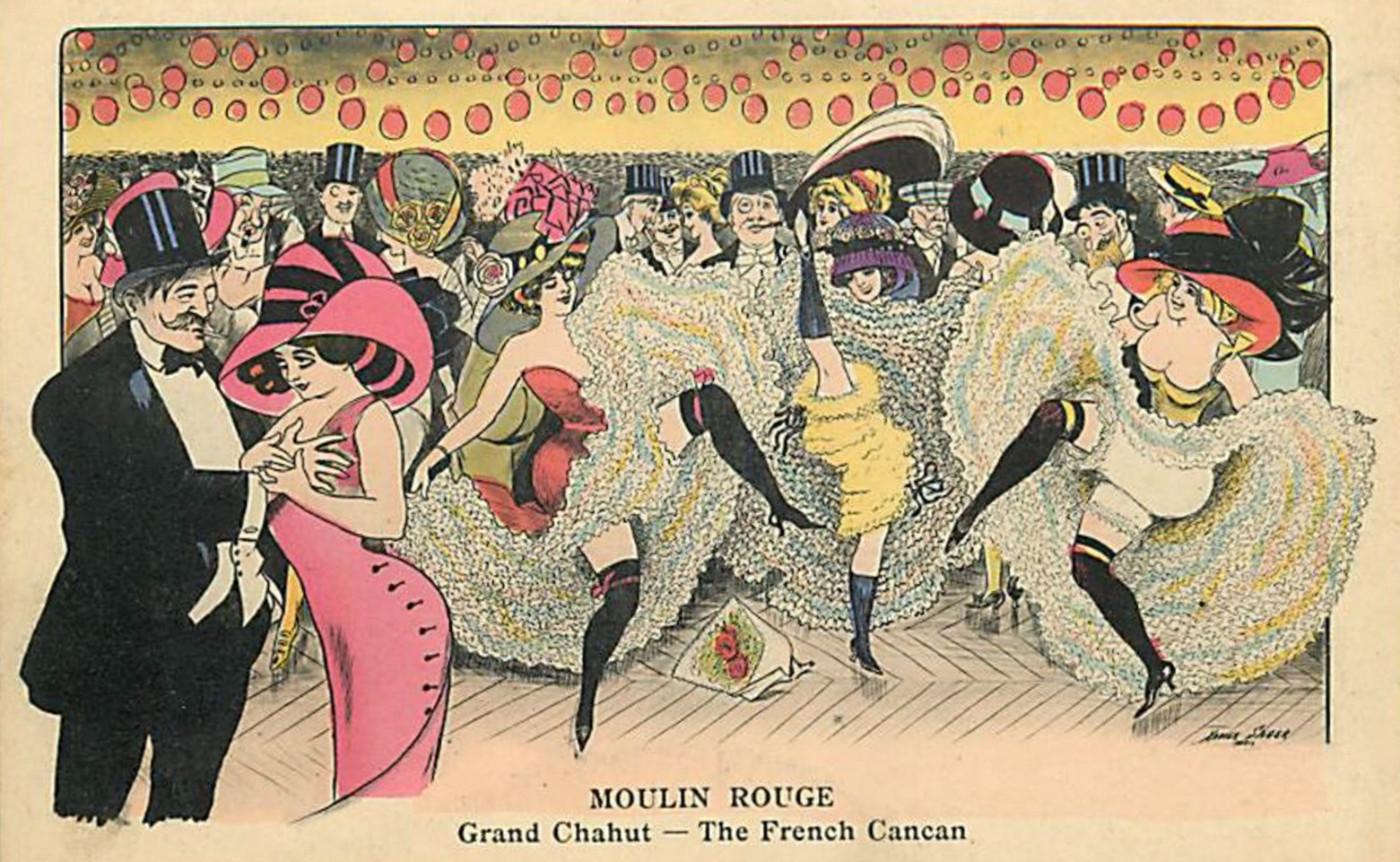
Xavier Sager Moulin Rouge Grand Chahut 2
Xavier Sager
- Medium:
- Oil Painting
- Era:
- 1920-1950 (Swing Era)
- Source:
- Wikimedia Commons
- Rights:
- Public domain — free to use, share and adapt.
- Recorded as:
- Public Domain
The chahut was the first fully professionalized, female-centered social dance form to become mass entertainment, and it did so through transgression: it was controversial partly because it worked. For historians of popular dance, commercial culture, and the gendered body in modernity, this image documents not a historical oddity but a template that persists. Sager's work also shows how dance imagery circulated in the early 20th century—as affordable, reproducible postcards for tourists and enthusiasts, making the ephemeral spectacle portable and collectible.
What you are looking at
A crowded cabaret scene bursts with energy across a wooden stage floor. Dozens of elegantly dressed patrons in evening wear—top hats, feathered bonnets, and formal jackets—crowd around a group of dancers in elaborate costumes. The dancers wear shimmering, densely patterned dresses with voluminous skirts in cream and gold tones, their legs clad in black stockings. The composition is deliberately compressed, with figures overlapping from foreground to background, creating a sense of exuberant chaos. Soft golden light fills the upper portion of the canvas, dotted with pink circular forms suggesting hanging lanterns or atmospheric effects. The artist has used visible brushwork and stippled textures, particularly in the costumes, giving the scene a vibrant, impressionistic quality. This is unmistakably a Paris music-hall of the Belle Époque or interwar period—the Moulin Rouge implied by the title.
The dancing
The central dancers display the high-kicking, extended leg positions characteristic of the chahut. Their torsos remain relatively upright while legs are thrust forward and upward, often at sharp angles. Arms are raised and extended freely. The poses suggest rapid, vigorous movement rather than balletic control—weight appears momentarily suspended in the kicking action. The surrounding spectators lean in, creating an intimate theatrical frame around the performers. Bodies in the crowd display the relaxed, conversational postures of an audience absorbed in the spectacle.
The dance depicted
This depicts the *Grand Chahut* (or *Quadrille Naturaliste*), the notorious chahut that electrified Parisian cabarets in the 1880s–1890s and remained popular into the 1930s when this work was made. The chahut was a high-energy, high-kicking social dance performed for entertainment in music halls, famous for the dancers' provocative leg extensions and the minimal undergarments they wore—a scandal that fascinated respectable audiences. The pose with legs kicked high toward the viewer while the body remained frontal was the signature move. This was not ballet or concert dance but commercial entertainment, performed by professional dancers in cabaret settings for paying audiences of bourgeois and bohemian clientele.
How it was made
The catalogue record identifies this as an oil painting, but the surface and handling suggest this may be a reproduction—possibly a chromolithograph or similar commercial print. The stippled texture, particularly visible in the heavily patterned costumes, the uniform color registration, and the stylized line work are consistent with early 20th-century color printing technology. The soft outlines and the way areas of color sit against one another indicate a medium suited to mass reproduction. This would position it as a postcard or print for popular consumption rather than a unique fine-art object, which aligns with its circulation as a *carte postale* (postcard).
About this work
This is a vivid document of the Moulin Rouge's signature spectacle in the interwar period, depicting the high-kicking chahut that had scandalized and enchanted Paris for half a century. The Grand Chahut was the product of Second Empire and Belle Époque permissiveness—a dance of flagrant display by female performers, rooted in working-class and bohemian social dancing but now professionalized and commodified as cabaret entertainment. Xavier Sager's energetic composition captures not just the dancers but the social fantasy of the music hall: an intimate proximity between performer and patron, a visual feast of movement and costume, and the collision of respectability and transgression that defined the modern cabaret. The work belongs in a dance gallery because the chahut was one of the defining dances of modern entertainment, a form that shaped everything from early cinema to fashion to the social experience of modernity itself.
How to look at it
Attend first to the legs: the repeated forward kicks at impossible heights, the way the extended leg lines dominate the composition even though the dancers occupy only part of the canvas. This high-kicking was the chahut's visual signature and what made it recognizable across time and reproductions. Notice also the artist's framing: we are not distant, watching from an orchestra pit, but crowded into the room, surrounded by spectators whose backs and profiles frame our view. This perspective—intimate, caught in the crowd—is exactly the experience of a cabaret patron. The overlapping figures, the cropped heads, the visual compression are all intentional; they create the sense of spectacle-as-social-event rather than spectacle-as-performance-on-a-stage.
The artist
Xavier Sager (1874–1950) was a French illustrator and painter specializing in scenes of Parisian nightlife, cabarets, and social entertainment. He was particularly known for his depictions of the Moulin Rouge and other music halls during the Belle Époque and interwar periods. His style blended Post-Impressionist color and composition with the reportorial clarity of commercial illustration, making him popular with both fine-art and mass-market audiences. Sager's work often appeared as postcards and prints, positioning him as a documenter and romantic interpreter of Paris's nightlife for both local and tourist consumption.
The period
By 1930, when this work was made, the chahut and the Moulin Rouge were already historical institutions—they had survived the First World War and had become emblematic of a Belle Époque that many now viewed with nostalgia. The chahut itself had originated in the 1880s as an exuberant variant of the can-can, performed by women in cabarets and music halls. It reached its peak of notoriety in the 1890s when paintings by Toulouse-Lautrec, Renoir, and others had already made it a subject of high art. By the interwar period, the dance had become somewhat domesticated—still risqué, but familiar, a tourist attraction and a symbol of 'gay Paris.' In visual culture, the chahut's representation had shifted from scandal to nostalgia; Sager's postcard captures this moment when the dance was simultaneously alive as entertainment and already being collected and commemorated as an icon of Parisian modernity.
Where it lives
The work is recorded as a Wikimedia Commons source, indicating it is held in a public collection or has been released into open access. The original notation identifies it as a *carte postale* (postcard) by Xavier Sager, suggesting it was produced and distributed as a mass-market entertainment souvenir rather than acquired by a formal art institution. This status as a postcard is significant: it reflects how dance imagery circulated, was consumed, and was treasured in the early 20th century.
Dance in this work
Questions about this work
What is the chahut and why is it important?
The chahut was a high-kicking social dance that became the signature spectacle of Parisian music halls, especially the Moulin Rouge, from the 1880s onward. It was notorious for its scandalous leg extensions and the bare legs of female performers—a provocation that simultaneously thrilled and horrified respectable society. The chahut was one of the first dances to emerge from working-class and bohemian street culture and become professionalized as commercial mass entertainment, making it a template for modern popular dance and a marker of Parisian modernity.
Is this the can-can?
The chahut is related to the can-can but is distinct. The can-can was an earlier, somewhat more restrained social dance; the chahut evolved from it and was notably more vigorous and provocative. The chahut's high-kicking style and performance context in cabarets made it more associated with professional entertainment. In common speech, the terms are sometimes conflated, but dancers and historians of the period distinguished them.
Who danced the chahut?
Professional female dancers performed the chahut in cabarets and music halls, particularly the Moulin Rouge. They were not classical-ballet-trained; they were entertainment professionals, often drawn from working-class backgrounds. The chahut was not a participatory social dance in this context but a performance, watched by paying audiences of mixed social classes—bourgeois spectators, bohemians, tourists, and locals all crowded into cabaret rooms to see it.
Why did Xavier Sager paint this as a postcard?
Postcards were the primary medium for circulating images of Parisian entertainment in the early 20th century. They were affordable, portable, and highly collectible, allowing tourists and enthusiasts to take home memories of the spectacles they saw. Sager's decision to work in this format reflects both the commercial viability of dance imagery and the way modern popular culture operated—through reproducible, mass-distributed images rather than unique artworks.
More dance artwork