41 works in this view — arrow keys or swipe to move between them.
Dance in Art
Comic Character — Plate 22
Gregorio Lambranzi
- Medium:
- Copper-plate engraving
- Dance:
- Notation/Choreography
- Era:
- 1700s (Enlightenment/Minuet Era)
- Collection:
- Nuova e curiosa scuola de' balli theatrali (1716)
- Source:
- Library of Congress
- Rights:
- Public domain — free to use, share and adapt.
- Recorded as:
- Public Domain
This plate is crucial evidence of how early 18th-century theatrical dance was notated, taught, and imagined. It shows that before classical ballet's codification, theatrical movement was already highly systematized and capable of expressing character, emotion, and narrative through carefully designed poses and costumes—and that this knowledge was captured in print and distributed as instructional material. The integration of music, image, and text in a single plate demonstrates how choreography was understood as an inseparable union of sound and movement.
What you are looking at
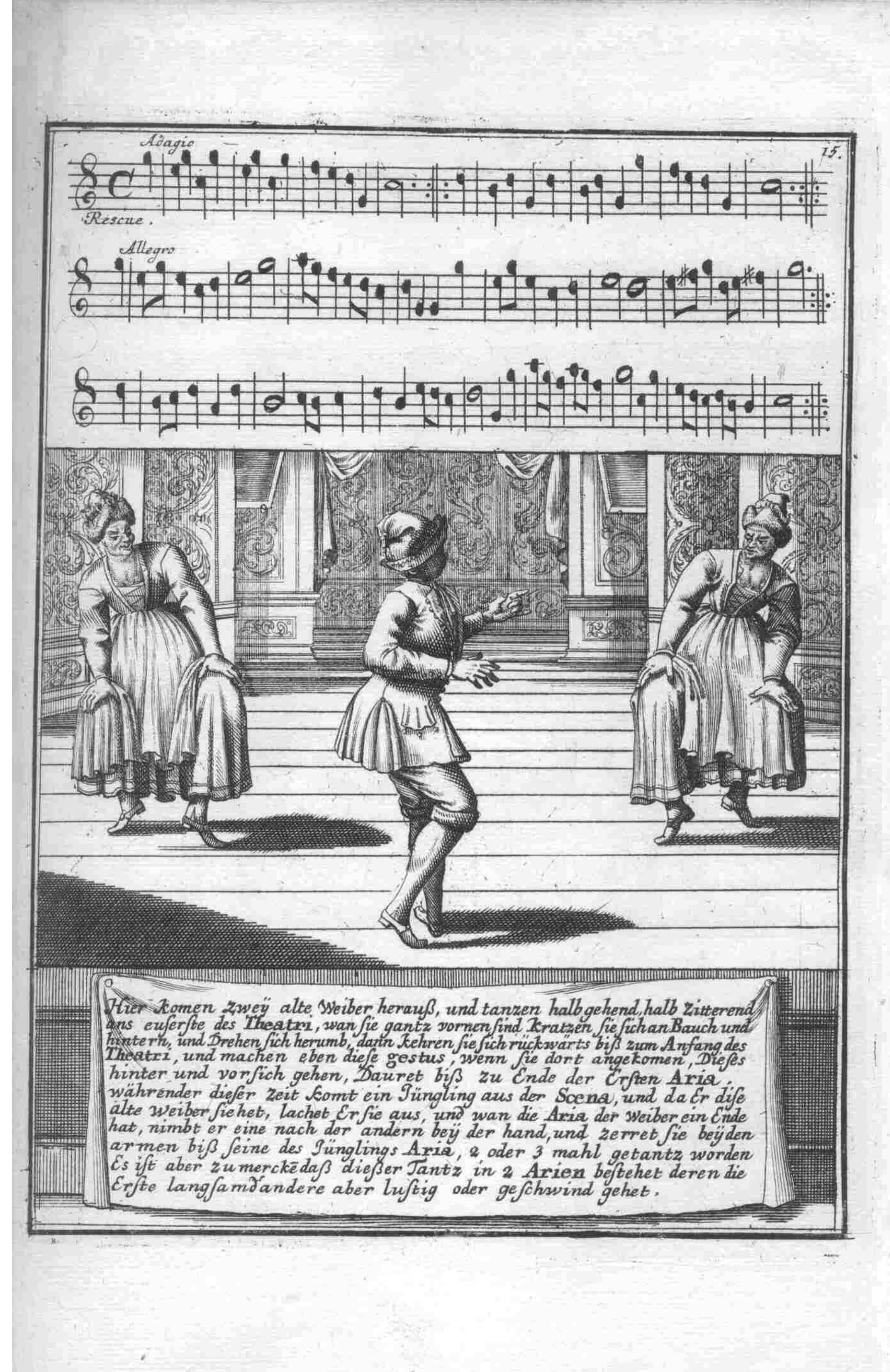
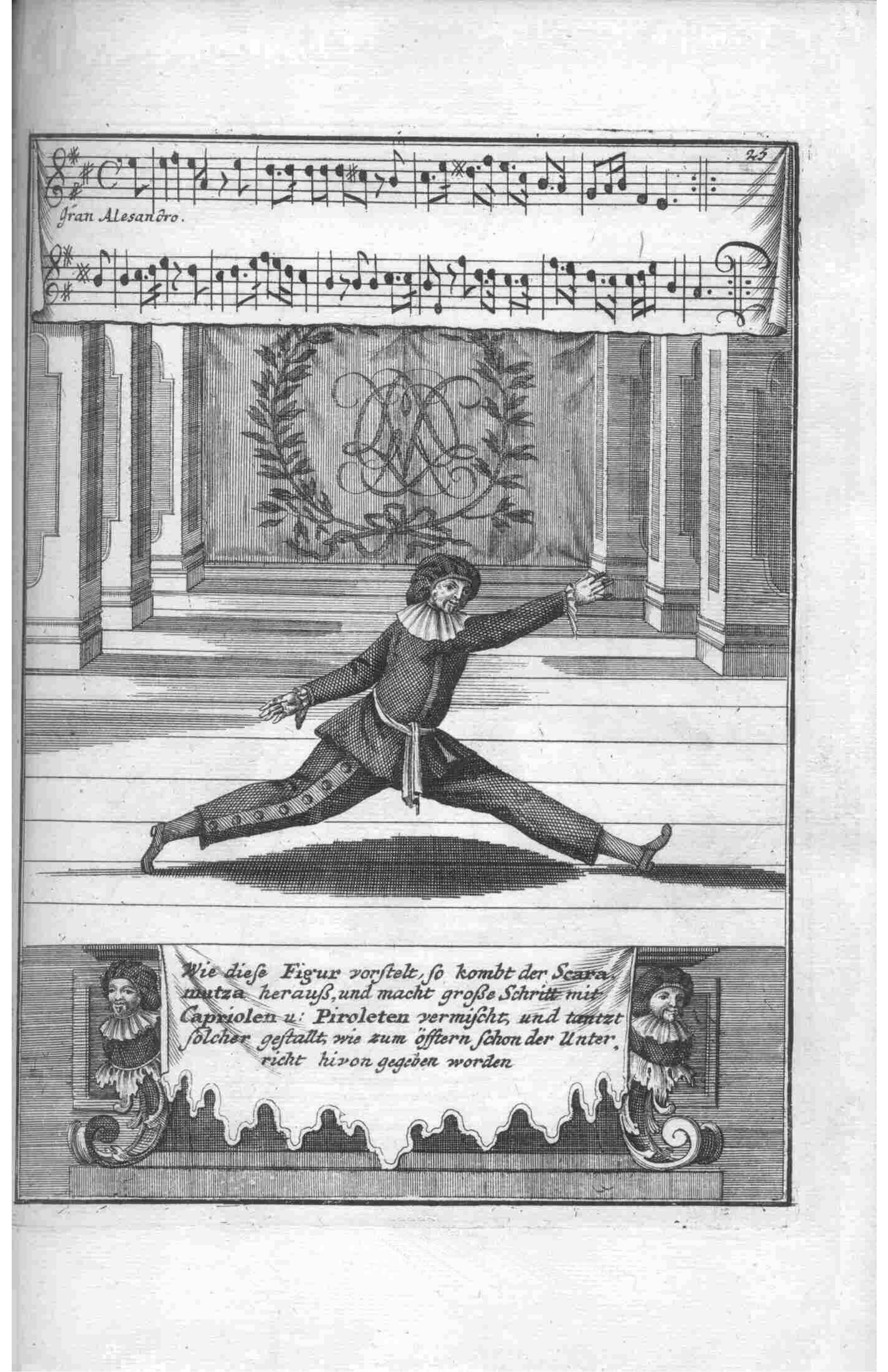
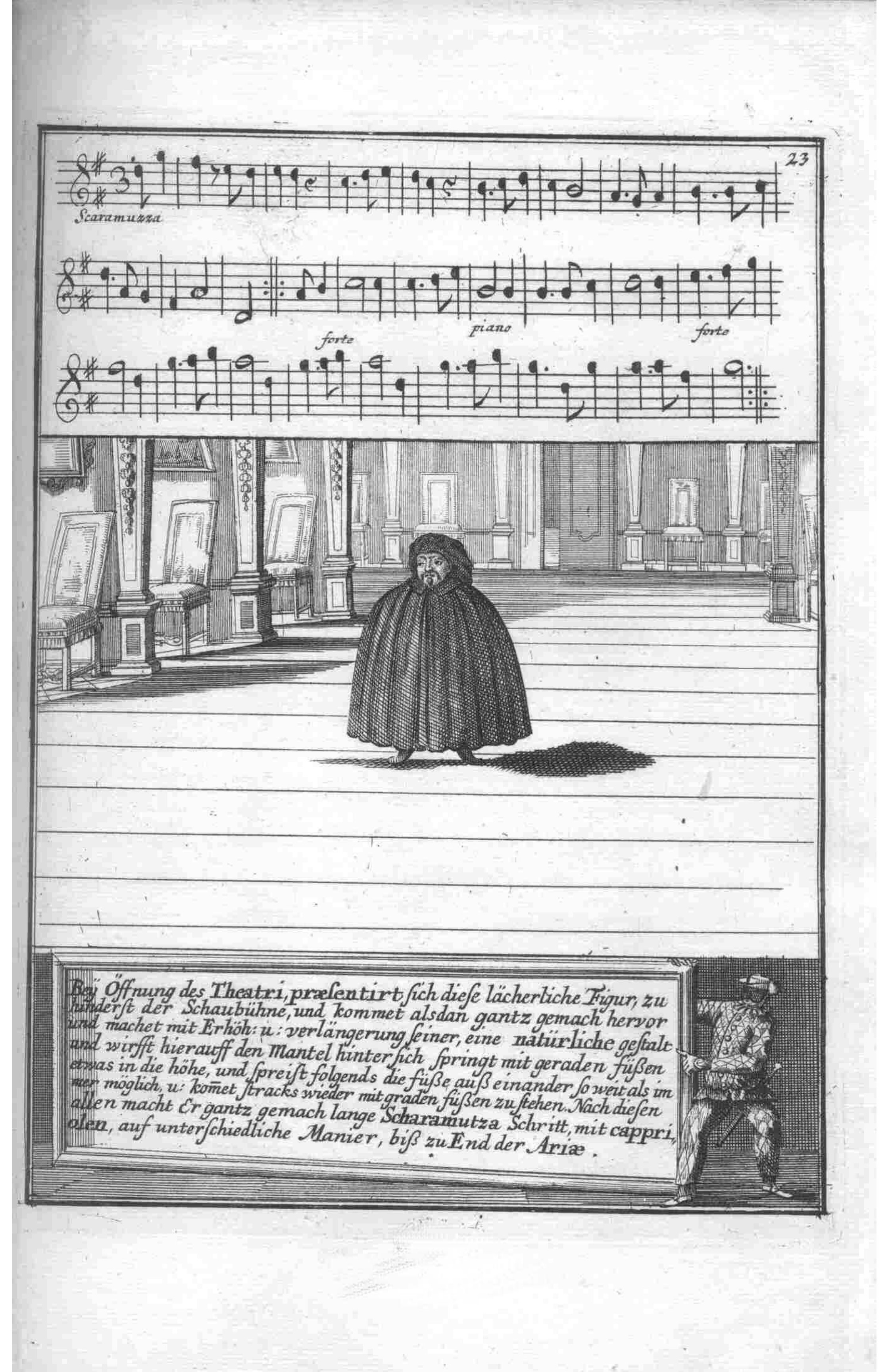
A solitary figure stands center stage in an ornate interior space defined by classical columns, arched doorways, and symmetrical architectural details rendered in fine engraved lines. The performer wears a voluminous dark cloak or cape that falls heavily to the ground, creating dramatic vertical folds and concealing the body beneath. The head is covered or hooded, the face turned slightly downward. The figure's posture suggests introspection or melancholy—the weight of the body settling into the hips, the shoulders rounded. The stage floor is rendered as a receding checkerboard, emphasizing depth and the solitary isolation of this costumed performer within the formal architectural frame. Above the scene, three staves of notated music accompany the image, indicating a specific musical piece composed to correspond with this choreographed figure. The German inscription below identifies this as a character from theatrical practice.
The dancing
The dancer stands with weight settled into a contrapposto stance, one hip slightly advanced, the torso tilted forward in a gesture of resignation or sorrow. The arms are not visible—absorbed into the heavy draping of the cloak. The covered head and hunched shoulders create a silhouette of inward-turning melancholy. There is no partner; this is a solo figure of character or pantomime, not a courtship dance or social form. The stillness of the pose is deliberate and expressive rather than dynamic.
The dance depicted
This appears to be a theatrical character dance or pantomime figure from the early 18th-century ballroom-theatrical tradition documented in Lambranzi's manual. The heavy cloak, hooded or covered head, and downturned posture suggest a personification of an emotional or allegorical type—possibly grief, penitence, or melancholy—rather than a named social dance. The figure is designed for theatrical spectacle on a raised stage within a dramatic architectural setting. Such solo character turns were integral to the theatrical dances that elaborated on the foundations of courtly minuet and baroque court choreography, performed in intermezzos, ballets de cour, and early operatic scenes.
How it was made
This is a copper-plate engraving, a medium that permitted fine detail, reproducible distribution, and precise alignment of text, music, and image. The technique allowed Lambranzi to publish choreographic instruction in a single integrated object: each plate pairs a musical score with a visual demonstration of the figure performing to that music, accompanied by explanatory German verse. Engraving on copper was the dominant medium for instructional and technical imagery in this period, allowing multiple impressions to be struck from a single plate and distributed across Europe. The precision of the medium made it suitable for both aesthetic display and practical reference.
About this work
This is Plate 22 from Gregorio Lambranzi's *Nuova e curiosa scuola de' balli theatrali* (Nuremberg, 1716), one of the most influential instructional manuals for theatrical dance of the early 18th century. The plate demonstrates a solo character figure—a theatrical type rather than a social dance—in which a cloaked, hooded performer embodies an emotional state through posture and costume. The figure is notated musically above and explained in German verse below, making it a complete choreographic document: text, image, and score together show how a specific moment of theatrical character should be danced, dressed, and timed.
Lambranzi's manual was designed for dancing masters and theatrical practitioners across the German-speaking lands and beyond. Each plate isolates a single figure or brief phrase, allowing instructors to teach and performers to learn choreography by reference to both written description and visual demonstration. The theatrical character dances in this collection represent the sophisticated elaboration of baroque courtly movement into dramatic and pantomimic forms suitable for stage performance.
How to look at it
Attend to the posture and the relationship between the body and the garment. The cloak is not merely a costume; it is part of the movement vocabulary—its weight and volume become part of the expression. Notice the slight forward tilt of the torso, the settled weight, the downturned head: these are minute adjustments of the body that communicate melancholy or resignation. The music notation above tells you this is not an improvisation or a generic pose; it is tied to a specific phrase of music. The formal architectural setting is not background; it frames the figure and gives the performance a stage and a scale. This is a moment of stillness within movement—a held pose that a dancer would arrive at through a preceding phrase and depart from into the next, all synchronized with the music above.
The artist
Gregorio Lambranzi (c. 1665–c. 1730) was a Venetian dancing master and choreographer who worked in Nuremberg and the German-speaking territories. His *Nuova e curiosa scuola de' balli theatrali*, published in two volumes (1716, 1728), is one of the few surviving comprehensive collections of theatrical choreography from the early 18th century. The work is illustrated with 110 copper-plate engravings, each pairing a musical staff with a costumed figure in performance. Lambranzi's collection captures a crucial moment in dance history: the period when social dances like the minuet were being formalized and systematized, and when theatrical dance was developing its own vocabulary of character, pantomime, and spectacular costume.
The period
The early 18th century saw the emergence of theatrical dance as a sophisticated art form distinct from court dancing. While the minuet and other courtly forms dominated aristocratic social practice, theatrical dance on stages in courts and public venues was becoming more elaborate, narrative-driven, and consciously designed to express character and emotion. Lambranzi's manual documents this theatrical elaboration: his figures are costumed, placed on formal stages, and designed to embody specific characters or emotional states. The engraved instructional manual itself was a growing genre—a vehicle for disseminating choreographic knowledge beyond the immediate pupils of a single dancing master. Such works were essential to the professionalization and standardization of dance technique across Europe.
Where it lives
This plate is from the complete two-volume *Nuova e curiosa scuola de' balli theatrali*, Lambranzi's printed instructional manual published in Nuremberg in 1716 (with a second volume in 1728). The work survives in multiple copies in institutional collections across Europe and North America, including the Library of Congress. Each plate is numbered and bound as part of the larger pedagogical project.
Dance in this work
Questions about this work
What is the figure wearing and why?
A dark, full cloak that conceals the body and falls heavily to the ground. In early theatrical dance, such garments were not mere costume but functional elements of the choreography: they created visual drama, altered the dancer's silhouette, and shaped how movement could be performed and read from a distance. The hooded or covered head reinforces an emotional effect—inwardness, mystery, or melancholy.
How was Lambranzi's manual used?
As a teaching and reference document. Dancing masters would use the engravings and accompanying musical and textual descriptions to instruct their pupils in both the steps and the theatrical character required for each figure. The manual was also a way for Lambranzi to publish and disseminate his choreographic knowledge across the German-speaking territories and beyond—a form of professional advertisement and knowledge-sharing among the learned dancing-master community.
Is this dance form still performed?
Not in its original theatrical context. However, scholars of early dance and historical choreography have reconstructed dances from Lambranzi's notation as part of the broader revival of baroque and early 18th-century movement. The character dances in his manual are studied as important evidence of pre-classical theatrical movement vocabulary.
What does the music above the figure tell us?
The musical notation indicates the specific piece to which this figure was choreographed. The rhythm, tempo, and character of the music were inseparable from the movement. A dancer performing this plate would count, listen to, or internalize this specific phrase while executing the pose and transitions shown in the engraving.
More Notation/Choreography artwork