44 works in this view — arrow keys or swipe to move between them.
Dance in Art
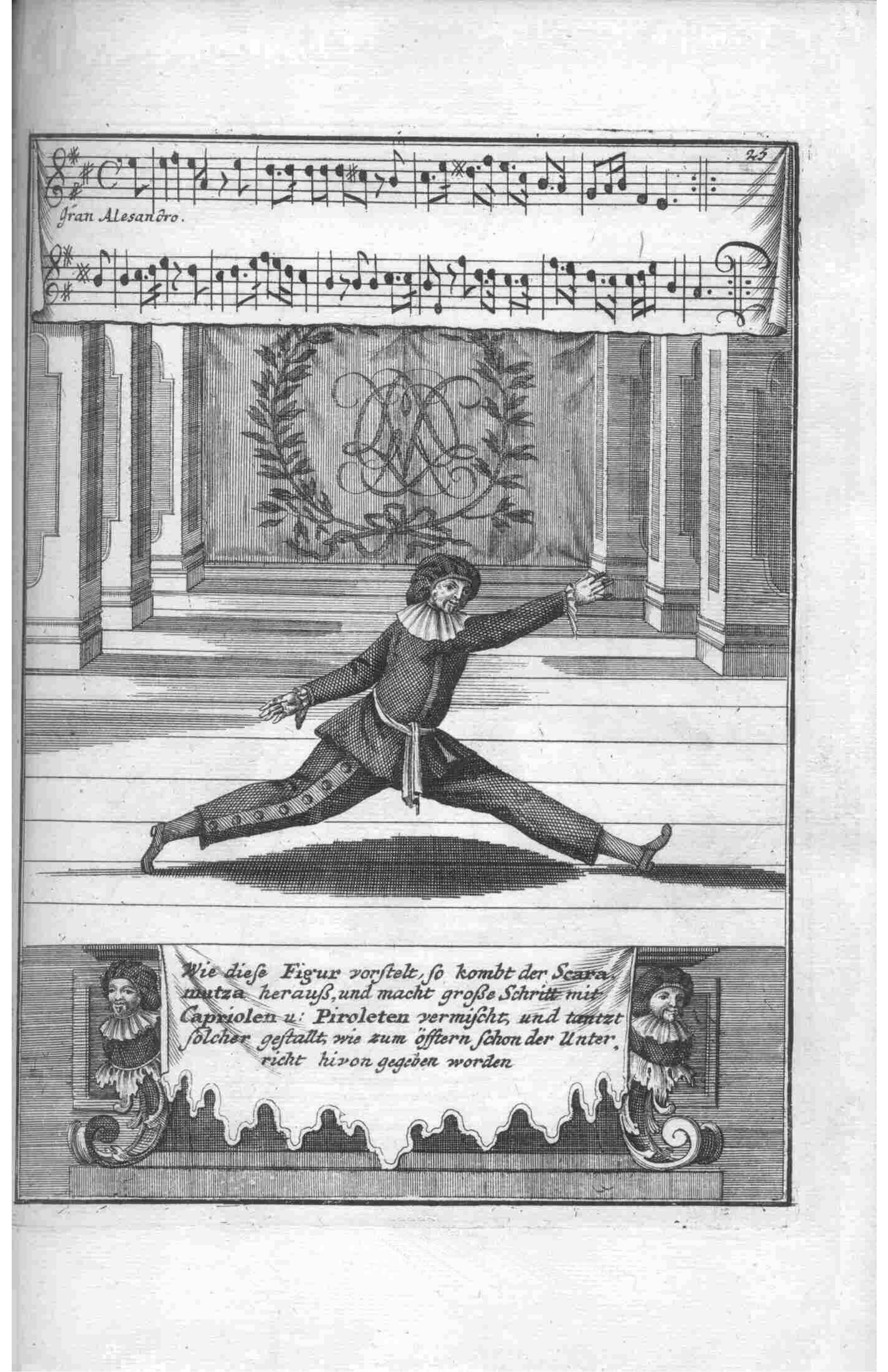
Comic Character — Plate 25
Gregorio Lambranzi
- Medium:
- Copper-plate engraving
- Dance:
- Notation/Choreography
- Era:
- 1700s (Enlightenment/Minuet Era)
- Collection:
- Nuova e curiosa scuola de' balli theatrali (1716)
- Source:
- Library of Congress
- Rights:
- Public domain — free to use, share and adapt.
- Recorded as:
- Public Domain
Lambranzi's manual is one of the earliest illustrated choreographic records and remains one of the most detailed visual documents of Baroque theatrical practice. This plate shows how comic dance and character work were conceptualized and transmitted in a period when dance technique was learned primarily through direct instruction and imitation, not notation. For historians of commedia dell'arte, theatrical dance, and the material culture of dance instruction, this work is essential.
What you are looking at
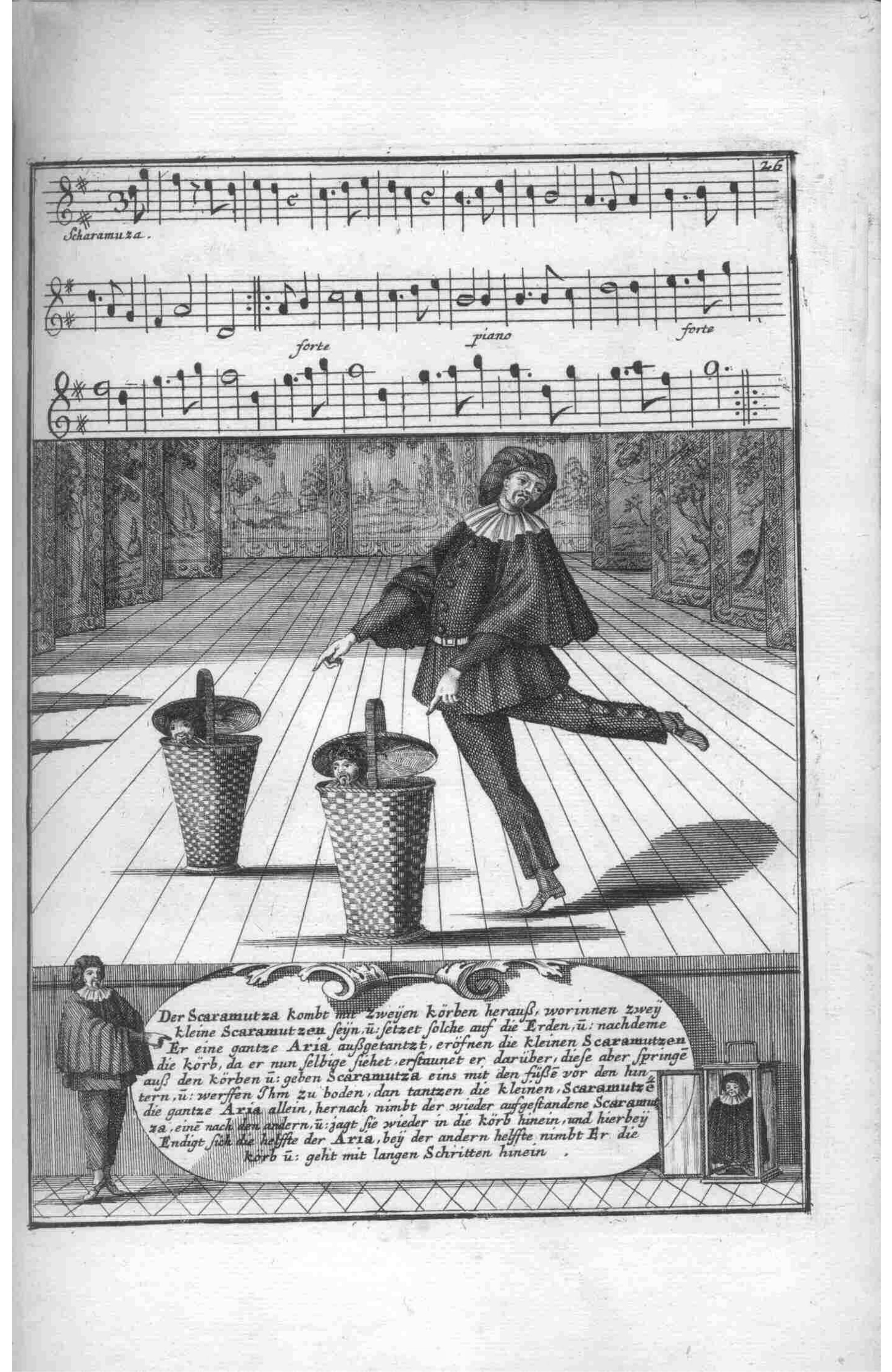
A man in early eighteenth-century theatrical dress stands on a wooden stage before a backdrop of draped curtains and a distant columned interior. He wears a dark quilted doublet with a voluminous cape, a large ruffled collar, and fitted breeches; his legs and feet are bare. He leans forward in an exaggerated pose, one leg extended in a wide stride, his torso twisted, and his arms spread asymmetrically—one bent, the other reaching—in a posture of comic exaggeration. Two woven baskets with handles sit on the stage floor before him, each containing what appears to be a child's head or mask. The figure's expression and posture suggest physical comedy and burlesqued movement rather than serious dance. The engraving is bordered by musical notation at the top—a three-line staff with notes marked 'Scaramutza' and indicating tempo changes ("forte," "piano," "forte")—and German verse text below describing the character and movement.
The dancing
A single male figure occupies the stage, his body twisted into an asymmetrical lunging position that demonstrates neither classical alignment nor the upright carriage of court dance. The extended leg and forward lean suggest comic stumbling or exaggerated striding; the arms are splayed without the formal frame of partner dance. The bare legs and feet are unusual in formal theatrical contexts and suggest either clownish exposure or the practical dress of commedia dell'arte. The entire pose reads as buffoonery rather than skilled technique.
The dance depicted
This plate depicts Scaramouche, a stock comic character from the commedia dell'arte tradition, performing theatrical movement rather than balletic dance. Scaramouche is typically a vainglorious, cowardly servant or soldier character—recognizable here by the theatrical costume and exaggerated posture. The accompanying music and German text suggest this is one scene in a choreographed comic interlude or ballet d'action, a theatrical genre that mixed music, spoken or sung text, and stylized movement to tell stories. The movement shown is gestural and characterful rather than technically demanding, designed for comic effect rather than display of skill.
How it was made
This is a copper-plate engraving, a technique that allowed fine detail and precise reproduction. The linear hatching creates shading and texture; the composition is viewed from slightly above, as if from the audience. Engraving's capacity for reproduction made it the standard medium for theatrical instruction manuals and illustrated librettos in the eighteenth century. This work is part of Lambranzi's *Nuova e curiosa scuola de' balli theatrali* (New and Curious School of Theatrical Dances), suggesting it was meant for circulation among dancers, choreographers, and theater practitioners across Europe—not merely for elite collectors.
About this work
This plate from Gregorio Lambranzi's influential 1716 theatrical dance manual shows a comic character in an exaggerated, twisting pose, one of dozens of choreographic moments documented in this foundational work. The manual pairs musical notation (here marked for a character called Scaramutza) with a detailed visual record of costume, setting, and body position, serving as a kind of choreographic notation before Beaumont-Feuillet notation became standard. The work is invaluable evidence of how comic action and character dance functioned in early eighteenth-century theater, and of how theatrical knowledge was transmitted visually and through the body rather than through verbal description alone.
Lambranzi's manual occupies a unique place: it documents the transition from commedia dell'arte buffoonery to the more formalized ballet techniques of the Baroque court, and it shows both forms side by side. This plate, with its emphasis on grotesque pose and narrative characterization, exemplifies the comic and gestural side of theatrical dance in the period when the minuet and courtly dances dominated the ballroom.
How to look at it
Notice the moment Lambranzi has chosen to freeze: not the apex of a leap or the height of a turn, but a twisted, off-balance lunge that reads as comic and momentary. The asymmetry is deliberate—one leg extended, the other bent; one arm reaching, the other crooked—exactly opposite to the symmetry and balance prized in courtly dance. The costume and setting are meticulously rendered to ground the figure in a real theater space. The musical notation above suggests that the movement was choreographed to music rather than improvised, but the text and baskets (with their puppet heads) indicate that the scene is a narrative or comedic episode, not pure abstraction. Look at how the body breaks the rules of courtly decorum to create character and story.
The artist
Gregorio Lambranzi (c. 1680–after 1740) was a choreographer and dance master active in Nuremberg. His *Nuova e curiosa scuola de' balli theatrali*, published in Nuremberg in 1716 and in French translation in Paris in 1728, was one of the most comprehensive and widely disseminated theatrical dance manuals of the early eighteenth century. The work ran to over 200 plates of choreographic instruction, mixing dances from the courtly tradition (minuets, gavottes, rigaudons) with comic theatrical pieces drawn from commedia dell'arte. Lambranzi's approach was practical and visual: each plate combines notation with an engraved figure or group, showing dancers how a given piece should look in action. Little is known of Lambranzi's own performing career, but his manual suggests he worked as a theater choreographer and teacher in a major commercial theatrical center.
The period
By 1716, the minuet and other stylized court dances dominated elite social dancing in Europe, and a codified Baroque technique—based on turnout, lifted carriage, and precise foot positions—was becoming formalized. But theatrical dance was more heterogeneous: the commercial stage still hosted commedia dell'arte, farce, and pantomime, all of which required gestural and comic movement styles. Lambranzi's manual documents both worlds—the courtly and the comic—at a moment when they were beginning to separate. The work appeared as Feuillet notation (a system for recording dance) was gaining currency, but Lambranzi chose visual and musical notation instead, suggesting that some choreographers and their students still preferred to learn through the image and the ear. The publication was timely: the 1720s and 1730s saw a boom in ballet d'action across Europe, a form that blended music, gesture, narrative, and formalized movement, all of which are visible here.
Where it lives
This plate is from the *Nuova e curiosa scuola de' balli theatrali*, first published in Nuremberg in 1716. The work survives in multiple copies in libraries and collections across Europe and North America. It is one of the foundational sources on early eighteenth-century theatrical dance and was reprinted and translated multiple times in the eighteenth century, indicating its wide influence on teaching and choreographic practice.
Dance in this work
Questions about this work
What is Scaramouche and why is a basket full of heads?
Scaramouche (or Scaramuccia) is a stock character from the commedia dell'arte—usually a cowardly, blustering servant or soldier, often played for laughs. The baskets with heads are likely comic props or masks, part of the theatrical machinery of farce and pantomime. The accompanying text would specify the narrative context. Commedia characters were known for absurdist and bawdy humor, and this image captures the crude comic energy of the form.
How would a dancer of the time learn from this engraving?
The plate combines notation, image, and text as a teaching tool. A student would read the musical staff to hear the piece, study the engraved figure to understand the posture and gesture to adopt, and read the German verse to learn the narrative context or character intention. Dancers learned partly through direct teaching and imitation, and partly through such illustrated manuals. This was a more visual and musical method than later verbal description or abstract notation.
Is this a ballet or a dance?
In modern terms, it would be called a theatrical dance or comic interlude—a short choreographed scene combining movement, music, costume, and narrative. 'Ballet' in the eighteenth century meant a staged theatrical dance production, often multi-act and with music and spoken parts, not necessarily what we would call ballet today. This scene is part of such a work, and it shows the comic and gestural side of theatrical dance, not the formalized technique of the court.
Why are his legs bare?
Bare or exposed legs were unusual and potentially comic in formal theatrical dress of the period. This could indicate either the practical underdress of a practicing dancer, or a deliberate comic or grotesque effect—exposing the body to emphasize the absurdity or low status of the character. Commedia dell'arte and comic farce often breached decorum deliberately.
More Notation/Choreography artwork