46 works in this view — arrow keys or swipe to move between them.
Dance in Art
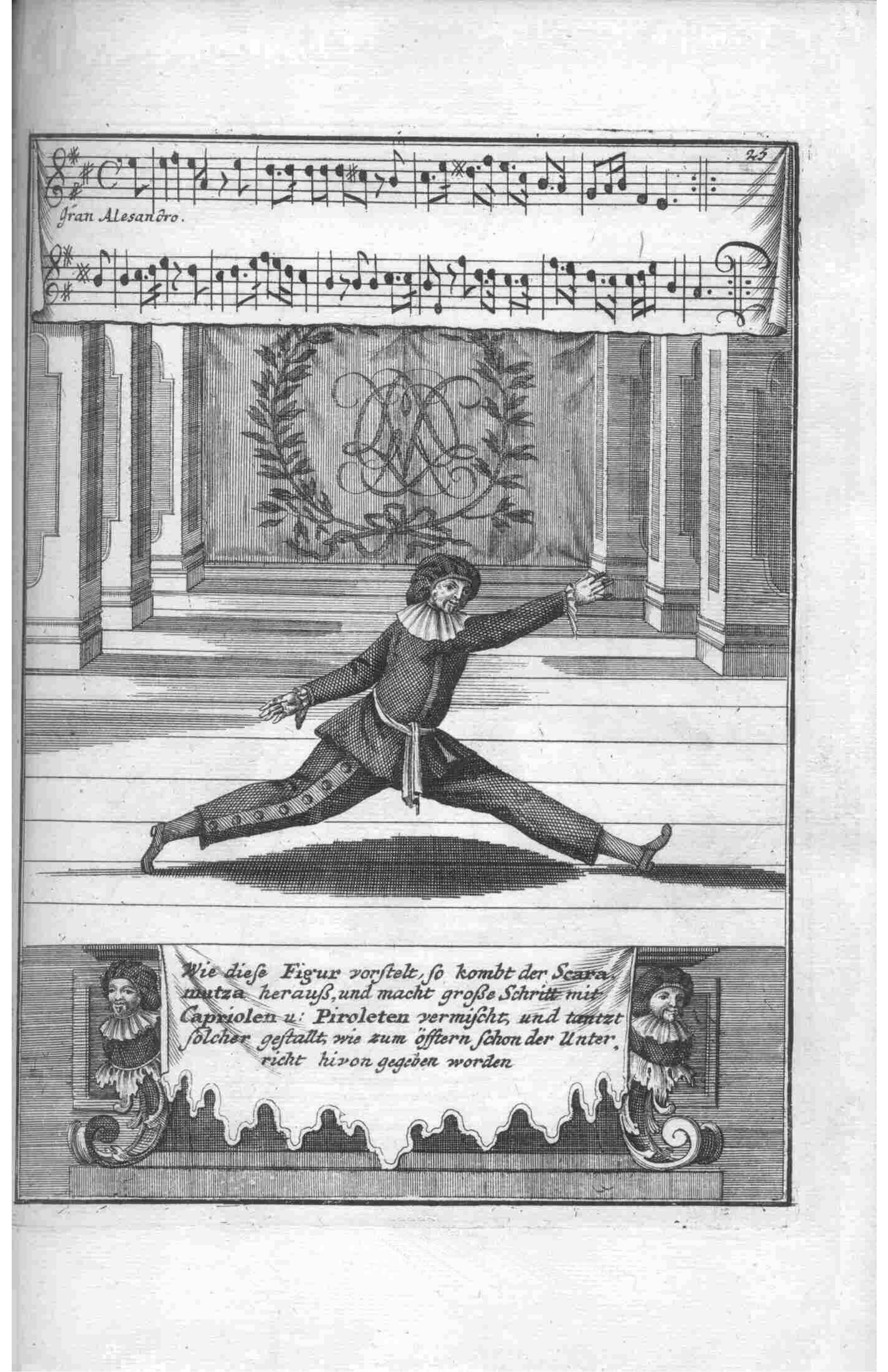
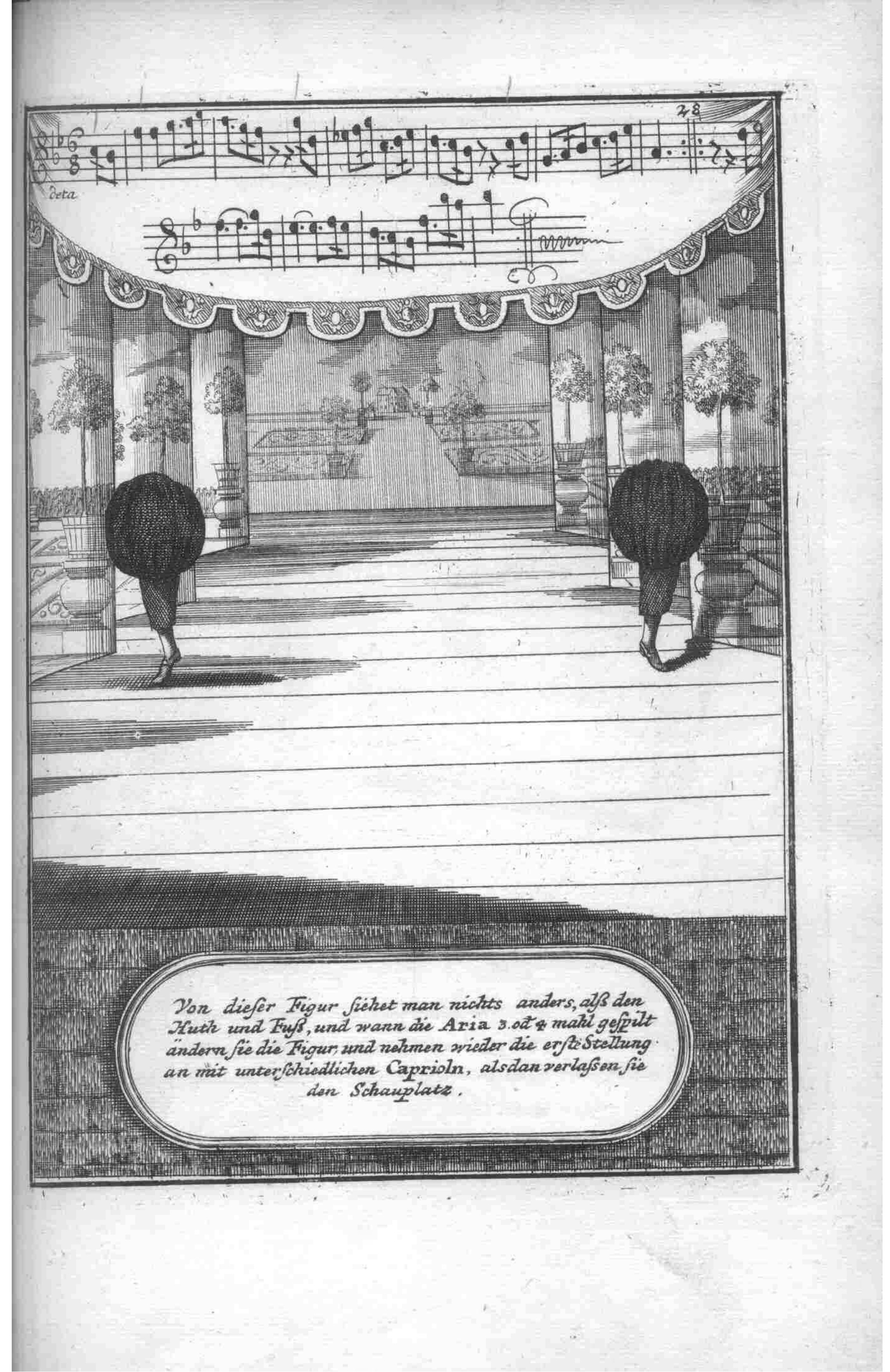
Acrobatic — Plate 27
Gregorio Lambranzi
- Medium:
- Copper-plate engraving
- Dance:
- Notation/Choreography
- Era:
- 1700s (Enlightenment/Minuet Era)
- Collection:
- Nuova e curiosa scuola de' balli theatrali (1716)
- Source:
- Library of Congress
- Rights:
- Public domain — free to use, share and adapt.
- Recorded as:
- Public Domain
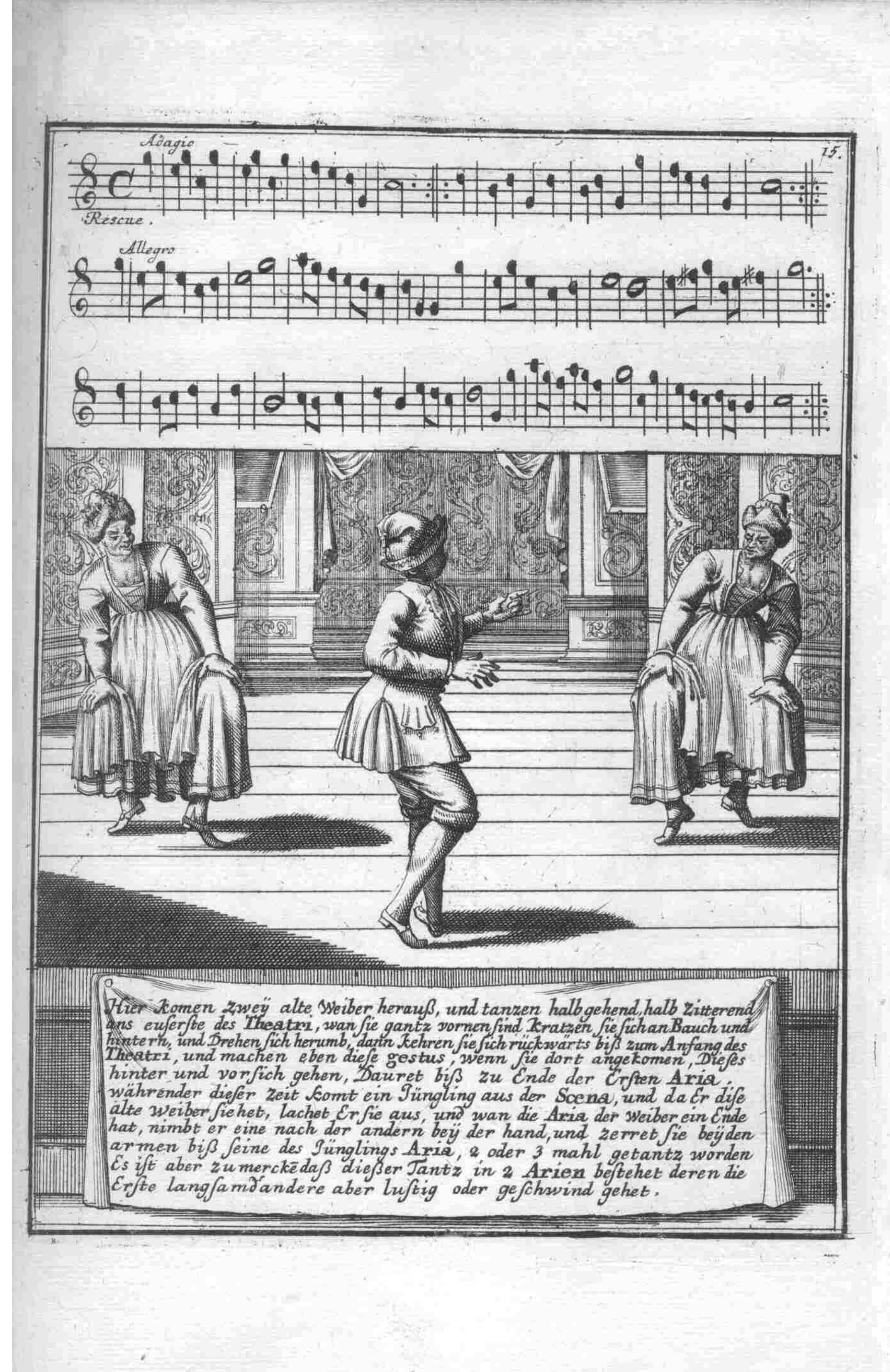
Lambranzi's manual is one of the very few systematic records of how theatrical bodies moved in the early 18th century, and it shows acrobatic skills—tumbling, vaulting, and extreme extensions—were central to stage dance, not marginal to it. This plate in particular demonstrates how symmetry and repetition structured theatrical learning and performance, a principle that shaped dance pedagogy for centuries after.
What you are looking at
A copper-plate engraving presenting a theatrical dance instruction in two register. At the top, two staves of musical notation in treble clef establish the accompaniment. Below, a single male dancer appears twice in symmetrical poses within an ornate proscenium stage. The dancer wears dark breeches and a fitted jacket in the style of early 18th-century theatrical costume. He stands on a wooden stage floor marked by horizontal planks, framed by a decorative scalloped valance overhead and tall topiary trees visible through the open sides. In both poses his arms are raised and extended outward at shoulder height, legs in a stance suggesting either preparation or recovery from a jump. The perspective recedes toward a distant garden or landscape background. Beneath the stage image runs a German verse caption in italic script, explaining the figure's execution and its relationship to basic positions and repetition.
The dancing
A single dancer is shown in bilateral symmetry, appearing twice to demonstrate the movement sequence. Both figures display arms raised to shoulder height and slightly forward, torso erect, legs in a standing position with weight evenly distributed. The body posture suggests the moment just before or after elevation—either the push-off or the landing of a jump or vault. The dancer's frame is formal and composed, with no apparent bending of knees or flexion visible, suggesting a sustained, balletic carriage rather than a gymnastic action. The repetition itself is instructional: the plate teaches the dancer to repeat the figure from alternating sides.
The dance depicted
This is theatrical dance instruction from Lambranzi's seminal 1716 manual of stage dancing. The title 'Acrobatic' and the symmetrical doubling of the figure suggest a trained movement suitable for theatrical performance, likely a precursor to modern acrobatic partnering or tumbling. The raised-arm port de bras and the contained body suggest ballet training, but the designation as acrobatic and the repetitive bilateral structure point toward the spectacular physical vocabularies that entertained courtly and public stages in the early 18th century. The German caption instructs the dancer not merely to hold the pose but to take it up again from the opposite side, embedding pedagogy into the image itself.
How it was made
Copper-plate engraving, a medium that allowed precise, reproducible instruction through line. The technique enabled the manual to be printed in multiple copies and distributed across Europe, making it one of the era's most influential choreographic documents. Engraving's clarity of line—visible in the notation staff, the stage architecture, and the dancer's contours—was essential for a work whose audience was primarily dancers and dance masters seeking to learn and replicate movement. The combination of notation above and figure below was a format Lambranzi refined across the entire manual, a hybrid approach to choreographic literacy.
About this work
This is Plate 27 from Gregorio Lambranzi's *Nuova e curiosa scuola de' balli theatrali* (Nuremberg, 1716), one of the most comprehensive and influential treatises on theatrical dance of the Baroque era. Each plate pairs musical notation with a costumed figure or figures in numbered or symmetrically arranged positions, functioning as both choreographic score and performance guide. The work synthesizes musical and kinetic instruction and was widely copied and adapted across 18th-century Europe, making it foundational to the transmission of theatrical dance practice from the Baroque into the emerging Classical period.
The manual addresses performers, teachers, and dance enthusiasts at all levels, from courtly amateurs to professional stage dancers. It exemplifies a moment when dance was beginning to develop its own written language—neither pure ballet notation nor pure description, but an instructional hybrid suited to the visual and kinetic requirements of the theatrical body.
How to look at it
Attend to the symmetry of the pose: the dancer appears twice, mirrored, a common pedagogical device that tells the reader 'learn this position, then reverse it.' Notice the raised arms and the upright carriage: this is not a grotesque or comic figure, but one trained in formal court movement, yet labeled as acrobatic. The title 'Acrobatic' should prepare you to see athleticism in what looks like balletic posture—Lambranzi's point is that theatrical training in this era required both courtly grace and physical virtuosity, often in the same body and on the same stage.
The artist
Gregorio Lambranzi (also known as Lambranzi di Brescia) was a dancer, choreographer, and dance master active in the Holy Roman Empire in the late 17th and early 18th centuries. He is known almost entirely through this one publication, *Nuova e curiosa scuola de' balli theatrali*, which appeared in two volumes (Nuremberg, 1716). The work was illustrated by the engraver Elias Gottlob Heußler and compiled on the basis of Lambranzi's own practice as a performer and teacher. The manual's authority derived from Lambranzi's reputation as a working stage dancer who documented what he and his peers actually performed, not merely abstract theory. His work was rapidly reprinted, translated, and adapted, and it remains the most detailed surviving account of non-balletic theatrical dance in the Baroque period.
The period
The early 18th century was a moment of rapid systematization in dance. The court ballet tradition was being codified into what would become the basis of modern ballet; simultaneously, commedia dell'arte and popular theatrical forms were incorporating acrobatic and gymnastic skills at an unprecedented scale. Lambranzi's manual captures this multiplicity: the figures range from courtly minuets to tumbling, from grotesque character dances to spectacular feats of athleticism, all presented as equally valid forms of theatrical performance. The engraved manual format itself was relatively new—the ability to reproduce movement notation and figure in printed form democratized dance instruction, shifting it from oral and embodied transmission within patronage networks to something closer to a printed technical literature.
Where it lives
This plate is from Lambranzi's *Nuova e curiosa scuola de' balli theatrali* (Nuremberg: engraved by Elias Gottlob Heußler, 1716), a two-volume manual that is now held in major libraries across Europe and North America. This particular copy or reference is recorded in the Library of Congress.
Dance in this work
Questions about this work
Is this ballet?
Not exactly. It is theatrical dance of the early 18th century, which combined courtly balletic training with acrobatic and gymnastic skills. The raised-arm port de bras and upright posture are balletic, but the title 'Acrobatic' and the symmetric doubling suggest athletic display. For Lambranzi's era, these were not separate categories.
Why does the dancer appear twice?
The repetition is instructional. Lambranzi is showing the reader how to execute the figure from both sides, or in sequence. This bilateral structure was common in early dance notation, where symmetry and reversibility were fundamental to how dancers learned and remembered movement.
What does the German text say?
The caption instructs that the figure should not be held in a single position, but should be taken up again from the opposite side, and that it should be repeated as indicated by the small numbers or notational marks on the figure. It is directing the dancer where to begin and how to count or repeat the phrase.
Who would have used this manual?
Professional and semi-professional stage dancers, dance masters, and educated amateurs in the German-speaking territories and beyond. Copies spread rapidly across Europe, and the manual became a standard reference for theatrical dance practice well into the 18th century.
More Notation/Choreography artwork