49 works in this view — arrow keys or swipe to move between them.
Dance in Art
Solo Dancer — Plate 31
Gregorio Lambranzi
- Medium:
- Copper-plate engraving
- Dance:
- Notation/Choreography
- Era:
- 1700s (Enlightenment/Minuet Era)
- Collection:
- Nuova e curiosa scuola de' balli theatrali (1716)
- Source:
- Library of Congress
- Rights:
- Public domain — free to use, share and adapt.
- Recorded as:
- Public Domain
Lambranzi's plates are among the only visual records we possess of how baroque theatrical dance actually looked in motion and costume. The work is foundational to the study of early modern dance history and offers direct evidence of the character types, gestures, and technical ideals that shaped European theatre dance for a century. For dancers and choreographers today, it provides a grammar of baroque movement that remains influential in period-informed and historical reconstruction work.
What you are looking at
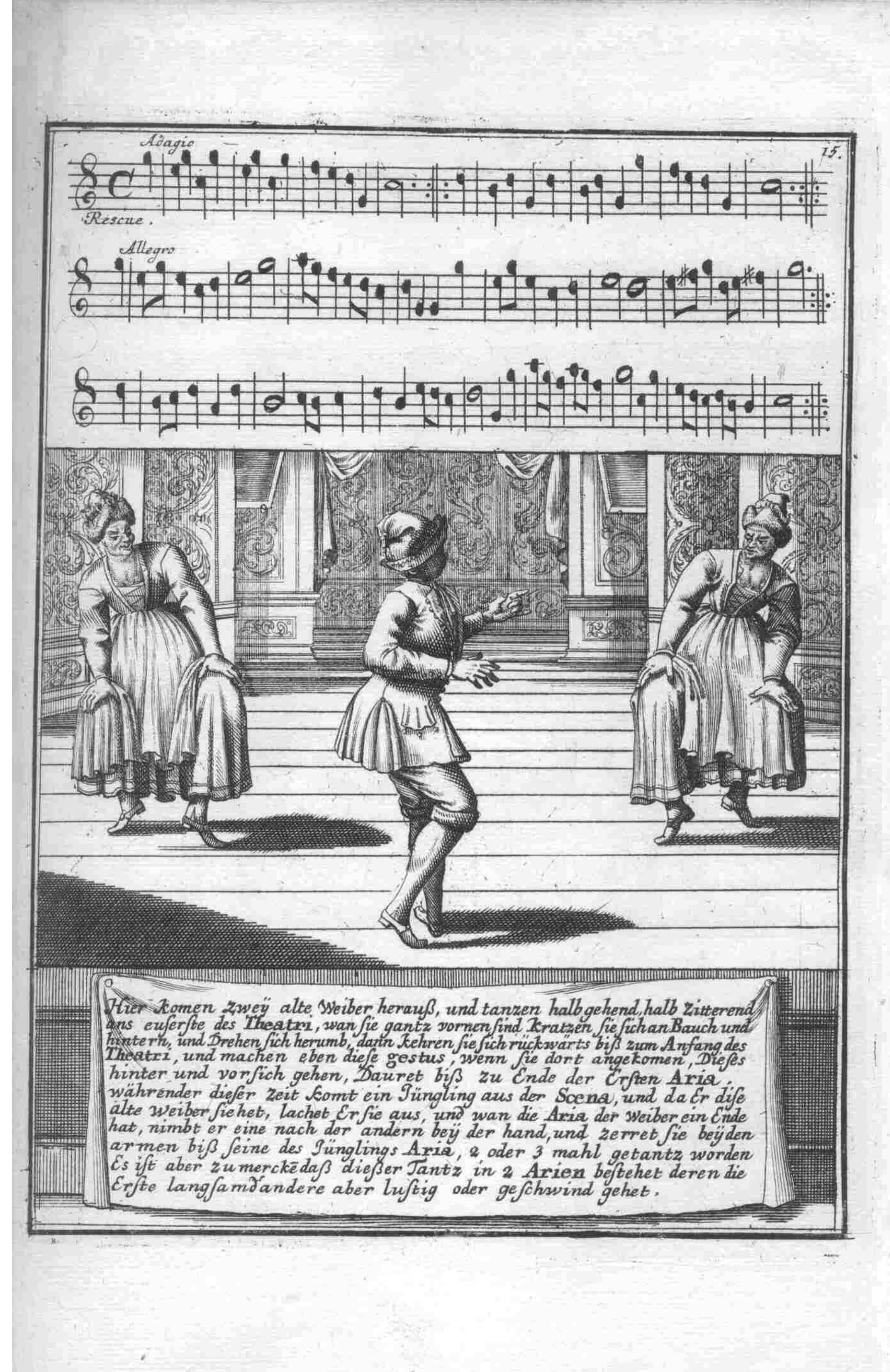
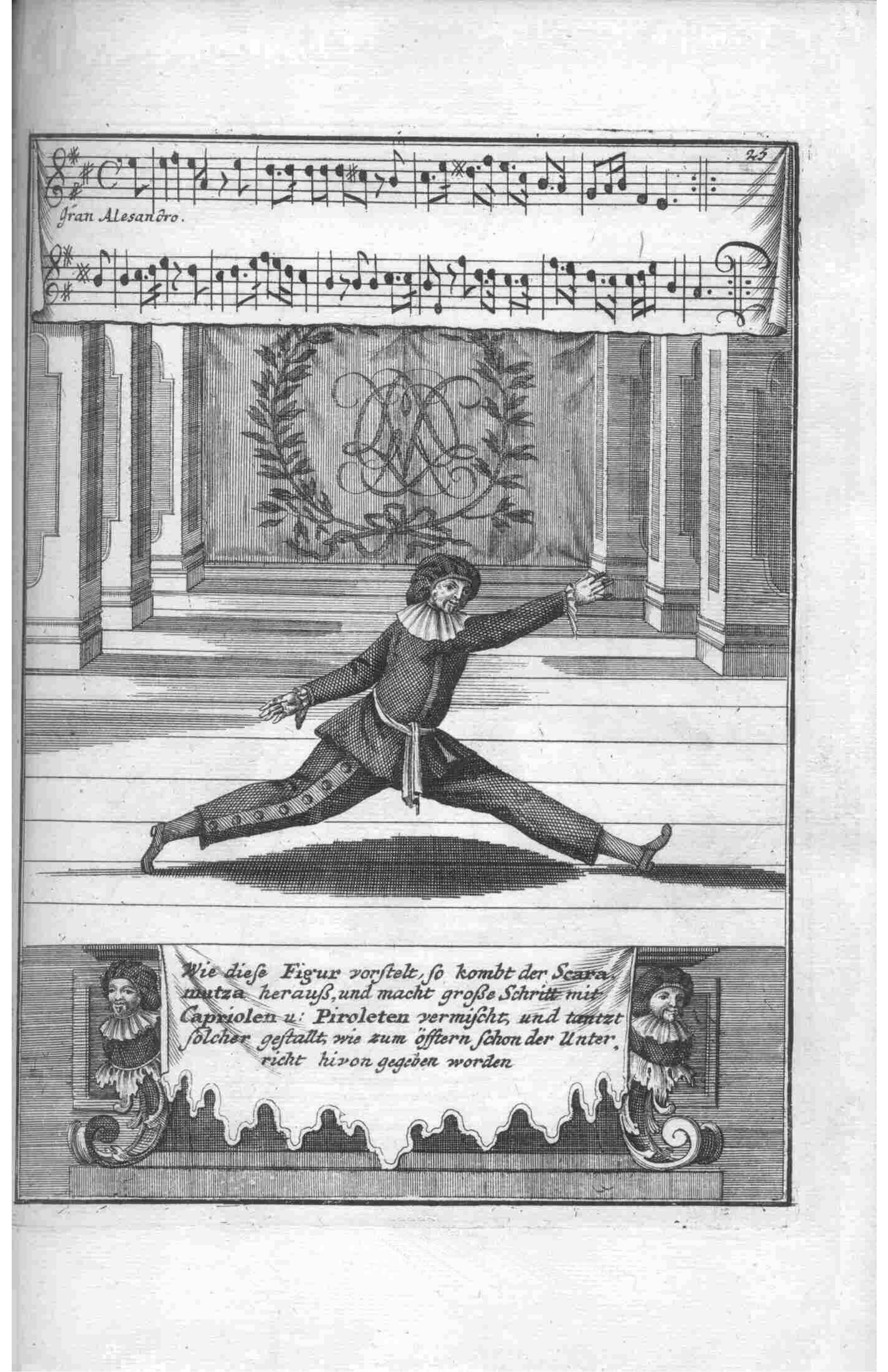
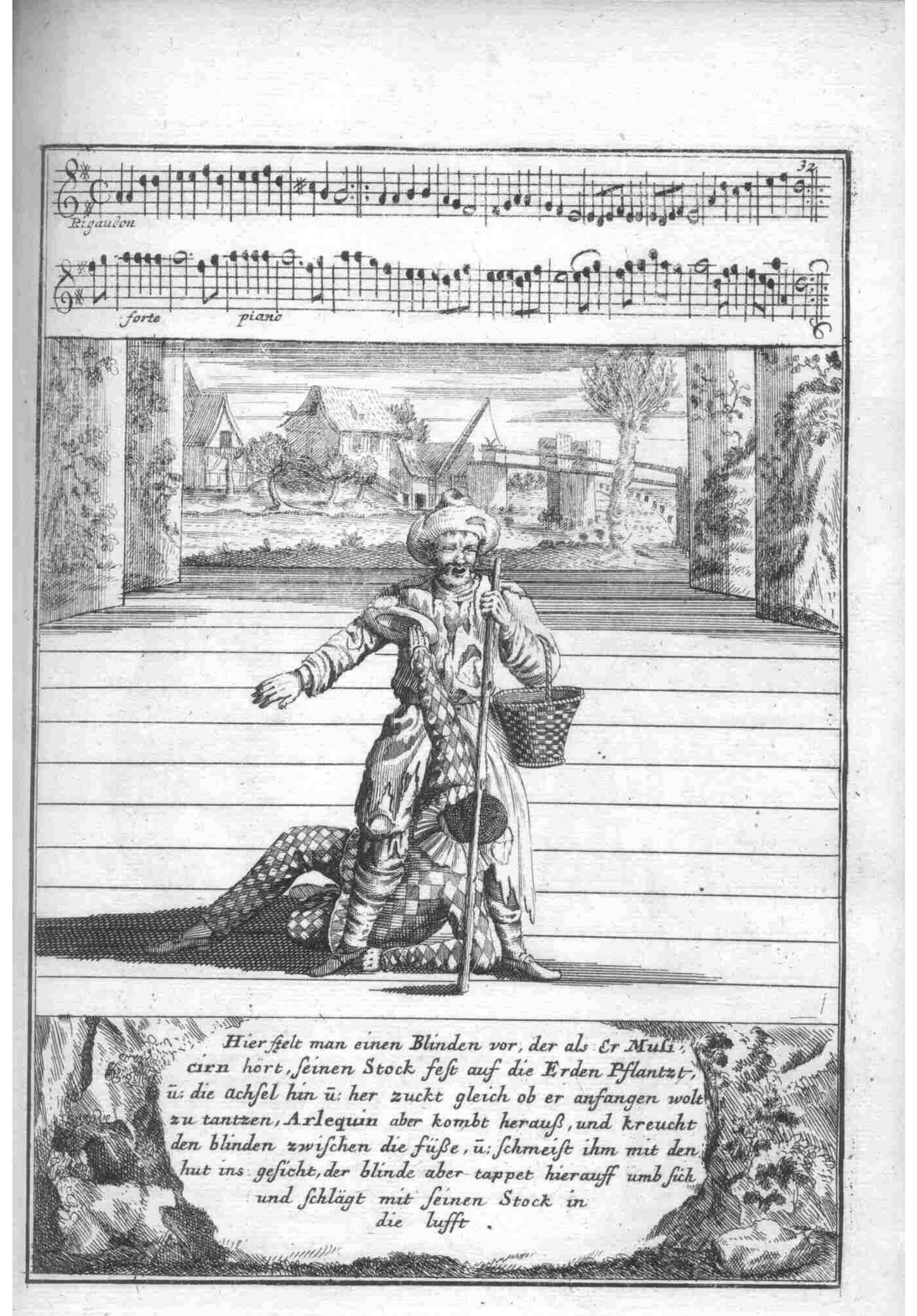
A solo dancer in elaborate early-18th-century costume stands alone on a wooden stage, framed by velvet curtains in a proscenium setting. The figure wears a richly patterned coat with scales or diamonds, leggings, a feathered cap, and carries a walking stick—the costume suggests a theatrical character or courtier rather than a peasant or comic type. The dancer's left arm extends outward in an open gesture, the right hand rests on the stick, the weight appears balanced on both feet in an upright stance. Behind the stage, through the curtains, a distant landscape with buildings, trees, and water is visible, establishing an aristocratic or court setting. The engraving is finely detailed; the hatching and line work of the copper plate create subtle gradations in the fabric and shadow. Above the scene, musical notation in treble clef is inscribed—the composition of the piece is provided. Below, a German caption in italic type describes the dance and its character.
The dancing
The dancer stands in an upright, formal posture with the torso erect and the weight evenly distributed. The extended left arm suggests an invitation or salute—a characteristic opening or greeting gesture from the baroque court dance vocabulary. The right hand's grasp of the walking stick grounds the figure and suggests an element of character or comic type within the courtly context. The body shows no bent knees or obvious jump; this appears to be a moment of stillness or a prepared position rather than a peak of dynamic movement.
The dance depicted
This is a plate from Lambranzi's *Nuova e curiosa scuola de' balli theatrali*, a manual that paired choreographic notation with engraved figures in costume to teach theatrical dance steps and characters. The dance style and character are typical of baroque theatre dance—a fusion of court dance technique with comic or character elements drawn from commedia dell'arte or popular entertainment. The costume, musical notation, and formal stage setting indicate this is a named dance or choreographed number for a solo performer, likely performed in an aristocratic theatre or carnival setting. Without consulting Lambranzi's written text, the specific identity of the step cannot be confirmed from the image alone, but the posture and gesture suggest a dance requiring lightness, elegance, and control—consistent with the galliard, minuet, or other baroque solo forms.
How it was made
A copper-plate engraving, one of the primary vehicles for spreading dance knowledge in the early modern period. Engraving allowed precise, fine-line illustration of costume detail and body position; the technique's labor and cost meant that works like Lambranzi's were produced in limited quantity for a learned, aristocratic, or professional theatrical audience. The pairing of music and figure on a single plate made this a reference work for dancers and choreographers—functional as well as decorative. The survival of such plates in book form meant that dance steps and characters could be circulated and studied across Europe long after a live performance.
About this work
This is one of thirty-two engravings from Gregorio Lambranzi's *Nuova e curiosa scuola de' balli theatrali* (Nuremberg, 1716), the most comprehensive and influential dance manual of the early 18th century. Each plate presents a character or step type in costume, paired with notated music and explanatory verse in German. The work synthesizes the court dance of Louis XIV's era—the formal, turned-out technique of the minuet and galliard—with the exuberant physicality and comic characterization of theatrical and carnival dance. Lambranzi was a dancer and ballet master working in the Holy Roman Empire; his manual was addressed to professional performers, court dancers, and wealthy amateurs who could read music and afford the bound volume. It stands at the threshold between the Renaissance court dance and the theatrical ballet of the 18th century.
How to look at it
Attend to the stillness and balance of the figure. Baroque dancers were trained to move from a stable, upright center; the extended arm and the hand on the stick show control and poise rather than dynamism. Notice the precision of the costume—the regular pattern of the coat, the neatness of the stockings and shoes. In baroque theatrical dance, the character and quality of movement were signaled through costume as much as through motion. The musical notation at the top can be read alongside the figure: this is not a snapshot of a living dancer, but a pedagogical image, a way of teaching someone who had access to the book how to perform this step and character. The proscenium stage and distant backdrop situate this as a theatrical performance, not a ballroom moment.
The artist
Gregorio Lambranzi (c. 1665–c. 1725) was an Italian dancer and choreographer who spent his career in the German courts, notably at Nuremberg and Weissenfels. He was trained in the French court ballet technique that had spread through Europe in the late 17th century, but he combined it with knowledge of Italian theatrical and popular dance forms. His treatise, published in two volumes (1716 and 1728), was the most systematic attempt of its time to notate and preserve both the steps and the theatrical character of baroque dance. It circulated widely among professionals and was reprinted and adapted throughout the 18th century.
The period
In 1716, baroque court dance was at its height in Germany and Austria, even as French court culture under Louis XIV was entering its twilight. The minuet had become the dominant social and theatrical form, but regional variations, comic roles, and technical virtuosity still flourished in court theatres and carnival entertainments. This was the era of the mature theatrical ballet de cour, when the boundary between social dance and theatrical spectacle was porous—the same steps and positions served both the ballroom and the stage. Lambranzi's manual captured this moment of codification and standardization, offering a German-language alternative to the French treatises that had dominated dance instruction.
Where it lives
This plate is from the first volume of *Nuova e curiosa scuola de' balli theatrali*, published in Nuremberg in 1716. The work exists in hand-colored and uncolored copies; the Library of Congress, which holds this image, preserves an uncolored impression. The book was issued in German and Italian editions and was reprinted and adapted by other publishers throughout the 18th century.
Dance in this work
Questions about this work
How is this different from a ballet?
In 1716, the distinction was not yet clear. This is theatrical dance of the baroque era, performed on a stage in costume with music. It uses the technique of court dance—turned-out positions, lifted torso, controlled arm movements—but incorporates comic characterization, popular steps, and character types drawn from commedia dell'arte. Lambranzi's dances are ancestors of ballet, but they retain a strong connection to social dance and popular entertainment that ballet later shed.
Can I learn to do this from the book?
Partially. The music and the written notation (which appears in Lambranzi's text, not on this plate) convey the timing and the named steps. But much would have been learned by watching a skilled dancer in person. The engraving shows the costume, the upright posture, and the arm position—a skilled baroque dancer could study this and recognize the character and style. Today, historians and choreographers use Lambranzi's treatise alongside other sources to reconstruct these dances, but some elements remain lost.
Who performed these dances?
Professional dancers in court theatres, trained amateurs at aristocratic estates, and traveling performers in fairs and carnival entertainments. Lambranzi addressed his book to anyone who could read music and afford to buy it—that meant a narrow, wealthy, educated audience. But the dances and characters he documented were circulating widely in European popular entertainment as well.
Why is this engraving, not a painting?
Because it's a page in a book. Copper-plate engraving was the standard technique for printed illustrations in this period. It allowed fine detail, was economical for multiple copies, and circulated widely. A painting would be a unique object; an engraving could be reproduced and distributed across Europe.
More Notation/Choreography artwork