49 works in this view — arrow keys or swipe to move between them.
Dance in Art
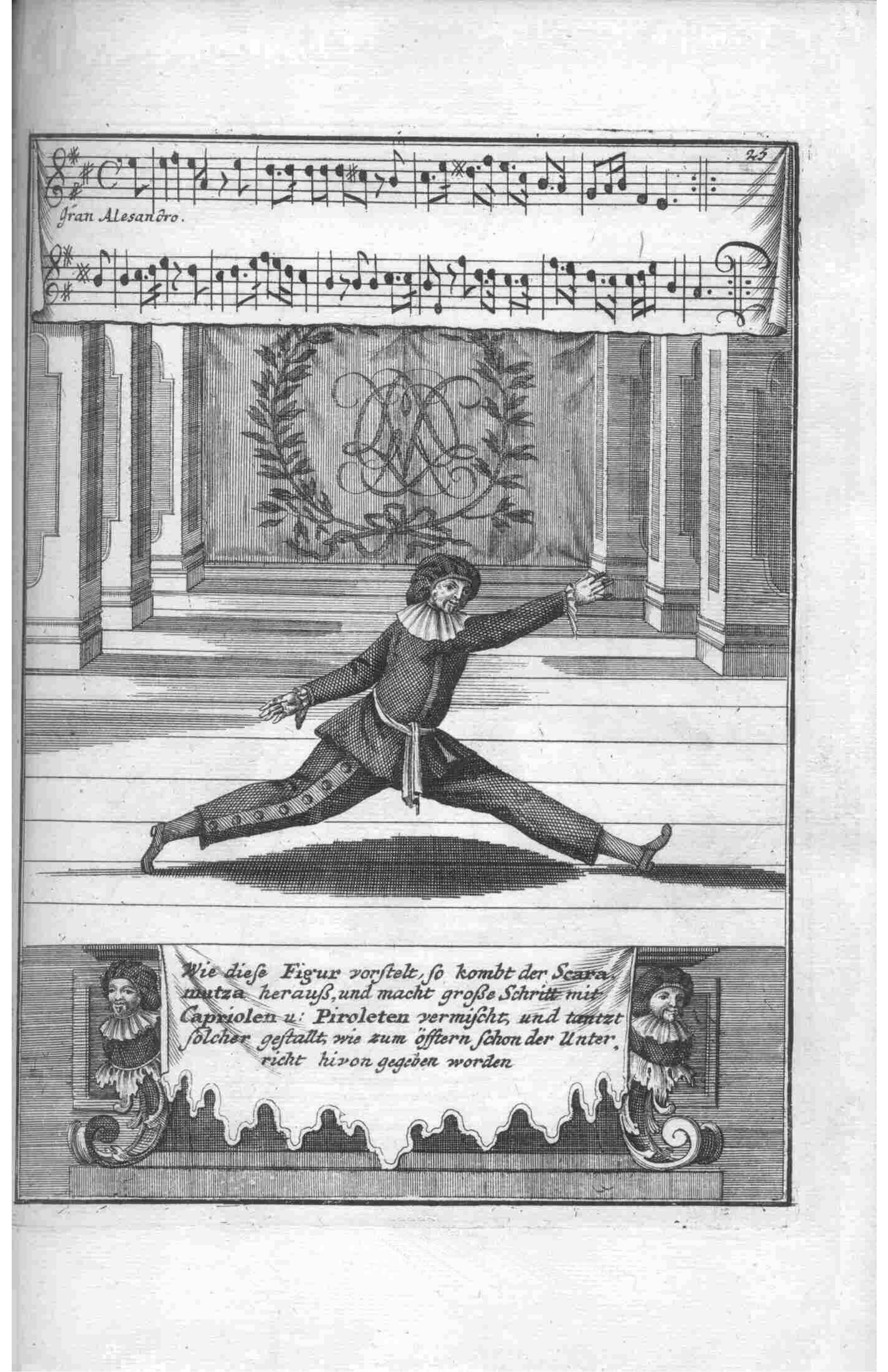
Acrobatic — Plate 35
Gregorio Lambranzi
- Medium:
- Copper-plate engraving
- Dance:
- Notation/Choreography
- Era:
- 1700s (Enlightenment/Minuet Era)
- Collection:
- Nuova e curiosa scuola de' balli theatrali (1716)
- Source:
- Library of Congress
- Rights:
- Public domain — free to use, share and adapt.
- Recorded as:
- Public Domain
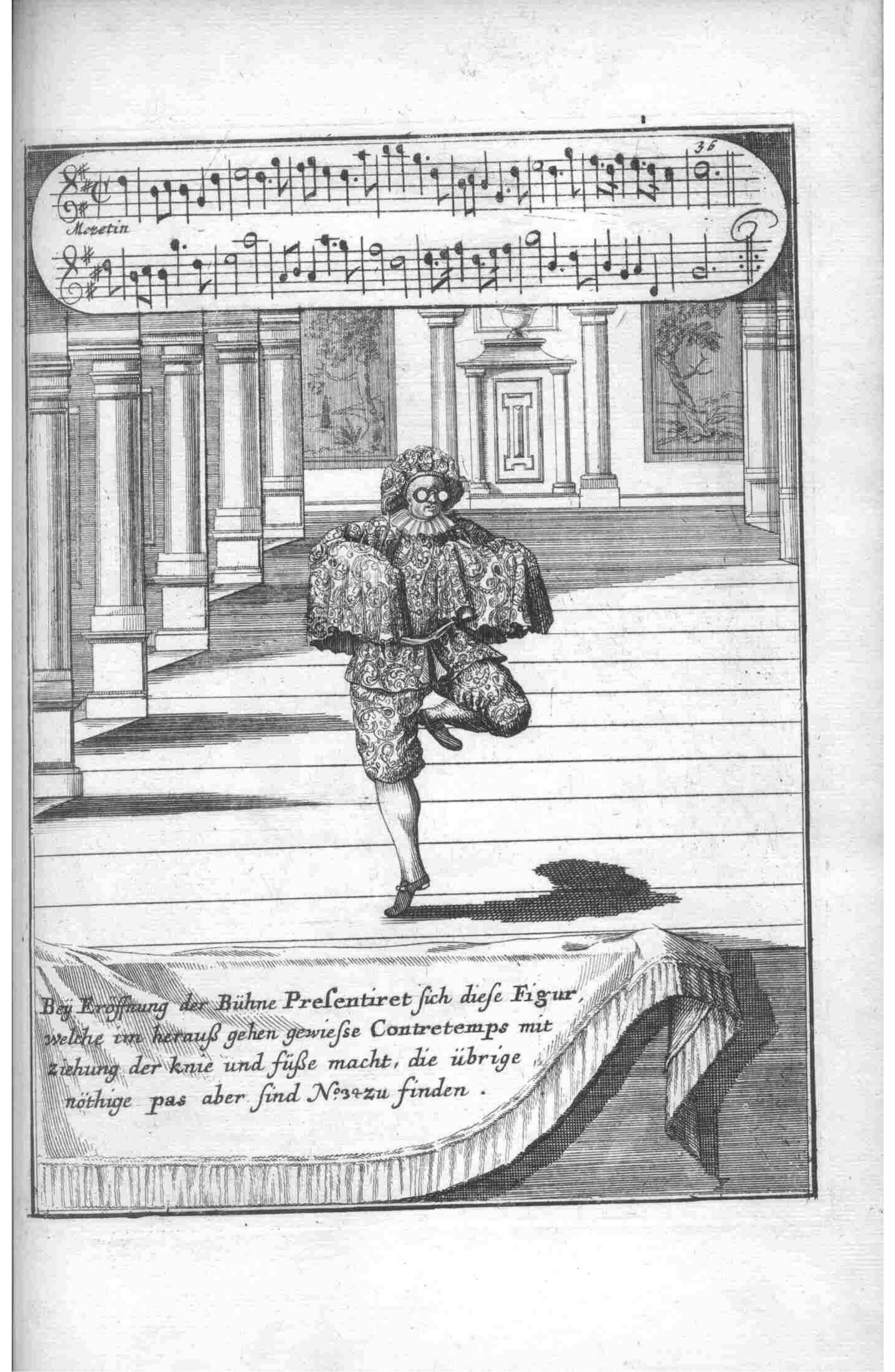
This image is primary evidence for how professional male dancers executed vertical elevation in the early 18th century—before the visual record becomes dominated by ballet iconography and well after the codification of theatrical technique had begun. The pairing of notation with image is rare and invaluable; it allows us to see what the choreographer intended and what the dancer's body was trained to accomplish. For anyone studying the history of male dancing, aristocratic theatrical culture, or the origins of notated dance, this work is essential documentation.
What you are looking at
A solitary male dancer in elaborate costume executes a dramatic leap across the floor of a grand neoclassical interior. The setting is a colonnade with fluted columns receding into the distance, their regularity creating strong linear perspective toward a doorway and architectural detailing beyond. The flooring is rendered in bold parallel lines suggesting polished boards. The dancer wears richly patterned brocade or embroidered coat with deep lace cuffs and collar, knee breeches, and what appears to be heeled shoes—the costume of a well-to-do 18th-century gentleman. His body is suspended in a vigorous upward leap, weight gathered and limbs extended, captured mid-action. The composition gives the figure centrality and drama against the austere architectural frame. Musical notation occupies the top of the plate in two staves, and a caption in German script appears below the architectural surround.
The dancing
A single male dancer suspended in a vertical leap with knees bent and lifted, the body rising from a gathered lower position. The arms are positioned at the sides or slightly extended for balance. The weight distribution suggests propulsive force upward and forward, with the feet leaving the ground decisively. The figure is shown in three-quarter view, allowing the viewer to assess both the height of the jump and the carriage of the torso. The pose conveys athleticism and control rather than effort or strain.
The dance depicted
This is a theatrical dance movement from the early 18th-century European theatrical tradition, most likely an element of the danced interludes and diversissements that accompanied opera and theatrical performances. The jumping motion—apparently a grand assemblé or similar elevation—was a virtuosic element of the professional male dancer's vocabulary of the period. The notation at the top suggests this jump was choreographed and documented in one of the early notational systems (likely Beauchamp-Feuillet notation, though the specifics are not legible here). The image records how theatrical male dancers of 1716 executed vertical elevation with articulate control, emphasizing the refined bearing and expensive costume that marked the professional male dancer as a figure of status and skill.
How it was made
This is a copper-plate engraving, a process of incising lines into a metal surface and using the grooves to hold ink for printing. The fine parallel lines and cross-hatching visible throughout create tonal gradation and texture—particularly evident in the rendering of fabric, the column fluting, and the floor. The engraver has achieved considerable spatial depth through linear perspective and the controlled use of line density. The medium allows for precise detail and fine tonal control, and such plates were durable and could be printed repeatedly, making them suitable for instruction manuals and relatively wide circulation. The combination of musical notation and figured plate was typical of early choreographic publications aimed at professionals and serious amateurs.
About this work
This engraved plate from Lambranzi's 1716 *Nuova e curiosa scuola de' balli theatrali* documents a moment of virtuosic male dancing in the early 18th-century European theater. The work pairs musical notation with a choreographed figure, presenting dancing not as courtly entertainment but as a codified technical practice requiring training and precision. The formal architectural setting elevates the dancer's body as a disciplined instrument capable of elevation and control. Lambranzi's manual was one of the era's most influential treatises on theatrical dance, and this plate exemplifies its purpose: to preserve, teach, and disseminate the professional vocabulary of stage dancing to a literate audience of dancers and patrons.
How to look at it
Attend first to the moment of suspension: the artist has frozen the dancer at the apex of his jump, where vertical thrust is most visible and the body is most extended. This choice emphasizes the energy and control required. Notice how the architectural surround—the columns and perfect floor—provides both a frame that elevates the dancer and a measuring scale against which we can judge the height of the leap. The precise costume detail and the dancer's refined bearing tell us this is a professional and an aristocrat. Finally, observe how the notation above—the visible record of music—anchors this moment in a documented choreography rather than improvisation or generic entertainment.
The artist
Gregorio Lambranzi (c. 1665–1725) was an Italian dancing master and choreographer active in Nuremberg. His *Nuova e curiosa scuola de' balli theatrali*, published in 1716 in two volumes with plates by Johann Georg Puschkin, was one of the most comprehensive and visually detailed choreographic manuals of the period. Unlike many dance treatises that focused on court dancing or ballroom technique, Lambranzi documented theatrical and character dances—the professional repertory of the stage. The combination of musical notation, detailed engravings, and descriptive captions made the work both a record and a teaching tool. The plates were admirably precise and remained influential well into the 18th century.
The period
In 1716, theatrical dancing in Italy and the German-speaking lands was undergoing rapid professionalization and systematization. The Italian *commedia dell'arte* tradition had given way to more formally choreographed theatrical spectacle, often integrated into operatic productions. The court dances of the French nobility—minuets and other social dances—were codified in the Beauchamp-Feuillet notation system and circulated widely, establishing dance as a literary and teachable art. Male dancers, often acrobatic and athletic, were valued for technical display and strength; the elaborate costume in this plate signals both the professional status and the courtly aspirations of the male dancer. Lambranzi's manual emerges at a moment when dance technique was becoming standardized and transmissible across geographical and linguistic boundaries through print, notation, and carefully observed engravings.
Where it lives
This plate is from *Nuova e curiosa scuola de' balli theatrali*, a two-volume manual of theatrical dances published in Nuremberg in 1716 by the dancing master and author Gregorio Lambranzi. The work was engraved by Johann Georg Puschkin and distributed in German-speaking territories and beyond. It is one of the most complete visual and notational records of professional theatrical dance technique from the early 18th century.
Dance in this work
Questions about this work
What is the notation at the top of the plate?
It appears to be musical notation corresponding to the choreography below, most likely indicating the tempo and character of the music to which this jump was performed. The combination of music and figure was typical of Lambranzi's method, allowing the reader to understand both the rhythm and the movement. The notation is not clearly legible in reproduction, but its presence signals that this was a documented, repeatable choreography rather than an improvised display.
What does the German text at the bottom say?
The caption begins 'Bei Aufführung der Bühne Präfentiret sich diese Figur...,' indicating that this figure presents itself on the theatrical stage in a particular way. The full caption likely describes the specific movement, how to execute it, or the character or story context. Lambranzi's captions were pedagogical, designed to guide dancers in learning and repeating the choreography.
Was this manual used for training?
Yes. Lambranzi's work was a professional teaching manual for dancers and dancing masters, comparable to a modern dance technique book. The combination of notation, engraved figures, and verbal description made it possible for a trained dancer in one city to learn and replicate choreography documented in another. It was thus both a record of existing practice and a tool for transmitting it.
How does this compare to ballet as we know it?
Lambranzi's theatrical dances predate the full systematization of ballet technique by several decades. The movement vocabulary—elevations, turns, leg extensions—is ancestral to ballet, but the aesthetic and the costume are still partly rooted in commedia and character dance traditions. The emphasis on acrobatic elevation and character expression differs from the later ideals of ethereal verticality and narrative pantomime that defined Romantic ballet.
More Notation/Choreography artwork