49 works in this view — arrow keys or swipe to move between them.
Dance in Art
Solo Dancer — Plate 37
Gregorio Lambranzi
- Medium:
- Copper-plate engraving
- Dance:
- Notation/Choreography
- Era:
- 1700s (Enlightenment/Minuet Era)
- Collection:
- Nuova e curiosa scuola de' balli theatrali (1716)
- Source:
- Library of Congress
- Rights:
- Public domain — free to use, share and adapt.
- Recorded as:
- Public Domain
Lambranzi's manual is one of the few surviving detailed records of how professional theatrical dancers actually moved in the early 18th century. Unlike abstract dance notation systems, the engravings show the dancer's body in space with costume and architectural context, offering dancers and historians visual evidence of Baroque theatrical technique, posture, and spatial presence. The work bridges the gap between the court dances documented in earlier texts and the emerging professional ballet tradition of the 18th century.
What you are looking at
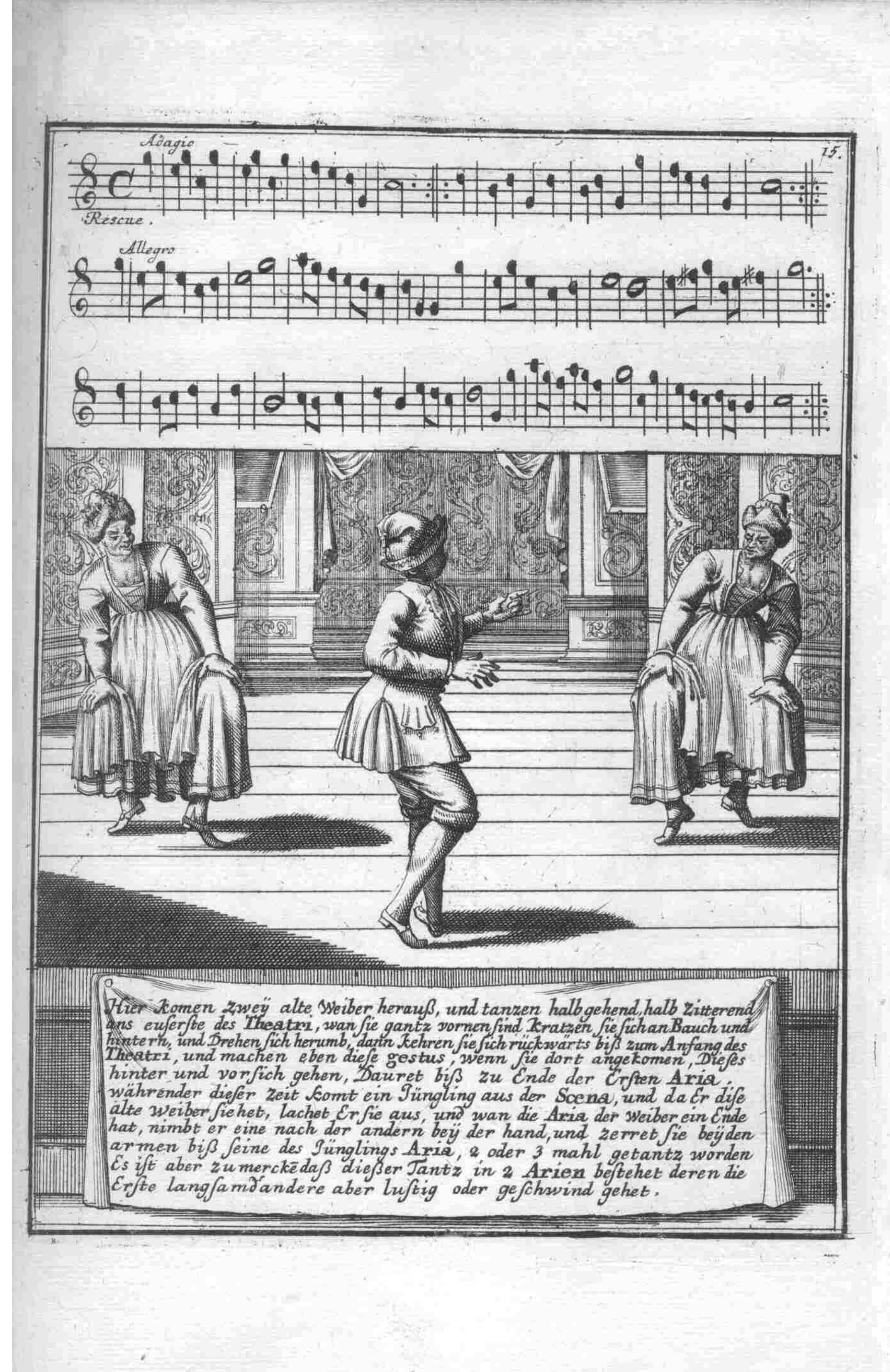
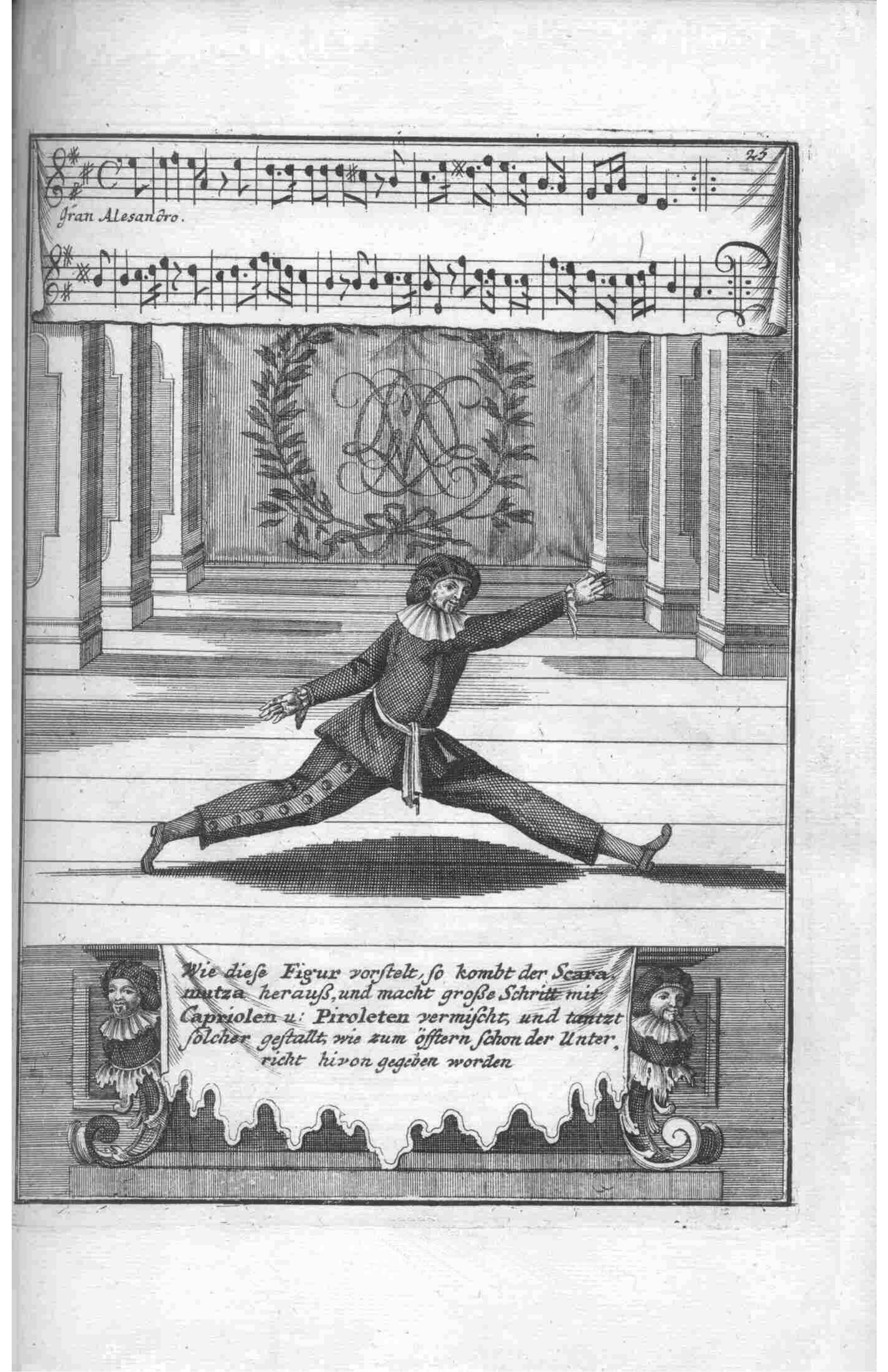
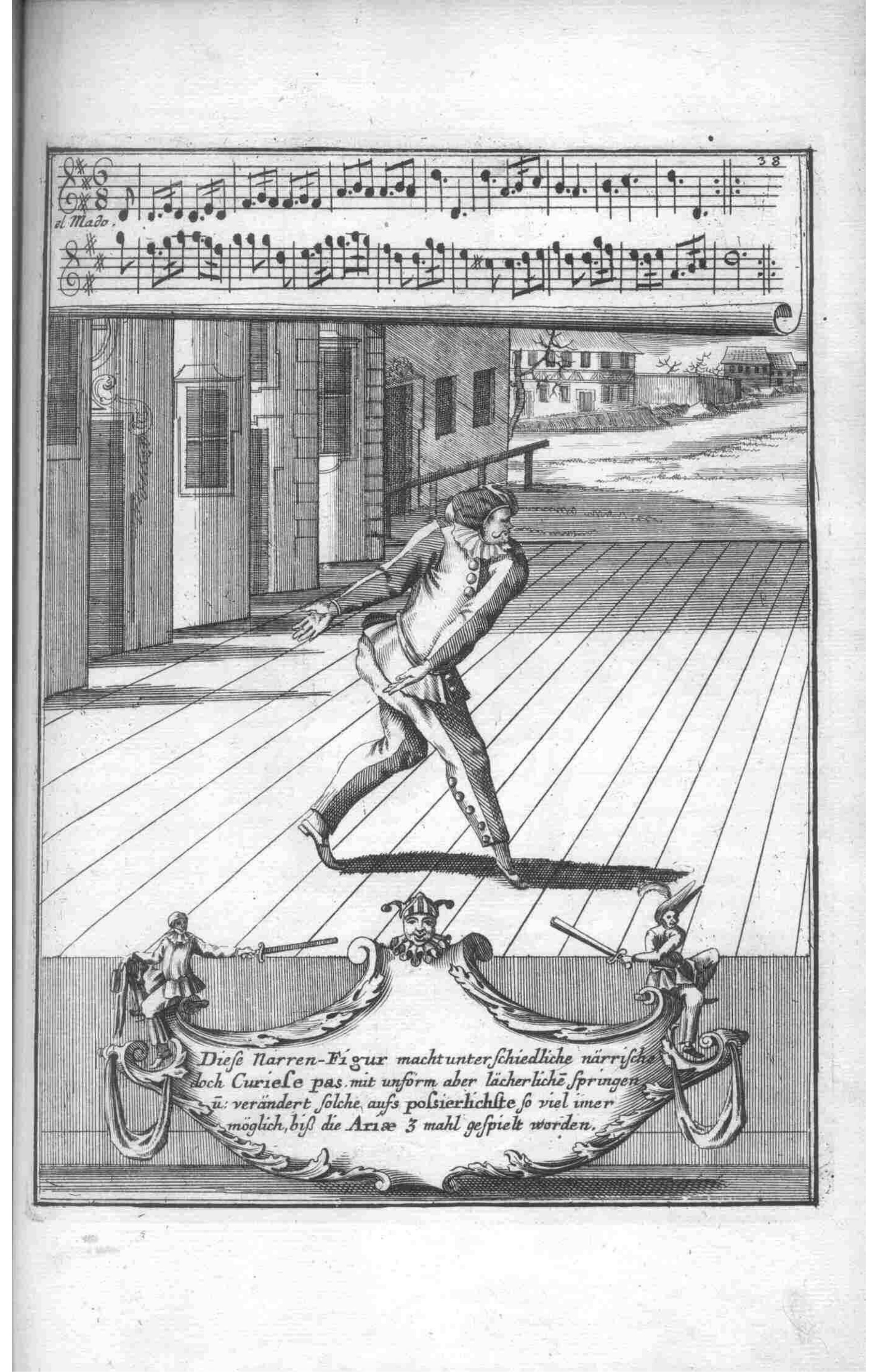
A single male dancer stands on a wooden stage platform within a framed theatrical space. The stage is set with classical architecture—columns and arched doorways visible at left, with a distant landscape featuring buildings and trees visible through the opening at right. The dancer wears early 18th-century theatrical costume: a fitted jacket with decorative buttons, breeches, stockings, and a plumed hat. He is captured mid-motion in a pronounced pose: his weight is shifted onto one leg, the other leg extended, his upper body tilted forward with arms outstretched in a dynamic gesture. The stage floor is rendered with careful perspective using parallel lines. Above the scene, two staves of musical notation (labeled "al Modo") provide the accompaniment. Below, ornamental cartouche framing contains a German caption describing the dance.
The dancing
A single male dancer occupies the stage in a fully-bodied geometric pose. His weight appears to rest on the downstage leg while the other leg extends behind or to the side; his torso inclines forward from the hips with considerable tilt, and both arms are raised and extended outward in a broad, expressive gesture. The body demonstrates the turnout and lifted carriage expected of theatrical dancing in this period, with the head held high despite the forward tilt of the torso. The overall effect is one of virtuosic balance and spatial command.
The dance depicted
This plate documents a solo from the early 18th-century European theatrical dance tradition, most likely a minuet or related court dance adapted for the stage. The pose exemplifies the sprezzatura and dynamic spatial presence of Baroque theatrical dance: the dancer is neither in repose nor traveling, but suspended in a moment of balletic display. The costume, notation, and stage setting all confirm this is from a choreographed theatrical repertoire intended for trained male dancers performing before audiences in indoor playhouses. The image does not show the continuous motion of social dance but rather a held position within a fixed choreography.
How it was made
This is a copper-plate engraving, a precision-intensive medium that required the artist to cut or etch lines into a polished copper surface, then ink and print the plate. The technique allowed for fine linear detail and tonal modeling through hatching and cross-hatching—visible in the rendering of the stage floor, the architectural backdrop, and the folds of costume. Engravings were expensive to produce but durable and could be reprinted many times, making them the primary medium for circulating illustrated instructional manuals like this one across Europe. The marriage of notated music, detailed figure, and architectural space on a single plate was a deliberate design choice: the engraving could be studied as both image and score.
About this work
This is Plate 37 from Gregorio Lambranzi's *Nuova e curiosa scuola de' balli theatrali* (Nuremberg, 1716), one of the most important surviving choreographic manuals of the Baroque era. Each plate in the collection pairs a notated musical excerpt with an engraved image of a costumed dancer in mid-choreography, creating a hybrid text that is both instruction and advertisement. The work documents the vocabulary and aesthetics of professional theatrical dance at the moment when ballet was transitioning from court spectacle to commercial stage entertainment. The careful engraving, inclusion of musical notation, and precise costume detail suggest this manual was aimed at professional dancers and choreographers rather than amateur courtiers, and its wide European circulation made it an influential standard for dance practice.
How to look at it
Observe the exact position of the dancer's weight and the geometry of his limbs. The extended leg and forward tilt of the torso create a diagonal line through space; the raised arms complete a balanced, open shape. This is not a natural posture but a constructed one—it shows off the dancer's turnout, extension, and control to an audience. Notice how the theatrical frame (the stage platform, the architectural surround, the receding perspective) creates a space in which the single figure commands full attention. The musical notation above tells us this position occurs at a specific moment in time within a scored piece; what Lambranzi has frozen is a moment of display, not transition.
The artist
Gregorio Lambranzi was an Italian dancer and choreographer active in the early 18th century. Little is documented about his life beyond this influential manual, which was published in Nuremberg and rapidly became a standard reference across Europe. The work represents both his own choreographic practice and a comprehensive survey of the theatrical dance vocabulary of his era. The pairing of engraved image with musical notation suggests he worked closely with a skilled engraver to translate kinetic experience into static visual form.
The period
In the early 18th century, theatrical dance was undergoing rapid professionalization and codification. The court ballet tradition of the 17th century was yielding to commercial stage entertainment in public theaters; simultaneously, the rising middle classes created demand for instruction in fashionable dance. Lambranzi's manual appeared at this inflection point, when the minuet and its variants dominated both court and stage, and when choreographers were beginning to systematize movement notation as a means of preserving and transmitting dance across generations. The engraving medium itself was at its height: illustrated books combining text, notation, and image were a primary vehicle for technical instruction in all the arts. Lambranzi's work sits within a broader European project to document and standardize artistic practice.
Where it lives
This plate is part of the complete engraved manual *Nuova e curiosa scuola de' balli theatrali*, published in Nuremberg in 1716 by Gregorio Lambranzi. The work is held in the Library of Congress collection and represents one of the few surviving illustrated choreographic treatises from the Baroque period. It circulated widely among professional dancers and dancing masters across 18th-century Europe.
Dance in this work
Questions about this work
What is the dancer actually doing in this pose?
He is suspended in a moment of static display—a held position within a choreographed dance, not a passing gesture. This kind of posed moment would have been used in the minuet or related court dances to show off the dancer's balance, line, and turnout to the audience. The position itself was likely brief, held only long enough to register visually before moving on to the next figure.
How do we know what music accompanies this movement?
Lambranzi included musical notation at the top of each plate—here labeled "al Modo" (in the manner/style). The notation shows the exact melody and rhythm for the movement below. A dancer learning from this manual would study both the image and the score together, understanding that specific steps occurred at specific moments in the musical measure.
Who would have used this manual?
Professional dancers, choreographers, and dancing masters—people who made their living teaching or performing theatrical dance. The level of detail, the inclusion of musical notation, and the expense of the engraved format suggest this was not an instructional book for amateurs, but a reference work for trained practitioners seeking to expand or standardize their choreographic vocabulary.
Why does he wear a hat while dancing?
This is theatrical costume for the stage, not everyday wear. The plumed hat was part of the fashionable aristocratic look of the period and signaled that this was a character role or styled theatrical persona. Male dancers of the era often danced in such hats, and the hat's movement with the body's motion was part of the visual effect.
More Notation/Choreography artwork