49 works in this view — arrow keys or swipe to move between them.
Dance in Art
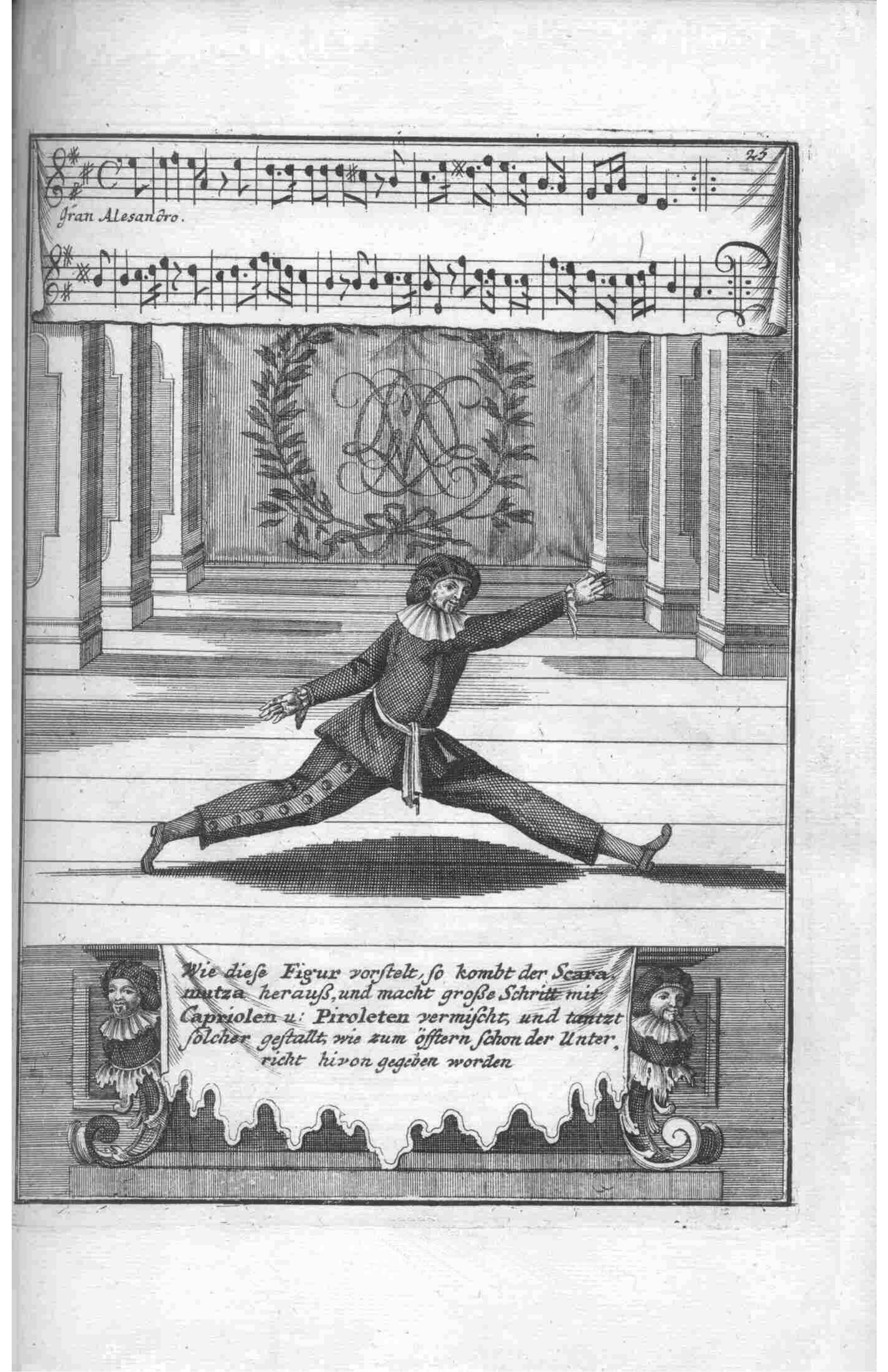
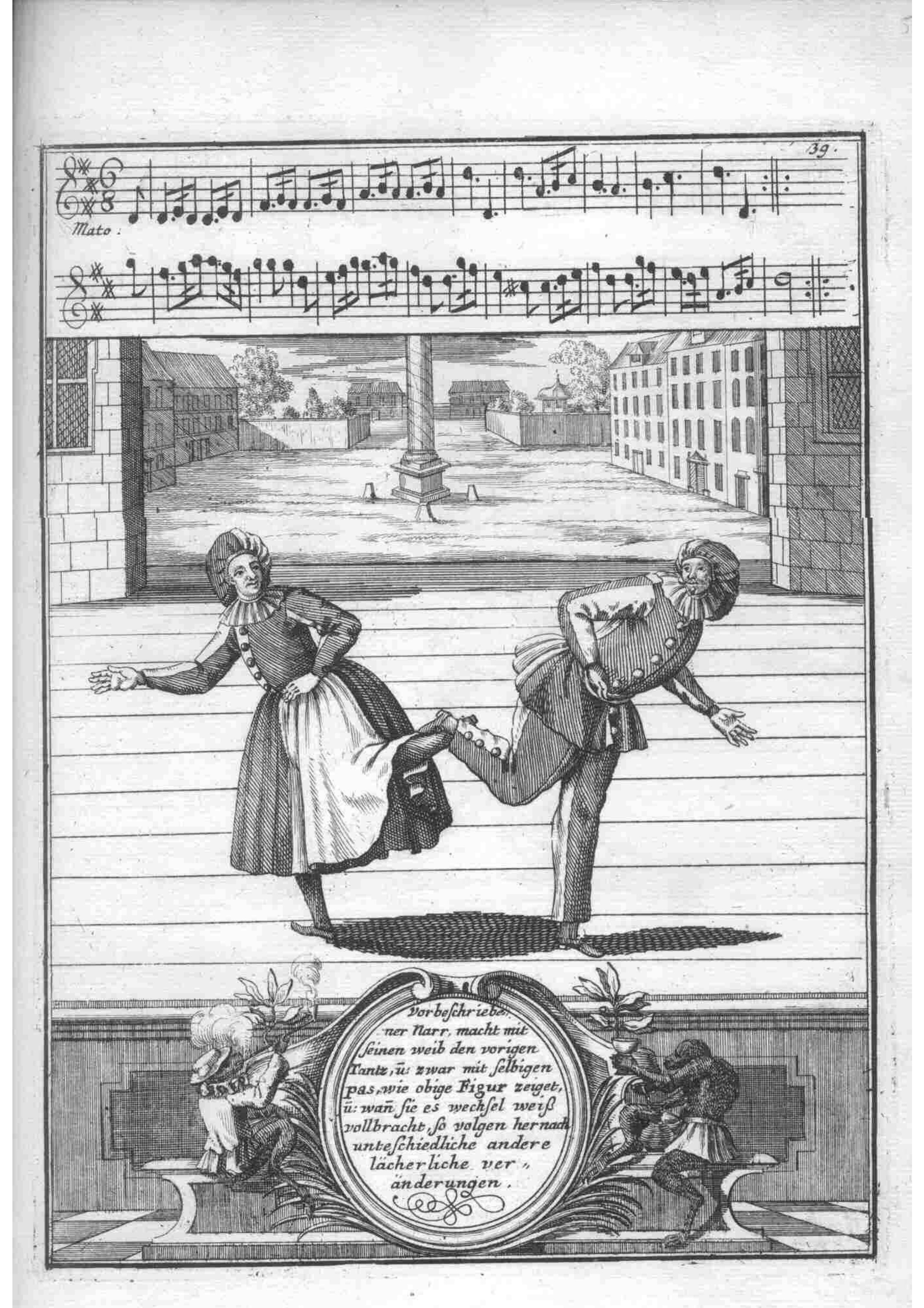
Grotesque — Plate 38
Gregorio Lambranzi
- Medium:
- Copper-plate engraving
- Dance:
- Notation/Choreography
- Era:
- 1700s (Enlightenment/Minuet Era)
- Collection:
- Nuova e curiosa scuola de' balli theatrali (1716)
- Source:
- Library of Congress
- Rights:
- Public domain — free to use, share and adapt.
- Recorded as:
- Public Domain
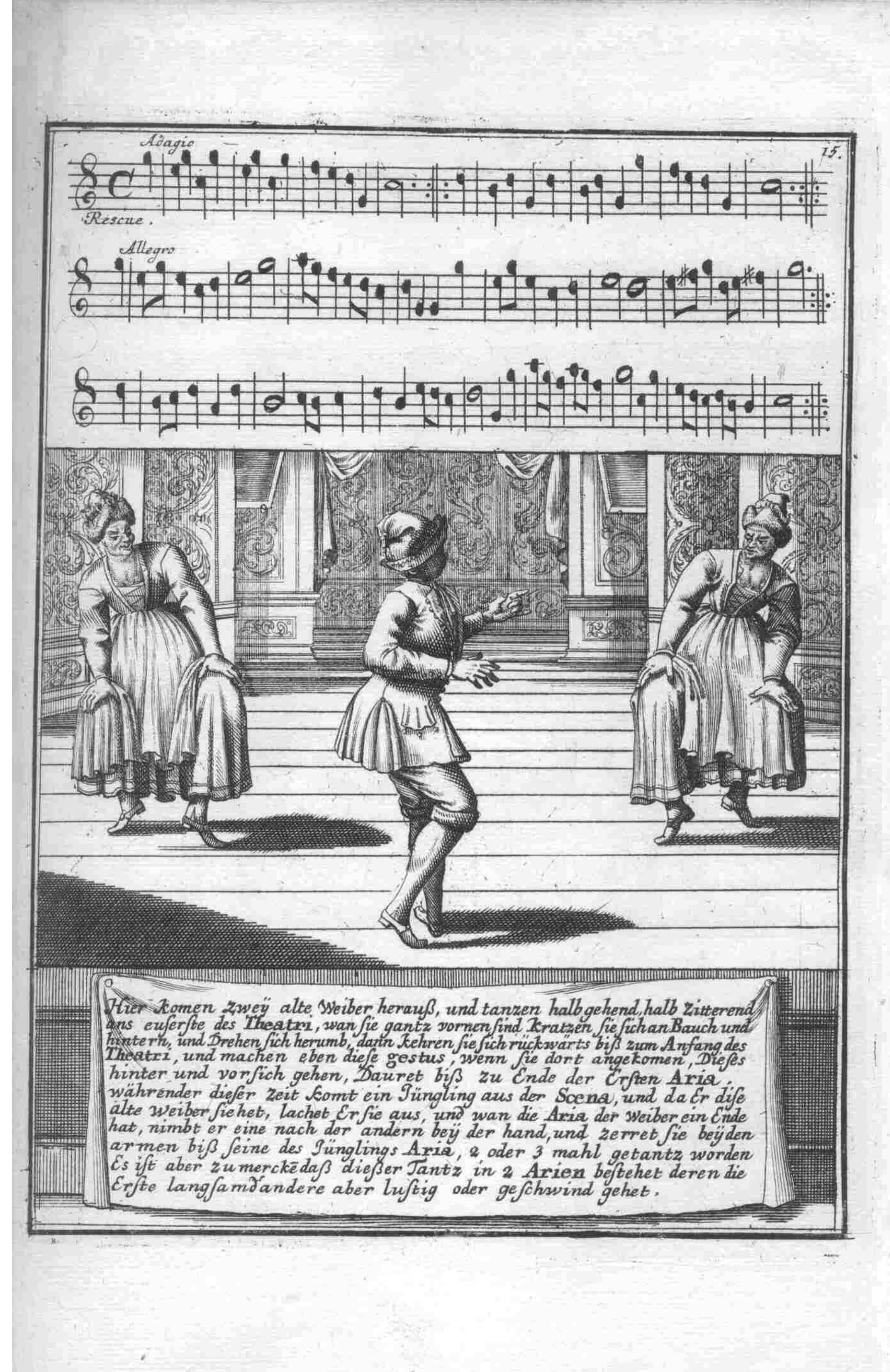
Lambranzi's manual is one of the era's most important sources for understanding how theatrical dancers actually moved and what roles they performed. This plate specifically documents the burlesque and grotesque traditions—characters and movements that shaped European popular theater but are often overlooked in dance history. It shows that the 18th century valued physical comedy, character work, and visual exaggeration as legitimate and skilled forms of stage dance, not merely aberrations from courtly refinement.
What you are looking at
A man and woman perform a burlesque dance on a wooden stage framed by a classical archway. The woman, dressed in a long dark skirt and white apron with an elaborate ruffled collar, stands with one arm extended in invitation; the man, portly and round-bellied, kicks his leg high in an exaggerated grotesque pose, his body tilted backward in comic distortion. Behind them, a distant cityscape with a central column suggests a public square or plaza. The composition captures a moment of theatrical absurdity: the contrast between the woman's composed gesture and the man's ungainly, oversized movement creates deliberate visual comedy. The engraving's fine lines render fabric texture and architectural detail with precision, while the figures themselves are rendered in the slightly caricatured style typical of commedia dell'arte or grotesque theatrical characters.
The dancing
The male dancer's body is dramatically contorted, with his right leg thrust upward at an acute angle while his torso leans back, arms spread wide for balance—a posture that suggests neither grace nor control but rather physical comedy and loss of equilibrium. The female dancer maintains an upright, composed stance with measured arm positions, her weight centered and her frame stable. The size discrepancy between the two figures—the man's exaggerated roundness and bulk against the woman's slighter form—is central to the burlesque effect. Their spatial relationship suggests a moment of interaction or provocation, with the man's wild gesture directed toward the woman's steady presence.
The dance depicted
This is a grotesque or burlesque theatrical dance, likely from the commedia dell'arte tradition or the world of 18th-century German-speaking theatrical entertainments. The style is explicitly coded as 'grotesque' in the plate title and the catalogue record, indicating a deliberate departure from the refined, balanced movements of courtly or classical dance. The exaggeration of the male figure's body—his rotundity and his explosive, ungainly leg kick—represents a particular character type in theatrical dance of this period: the ridiculous, over-the-top buffoon. The woman's restraint and stability set off his abandonment of control. Such dances were designed for popular entertainment and would have been performed by professionals skilled in physical comedy and character work, likely in city theaters or court entertainments designed to amuse through contrast and absurdity.
How it was made
This is a copper-plate engraving, a technique that allowed fine linear detail and wide circulation through printing. The image is printed from an incised metal plate, creating the sharp, consistent lines visible throughout—in the architectural elements, the cross-hatching that suggests fabric and shadow, and the precise rendering of the stage setting. Engraving was the dominant reproductive medium for the circulation of images in the early 18th century, allowing a single designed plate to produce dozens or hundreds of impressions. This technique was well-suited to the dissemination of theatrical knowledge: the image could be distributed to theaters across Europe and could be studied by dancers and choreographers as a record of movement and character. The notation at the top of the page—musical staff with figured melody—reinforces this didactic purpose.
About this work
Plate 38 from Gregorio Lambranzi's 1716 theatrical dance manual is a copper-plate engraving depicting a burlesque dance performance by a man and woman on a stage. The male dancer executes an exaggerated, grotesque leg kick while his portly body tilts backward, while the female dancer maintains composed, measured positioning. The image is one of a series pairing musical notation with illustrated theatrical dances, designed to teach performers the steps, characters, and comedic effects of early 18th-century European stage entertainment.
This work belongs in a gallery about dance because it is a direct historical record of how theatrical bodies moved in this period, what kinds of movement were valued (or mocked), and how dance was documented for transmission. The engraving is not merely a decorative illustration but a working manual—a teaching tool that would have been consulted by performers and choreographers. It shows that dance history includes not only the refined and the graceful but also the grotesque, the comic, and the deliberately ugly.
How to look at it
The engraver has frozen the grotesque dance at a moment of maximum visual contrast and comedy: the instant at which the male dancer's body is most distorted and the female dancer's composure most evident. Notice how the artist uses the frame of the archway and the distant plaza to establish theatrical perspective—this is a performance, not a social dance. The musical notation at the top connects the visual to the aural; a viewer familiar with music could imagine the character of the dance from both the notation and the image. The cross-hatching and fine lines create volume and weight in the male figure's body, emphasizing his physicality and bulk. The grotesque style deliberately rejects the balanced, symmetrical postures of courtly dance, inviting you to see how completely different movement vocabularies could coexist on the same stage.
The artist
Gregorio Lambranzi (c. 1665–1729) was a German choreographer, dancer, and dance theorist active in Nuremberg. His *Nuova e curiosa scuola de' balli theatrali* (New and Curious School of Theatrical Dances), published in Nuremberg in 1716, is a two-volume illustrated manual containing 110 engraved plates, each pairing a musical score with an illustrated dance figure or scene. The work is a comprehensive record of early 18th-century German and European theatrical dance, including court dances, grotesques, character dances, and comic scenes. Lambranzi's manual was translated and republished in English (London, 1728) and circulated widely, making it one of the most influential dance instruction texts of its time. His approach combined notation, visual representation, and descriptive text to capture movement that earlier manuals had not fully recorded.
The period
In the early 18th century, theatrical dance in German-speaking Europe existed in close relationship to commedia dell'arte, French court ballet, and the emerging genres of comic opera and popular entertainment. While the Baroque court dance (minuet, courante, rigaudon) dominated elite ballrooms, theatrical stages hosted a much wider range of movement vocabularies: grotesque dances, character dances, and burlesque entertainments that caricatured or exaggerated the human form. The publication of Lambranzi's manual in 1716 coincides with a broader European interest in documenting and systematizing dance practice—a response to dance's growing complexity and its status as a skilled profession. Engraving allowed these images to circulate widely, establishing a visual standard for how dances should look and how characters should be performed. The explicit pairing of music and dance in these plates reflects the inseparable relationship between the two arts in theatrical practice.
Where it lives
This plate is from Lambranzi's *Nuova e curiosa scuola de' balli theatrali* (Nuremberg, 1716), one of the era's foundational illustrated dance manuals. The work is held by the Library of Congress and exists in multiple surviving copies in European libraries and collections. It is a printed book—a work designed for circulation and study—rather than a unique artwork; its value lies in its status as a historical record and teaching tool.
Dance in this work
Questions about this work
What is a grotesque dance?
A grotesque is a theatrical dance characterized by exaggeration, distortion, and comic effect—movements and poses that deliberately defy the balanced, controlled elegance of courtly dance. In 17th- and 18th-century European theater, grotesque dances were performed by skilled professionals who used physical comedy, character work, and visual absurdity to entertain audiences. They were a standard part of theatrical repertoire, alongside refined dances, and required considerable technical skill in body control and character portrayal.
Who was Gregorio Lambranzi?
Lambranzi was a German choreographer and dancer active in Nuremberg in the late 17th and early 18th centuries. His 1716 manual *Nuova e curiosa scuola de' balli theatrali* is one of the most important surviving documents of early 18th-century theatrical dance, containing 110 engraved plates illustrating dances, characters, and movement vocabularies. The manual was influential across Europe and survives in multiple copies, making it an essential primary source for dance historians.
Why pair music with dance in these plates?
In theatrical and social dance practice, music and movement are inseparable: the music determines the rhythm, phrasing, and character of the dance. By pairing notated music with an illustrated movement, Lambranzi's manual allows a reader to understand both the sound and the sight of the dance. A performer could read the music to understand the tempo and melody, and look at the image to understand the movement vocabulary and theatrical character. This combination was more complete than either alone.
How were these plates used?
Lambranzi's manual was a working tool for performers and choreographers. Dancers would study the plates to learn new dances or perfect their understanding of movement vocabulary and character types. The book could be used in rehearsal and teaching. The fact that it was printed and circulated widely means it was designed for practical use, not merely as an art book. Multiple performers across different cities and courts could learn the same dances from the same source.
More Notation/Choreography artwork