49 works in this view — arrow keys or swipe to move between them.
Dance in Art
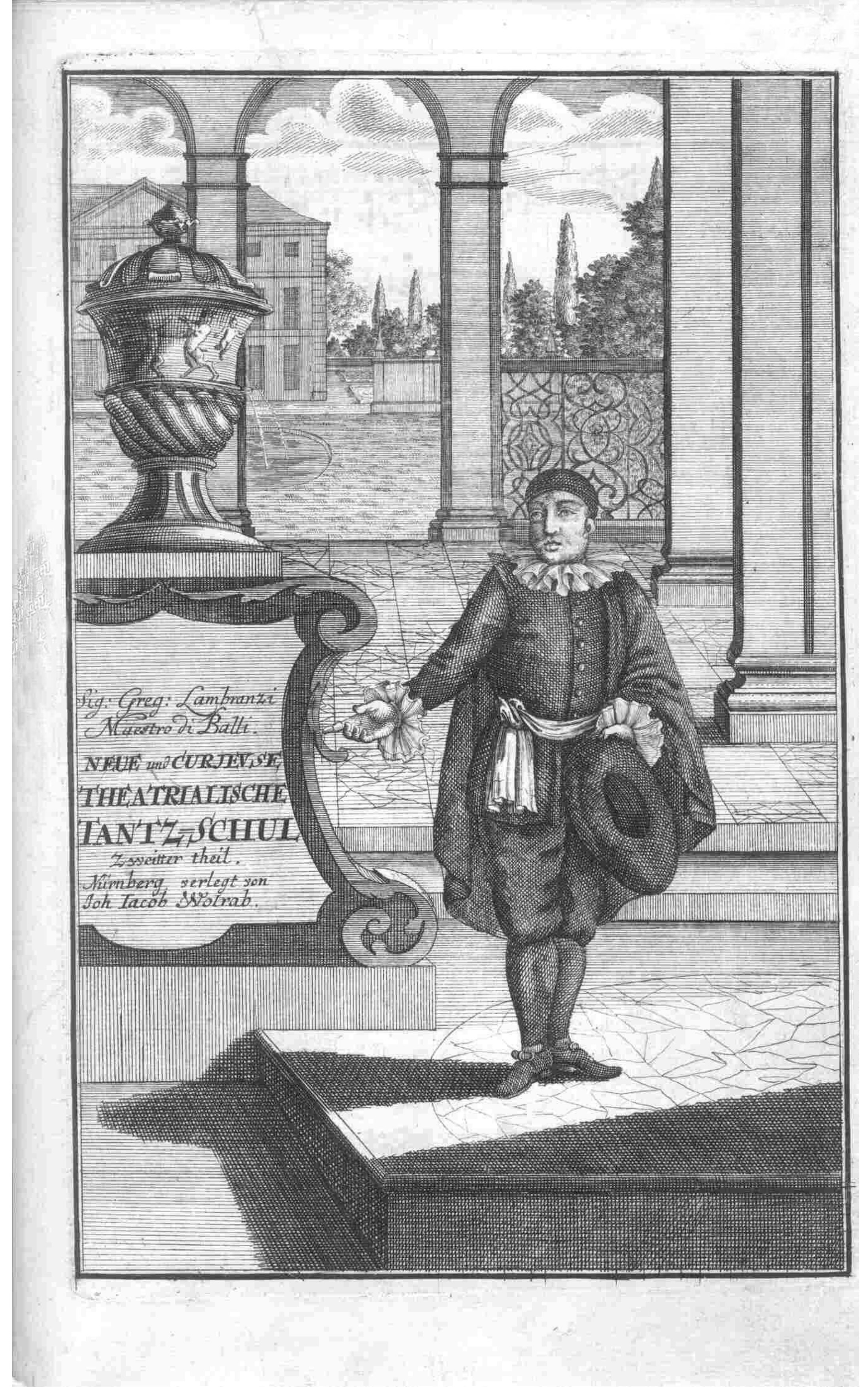
Allegorical — Plate 50
Gregorio Lambranzi
- Medium:
- Copper-plate engraving
- Dance:
- Notation/Choreography
- Era:
- 1700s (Enlightenment/Minuet Era)
- Collection:
- Nuova e curiosa scuola de' balli theatrali (1716)
- Source:
- Library of Congress
- Rights:
- Public domain — free to use, share and adapt.
- Recorded as:
- Public Domain
Lambranzi's manual is one of the few detailed surviving windows into how professional dancers moved on the Baroque stage—not in courtly social dance, but in the choreographed theatrical contexts where narrative and spectacle dominated. The engraving shows how carefully the body was composed for the stage: the costume, the formal architectural frame, the measured gesture, and the upright carriage all communicate a vision of dance as a learned, deliberate art form tied to classical rhetoric and visual beauty. For dancers and historians, the work documents the material and aesthetic conditions of professional performance in a period from which few dance records survive.
What you are looking at
A costumed male dancer stands in a classical architectural interior, framed by massive fluted columns and a barrel-vaulted ceiling that opens onto a distant landscape of cypress trees and formal gardens. The setting is a Baroque theatrical stage, with the action frozen in a shallow space—the dancer occupies the foreground while the elaborate architectural frame recedes behind him. An ornamental urn or trophy sits elevated to the left, sculptural and monumental. The entire scene is rendered in fine copper-plate engraving with delicate cross-hatching to suggest volume, shadow, and the play of light across marble and fabric. The dancer wears a richly decorated theatrical costume: a long-sleeved coat with ornamental buttons, white stockings, and dark shoes. His posture is upright and dignified, with one arm extended in a measured gesture toward the urn—a pose that suggests allegory and formal presentation rather than dynamic movement.
The dancing
The single male figure stands in three-quarter view, weight evenly distributed, spine erect in the formal carriage of court dance. One arm is extended in a controlled, deliberate gesture—not raised dynamically but placed with what appears to be symbolic intention toward the ornamental object. The opposite arm hangs with apparent ease. The overall frame is vertical and stable; there is no indication of rapid footwork, turn, or the weight shifts of social dance. The posture belongs to presentation and rhetorical gesture rather than to ballistic movement.
The dance depicted
This is a theatrical dance notation plate from Lambranzi's manual, which documents early-18th-century Italian theatrical dance for the trained professional stage. The pose and context suggest allegorical pantomime or a formal theatrical entry—a dance of presentation and symbolic meaning rather than social exchange. The upright posture, measured gesture, and lack of evident rotation or weight transfer indicate a style of theatrical movement based on classical dignity and geometric clarity. This is consistent with the formal theatrical dancing of the Baroque court and professional stage, where dance often served narrative and emblematic functions.
How it was made
Copper-plate engraving allows the artist to render fine detail, texture, and the modulation of light through varying densities of line. The architectural setting is constructed with linear perspective, suggesting deep space. The figure's costume is articulated through careful line work and cross-hatching that defines fabric, ornament, and the play of shadow. As an engraving, this image was reproducible and portable—the manual circulated widely in printed form, making Lambranzi's choreographic notation and theatrical style available to dance masters across Europe who lacked direct access to Italian performance traditions.
About this work
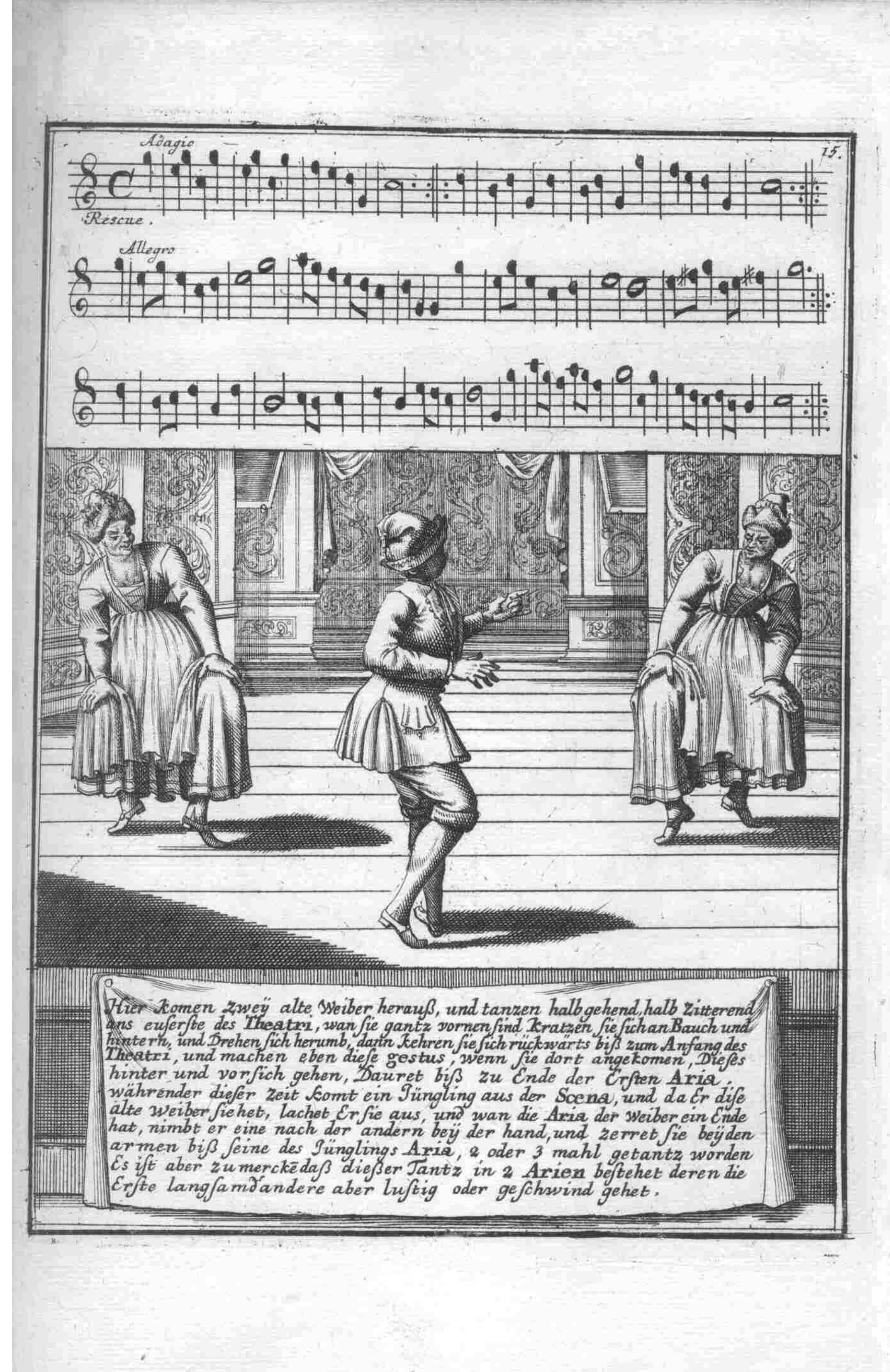
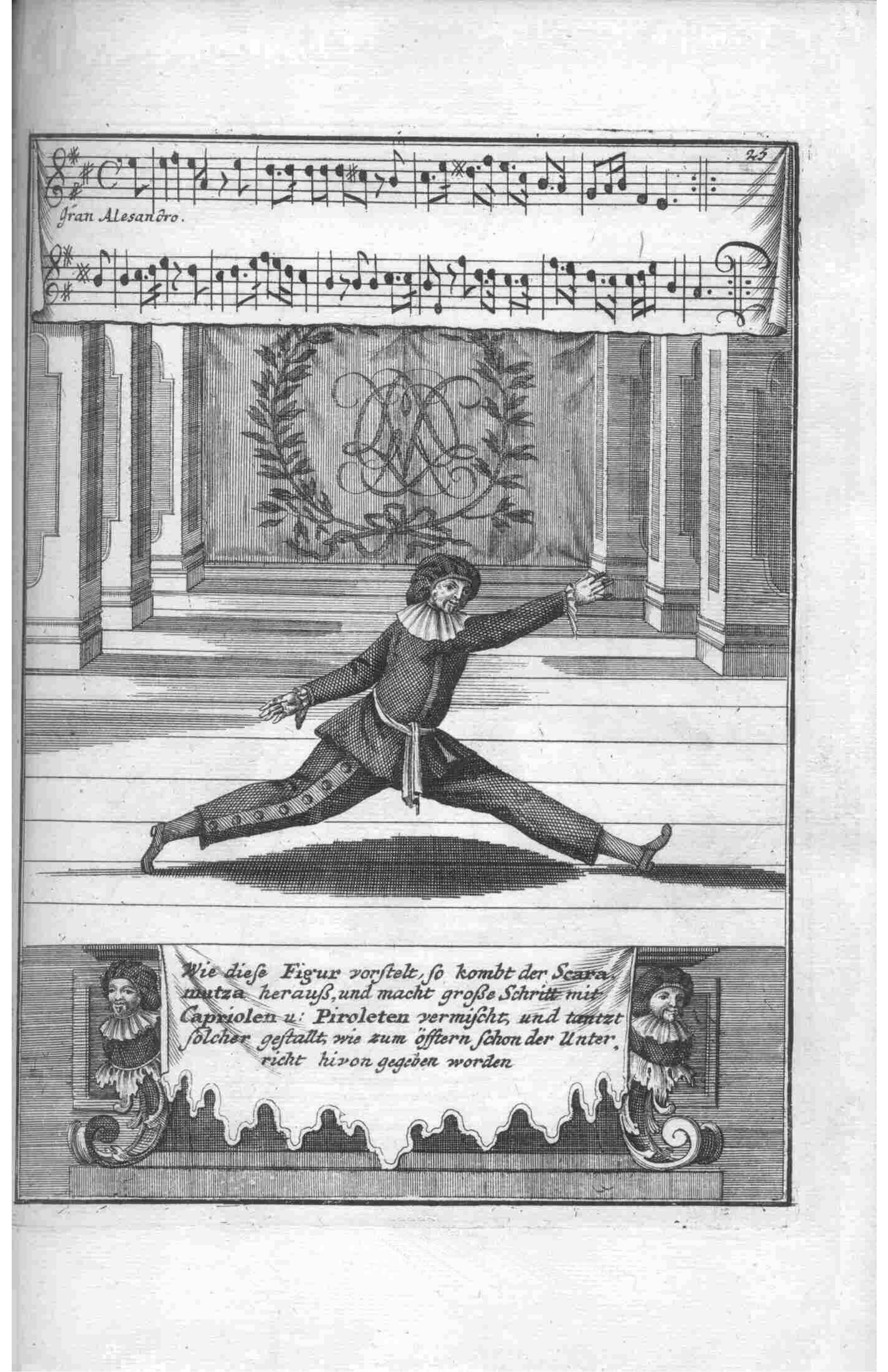
This is Plate 50 from Gregorio Lambranzi's *Nuova e curiosa scuola de' balli theatrali* (Nuremberg, 1716), one of the most comprehensive surviving records of early-18th-century theatrical dance notation and practice. Each plate in the manual pairs a notated music line (visible at the top) with a costumed figure and a brief German or Italian inscription, creating a choreographic score for the professional stage. The manual documents the vocabulary and movement quality of Italian theatrical dancing as it was performed and taught in court and professional contexts across the early modern period. This particular plate shows the formal, architecturally framed presentation of a single male dancer in an allegorical role—a reminder that early theatrical dance was deeply tied to scenic design, classical learning, and symbolic communication.
How to look at it
Attend to the careful composition of the figure within the architectural frame—the dancer is not performing for an audience in the picture, but rather presented to the viewer as an exemplum of a specific movement phrase or theatrical role. The extended arm and upright posture are not moments of dynamic action but rather frozen positions in a longer phrase, shown as a kind of sculptural statement. The ornamental urn and the classical architecture suggest that this is not social dance but rather an allegorical or narrative moment—dance integrated into theatrical spectacle. The precision of the engraving reveals how carefully the artist and choreographer understood the geometry and formal dignity required of the professional stage dancer.
The artist
Gregorio Lambranzi (fl. early 18th century) was an Italian dance master and choreographer who compiled and notated the theatrical dances of his era in one of the most significant dance manuals of the Baroque. His *Nuova e curiosa scuola de' balli theatrali*, published in Nuremberg in 1716, presented 144 plates of choreographic notation with accompanying engravings, each showing a costumed performer in a specific dance or theatrical role. Lambranzi worked in a tradition of Italian dance notation that combined written instruction, symbolic notation, and visual representation—a multimedia approach to documenting and transmitting dance knowledge. The manual was reprinted and translated, indicating its value as a practical resource for dance masters and as a record of professional theatrical practice.
The period
In the early 18th century, theatrical dance was undergoing rapid formalization and codification. The court ballet traditions of the 17th century were being refined into professional vocabularies, and dance was emerging as a serious art form worthy of written notation and theoretical study. Engraved dance manuals like Lambranzi's served professional practitioners and reflected broader Enlightenment interests in classification, notation, and the rational description of human movement. The Baroque theatrical aesthetic—marked by elaborate costume, architectural spectacle, and the fusion of dance with music, narrative, and design—is fully visible in Lambranzi's engravings. His work coincides with the rise of professional ballet as an institution and with growing attention to the technical mastery and compositional structure of choreography.
Where it lives
This plate belongs to Gregorio Lambranzi's *Nuova e curiosa scuola de' balli theatrali*, a comprehensive manual of theatrical dances published in Nuremberg in 1716. It is held in the Library of Congress collection. The manual is a foundational printed work of dance notation and theatrical choreography, combining notated music with engraved figures and German-language descriptions to communicate dance phrases to a professional audience.
Dance in this work
Questions about this work
What is a 'Scuola de' balli' and why does Lambranzi call this one 'curious'?
'Scuola' means school or method; Lambranzi's title promises a new and curious (i.e., novel and worth noting) school of theatrical dances. The manual is organized as a teaching method, moving from simpler dances to more complex theatrical combinations. The word 'curious' signals to the reader that this is a comprehensive, up-to-date account of Italian theatrical practice—something worth studying.
How do you read the notation at the top of the plate?
The small lines above and below the staff represent a musical score for the dance phrase. In Lambranzi's system, the score is synchronized with the dance figure shown below it. A trained dance master would use both the music and the engraved figure to understand the timing, rhythm, and movement quality of the phrase.
Is this a real person, or is the figure invented?
Lambranzi's figures are idealized representations of dance positions and theatrical roles, not portraits of specific dancers. However, they are based on the actual movement vocabulary of professional dancers in his time. The costume, posture, and gesture represent a real dance practice—the figure is a type rather than an individual.
Why does the dancer face away or to the side rather than directly at the viewer?
The angle shows the body in profile or three-quarter view so that the viewer can see the full geometry of the posture and the arm gesture. This was common in dance notation of the period—the aim was to communicate the shape and direction of the body clearly, not to simulate theatrical presence from a single viewpoint.
More Notation/Choreography artwork