49 works in this view — arrow keys or swipe to move between them.
Dance in Art
Acrobatic — Plate 51
Gregorio Lambranzi
- Medium:
- Copper-plate engraving
- Dance:
- Notation/Choreography
- Era:
- 1700s (Enlightenment/Minuet Era)
- Collection:
- Nuova e curiosa scuola de' balli theatrali (1716)
- Source:
- Library of Congress
- Rights:
- Public domain — free to use, share and adapt.
- Recorded as:
- Public Domain
Lambranzi is one of the few dance masters of the early 18th century whose work was both recorded and widely circulated; his manual is essential primary evidence for understanding how Baroque theatrical dance actually looked and was taught. This plate specifically shows the acrobatic vocabulary that male dancers were expected to master—a skill set that later Romantic ballet would largely suppress in favor of the female vocabulary of ethereal lightness, making it crucial evidence for the gendered history of ballet technique.
What you are looking at
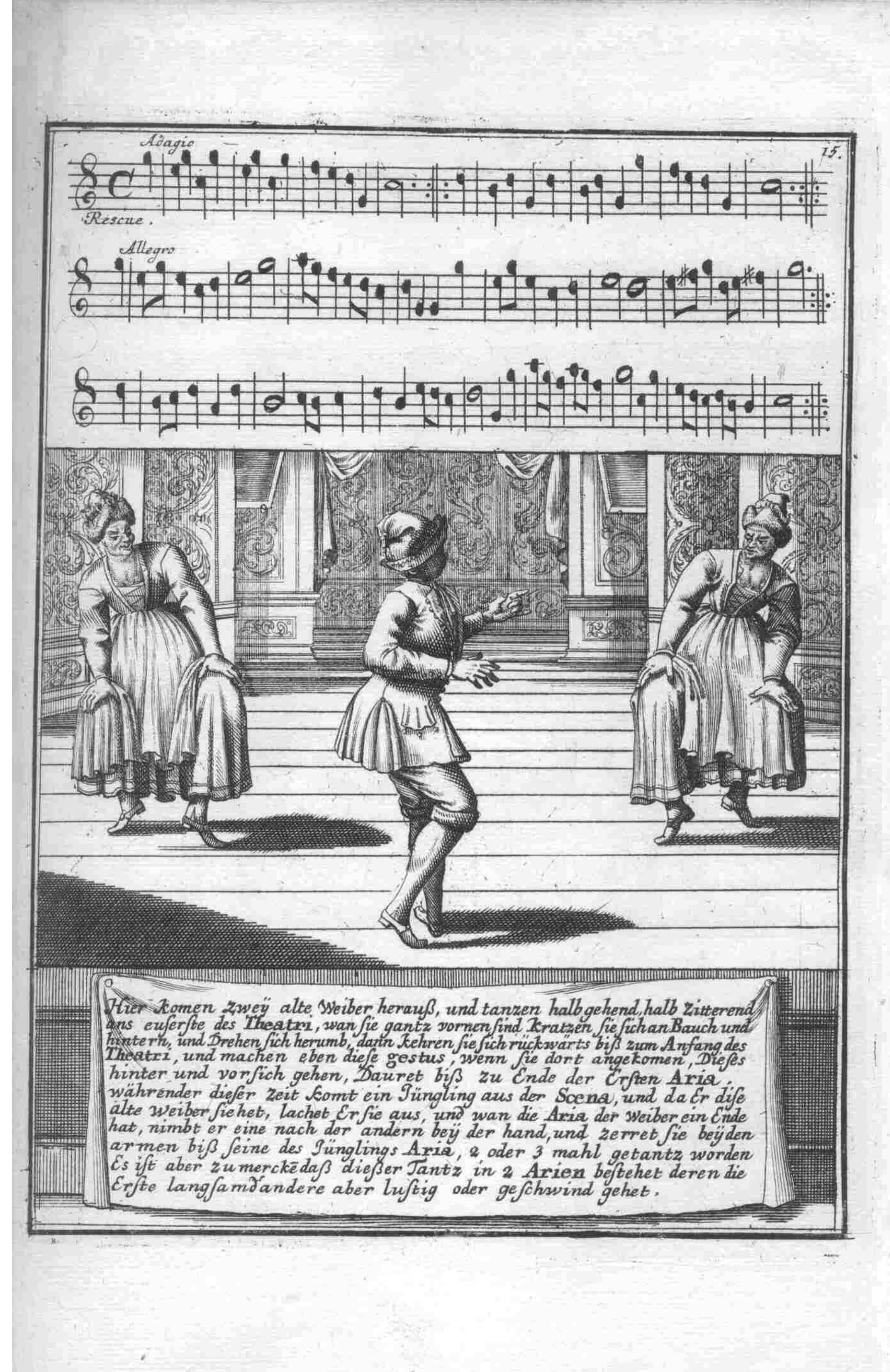
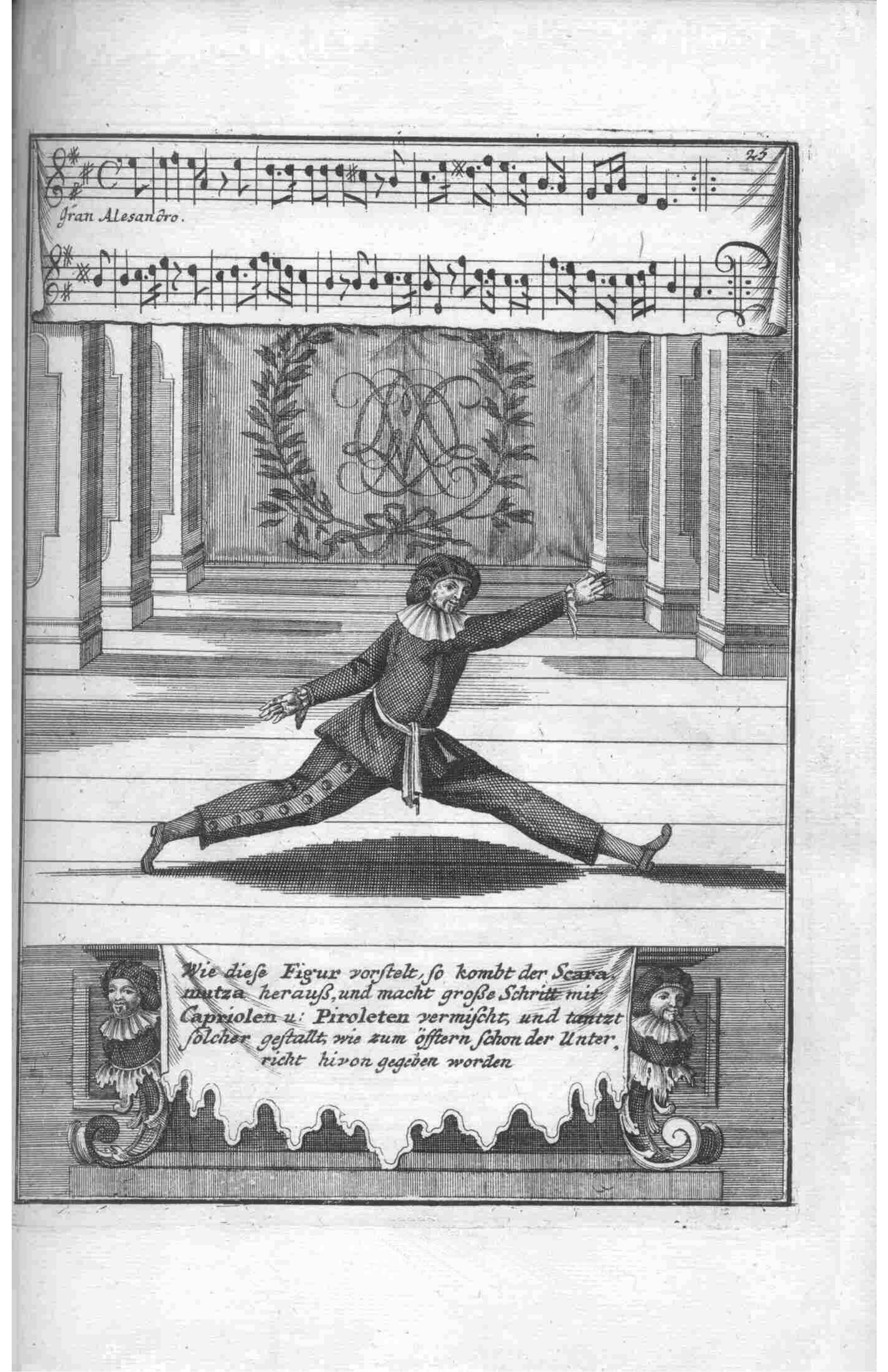
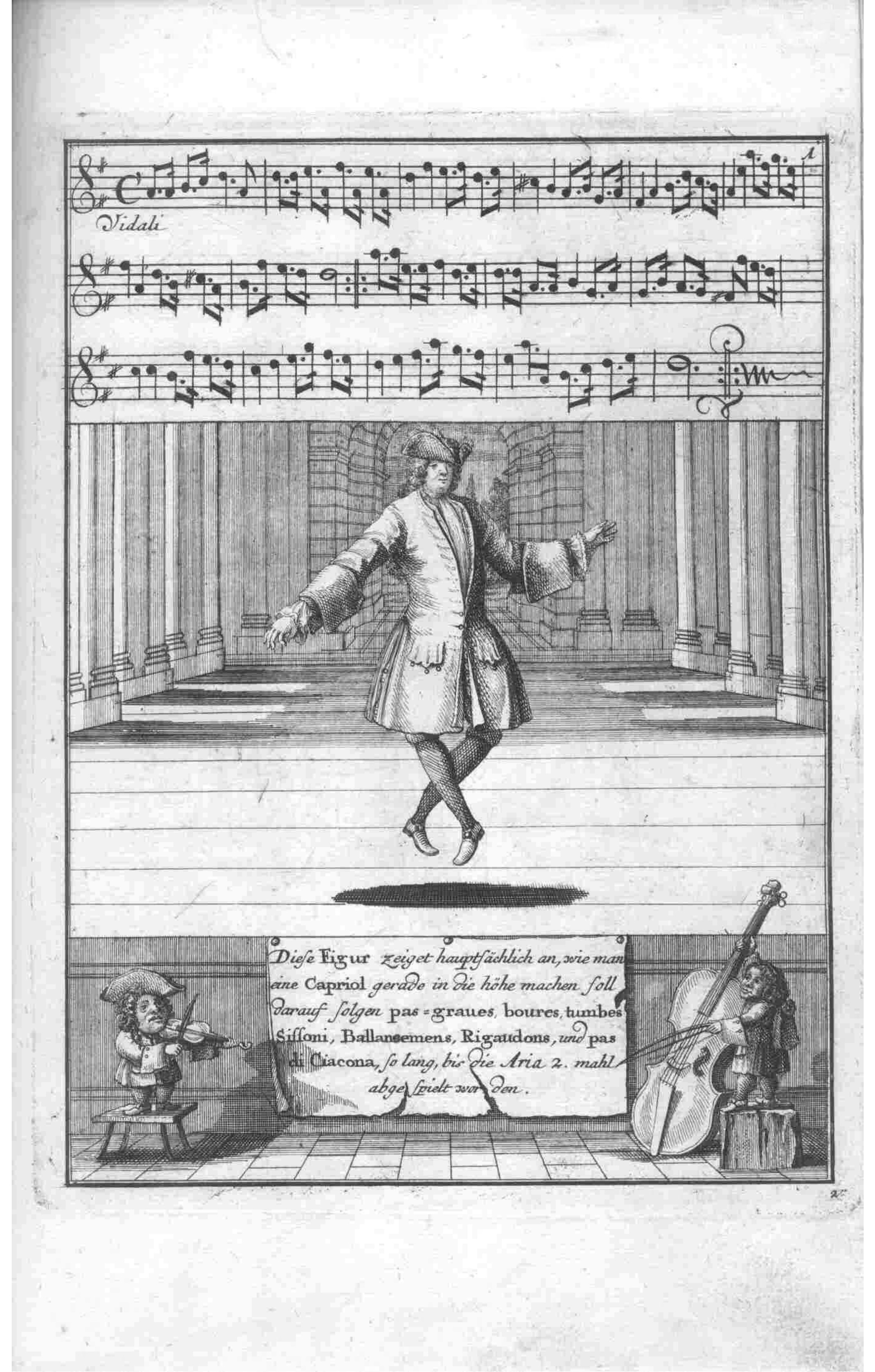
A solo male dancer in early 18th-century theatrical dress executes a high leap on a bare stage framed by classical columns and heavy curtains. He wears a light-colored coat with decorative trim over knee breeches and stockings, his body caught mid-air with legs extended and arms thrown open in an expansive gesture. The stage is a simple platform rendered in linear perspective, creating depth against the columned architectural setting. The dancer is suspended well above the stage floor, his weight distributed between the outward reach of his limbs and the airborne position of his body. Above the scene, three staves of musical notation in treble clef are labeled "Sidali" at the left margin, indicating this is one plate from a choreographic manual where each dance is paired with its music. Below the stage, German verse in a caption box describes the figure and its prescribed movements, flanked by allegorical instruments—a viol da gamba on the right and what appears to be a cupid or putto on the left.
The dancing
The dancer's frame is entirely vertical, with his torso upright and his arms opened wide in an exuberant gesture that reads as joy or theatrical exultation. His legs are extended in a nearly horizontal position, suggesting significant height and power in the leap. The posture shows no closed holds or partnering; this is a solo display of virtuosity. His extended reach and airborne attitude indicate a performer trained in balletic vocabulary but performing a move that emphasizes theatrical flair and acrobatic capability rather than the controlled geometry of later ballet technique.
The dance depicted
This is a theatrical dance from the early 18th-century European court and stage tradition, most likely a theatrical step or 'capriole' type movement—a high jump with a distinctive quality that Lambranzi's German caption describes as performed with specific rhythmic ornaments. The notation and costume place it firmly in the Baroque theatrical dance world, where such 'sautés' and acrobatic leaps were a standard feature of male dancer technique. The image demonstrates how even formal theatrical dance of this era incorporated vigorous aerial work; the term 'Acrobatic' in the plate title is likely the cataloguer's modern translation of a more specific historical step name. The movement would have appeared in theatrical divertissements, opera-ballets, and courtly entertainments.
How it was made
This is a copper-plate engraving, a technique that allowed fine linear detail and reproducibility essential for a dance manual's pedagogical purpose. The engraver has used parallel hatching to create volume and shadow, particularly visible in the drapery of the curtains and the modeling of the dancer's limbs. The marriage of notation and image on a single plate was a significant innovation: it allowed a reader to see the movement while simultaneously consulting its musical score. As a printed plate from Lambranzi's 1716 Nuremberg publication, this would have been distributed among the educated elite—courtiers, professional dancers, and dance masters—making it a rare window into how early 18th-century theatrical dance was codified and transmitted.
About this work
This is Plate 51 from Gregorio Lambranzi's *Nuova e curiosa scuola de' balli theatrali* (New and Curious School of Theatrical Dances), published in Nuremberg in 1716. The plate exemplifies the manual's format: a notated musical phrase paired with a costumed dancer performing a single figure on a stage set. Lambranzi's work is one of the most important surviving choreographic documents of the Baroque era, combining a master dance teacher's knowledge with the communicative power of the engraved image.
The *scuola* was not a textbook in the modern sense but a repertory of steps and figured dances with musical accompaniment, designed for circulation among professional and courtly dancers. Each of the 110 plates shows a named dance step, theatrical display, or short choreographic sequence performed in contemporary stage dress on a theatrical stage set. The detail visible here—the precise posture, the height of the leap, the spatial relationship to the architecture—was meant to instruct dancers in the exact manner of execution. This plate specifically demonstrates the high, open, exuberant leap vocabulary of male Baroque theatrical dancing, distinct from the more restrained court dances of the same era.
How to look at it
Look at the height and openness of the leap: this is not a neat petit allegro but an expansive, exuberant display of power and reach. Notice how the artist has positioned the dancer at the apex of the jump, not in ascent or descent—the choreographic moment chosen for the image is the moment of maximum extension and visibility. The columned architectural frame is not incidental; it suggests that this dancer is performing on a formal stage before an audience, not in a private chamber. The open arms and lifted chest convey not technical precision but theatrical presence and joy. Compare this to later neoclassical ballet poses to see how the aesthetic of male dancing changed: the verticality and reach here would become more constrained, the movement more internalized.
The artist
Gregorio Lambranzi (active late 17th–early 18th century) was an Italian dance master and choreographer working in the tradition of Feuillet notation and the Baroque theatrical dance school. Little is known of his biography, but his *Nuova e curiosa scuola de' balli theatrali* (1716) and its French translation demonstrate that he was engaged with both the courtly dance tradition and theatrical entertainment. The manual's publication in Nuremberg suggests his work had circulation in German-speaking territories. His use of notation combined with engraved illustration was innovative and influential; the work influenced later dance pedagogues and remains one of the most detailed surviving records of Baroque choreography.
The period
In the early 18th century, theatrical dance was undergoing rapid formalization. The Feuillet notation system (developed in the 1690s) had recently standardized the recording of dances, and dance masters were beginning to publish their work in notated form. Simultaneously, dance was diversifying into distinct traditions: courtly minuets and allemandes; theatrical dances in opera and ballet d'action; and the acrobatic display work shown here. Lambranzi's manual captures this moment of standardization and also the vigor of theatrical practice—the high leaps, turns, and physical display that characterized male dancer training. By the 1730s–1750s, as ballet d'action developed and Romantic ballet emerged, this acrobatic vocabulary would gradually be deemphasized in favor of a more ethereal aesthetic.
Where it lives
This engraving is one plate from the two-volume *Nuova e curiosa scuola de' balli theatrali*, published in Nuremberg in 1716. The work was printed in limited quantities and circulated among dance professionals, courtiers, and the educated elite. The Library of Congress holds a copy, as do other major research libraries. Each plate is a self-contained unit but derives its authority and meaning from its position within the systematic repertory of the whole manual.
Dance in this work
Questions about this work
What is Lambranzi's manual used for today?
Scholars and historically informed dancers use it to understand Baroque theatrical dance technique, spacing, and style. While notation can be ambiguous across time, the paired images and notation together allow reconstruction of steps and phrases. The manual is a primary source for early 18th-century dance history and a touchstone for historically informed performance.
How do you read the notation at the top?
The notation is Feuillet notation, a system that records path, direction, timing, and some quality through symbols placed on a musical staff. The three staves shown here correspond to the three dimensions of the dance (sideways, forward/back, and timing). Reading Feuillet notation requires training, but scholars have developed keys to decode it. The notation and the image together give far more information than either alone.
Was this movement considered difficult?
Yes. The height, the openness of the frame, and the apparent suspension required significant training in jumping, elevation, and control. Male dancers of the Baroque theatre trained for years to achieve this kind of height and extension. The inclusion of this step in a published manual suggests it was an important mark of professional male dancer training.
Why does the dancer wear such elaborate dress?
This is theatrical stage costume of the period. Male dancers of the Baroque often wore tailored jackets, breeches, stockings, and heeled shoes. The costume shown here is characteristic of a professional dancer performing in a theatrical context—not court dress, but 'stage clothes' that suggested nobility, elegance, and the formal world of theatre.
More Notation/Choreography artwork