49 works in this view — arrow keys or swipe to move between them.
Dance in Art
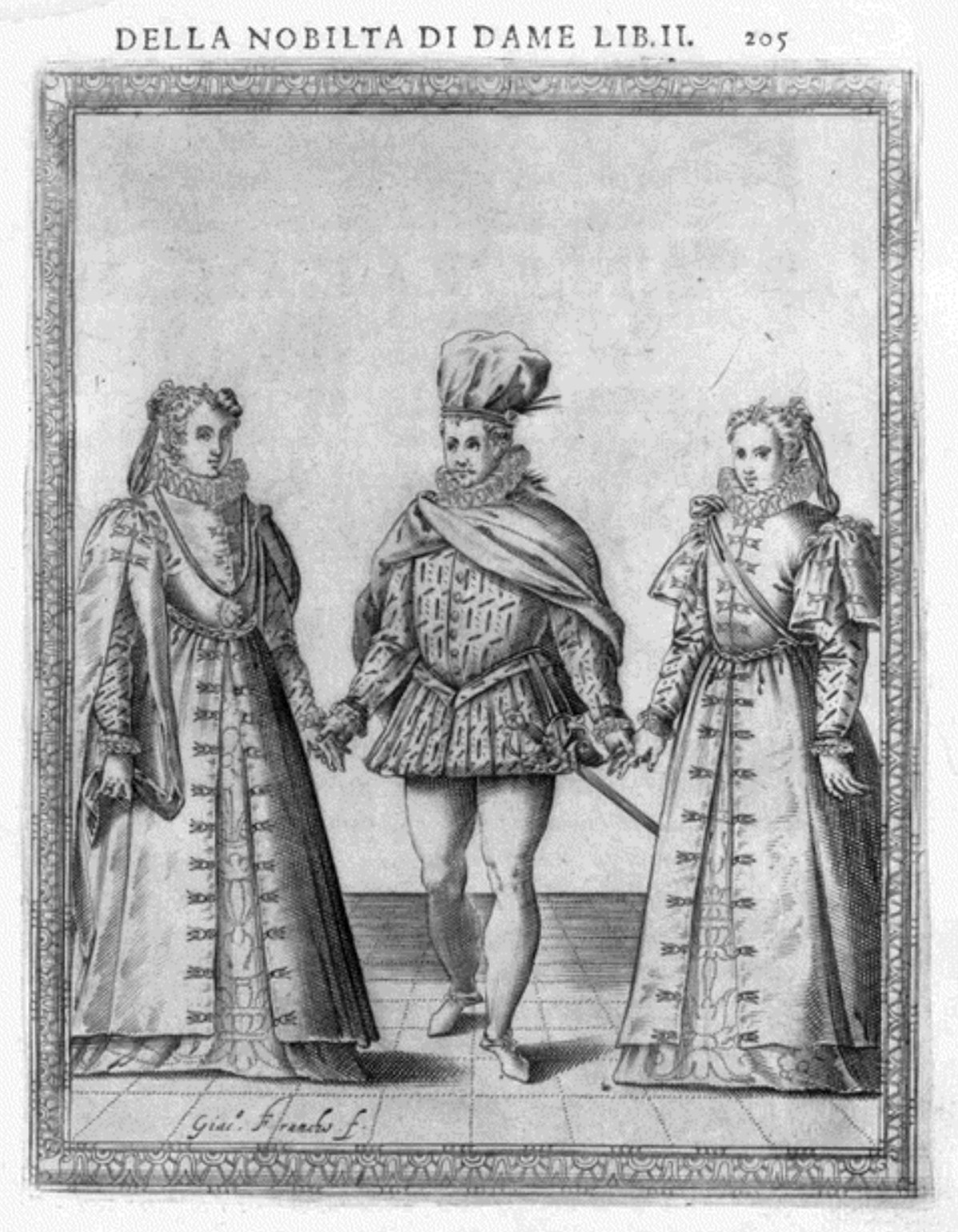
Caroso Nobiltà — Dance Plate (plate 19)
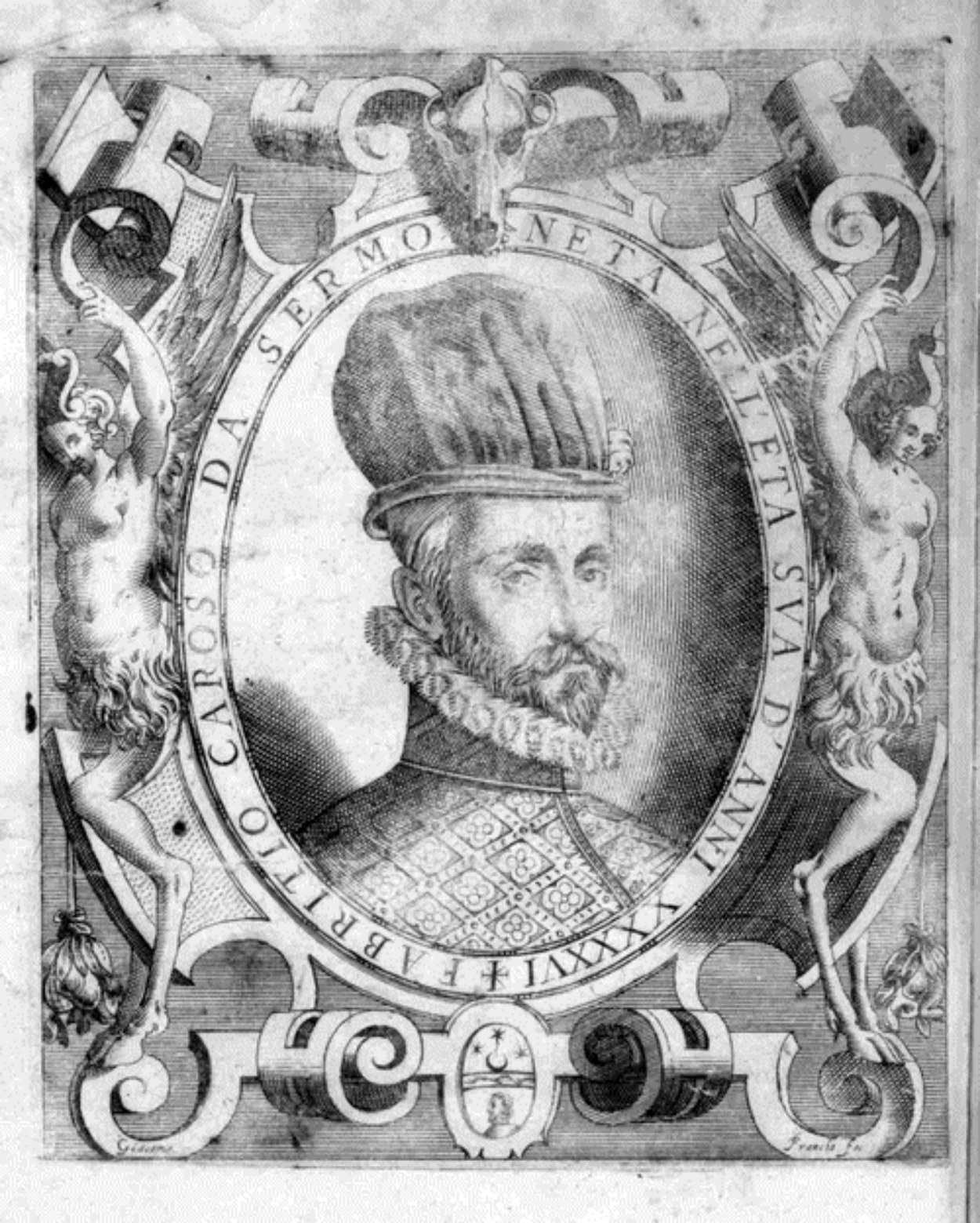
Fabritio Caroso da Sermoneta
- Medium:
- Woodcut
- Dance:
- Notation/Choreography
- Era:
- Pre-1700 (Renaissance/Baroque)
- Collection:
- Nobiltà di Dame (1600)
- Source:
- Library of Congress
- Rights:
- Public domain — free to use, share and adapt.
- Recorded as:
- Public Domain
This image is the closest thing Renaissance dance has to notation. For modern dancers and historians, it is evidence of how court dance was structured, who danced it, how the body was dressed and presented, and what formations mattered enough to preserve in print. Caroso's woodcuts are among the only visual records of Italian Renaissance dance in motion, however static they appear.
What you are looking at
Three figures stand in a shallow stage space defined by a plain ground line, against a neutral background. The central figure is a man in a doublet and hose, bare-legged, wearing a tall plumed hat and a cape draped across one shoulder; he holds a sword and stands with legs apart in a commanding pose. On either side stand women in long gowns with fitted bodices, puffed sleeves, and full skirts decorated with vertical trim or embroidered bands. Both women wear their hair elaborately dressed and crowned with jeweled ornaments. The women stand upright, their bodies aligned with the central male figure, creating a formal triangular composition. The figures are rendered as woodcut line-work with fine cross-hatching and detail; the image carries an inscription at the base that appears to read 'Gioi. Frania.'
The dancing
The three figures present a formal, symmetrical arrangement rather than a dynamic embrace. The man stands centrally with weight evenly distributed and knees slightly bent, arms extended; the women flank him at equal distances, their posture upright and mirrored. There is no closed ballroom hold; instead, the grouping suggests a processional or presentational moment. The man's extended arms and the women's calm stance suggest either the opening of a dance sequence or a formal pose for display. The distance between figures and their frontal orientation toward the viewer indicates this is a notation of position rather than a captured movement.
The dance depicted
This is a plate from Caroso's *Nobiltà di Dame*, the authoritative source for Italian Renaissance court dance in the late sixteenth and early seventeenth centuries. The image presents a *ballo* — a formal, choreographed court dance involving multiple dancers in prescribed figures. The composition illustrates what Caroso called a 'pairèd figure,' a foundational formation in which a man dances with two women in sequence or symmetry. The figures' formal dress, the presentation to the viewer rather than engagement with each other, and the arrangement all reflect the courtly protocol of the Renaissance Italian dance, which emphasized geometric precision, hierarchical positioning, and restrained nobility of movement over virtuosity.
How it was made
This is a woodcut, printed from the Venice 1600 edition of *Nobiltà di Dame*. Woodcut allowed for widespread circulation of dance instruction to courts across Europe and made Caroso's choreographies the standard reference for courtiers learning fashionable dance. The technique's bold line-work and clear definition suited the educational purpose — the figures must be legible at small scale and reproducible without loss. Each page of Caroso's treatise combined such woodcuts with written notation and prose description, making the book a hybrid text: visual, textual, and instructional.
About this work
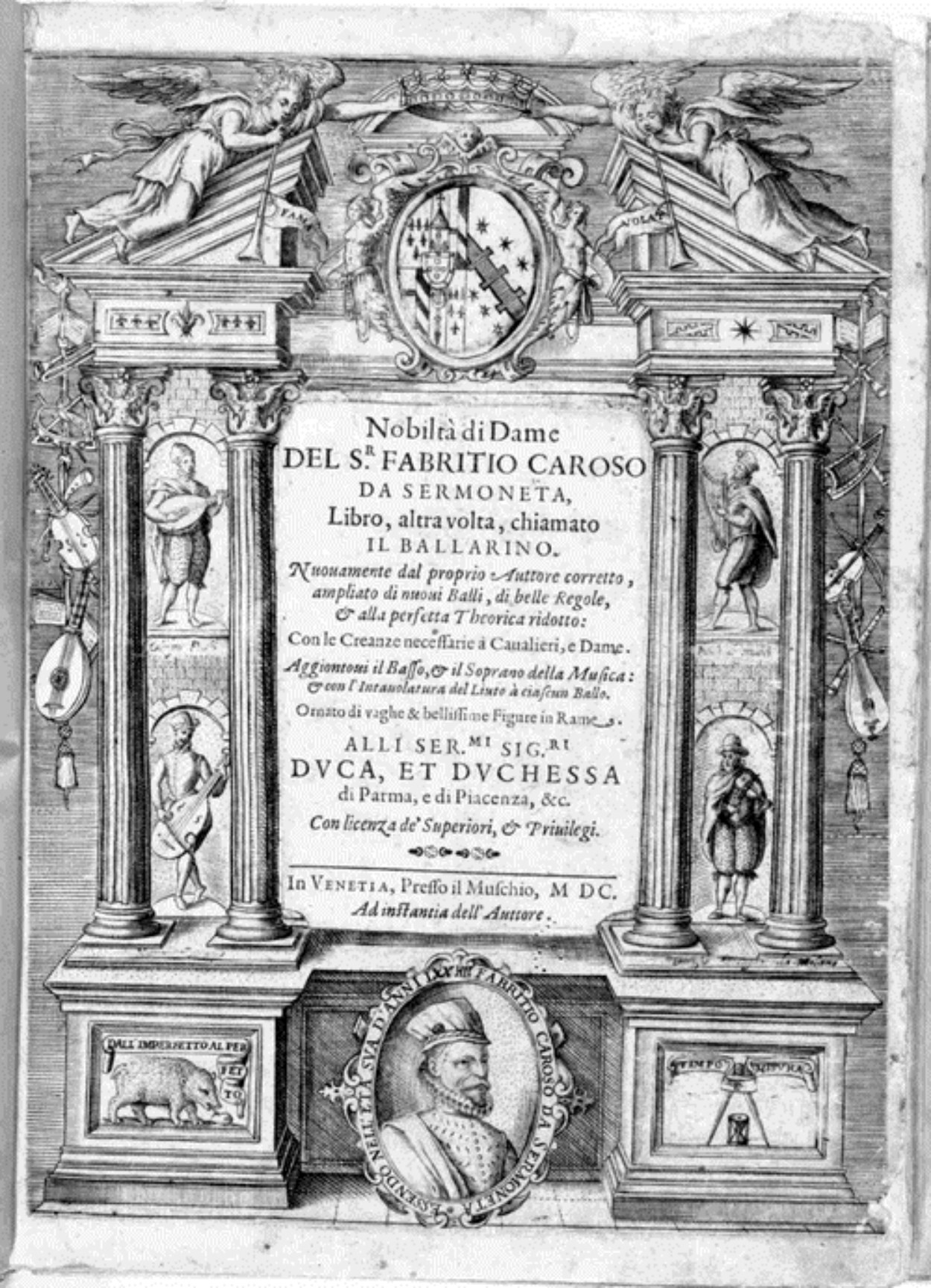
This is a choreographic notation in image form — one plate among hundreds in the foundational manual of Italian Renaissance dance. Caroso's *Nobiltà di Dame* (Venice, 1600) was a refined re-edition of his earlier *Il Ballarino* (1581), and it documents the dances performed at the courts of Italy at the turn of the seventeenth century. This particular plate illustrates a formal triple grouping, a man with two women, typical of the *balli* that dominated court entertainment. The composition is not theatrical but instructional: it freezes a specific formation so that dancers elsewhere could learn and replicate it.
The work belongs in a dance history collection as evidence of how Renaissance choreography was transmitted, standardized, and performed. Caroso was to sixteenth-century Italian dance what Beaumont and Arbeau were to other European courts — the keeper of authorized movement vocabularies and their visual record.
How to look at it
Look first at the positioning: the man stands in the center, slightly forward, with the two women equidistant on either side. This is not a couple's dance or a moment of embrace, but a formal, symmetrical arrangement. The man's extended arms and open posture suggest he is either leading or presenting; the women's upright, mirrored bodies show compliance with a prescribed formation. The costumes—particularly the man's sword and plumed hat, and the women's jeweled headdresses—signal that this is noble, courtly dance, not popular or theatrical performance. The woodcut technique itself is important: the clear, bold lines and the frontal presentation indicate this is a notation meant to be read and learned, not a representation of a moment witnessed.
The artist
Fabritio Caroso da Sermoneta (c. 1525–1605) was a dance master active in Rome and Venice, and the author of two editions of *Il Ballarino* / *Nobiltà di Dame*. He was among the most celebrated choreographers of the late Renaissance, and his two treatises are the most comprehensive surviving records of Italian court dance of that era. The 1600 edition, dedicated to Christine of Lorraine, grand duchess of Tuscany, represents Caroso's mature practice and incorporates revisions and fashionable updates to the dances from the 1581 first edition. His treatises combined prose description, geometric diagrams, and woodcut illustrations to create a comprehensive dance manual—a form that proved influential and was imitated by later dance masters across Europe.
The period
In the late sixteenth and early seventeenth centuries, dance was a primary courtly accomplishment and a medium for expressing rank, alliance, and aesthetic refinement. Italian court dance, particularly as practiced in Venice and Rome, was considered the most sophisticated in Europe. The *ballo* — a choreographed, multi-dancer court dance with fixed sequences — was the dominant form, distinct from the improvised *balletto* of earlier decades. The 1600 edition of Caroso's work reflects the transition from the high Renaissance to the early Baroque court, a moment when dance was becoming increasingly codified and when printed dance manuals were becoming essential tools for courtly education. This coincided with the rise of visual arts documenting courtly life and the expansion of print technology for instructional texts.
Where it lives
This plate comes from the Venice 1600 edition of *Nobiltà di Dame*, held by the Library of Congress. The book is a comprehensive manual of late Renaissance Italian court dance, containing dozens of such plates illustrating specific figures, formations, and dances, each accompanied by prose and geometric notation. The work circulated among courtiers, dance masters, and educated elites across Europe.
Dance in this work
Questions about this work
What is a 'pairèd figure' and why would a Renaissance dancer need to learn it?
A pairèd figure was a fundamental formation in Italian court dance in which a man danced with two women in equal or symmetrical roles. It was essential to the social grammar of the court: it demonstrated the dancer's ability to manage multiple partners, maintain geometric precision, and navigate the hierarchies of rank and gender that structured courtly life. Mastering such figures was a mark of accomplishment and social standing.
Why are there woodcut illustrations in a dance treatise?
Woodcuts served as visual notation. In an era without film or Labanotation, the printed image was the closest a dance master could come to documenting actual movement for a distant reader. Combined with prose description and geometric diagrams, the woodcut allowed Caroso's dances to be circulated, learned, and replicated in courts across Europe. The technique's clarity and reproducibility made it ideal for instruction.
What is the difference between the 1581 and 1600 editions of Caroso's work?
The 1600 edition, *Nobiltà di Dame*, was a refined re-edition that incorporated new dances and revisions reflecting changes in courtly fashion and movement style over the preceding two decades. It was also dedicated to a more prominent patron (Christine of Lorraine), signaling the continued prestige of Italian court dance at the turn of the century. Many of the core dances remained, but the 1600 edition is considered more authoritative and comprehensive.
Can you tell from this image what the actual steps and movements were?
Not entirely. The image shows formation and positioning, but the detailed footwork, timing, and arm movements are described in the accompanying prose text and geometric diagrams in the book. A complete reading of Caroso requires consulting all three forms of notation together—image, word, and diagram. Modern dance historians have reconstructed these dances by combining all available evidence from Caroso's manual and other contemporary sources.
More Notation/Choreography artwork