49 works in this view — arrow keys or swipe to move between them.
Dance in Art
Caroso Nobiltà — Dance Plate (plate 25)
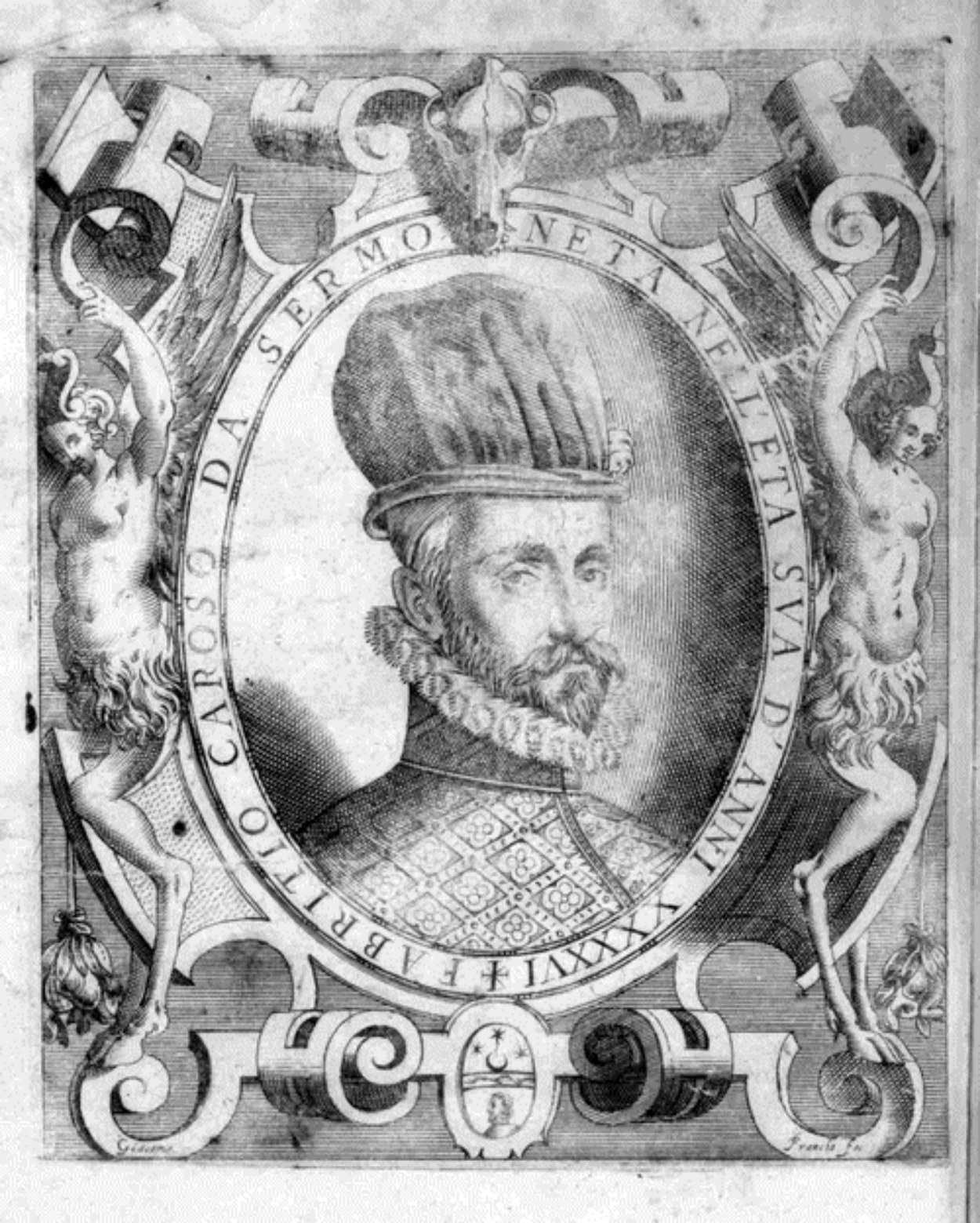
Fabritio Caroso da Sermoneta
- Medium:
- Woodcut
- Dance:
- Notation/Choreography
- Era:
- Pre-1700 (Renaissance/Baroque)
- Collection:
- Nobiltà di Dame (1600)
- Source:
- Library of Congress
- Rights:
- Public domain — free to use, share and adapt.
- Recorded as:
- Public Domain
This diagram preserves the actual choreography of a Renaissance court dance in a form that allows reconstruction and performance. It is direct evidence of how movement was conceptualized, notated, and taught in the highest circles of European court culture, making it invaluable both to dance historians and to practitioners attempting historical reconstruction. The geometric abstraction of the diagram also shows how Renaissance thought applied mathematical order to the body's movement through space.
What you are looking at
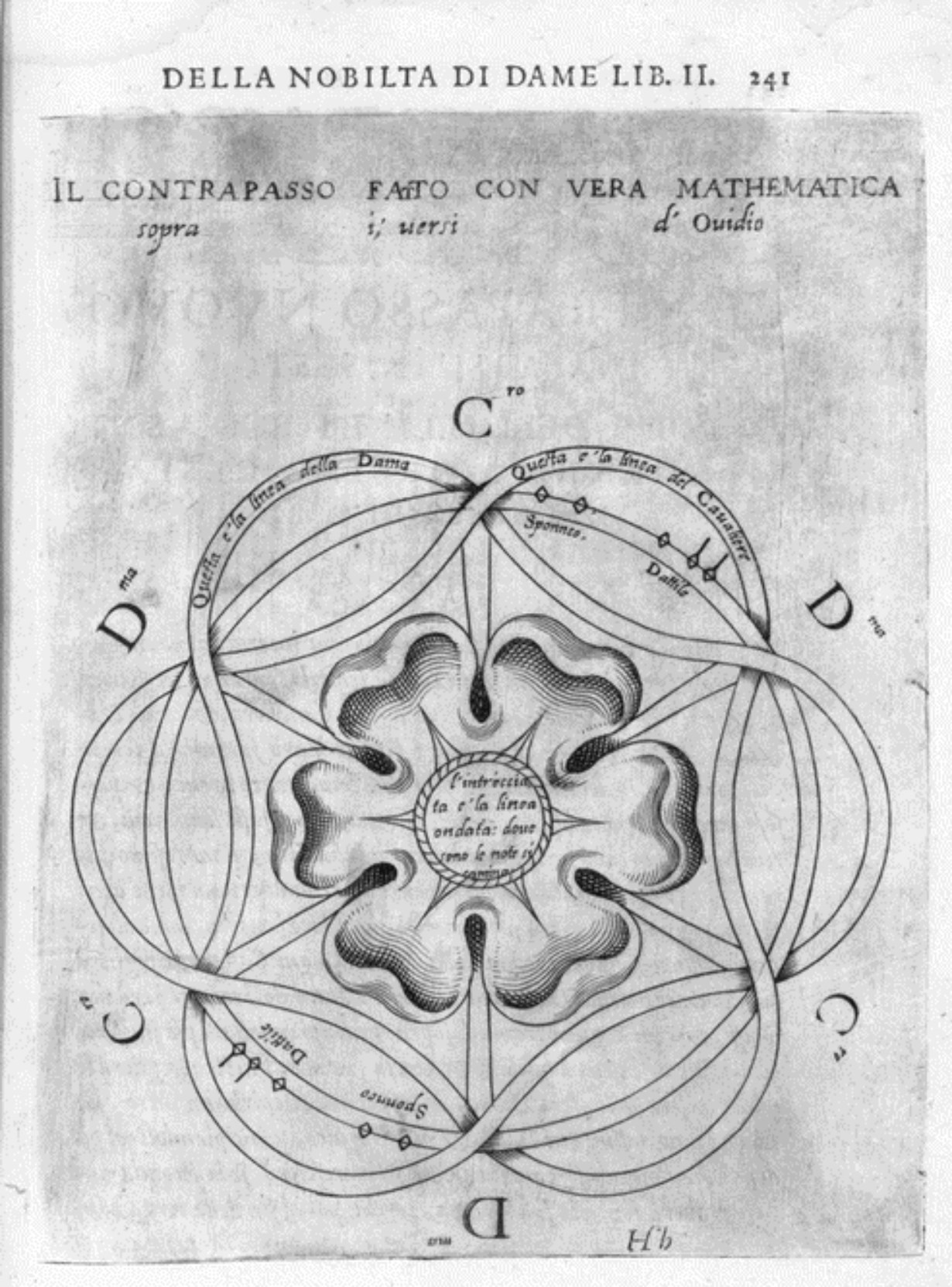
This is a geometric diagram from a Renaissance dance manual, not a representational scene. At its center is an eight-petaled flower or star motif, rendered in cross-hatching, around which orbit four overlapping circles labeled C, D, and repeated positions. Each circle contains notational marks and labels in Italian script identifying dance positions and figures. The outer rings of the diagram show curved lines marked with points, suggesting the pathways and spatial positions dancers would occupy. The entire composition is symmetrical and mathematical in construction, reflecting the ordered, geometric approach to choreography in late 16th-century Italian court practice. This is a choreographic ground plan or 'contrapasso' — a mapping of dancers' positions and movements through space rather than a pictorial representation.
The dancing
No human figures are depicted. Instead, the diagram uses abstract notation: labeled points (marked with small circles), curved lines indicating paths of travel, and concentric rings showing spatial relationships. The letters C and D appear to mark specific dancers or pairs, positioned at cardinal points around the central motif. The curved pathways suggest movement in coordinated, symmetrical patterns typical of the formal couple dances of the period. This is notational rather than representational art — a score for movement rather than an image of bodies.
The dance depicted
This is a choreographic diagram for a Renaissance court dance, almost certainly one of the dances documented in Caroso's manual. The notation system shows the 'contrapasso' (counter-passage or meeting figure), a fundamental movement pattern in 16th-century Italian dance where couples approach and pass each other in symmetrical, interlocking paths. The geometric precision reflects the mathematical principles underlying Renaissance choreography, where dancers moved through carefully prescribed spatial patterns. Caroso's dances typically involved pairs or small groups executing these patterns to the measured rhythms of music, with considerable emphasis on courtly decorum and geometric order.
How it was made
Woodcut, as stated in the record. The medium is crucial here: woodcut allowed Caroso to produce multiple copies of his notational system, making this diagram reproducible and distributable to dance masters and noble pupils across Europe. The technique's limitations — sharp lines, bold areas of black and white, reliance on clear geometric forms — actually served the notational purpose well, as complex curves and overlapping paths needed to be legible when printed on small pages. The precision of the cutting suggests a highly skilled craftsman translating mathematical diagrams into the woodcut medium.
About this work
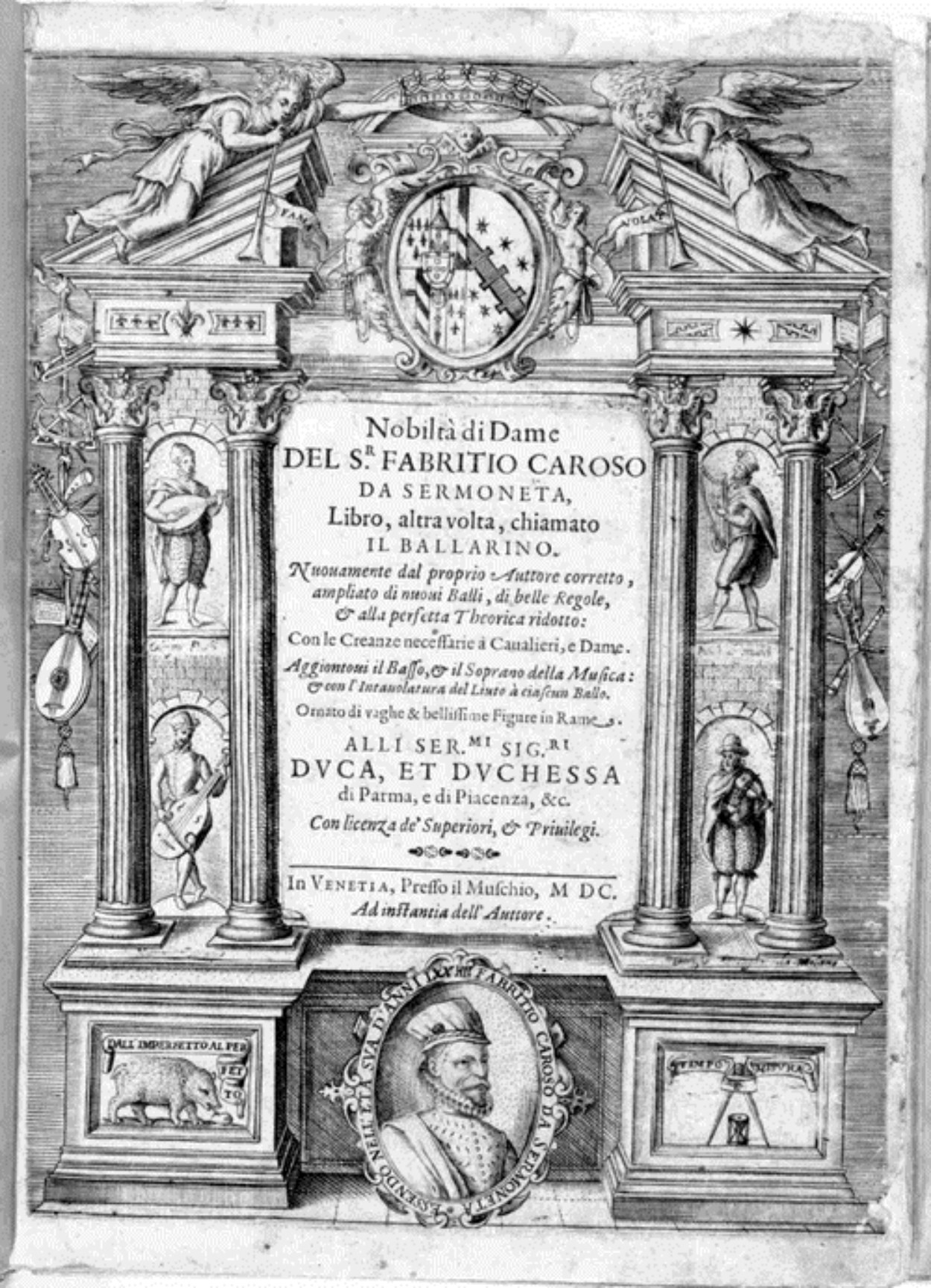
This is a choreographic notation from Fabritio Caroso's *Nobiltà di Dame* (Venice, 1600), the refined republication of the most authoritative Renaissance dance manual of the 16th century. Rather than depicting dancers, it documents how they should move — a ground plan for a 'contrapasso,' the fundamental counter-passing figure of Italian court dance. The work belongs in a dance history collection as evidence of how Renaissance dance was transmitted through written notation, and in visual culture history as an example of how notation systems visualize abstract movement. Caroso's notational plates are primary sources for understanding the actual choreography of Renaissance court dances and the mathematical principles underlying them.
How to look at it
Approach this as you would a musical score: the geometric shapes and labeled points are instructions for movement in time and space. The central eight-petaled motif is the moment of the dance being diagrammed; the orbital paths show how dancers arrive at and depart from this formation. The letters C and D mark specific dancers or couples. The symmetry of the diagram is key — Renaissance court dances depended on mirror-image movements and geometric precision, and the perfect symmetry here is not decorative but functional. This is a moment frozen in spatial notation rather than temporal sequence.
The artist
Fabritio Caroso da Sermoneta (c. 1526–c. 1605) was the most celebrated dance master of late 16th-century Italy and the author of the two most comprehensive and influential Renaissance dance manuals. His first treatise, *Il Ballarino* (1581), established him as the leading authority on courtly dance; *Nobiltà di Dame* (1600) was a substantially revised and expanded edition, dedicated to Christine of Lorraine and incorporating the most current practices of the Medici and other Italian courts. Caroso's notational system, though not the first, was the most systematic and widely adopted, and his manual served as the model for dance instruction across Europe. His work represents the apex of Renaissance humanist thinking about dance as a liberal art combining mathematics, music, and bodily discipline.
The period
By 1600, when this plate was published, Renaissance court dance had reached its fullest formal development. The dances Caroso notated — pavanes, galliards, and particularly the branles and 'contrapassos' shown here — were the standard repertory of European noble life. The turn of the century saw the transition from the vital, jumping galliard style toward the more measured, processional forms that would dominate Baroque dance. Caroso's emphasis on geometric precision and mathematical order in the ground plans reflects the late Renaissance fascination with proportion and harmony in all arts. The publication of *Nobiltà di Dame* in Venice, the leading printing center of Europe, ensured wide circulation among both dance masters and the nobility they served.
Where it lives
This is plate 25 from *Nobiltà di Dame*, the 1600 Venice edition, one of the most widely held Renaissance printed books. The Library of Congress holds multiple copies of this edition, making it among the most accessible primary sources for Renaissance dance study.
Dance in this work
Questions about this work
Is this an actual picture of people dancing?
No. This is a choreographic notation or ground plan — a diagram showing where dancers should move and how they should meet each other in space. It is more like a musical score than a representational picture. Caroso created these diagrams so that dance masters in different cities could teach his choreography to their pupils.
What is the flower shape in the middle?
The eight-petaled motif represents the moment when the dancers are arranged in a symmetric pattern around a central point. The curved lines radiating outward show the pathways they take to reach and leave this formation. It is a moment of geometric order within the larger dance pattern.
Could dancers actually perform from these diagrams?
Yes, if they had already been trained in Renaissance dance vocabulary by a master. The diagram shows *where* to go and *when* to meet your partner, but assumes knowledge of the basic steps, arm movements, and the music. Caroso's book includes both diagrams and detailed written descriptions of steps and music for this reason.
Why is everything so symmetrical?
Symmetry was a core value of Renaissance court culture — it signaled harmony, divine order, and courtly refinement. The dancers' movements had to be geometrically perfect and mirrored, reflecting the mathematical principles the Renaissance applied to art, music, and architecture. Perfect symmetry proved mastery.
More Notation/Choreography artwork