49 works in this view — arrow keys or swipe to move between them.
Dance in Art
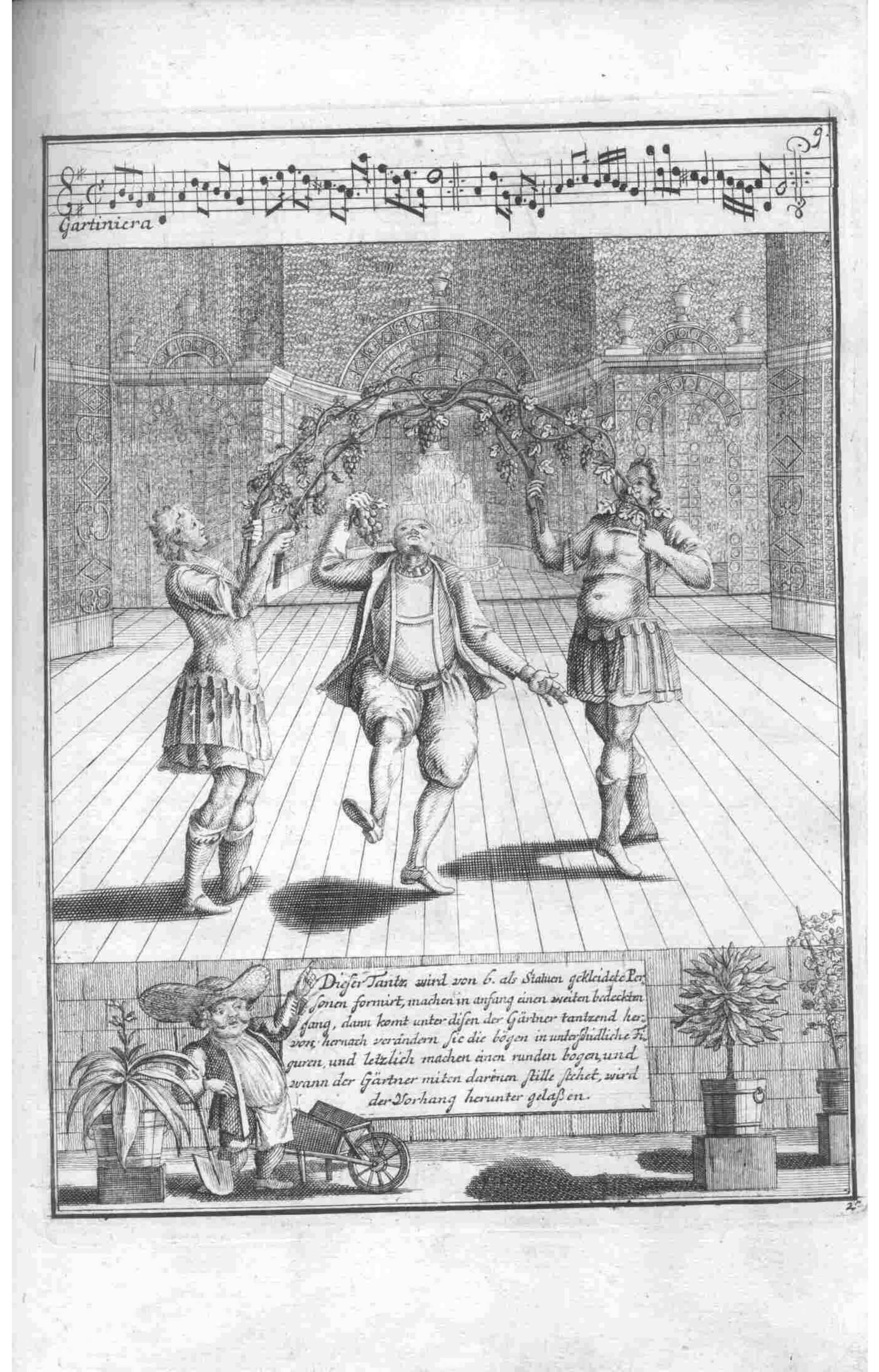
Acrobatic — Plate 59
Gregorio Lambranzi
- Medium:
- Copper-plate engraving
- Dance:
- Notation/Choreography
- Era:
- 1700s (Enlightenment/Minuet Era)
- Collection:
- Nuova e curiosa scuola de' balli theatrali (1716)
- Source:
- Library of Congress
- Rights:
- Public domain — free to use, share and adapt.
- Recorded as:
- Public Domain
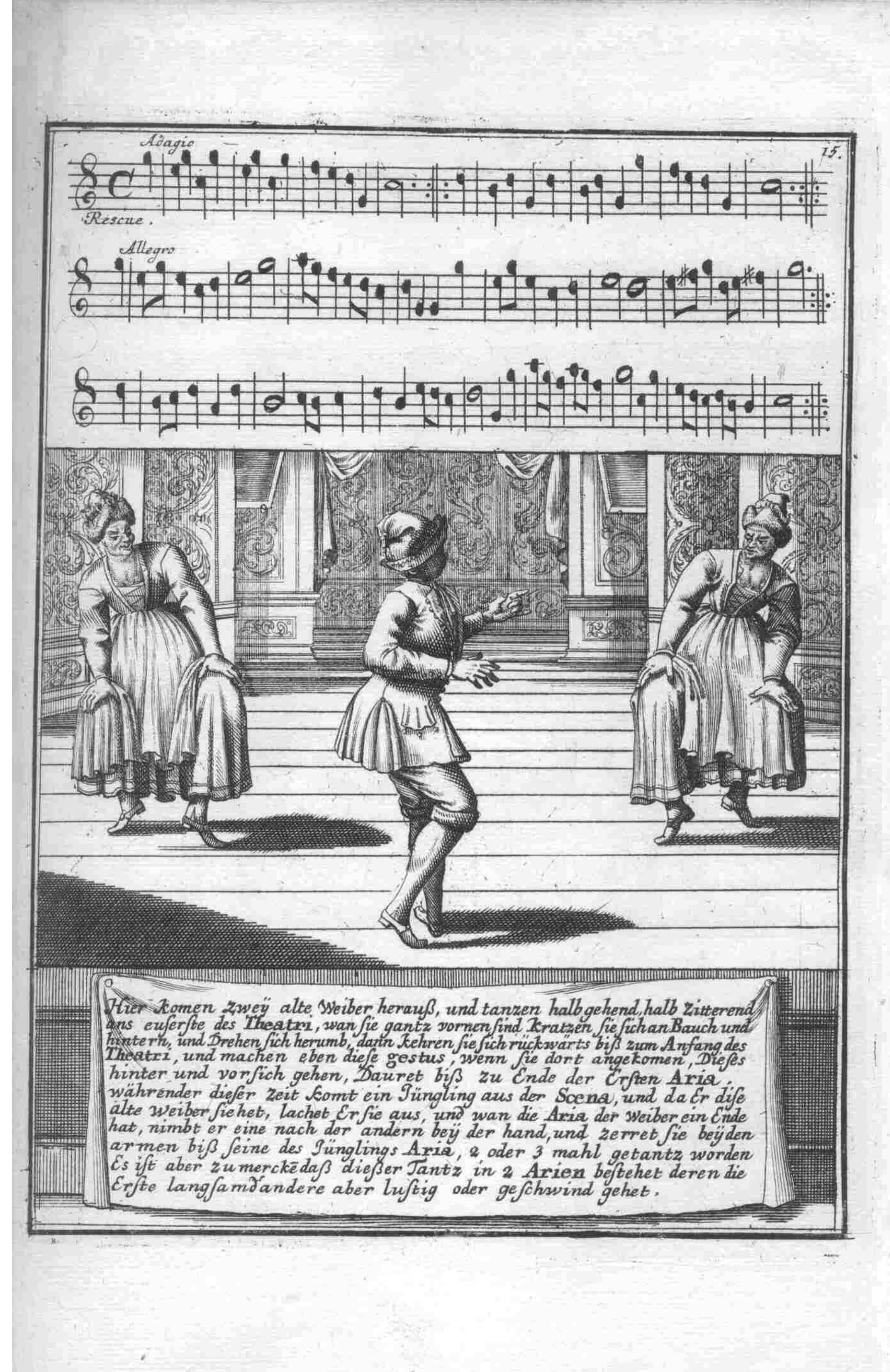
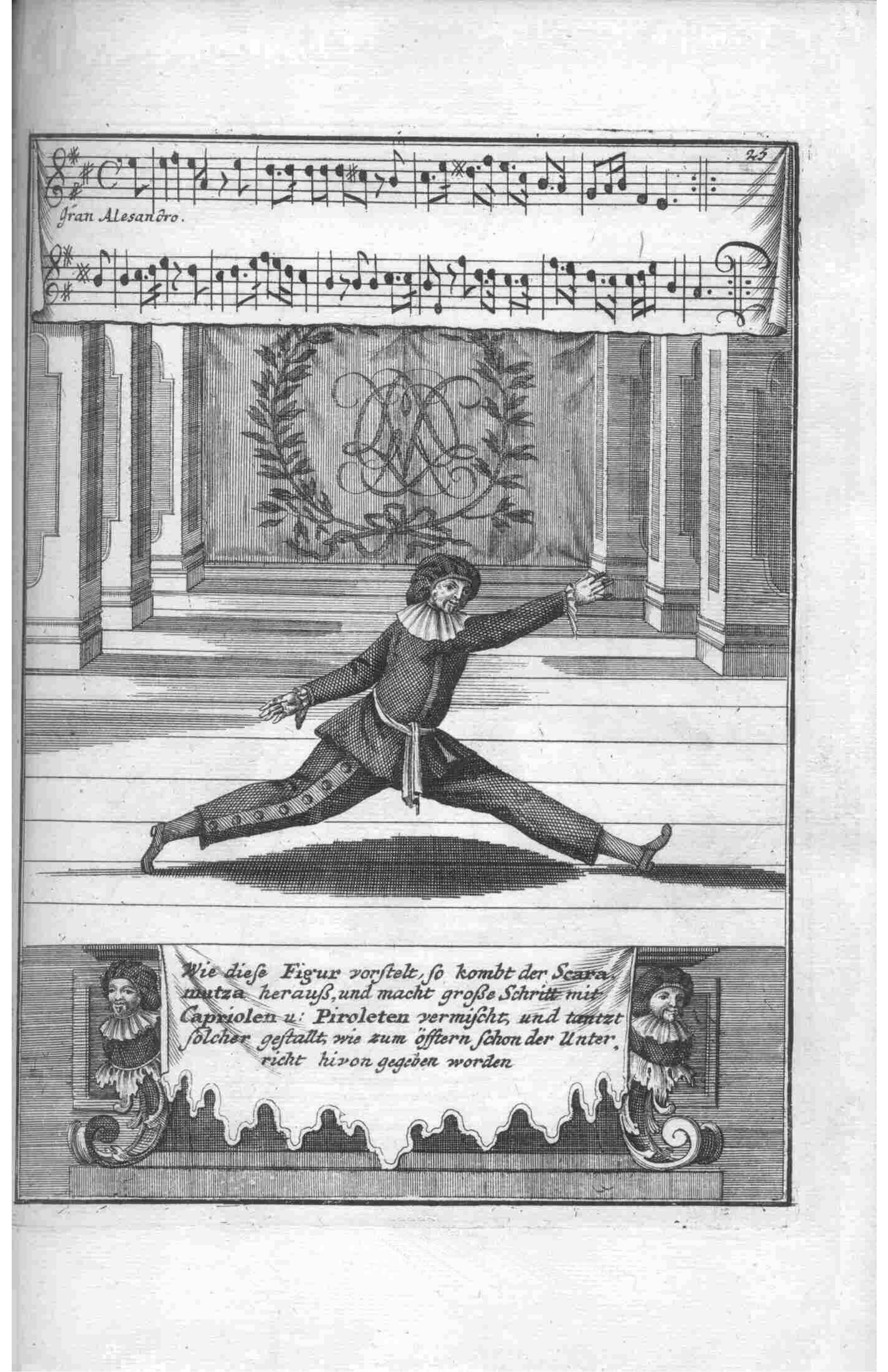
Lambranzi's plates are among the few surviving records of how theatrical dancers actually moved in the early 18th century before the dominance of academic ballet. This image documents the acrobatic component of theatrical dance—a capability that would later be absorbed into ballet's vocabulary but is here shown as an independent, display-oriented feat. For dance historians, these plates are foundational evidence of pre-classical technique.
What you are looking at
A theatrical stage set with ornate curtains and architectural background shows three male figures engaged in acrobatic movement. The central figure, wearing a simple tunic and appearing to be mid-leap or jump, is captured with legs extended in the air. Two companion figures—one on the left in a shortened skirt typical of theatrical costume, one on the right in armor-like dress—flank the leaping dancer, their bodies in supporting postures with arms raised. The floor is rendered in perspective lines suggesting depth; the stage is framed by decorated columns and a semi-circular arch above. The engraving technique creates strong contrasts between the figured architecture, the dancers' bodies, and the background, with fine hatching suggesting volume and shadow. Above the scene runs a single staff of musical notation labeled 'gartiniera,' providing the score that accompanies the movement.
The dancing
All three figures display weight commitment to vertical space. The central jumper shows extended legs in what appears to be a broad horizontal split or straddled leap—a feat requiring significant strength and flexibility. His companions stand with legs firmly planted, upper bodies engaged, arms positioned to suggest either support, encouragement, or rhythmic counterpoint to the jump. The pose is one of explosive vertical momentum, frozen at the apex of the action.
The dance depicted
This depicts a theatrical acrobatic or aerial feat, most likely the 'caper' or jump mentioned in the catalogue. In early 18th-century theatrical dancing, capers and aerial jumps were essential displays of virtuosity in comic and pastoral scenes. The notation 'gartiniera' may indicate a specific theatrical genre or musical form accompanying such tricks. The presence of multiple figures suggests this was a group feat or ensemble sequence rather than solo display. The acrobatic movement shown here belongs to the broader vocabulary of theatrical dance before the codification of academic ballet technique.
How it was made
Copper-plate engraving, as indicated by the fine linear hatching, sharp contrasts, and precise linework visible throughout. This technique allowed for detailed notation and small, reproducible prints suitable for circulation as teaching materials or reference documents. The combination of musical staff at top and stage scene below is characteristic of dance instruction books from this period, where score and choreographic image were integrated. The quality of the engraving and the detail suggest a commercially produced plate intended for a book of some circulation and authority.
About this work
This is Plate 59 from Gregorio Lambranzi's *Nuova e curiosa scuola de' balli theatrali* (1716), one of the most detailed and influential manuals of theatrical dance technique from the early Enlightenment. The plate pairs a notated musical piece with a precisely observed acrobatic movement, demonstrating how theatrical virtuosity operated at the intersection of music, spectacle, and technical display. The work belongs to a lineage of Renaissance and Baroque dance instruction books, but Lambranzi's two-volume compilation is distinguished by its systematic notation of multiple body positions and its attention to theatrical staging—here evident in the ornate stage setting, costume variations, and multi-figure composition. The manual was designed for professionals training in courtly and theatrical dancing across Europe.
How to look at it
Note the moment the engraver chose: the very apex of the jump, with the jumper's legs fully extended and the companions' bodies still engaged in support or response. This freezing of the moment of maximum extension and lightness was a convention of dance illustration—not the preparatory crouch or the landing, but the moment of triumph and weightlessness. Observe how the notated music above indicates tempo and phrasing; the engraver's task was to show the body position that corresponds to a specific musical moment. The theatrical setting—the ornate stage, the audience perspective, the costume details—identifies this as professional theatrical dancing, not social or courtly dancing.
The artist
Gregorio Lambranzi (fl. 1705–1716) was an Italian dancing master and choreographer active in Nuremberg. He is known almost solely through his two-volume *Nuova e curiosa scuola de' balli theatrali* (1716), published in Nuremberg in German and Italian editions. The work compiled and illustrated theatrical dance techniques, movements, and character types in use in German-speaking territories. Lambranzi likely worked as a court or theater dancing master, and the manual represents his effort to standardize and document theatrical practice for circulation and instruction. The work had limited direct influence but is now recognized as one of the most valuable documentary sources for understanding pre-classical theatrical dance.
The period
The early 18th century was a moment of transition in theatrical dance. Baroque court dance and comedia dell'arte-influenced theatrical movement remained dominant, but the eventual systematization of ballet technique was beginning. Acrobatic display—jumps, tricks, flexibility feats—was a valued component of theatrical entertainment, particularly in comic and pastoral scenes. Dance notation was actively being developed and debated; Lambranzi's approach was visual and practical rather than employing Beauchamp-Feuillet notation or other abstract systems. The publication of such manuals in vernacular languages and with detailed illustrations reflected growing interest in dance as a teachable, codifiable art form across European courts and commercial theaters.
Where it lives
This plate comes from *Nuova e curiosa scuola de' balli theatrali*, published in Nuremberg in 1716 in both German and Italian versions. It is one of two volumes of similar size and format. The work was a comprehensive manual of theatrical dancing technique and character types, intended for professional use by dancing masters and their students across German-speaking Europe. Individual plates have been widely reproduced and dispersed; the present holding is from the Library of Congress.
Dance in this work
Questions about this work
How do we know what the music and movement correspond to?
The engraver positioned the notated staff directly above the stage scene to indicate synchronization. The label 'gartiniera' names the musical form or piece. However, without access to how music and choreography were actually coordinated in performance, we can only infer that specific positions corresponded to specific musical moments—likely the apex or climax of the movement, as was typical for such illustrations.
Is this early ballet?
No. This predates the crystallization of academic ballet technique by decades. This is theatrical dance in the Baroque tradition—a fusion of courtly movement, acrobatic display, and dramatic character. Ballet as a codified system emerged later in the 18th century. What Lambranzi documents is what theatrical dancers could and did perform before ballet professionalism.
Could a modern dancer do this?
The leap itself—a broad straddle jump—is achievable, but likely not as a sustained moment in a continuous theatrical sequence. The feat shown here would have required specific training in acrobatics, flexibility, and the strength to jump explosively. The setting and companions suggest this was a showstopper moment rather than part of a longer phrase.
Why does Lambranzi's manual matter if it had limited circulation?
Because it is nearly the only detailed, illustrated record of how theatrical dancers actually moved in the early 18th century. Most other dance notation of the period was abstract or schematic. Lambranzi's combination of stage setting, costume, multiple figures, and notated music makes his plates unique evidence for dance historians reconstructing this period.
More Notation/Choreography artwork