49 works in this view — arrow keys or swipe to move between them.
Dance in Art
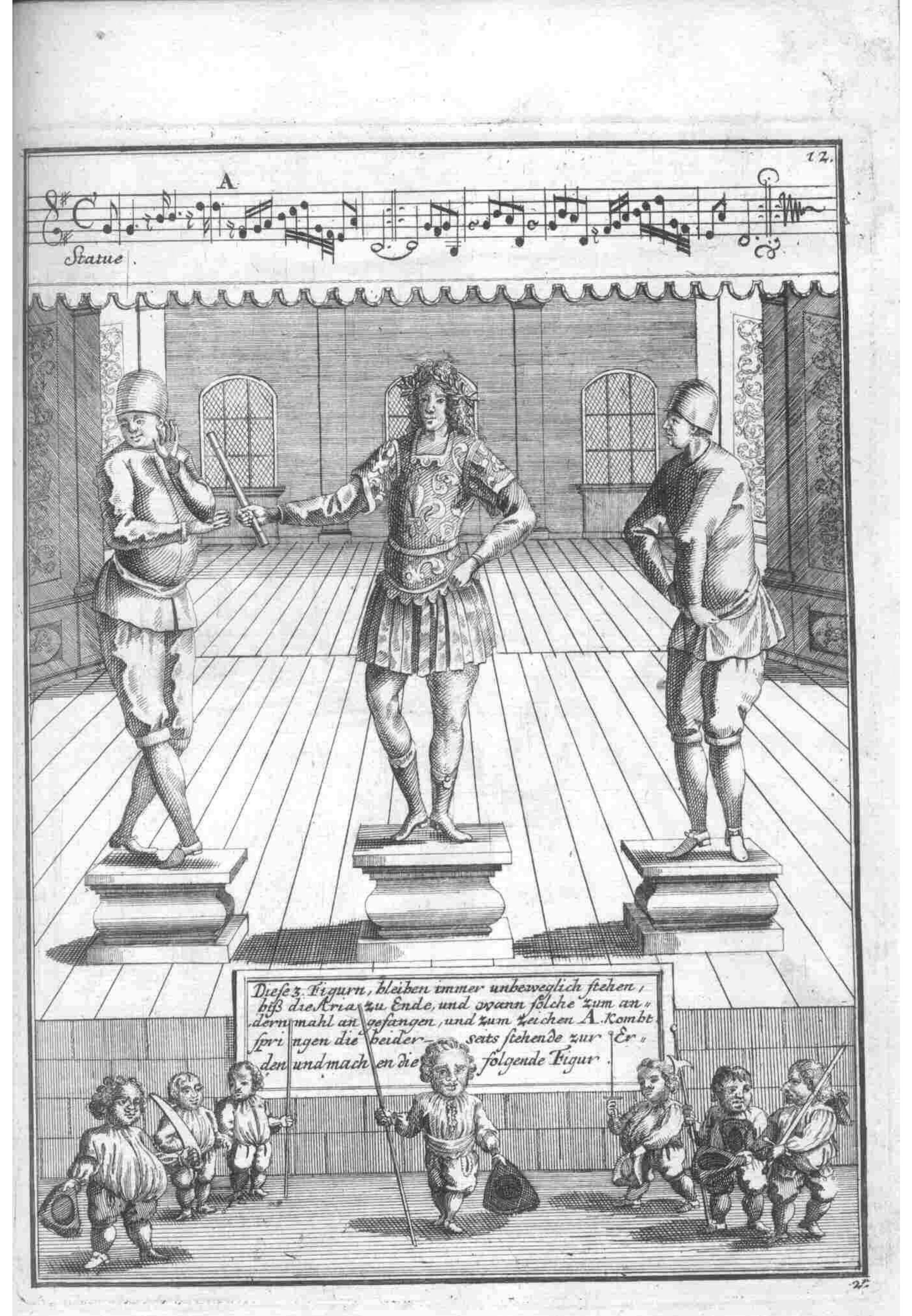
Group — Plate 62
Gregorio Lambranzi
- Medium:
- Copper-plate engraving
- Dance:
- Notation/Choreography
- Era:
- 1700s (Enlightenment/Minuet Era)
- Collection:
- Nuova e curiosa scuola de' balli theatrali (1716)
- Source:
- Library of Congress
- Rights:
- Public domain — free to use, share and adapt.
- Recorded as:
- Public Domain
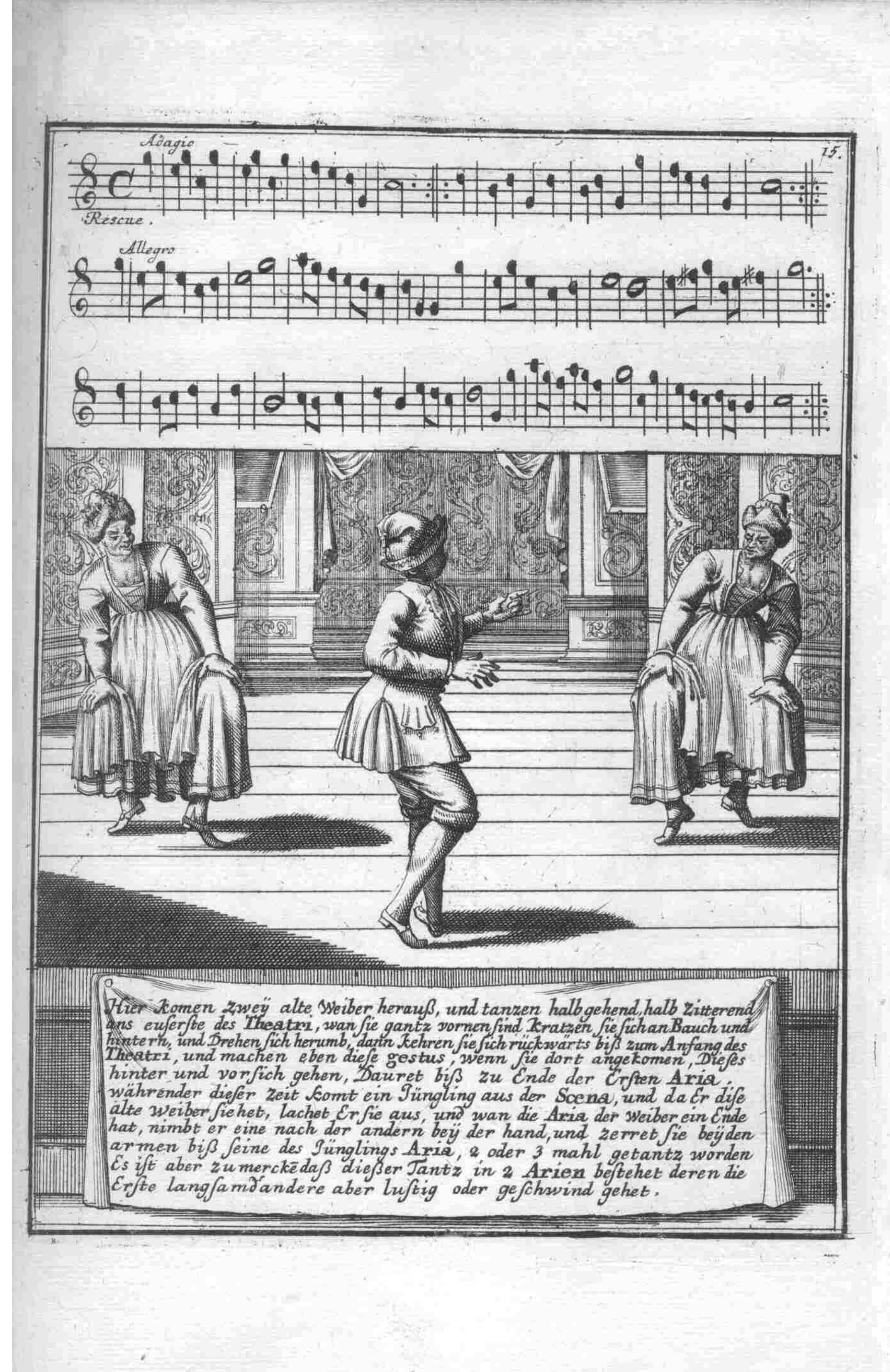
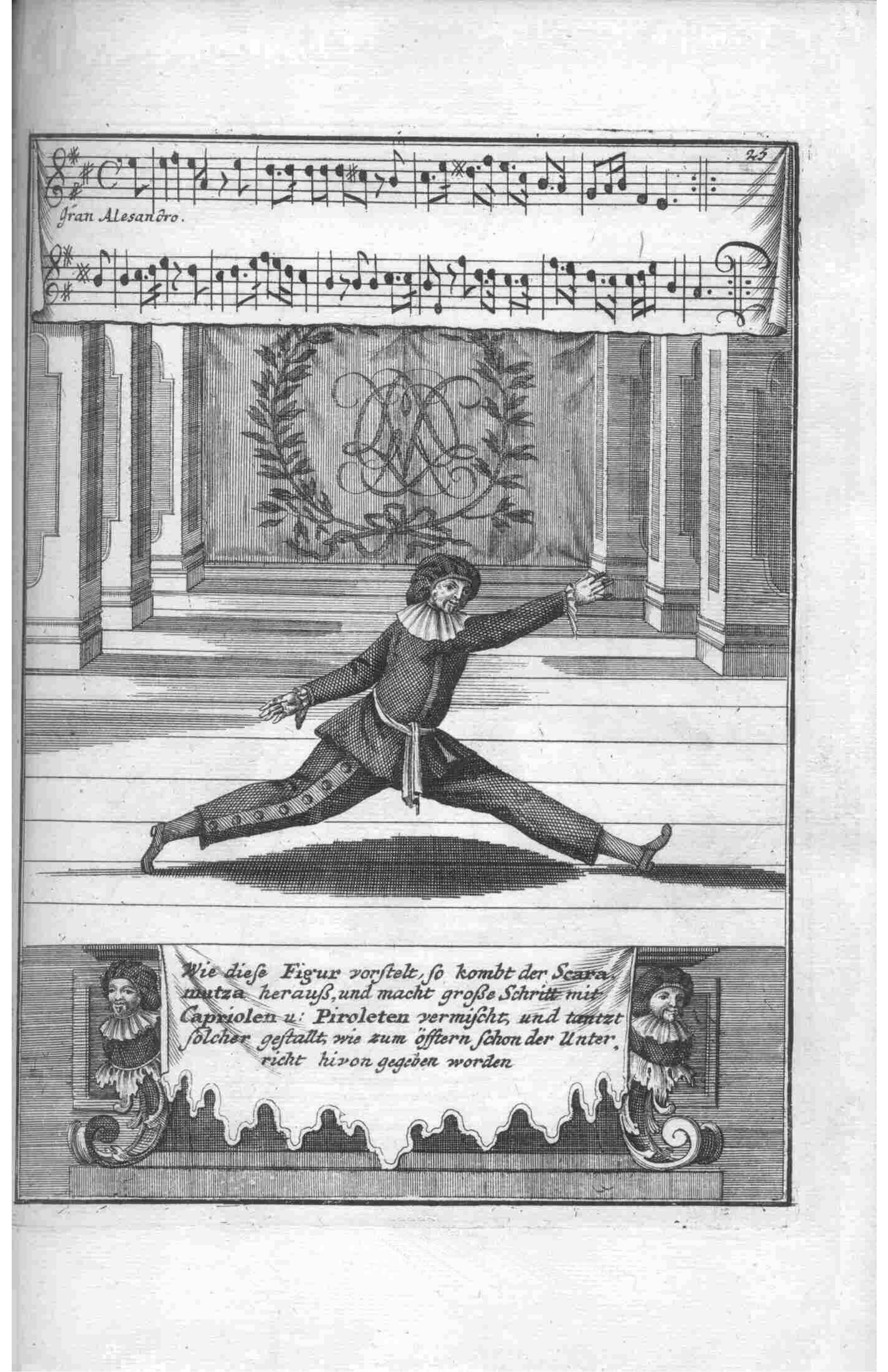
Lambranzi's manual is one of the earliest systematic attempts to record theatrical choreography in conjunction with music, making it invaluable for understanding how baroque theatrical dances were actually staged and what dancers' costume and deportment signaled about character and action. For dancers and dance historians, this engraving demonstrates how theatrical dance differed from social dance in the same period — the formality, the hierarchical grouping, the integration of music and gesture.
What you are looking at
A theatrical stage scene with three figures in classical costume arranged on a wooden floor beneath a scalloped curtain valance. The central figure, a woman in an ornate tunic with decorative trim and a pleated skirt, stands in a commanding pose with one arm extended. She wears a jeweled headdress and stands elevated on a low platform. On either side stand two smaller male figures in helmets and fitted tunics with short skirts, also on platforms, creating a triangular composition. A musical score in treble clef is engraved above the stage scene. Below the stage, a chorus of eight or nine smaller figures — dressed as comic or supporting characters in various costumes — observe or respond to the central action, creating a marked visual hierarchy between the stage performers and the watching ensemble.
The dancing
The central female figure holds an erect, authoritative stance with her weight centered and one arm raised in a declarative gesture; both flanking male figures mirror her upright posture with a similar contained bearing. All three main dancers stand on individual platforms at ground level rather than suggesting elevated action — this is a posed or processional arrangement rather than a dynamic, stepping choreography. The watching figures below are rendered in a smaller scale and grouped informally, their postures varied and gestural rather than coordinated.
The dance depicted
This is an illustration from Lambranzi's theatrical-dance manual, a foundational pedagogical work. The scene depicts what appears to be a theatrical grouping or procession — possibly an allegorical or heroic pantomime figure with attendants. The notation and formal costume suggest a choreographed theatrical number intended for a professional stage, but the arrangement is stately and ceremonial rather than a recognizable ballroom or folk dance form. Without the accompanying German verse (which the caption indicates is present but not legible in the image), the specific identity of the dance cannot be confirmed, though the scale and setting mark it as a theatrical piece designed for court or commercial theatre.
How it was made
Copper-plate engraving, a labor-intensive medium that produced fine detail and permitted wide circulation through printing. The use of fine parallel lines (hatching) to create tonal depth, especially visible in the costumes and the spatial recession of the floor, is characteristic of engraving technique. The clarity of the musical notation at the top and the legible architectural detail suggest an engraving made from a carefully prepared copper plate, likely printed in an edition. This medium indicates a work intended for educated audiences — dancers, dancing masters, musicians, and wealthy amateurs who could afford printed dance manuals.
About this work
This is Plate 62 from Gregorio Lambranzi's *Nuova e curiosa scuola de' balli theatrali* (Nuremberg, 1716), a copper-plate engraving pairing musical notation with a choreographed theatrical tableau. The plate shows a formal stage scene with three principal dancers in classical costume and a chorus of attendant figures, representing a moment of theatrical spectacle. As one of the era's most influential dance manuals, Lambranzi's work bridged the professional stage and the amateur dancer's study, using engravings to make both the music and the spatial composition of a scene permanently legible and reproducible.
The work belongs to the early 18th-century intersection of theatrical dance, music notation, and illustrated instruction. Unlike Renaissance dance manuals that focused on court dances in geometric floor patterns, Lambranzi emphasized theatrical spectacle and costume, reflecting the growing importance of professional opera-ballet and the visual elaboration of the baroque stage.
How to look at it
Observe the use of platforms and scale: the three principal dancers stand apart and elevated (conceptually if not literally), marked by their size and isolation, while the chorus figure below are smaller and grouped informally. This visual language signals theatrical hierarchy — not all bodies on stage carry the same narrative weight. Notice also the formal frontality of the central figure's pose and the symmetrical placement of the attendants; this is a moment of display or declaration, frozen in a stately attitude rather than a transitional gesture. The musical notation above anchors the scene to a specific temporal and sonic event, inviting the reader to imagine how this tableau moved and sounded.
The artist
Gregorio Lambranzi (fl. early 18th century) was an Italian dancing master and choreographer active in Nuremberg. His *Nuova e curiosa scuola de' balli theatrali* (New and Curious School of Theatrical Dances), published in 1716, is the primary record of his practice. The work was influential across Europe and was republished and translated multiple times. Lambranzi's approach — illustrating dances with engraved figures paired to musical notation — became a model for later dance pedagogy and suggests he held a senior position in a major theatrical center, likely court or operatic.
The period
In 1716, theatrical dance in European courts and commercial theaters was undergoing rapid professionalization and elaboration. The minuet and other court dances had become formalized social dances, while the stage developed increasingly spectacular choreography often integrated into opera, ballet d'action, and pantomime. Engraving and the spread of printed manuals meant that choreography could circulate beyond oral tradition or manuscript notation. Lambranzi's work appeared at the moment when theatrical dance was beginning to assert itself as a distinct practice from social dance, and when the visual and musical literacy required to read a dance from a page became an expected skill for professional dancers.
Where it lives
The engraving comes from the 1716 Nuremberg edition of Lambranzi's *Nuova e curiosa scuola de' balli theatrali*, a printed and widely distributed theatrical dance manual. The Library of Congress holds the source copy. As a plate from an instructional book designed for circulation, it represents both a specific choreographed work and a model for how such works should be understood and transmitted.
Dance in this work
Questions about this work
What is the notation at the top, and can we dance from it?
The staves at the top are a musical score in treble clef, indicating the melody that accompanies this choreographed scene. The music alone does not notate the dance steps; instead, the engraving shows the visual arrangement and costume of the dancers while the score indicates the temporal and sonic structure. A dancer of the period would have learned the steps from a master or a more detailed choreographic notation, using the music and the engraved image as guides to context and style.
Why are there two groups of figures — the three on stage and the many below?
The smaller figures below appear to be a theatrical chorus or audience witnessing the principal action. This two-tier composition reflects baroque theatrical practice, where a small number of skilled principal dancers performed while a larger ensemble provided visual support, comic relief, or collective participation. It also demonstrates Lambranzi's pedagogical goal: showing both the refined dancing of professional performers and the broader social or dramatic context in which such dances occurred.
How does Lambranzi's approach differ from Renaissance dance manuals?
Renaissance manuals like Arbeau's *Orchésographie* focused on social court dances recorded in geometric floor patterns. Lambranzi's work emphasizes theatrical dances with elaborate costumes, hierarchical groupings, and integration with music and drama. This shift reflects the rise of professional opera-ballet and the separation of stage dance from social dance — showing that by 1716, theatrical dance had become a specialized and visually spectacular art.
More Notation/Choreography artwork