49 works in this view — arrow keys or swipe to move between them.
Dance in Art
Combat/Duel — Plate 65
Gregorio Lambranzi
- Medium:
- Copper-plate engraving
- Dance:
- Notation/Choreography
- Era:
- 1700s (Enlightenment/Minuet Era)
- Collection:
- Nuova e curiosa scuola de' balli theatrali (1716)
- Source:
- Library of Congress
- Rights:
- Public domain — free to use, share and adapt.
- Recorded as:
- Public Domain
Lambranzi's manual is one of the only surviving detailed records of how theatrical dance was actually performed and choreographed in the early 18th century, and his method of representing movement influenced dance notation for centuries. This specific plate documents a male combat choreography—a theatrical genre that was important to court spectacle and to the training of professional dancers, but is rarely depicted in dance imagery. The precision of the engraving and the clarity of the choreographic moment make it an exceptionally valuable record of a lost performance practice.
What you are looking at
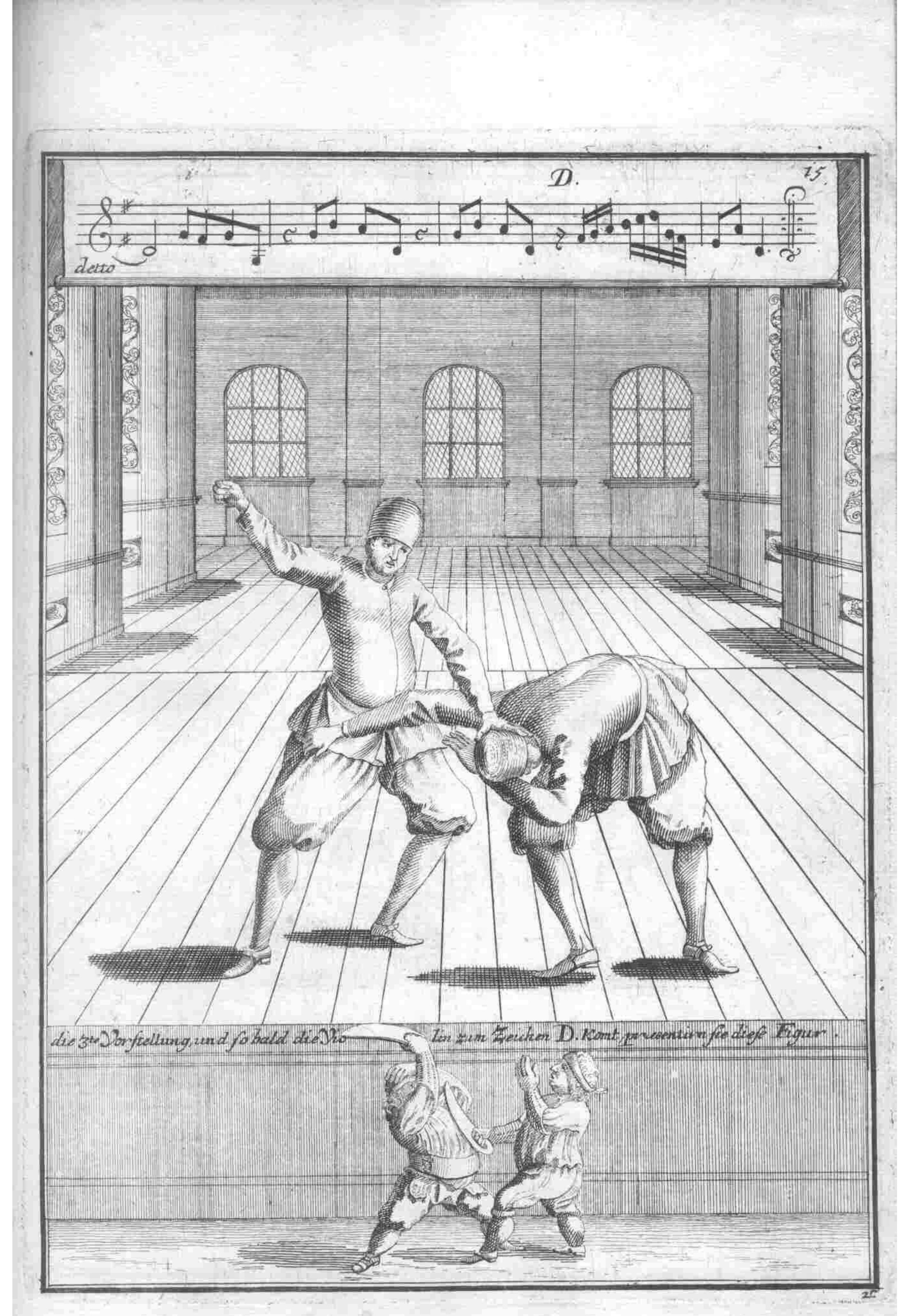
Two male dancers in Renaissance costume occupy a wooden-floored stage set with classical architecture—three tall arched windows with lattice panes set into paneled walls, and fluted columns at either side. The figure on the left wears a close-fitting doublet and puffed breeches; his right arm is raised high and his body twisted, weight forward on his left leg as though mid-lunge or parry. His companion bends deeply at the knees in a low, wide stance, torso folded forward, arms extended outward to either side—a posture of defense or balance recovery. Both wear caps and hose. The floor recedes in strict perspective, emphasizing the theatrical depth. A musical phrase in notation appears at the top of the plate. Below the stage scene, a smaller supplementary figure study shows a similar pose from a different angle. The engraving is delicate and precise, with fine cross-hatching defining musculature and fabric folds.
The dancing
Two dancers occupy the stage in what appears to be an asymmetrical encounter. The left figure stands taller, driving forward with his torso rotated and his raised arm extended upward—a gesture of attack or thrust, with his weight committed. The right figure counters with a deep, wide plie that drops his center significantly below the first dancer's, his arms spread wide for balance or defense, suggesting either recovery from a blow or preparation to parry. Both men maintain the turned-out leg positions and upright carriage characteristic of Renaissance court training, but their interaction is dynamic and asymmetrical, implying combat or at least a competitive exchange.
The dance depicted
This is a theatrical sword dance or combat duo, a staged fight choreography from the school of theatrical dance. The catalogue identifies it as a 'combat/duel' and Lambranzi's manual, *Nuova e curiosa scuola de' balli theatrali*, was the most influential printed manual of Italian stage dance of the early 18th century. These were not social dances but theatrical set-pieces performed for court or professional audiences, often to accompany sword-fighting displays or to demonstrate the dancer's agility, coordination, and dramatic presence. The music notation indicates this was a precisely timed performance piece. The asymmetrical relationship between the two figures—one attacking, one defending—is central to the choreography and to the drama being staged.
How it was made
This is a copper-plate engraving, a medium that required careful preliminary drawing on the copper surface and hand-incised lines filled with ink for printing. The fineness and regularity of the engraved lines are visible throughout—particularly in the hatching that defines the musculature of the dancers' legs and the fabric of their clothing. Engraving allowed precise reproduction and wide circulation; a single plate could be printed many times and the manual's 114 plates were distributed across Europe, making Lambranzi's work and its dance notation accessible to dancers, choreographers, and scholars far beyond Italy. The technique required technical mastery and meant the work was expensive to produce but durable and repeatable.
About this work
This is Plate 65 from Gregorio Lambranzi's *Nuova e curiosa scuola de' balli theatrali* (Nuremberg, 1716), one of the foundational printed manuals of European theatrical dance. Each plate pairs a musical phrase with a costume figure or choreographic moment on a formal stage, creating a kind of dance notation and performance guide. This plate documents a stage combat choreography for two male dancers, showing the asymmetrical dynamic of thrust and recovery, attack and defense. Lambranzi's manual was hugely influential: it systematized theatrical dance instruction, established conventions for representing movement in print, and preserved a repertory of court and theatrical dances that might otherwise have been lost. The work sits between the Renaissance court dance tradition and the emerging ballet vocabulary of the 18th century.
How to look at it
The composition captures a single decisive moment in a fight choreography: the lunge and the counter. Notice the contrast between the two bodies—the left figure rising and driving forward, the right figure surrendered to a deep descent and opening. This asymmetry is essential to the drama and to the choreographic idea; it is not a symmetrical display but a narrative of action and reaction. The careful perspective of the stage floor grounds the dancers in a specific theatrical space and emphasizes the theatrical convention: this is a staged fight, not a real one, performed for an audience. The musical notation at the top reminds us that this choreography was set to precise timing and intended to be repeatable and teachable.
The artist
Gregorio Lambranzi was a dancer and choreographer active in early 18th-century Germany. He worked in Nuremberg and published his manual there in 1716, with a second expanded edition following. The *Nuova e curiosa scuola* was illustrated by a skilled engraver and remains the most comprehensive printed record of European theatrical dance choreography from that period. Lambranzi's work synthesized Italian, German, and French dance traditions and served as a practical manual for dancers and choreographers rather than as a theoretical text. The breadth of the repertory—from court dances to theatrical combat scenes to acrobatic demonstrations—reflects the range of skills expected of professional performers.
The period
In the early 18th century, theatrical dance was entering a period of codification and systematization. The court ballet tradition of the 17th century was being formalized into a repeatable vocabulary, and printed manuals like Lambranzi's were helping to standardize technique and preserve choreography. At the same time, Baroque court spectacle was flourishing, and dancers—especially male dancers—were expected to be accomplished not only in elegant court dances but in theatrical display, acrobatics, and martial choreography. Combat and dueling scenes were popular elements of court entertainments and professional theatre. This was also a period when printed music and dance notation were beginning to achieve wider circulation, making it possible for dance to be transmitted across geographic and social boundaries in ways it had not been before.
Where it lives
This is Plate 65 from *Nuova e curiosa scuola de' balli theatrali*, a manual of theatrical dance and choreography published in Nuremberg in 1716 by Gregorio Lambranzi. It is held in the Library of Congress collection. The manual contains 114 plates, each pairing a musical phrase (in notation) with a theatrical dance figure or choreographic moment, along with German text.
Dance in this work
Questions about this work
Is this a real sword fight or a choreographed dance?
It is choreographed. This is a theatrical piece created for performance—the dancers are trained in the courtly dance tradition, and the combat movements are set to music (notated at the top of the plate) and intended to be repeated. The precise stage setting and the artistic composition make clear this is a staged spectacle, not a functional fight. Theatrical combat choreographies like this were popular court entertainments in the early 18th century.
What does the music at the top tell us?
The notation indicates that this choreography was precisely timed to a specific musical phrase, suggesting it was a repeatable, teachable piece of dance. Dancers would learn both the steps and the music together, ensuring consistent performance. The inclusion of notation in Lambranzi's manual shows that dance was beginning to be treated as a formal, documented art form rather than an improvisation.
Who would have danced this?
Professional court dancers or ballet performers working in German-speaking courts or theatres. Lambranzi's manual was a practical training text for working dancers, not a historical curiosity. Male dancers were expected to be skilled in combat choreography as part of their theatrical repertory, especially for court spectacles and professional theatrical productions.
How was this engraving made?
The image was hand-incised into a polished copper plate using a burin (a pointed engraving tool), with the lines filled with ink for printing. Engraving was labor-intensive and expensive, but allowed precise reproduction and wide distribution. Lambranzi's 114-plate manual was one of the most ambitious engraved dance manuals of its time, and copies circulated across Europe, making it hugely influential.
More Notation/Choreography artwork