49 works in this view — arrow keys or swipe to move between them.
Dance in Art
Combat/Duel — Plate 67
Gregorio Lambranzi
- Medium:
- Copper-plate engraving
- Dance:
- Notation/Choreography
- Era:
- 1700s (Enlightenment/Minuet Era)
- Collection:
- Nuova e curiosa scuola de' balli theatrali (1716)
- Source:
- Library of Congress
- Rights:
- Public domain — free to use, share and adapt.
- Recorded as:
- Public Domain
Lambranzi's manual is among the few surviving sources that visualize the actual body positions and spatial relationships of early 18th-century stage dance, predating most other detailed instructional imagery. This combat sequence reveals that theatrical martial action was as highly choreographed as court dances—a crucial insight for understanding how Renaissance and Baroque spectacle worked. For historians and reconstruction artists, the precise spatial geometry and mirror-symmetry shown here offers concrete evidence of how bodies moved in aristocratic dramatic performance.
What you are looking at
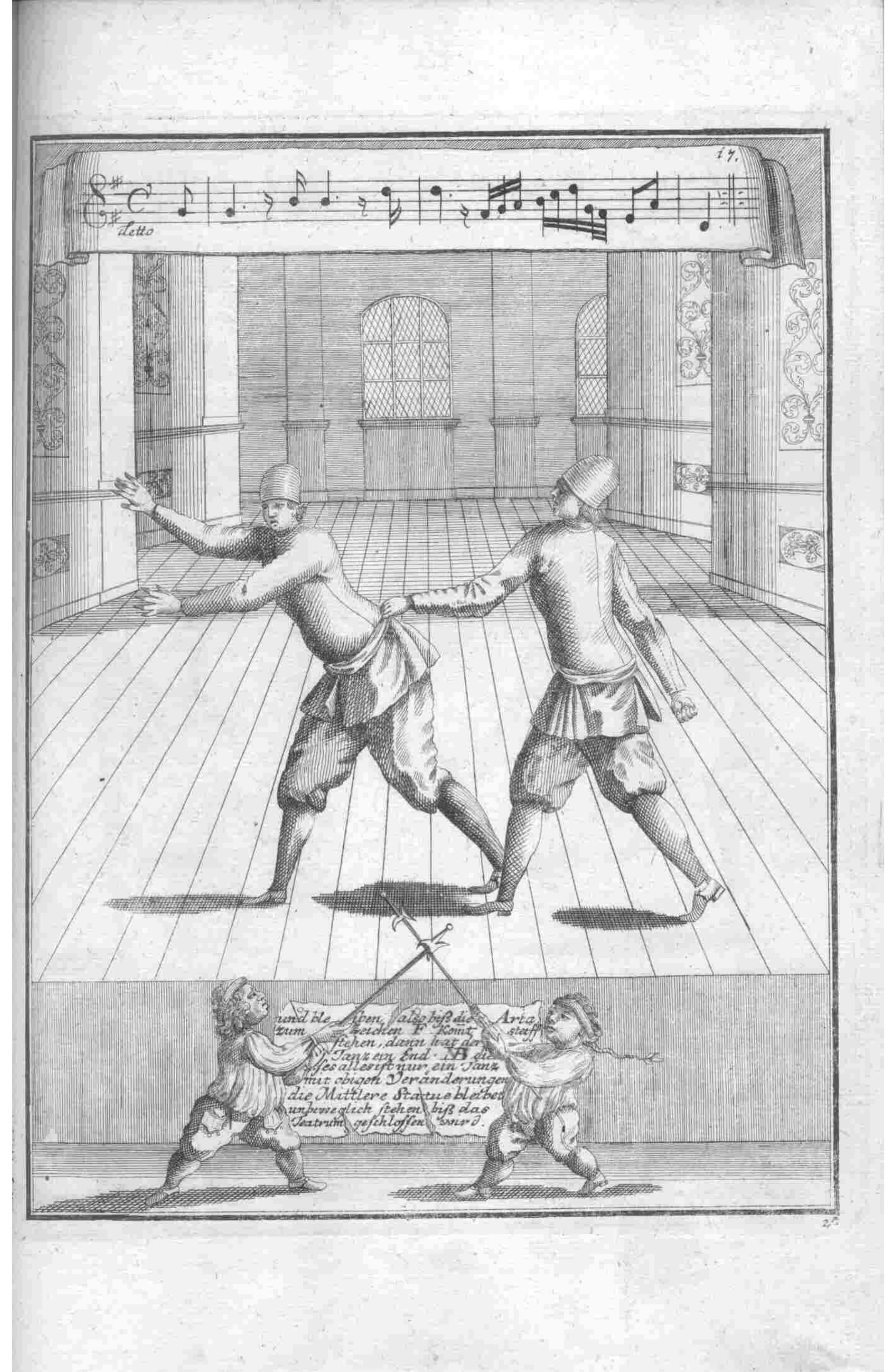
Two male figures in metallic armor—steel breastplates and close-fitting helmets—face each other in combat stance on a wooden stage floor. The setting is a Renaissance interior with fluted columns, decorative wall panels, and two latticed windows suggesting a palazzo or court hall. The figures are mid-action: the figure on the left has his right arm extended forward in a lunging thrust while his left arm is raised in counterbalance; the figure on the right mirrors this with defensive posture, one arm parrying. Both wear hose and short skirts, and their legs are bent in a dynamic, weight-forward stance. A musical score with notation labeled 'detto' (meaning 'the same' or 'as before') runs along the top of the composition. Below the stage, two putti (cherub figures) flank a German text cartouche, a common decorative feature in prints of this period.
The dancing
The two male dancers are in a symmetrical but opposed geometric relationship, each occupying roughly equal space. Their weight is distributed low, with knees bent and feet in a wide stance suggesting ground contact and stability. The extended arm of the left figure shows an open, flowing line from shoulder to fingertip; the right figure's raised arm echoes this in defense. Both maintain upright torsos despite the aggressive arm positions, and the spacing between them—roughly the length of a lunge—indicates the choreographed distance of a controlled exchange rather than actual combat.
The dance depicted
This plate depicts a theatrical combat or duel choreography, likely from commedia dell'arte or intermedi tradition popular in European court theaters. The notation at top confirms this is accompanied music (labeled 'detto,' suggesting it follows a preceding melody). The mirrored positioning and controlled distance indicate this is a formalized dance-combat for stage effect rather than realistic fencing. The armor costume places this in the heroic or martial drama genre, possibly representing mythological or historical warrior characters, and the sophisticated indoor setting confirms performance for a courtly or aristocratic audience rather than street theater.
How it was made
Copper-plate engraving, a labor-intensive process allowing precise linear detail and wide circulation through printing. The fine parallel hatching creates volume and shadow in the architectural space and musculature. This technique allowed Lambranzi's choreographic manual to reach dancing masters and court musicians across the German-speaking territories; engravings were far more durable and reproducible than manuscript notation or drawings. The clarity of the figural poses and the integration of musical score with movement notation made this a functional teaching document, not merely decorative.
About this work
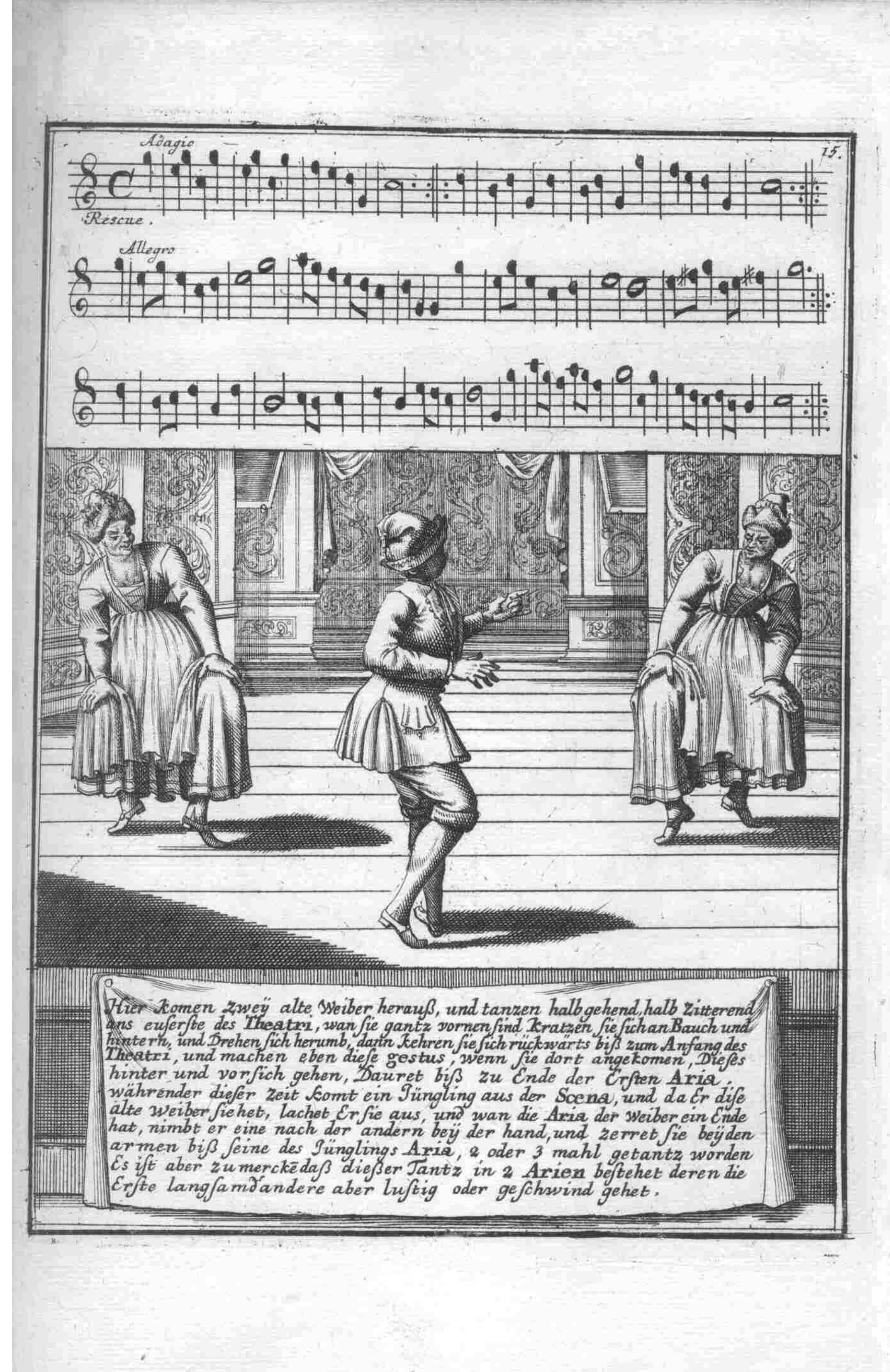
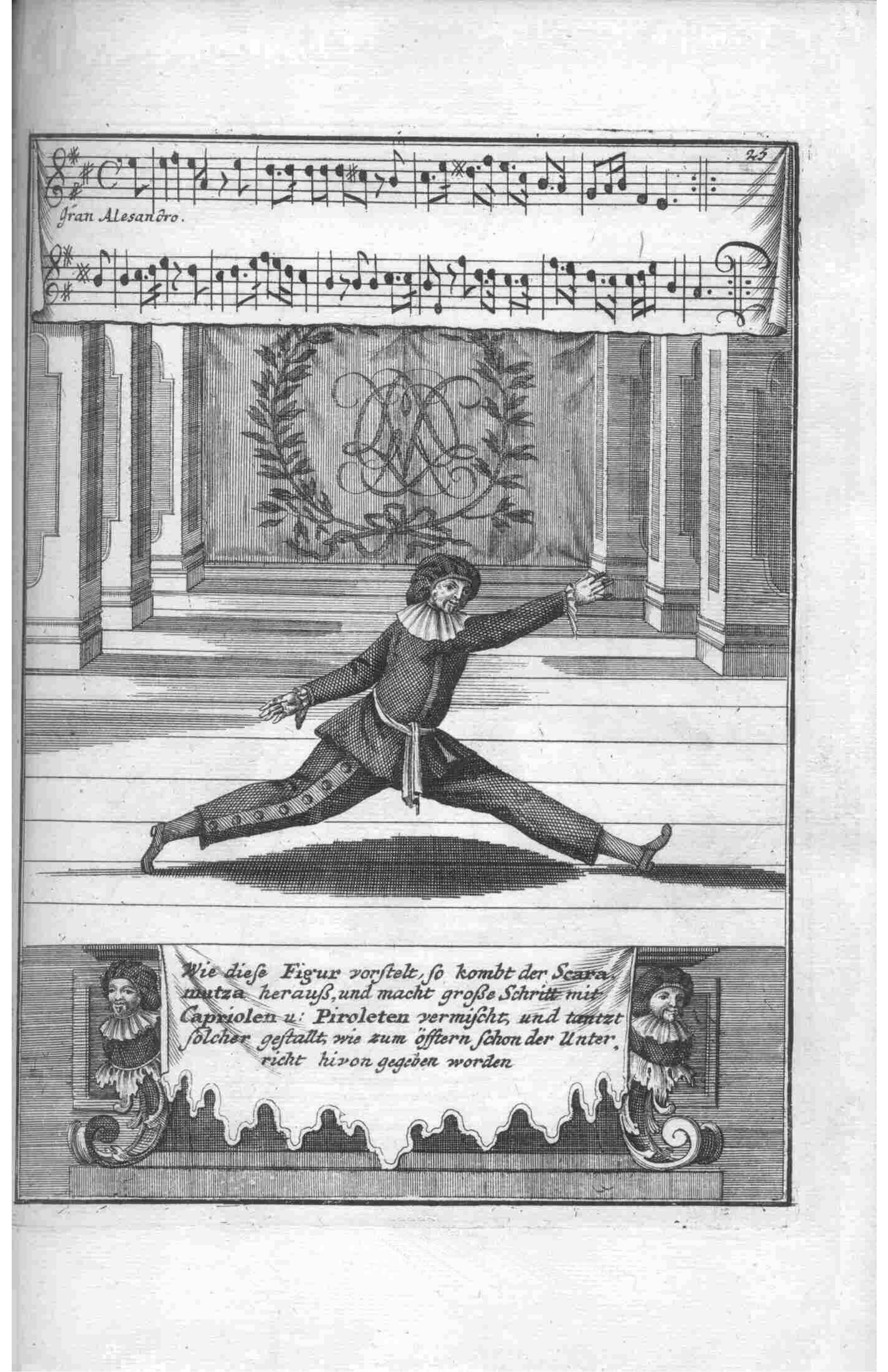
This is one of 67 plates from Gregorio Lambranzi's *Nuova e curiosa scuola de' balli theatrali* (Nuremberg, 1716), a foundational illustrated dance manual that paired music notation with precisely rendered movement sequences. Each plate combined a musical phrase with a choreographed pose, creating a kind of visual score for theatrical dancers and dancing masters. The work circulated widely in German and Italian court circles and remains one of the richest surviving records of early 18th-century theatrical-dance practice. This particular plate shows the formalized combat choreography used in heroic dramatic genres, demonstrating how even violent action was stylized into elegant, patterned exchange.
How to look at it
Watch the symmetry: the artist has frozen the moment of exchange, not the moment before or after, so that each dancer's action and reaction are equally visible and balanced. Notice how the extended arm lines flow from the bent legs—the impression of control rather than collapse. The latticed windows behind are not arbitrary scenery but establish this as an indoor, civilized space, making the controlled formality of the combat more legible. The score at top indicates this moment occupies a specific fraction of a musical phrase, so the position is not naturalistic but precisely timed.
The artist
Gregorio Lambranzi (1704–?) was a dancer, choreographer, and dance theorist active in the German-speaking territories, likely based in Nuremberg where his manual was published. Little is known of his early life, but his manual suggests he had access to court dance traditions and commedia dell'arte practices. The *Scuola* was his major surviving work; it represents the culmination of Renaissance notation systems and anticipates 18th-century codification of movement. The work was reprinted and republished well into the 19th century, suggesting its authority as a teaching text.
The period
In 1716, theatrical dance existed in the overlap between courtly formality and commedia dell'arte improvisation. The Baroque age had elevated dance to a court art through Louis XIV's academies and the patronage of Italian and German princes. Combat choreography featured prominently in intermedi, opera ballets, and heroic dramas performed at court. Musical notation had been refined for decades, but systematic notation of movement remained partial and idiosyncratic—Lambranzi's pairing of score with figure was an attempt to create a more legible system. This was also the era when male dancers still dominated stage roles in most of Europe, as visible here.
Where it lives
This plate is from *Nuova e curiosa scuola de' balli theatrali*, published in Nuremberg in 1716 by Lambranzi. The work survives in multiple copies in European libraries and museums. The Library of Congress copy (from which this image derives) is among the most complete and well-preserved versions.
Dance in this work
Questions about this work
Is this real fencing or choreographed dance?
Purely choreographed. The symmetrical positioning, the controlled distance, the balletic arm lines, and the musical notation all indicate this is a formal dance-combat designed for theatrical effect. A real duel would be asymmetrical and chaotic; this is patterned and mirrored like a minuet or courante.
Who would have danced this?
Professional male court dancers or commedia dell'arte performers in German and Italian noble households and court theaters. Lambranzi's manual was a teaching text for dancing masters and their students, so this was performed repeatedly and taught to others, not a one-time spectacle.
Why is there music notation at the top?
Every movement in Lambranzi's system is coordinated to a specific musical phrase. The notation allows musicians to understand exactly how long each posture lasts and how the dance relates to the score. The word 'detto' means this melody repeats from an earlier plate, creating continuity.
What is the language in the cartouche below?
German. Lambranzi's manual includes explanatory text and poetry in German, reflecting its primary audience in the German-speaking territories, though copies circulated widely in Italy as well.
More Notation/Choreography artwork