49 works in this view — arrow keys or swipe to move between them.
Dance in Art
Group — Plate 68
Gregorio Lambranzi
- Medium:
- Copper-plate engraving
- Dance:
- Notation/Choreography
- Era:
- 1700s (Enlightenment/Minuet Era)
- Collection:
- Nuova e curiosa scuola de' balli theatrali (1716)
- Source:
- Library of Congress
- Rights:
- Public domain — free to use, share and adapt.
- Recorded as:
- Public Domain
This work is essential for understanding how theatrical dances were taught, notated, and circulated in the early 18th century. The image shows that dance instruction combined visual, musical, and written information—a model that influenced dance pedagogy for centuries. For historians and dancers, Lambranzi's plates are primary evidence of how bodies moved, how they used props and geometric space, and how dance was codified and standardized as a theatrical practice.
What you are looking at
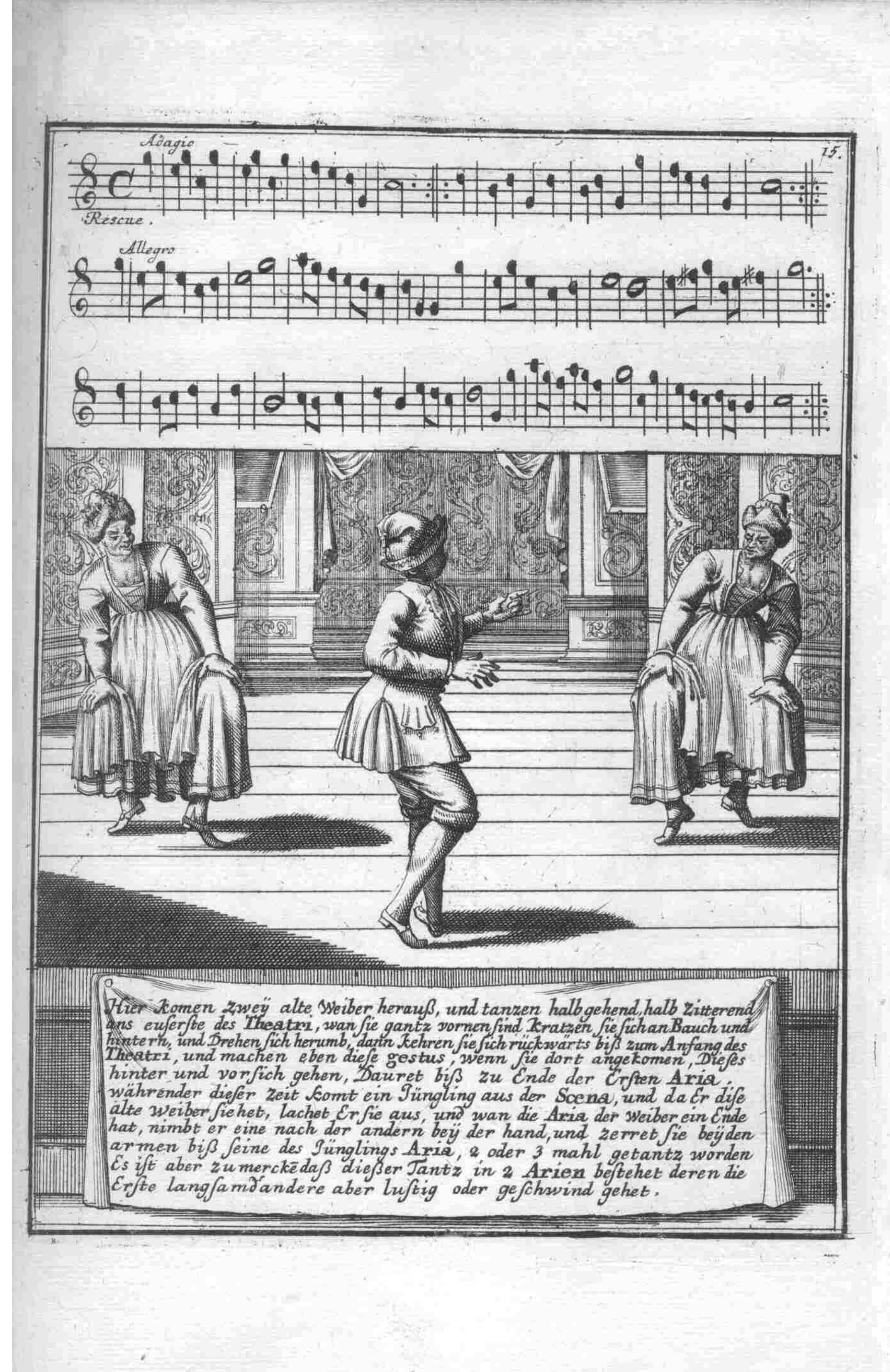
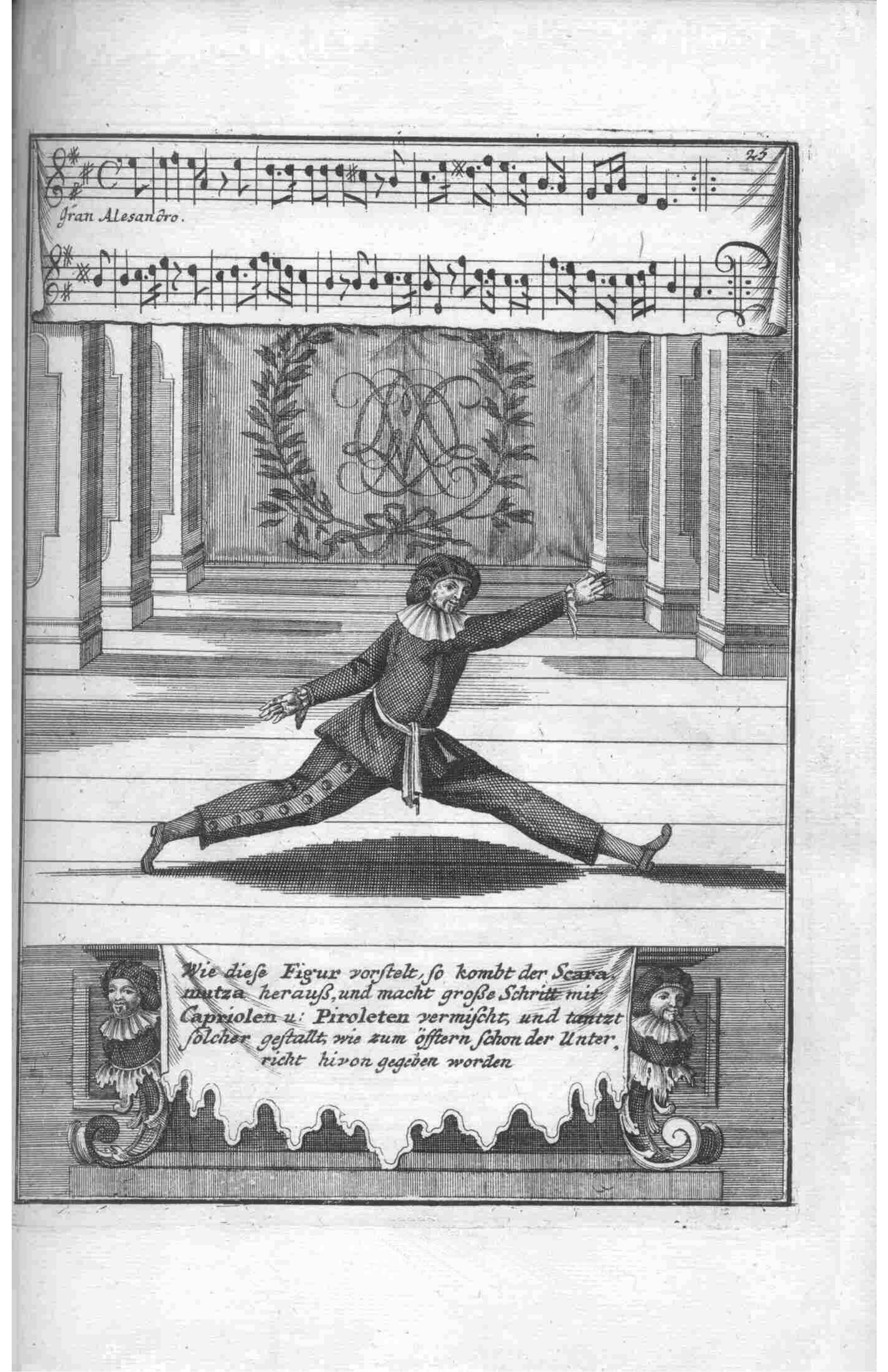
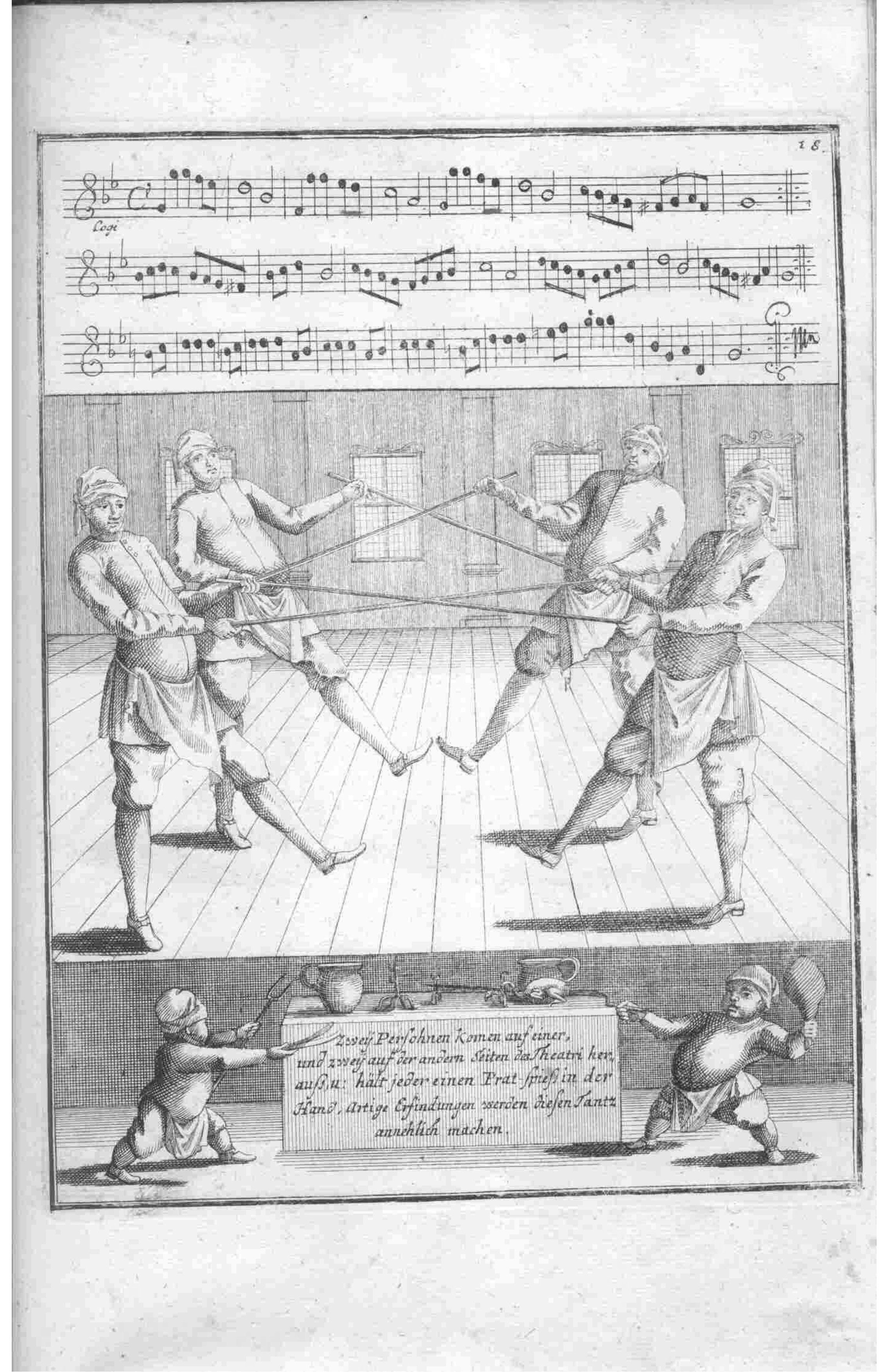
Four men in 18th-century dress—breeches, stockings, and close-fitting jackets—occupy a wooden stage beneath a curtained backdrop. They are arranged in a symmetrical formation, each holding a thin stick or rod extended toward a central point. The two figures in the middle hold their sticks crossed, creating an X; the outer two figures hold theirs at angles that meet the central intersection. The pose is held and formal, suggesting a moment of precise geometric alignment rather than motion. Above the stage scene, three staves of musical notation provide the accompaniment. Below the engraved image, two cherubs hold aloft a German text cartouche. The overall composition emphasizes pattern, symmetry, and the coordination of multiple bodies in space.
The dancing
All four men stand in an upright, formal posture with weight evenly distributed, facing toward the center or slightly outward. Their arms are extended at varied angles to hold the rods in alignment. The sticks appear to be props that structure the figure—this is not a hold between dancers but rather an ensemble coordinating around objects. The composition suggests careful spacing and geometric precision rather than improvisation or flight.
The dance depicted
This appears to be a theatrical dance figure from the early 18th-century German repertoire of staged court dances, likely a figure from a quadrille, contredanse, or similar ensemble formation dance. The use of props (the rods) and the emphasis on symmetrical pattern-making is consistent with the ballroom and theatrical dances documented in Lambranzi's *Nuova e curiosa scuola de' balli theatrali*. The notation above indicates this was a composed, reproducible piece for trained dancers. The specific choreography—coordinating four bodies around intersecting sticks—suggests an allegorical or playful theatrical gesture rather than a standard social dance.
How it was made
This is a copper-plate engraving, a reproductive medium that allowed the manual to circulate widely in multiple impressions. Engraving permits fine linear detail and precise rendering of the musical notation, body positions, and geometric props. The medium was ideal for a dance manual: legible, durable, and capable of recording both notation and visual demonstration in a single frame. The technique enabled Lambranzi's work to become one of the era's most influential sources for theatrical dance practice across Europe.
About this work
This plate is part of Gregorio Lambranzi's *Nuova e curiosa scuola de' balli theatrali* (Nuremberg, 1716), one of the most important dance manuals of the early 18th century. Each plate pairs musical notation with a costumed dancer or group of dancers performing a specific figure, providing both aural and visual instruction. The symmetrical, prop-based composition here suggests a theatrical group dance, likely from the ballroom or court repertoire, presented as a repeatable model for performance. The manual documents the transition between baroque social dances and the more formalized theatrical dances of the early Enlightenment.
How to look at it
Observe the precise symmetry of the formation and the way the sticks structure the dancers' positions. The artist has frozen the moment of alignment—not the moment of arrival or release, but the held geometric configuration itself. Notice how the notation above the stage tells you this was a repeatable, scored piece: the dance was not improvised but learned and reproduced. The use of props (the rods) was typical of theatrical dances of this era and distinguished them from court ballroom dances, which relied on body alone.
The artist
Gregorio Lambranzi (fl. early 18th century) was an Italian dance master and choreographer active in Nuremberg. The *Nuova e curiosa scuola de' balli theatrali* is his most significant surviving work; it was published in two volumes (1716) and remains one of the most comprehensive visual records of early 18th-century European theatrical dance. Lambranzi combined notation, illustration, and instruction to create a manual suited to both trained dancers and educated amateurs. His approach was innovative in pairing music and choreography visually on the page.
The period
The early 18th century saw the formalization and theatricalization of dance. The French court had established strict conventions for baroque dances (minuets, gavottes, courantes); these began to migrate into public theaters and to be documented in writing and images. Lambranzi's manual emerged during a period when dance was transitioning from improvised social practice to scored and repeatable theatrical performance. The use of geometric figures, symmetry, and props reflects the era's fascination with order, mathematics, and rational design—concerns shared across baroque and early Enlightenment art and philosophy.
Where it lives
This plate is from Gregorio Lambranzi's *Nuova e curiosa scuola de' balli theatrali*, a two-volume illustrated dance manual published in Nuremberg in 1716. The work survives in multiple copies and remains one of the most consulted sources for early 18th-century dance history. The holding institution is the Library of Congress.
Dance in this work
Questions about this work
What are the sticks the dancers are holding?
These are props integrated into the choreography, used to create geometric patterns and spatial relationships between dancers. The crossed and angled configuration suggests a figure-based dance, possibly a quadrille or theatrical contredanse. Props were common in theatrical dances of this era but rare in social ballroom dances.
How do we know how this dance was performed?
The notation at the top of the plate provides the music. Lambranzi's manual combined musical notation with visual images of dancers and their positioning, allowing readers to reconstruct the movement. While modern performers cannot recover every detail, the combination of notation, image, and text makes Lambranzi one of our most reliable sources for early 18th-century dance.
Was this a social or theatrical dance?
The presence of props, the formalized notation, and the published manual all indicate this was a theatrical dance—a composed piece for the stage rather than a social ballroom dance. It would have been performed by trained dancers for an audience.
Why is this manual important?
Lambranzi's *Nuova e curiosa scuola* is one of the most complete visual and musical records of early 18th-century theatrical dance. It documents choreography, music, costume, and performance at a moment when dance was being formalized and professionalized. For historians and dancers, it is essential primary source material.
More Notation/Choreography artwork