49 works in this view — arrow keys or swipe to move between them.
Dance in Art
Comic Character — Plate 70
Gregorio Lambranzi
- Medium:
- Copper-plate engraving
- Dance:
- Notation/Choreography
- Era:
- 1700s (Enlightenment/Minuet Era)
- Collection:
- Nuova e curiosa scuola de' balli theatrali (1716)
- Source:
- Library of Congress
- Rights:
- Public domain — free to use, share and adapt.
- Recorded as:
- Public Domain
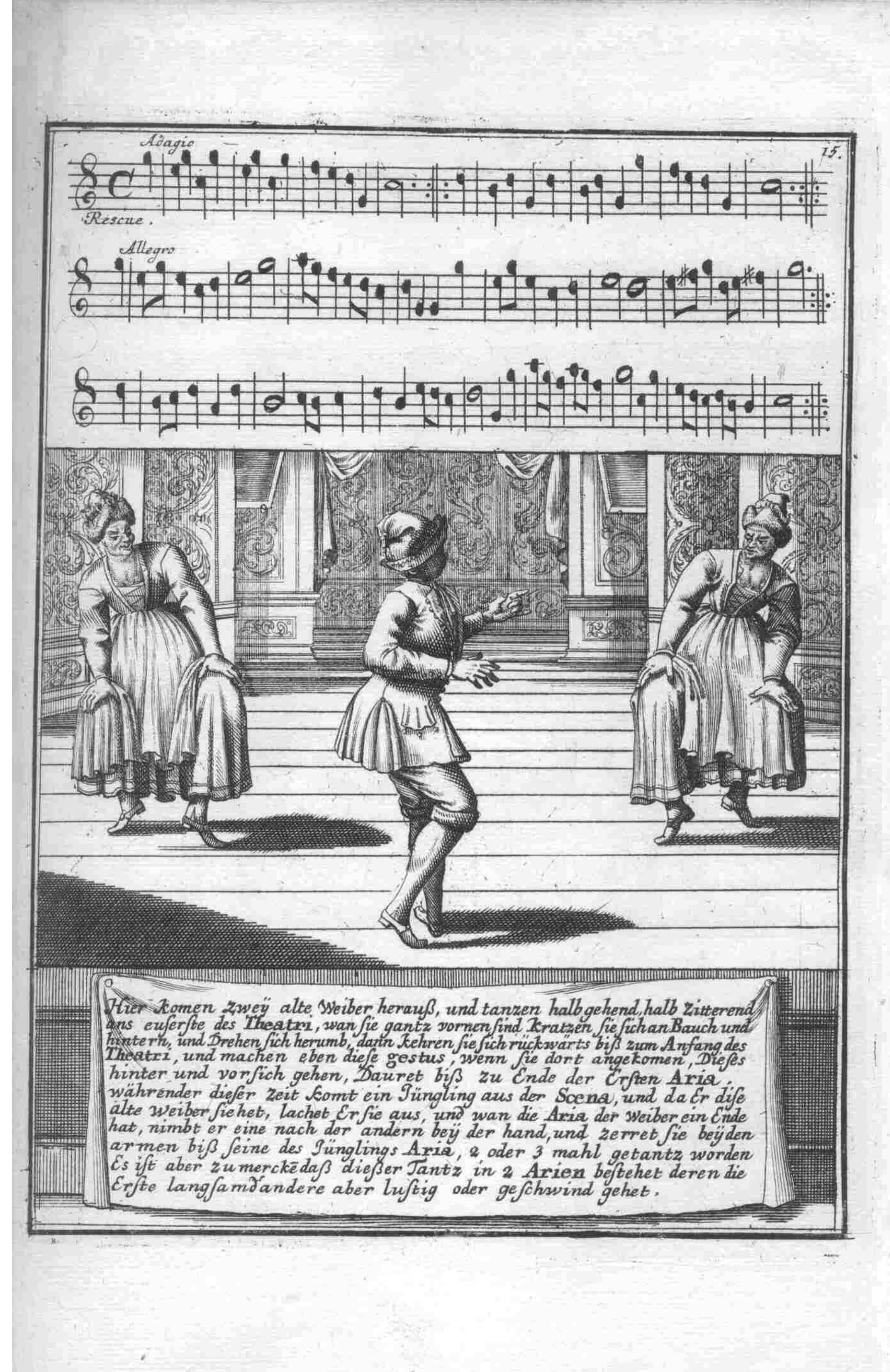
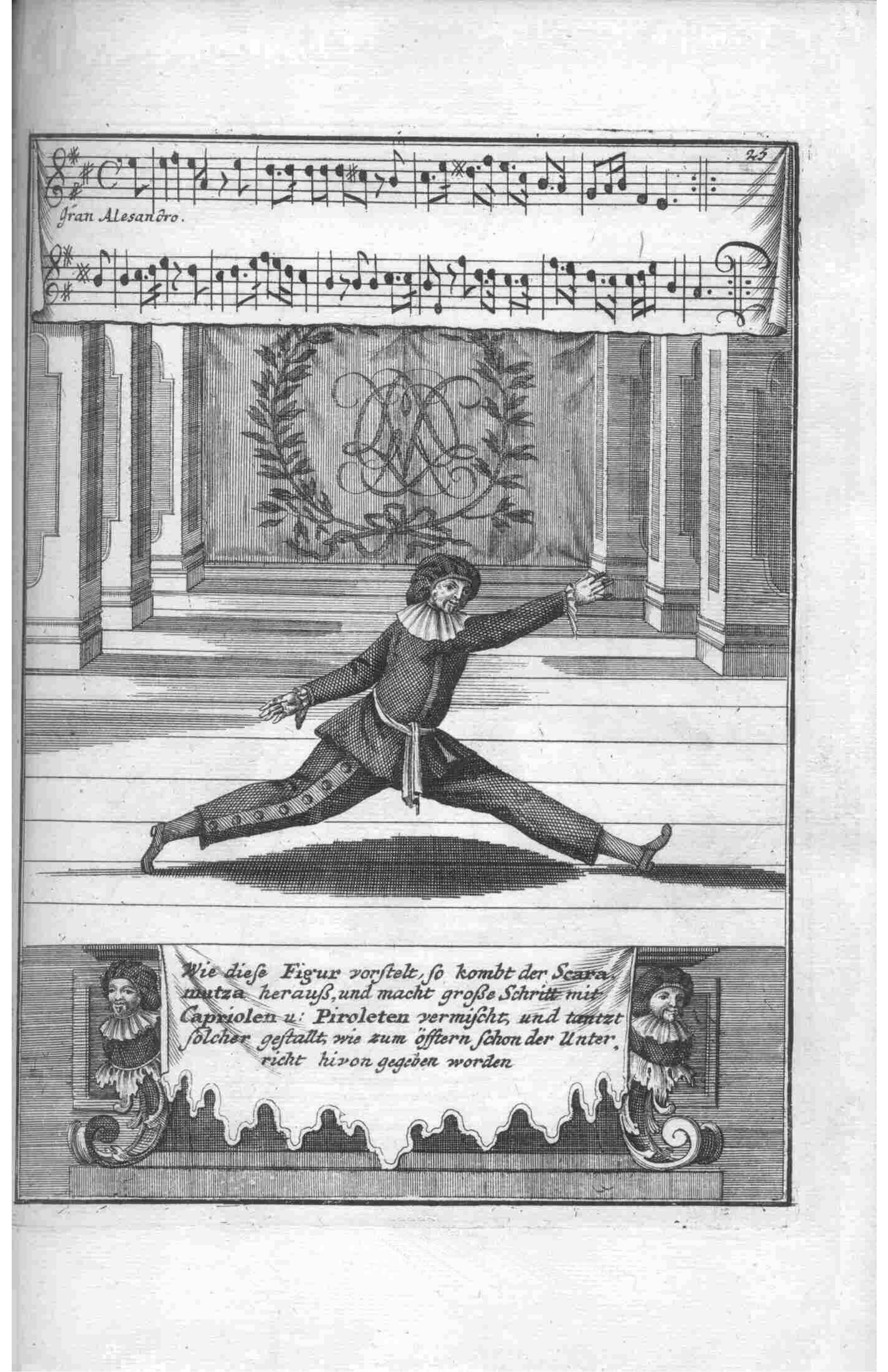
Lambranzi's manual is one of the few surviving visual and notational records of how Baroque theatrical dancers actually moved, particularly in comic and character roles that were otherwise unpreserved. This plate specifically documents a type of comic ensemble dance that has left almost no other trace in dance history, making it essential evidence for understanding the full spectrum of 18th-century theatrical performance.
What you are looking at
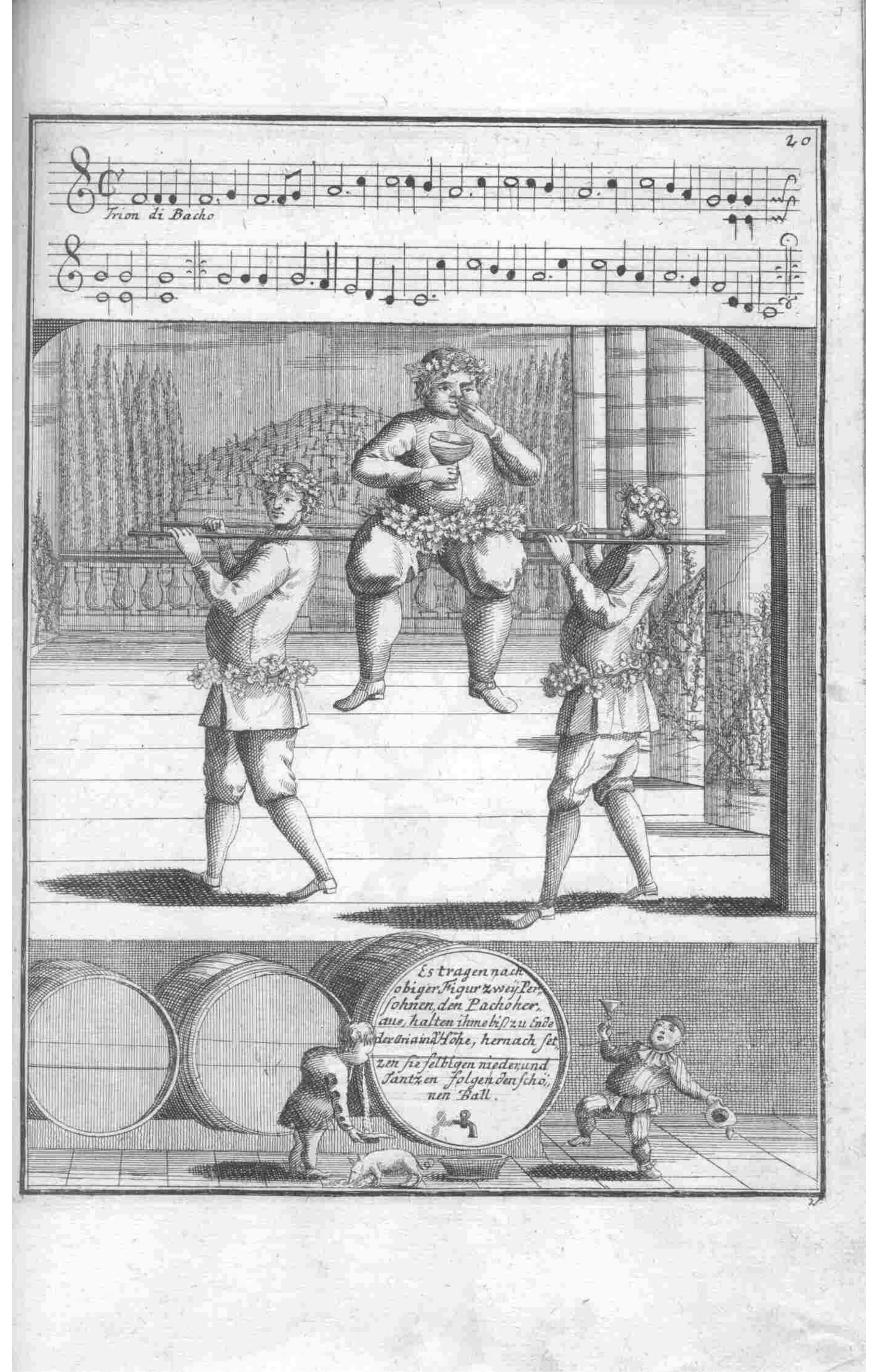
A theatrical stage set enclosed by a curtained proscenium shows three plump putti or cherub-like figures in a comic dance scene. The central figure, larger and more corpulent than the others, stands upright holding a bowl or cup to his mouth in a drinking gesture, adorned with a floral wreath around his middle. Two smaller attendant figures flank him, each holding a long staff or pole that passes beneath or through the central figure in a coordinated theatrical maneuver—possibly a comic basket-dance or prop-based comic turn. The setting is a classical interior with fluted columns, draped curtains in the background, and flowering plants in urns. Below the stage, in a separate vignette, two more small figures (perhaps musicians or dancers) are shown with large barrel-shaped drums or props, and a German verse inscription appears in a cartouche between them. The entire composition is framed as a copper-plate engraving with musical notation—two staves of notated music—printed above the theatrical scene.
The dancing
The central figure is a large, round male body shown frontally, his posture upright and stable, with one arm raised to bring the drinking vessel to his mouth—a pose of comic consumption rather than balletic grace. His two smaller attendants adopt a coordinated stance on either side, holding horizontal staffs or poles at waist height in a synchronized theatrical action. The overall grouping suggests a practiced comic ensemble rather than individual dancers; their bodies are squat and heavily modeled to comic effect. The attendant figures in the lower scene show similar compact, sturdy proportions.
The dance depicted
This appears to be a comic character dance or intermezzetto from early 18th-century theater, likely performed by professional dancers specializing in comic or grotesque roles. The drinking pose and the coordinated staff-handling suggest a scene of festive excess or comic business rather than courtly grace. The notation at the top indicates this was a choreographed piece with an accompanying musical score. The label 'Comic Character' and the theatrical framing within Lambranzi's manual confirm this was a prepared, taught performance—part of the repertory of theatrical dance that complemented or alternated with more formal dances during the Baroque era.
How it was made
This is a copper-plate engraving, a process that allowed for precise, repeatable printing and wide circulation of dance instruction. The fine parallel lines (hatching) create volume and shadow on the figures' bodies, and the technique permits sharp detail in the architectural setting and musical notation. Engraving was the standard vehicle for dance manuals of the period: it was durable, could be bound into volumes, and reached European dance masters and theater professionals. The presence of musical notation integrated into the same plate shows how completely the image and music were conceived as a single instructional unit.
About this work
This is Plate 70 from Gregorio Lambranzi's *Nuova e curiosa scuola de' balli theatrali* (*New and Curious School of Theatrical Dances*), published in Nuremberg in 1716. Lambranzi's two-volume manual is one of the most influential dance-instruction books of the Baroque era, pairing choreographic notation with copper-plate engravings of costumed dancers in theatrical scenarios. This particular plate presents a comic character dance—a genre distinct from the courtly minuets and contredanses that dominate the manual. The engraving shows a stage scene with three grotesquely proportioned figures performing a coordinated piece of comic business involving drinking and staff-handling, accompanied by notated music.
The work belongs to the tradition of early 18th-century theatrical dance, which encompassed both formal court dances and the comic intermezzos, ballet d'action, and character dances that provided contrast and entertainment in the theater. Lambranzi's manual was the first to document such a wide range of theatrical styles—from minuets to comic turns—and to present them with both notation and vivid scenic representation, making it an invaluable record of what actually happened on stage.
How to look at it
Attend first to the compositional symmetry: the two attendant figures mirror each other on either side of the central figure, suggesting a coordinated, practiced ensemble piece rather than solo virtuosity. Notice the moment chosen—not a moment of peak athleticism or courtly elegance, but of comic excess (the drinking) and prop-handling (the staffs), which would have generated laughter or pleasure through incongruity and skill in comic timing. The musical notation above is not decorative: it indicates that this comic turn had a precise musical accompaniment, implying that the timing of the physical comedy was coordinated with the music's phrasing.
The artist
Gregorio Lambranzi was an Italian dance master and choreographer active in the early 18th century, based in Nuremberg. His *Nuova e curiosa scuola de' balli theatrali* (1716) represents a synthesis of Italian dance tradition with German theatrical practice and represents one of the last and most comprehensive attempts to notate and illustrate the full range of theatrical dance before the rise of the ballet d'action. The two volumes contain 200 plates showing individual dances, character types, and scenic moments, each paired with musical notation and often with German verse captions. The work was influential throughout Europe and was republished (with plates recut) in other editions.
The period
In the 1710s, European theater was transitioning between the court ballet tradition and a new emphasis on staged action and spectacle. Minuets and courtly dances were still foundational, but professional theaters increasingly featured comic dances, character dances, and ensemble pieces that drew on popular sources and commedia dell'arte traditions. Dance notation—particularly the Feuillet notation system, which Lambranzi used—had been developed in France in the 1690s to preserve choreography in a standardized form. Lambranzi's manual came at the moment when this notation was spreading through the dance professions, and his decision to pair notation with vivid engravings made dance instruction more accessible to working theater professionals who might not have mastered the abstract notation alone.
Where it lives
This plate is from the holdings of the Library of Congress and is part of Lambranzi's *Nuova e curiosa scuola de' balli theatrali* (Nuremberg, 1716). The work is an illustrated choreographic manual—a teaching and reference book intended for professional dance masters and theater practitioners, not a work of fine art for collectors.
Dance in this work
Questions about this work
What is a 'comic character dance' and who performed it?
Comic character dances were short theatrical pieces designed to amuse audiences through exaggerated gesture, grotesque costume, and physical comedy. They were performed by specialized dancers (often called *danseurs grotesques*) in theaters, at court balls, and in interludes between acts of plays. Unlike courtly minuets, which emphasized elegance and decorum, comic dances celebrated absurdity and physical play.
How do I read the musical notation at the top?
The notation at the top is in the Feuillet or French notation system, standardized in the 1690s, which records the steps, positions, and timing of the choreography. The two staves show the melody that accompanied this dance. To a trained reader of the period, both notation and music together communicated the complete choreography and its musical phrasing.
What is the significance of Lambranzi's manual?
It is one of the most comprehensive surviving records of what dancers actually performed in the early 18th century, including many styles (minuets, contredanses, character dances, comic turns) that are documented nowhere else. Because it combines notation with vivid scenic representation, it offers both the choreographic skeleton and a visual sense of the dancer's body, costume, and theatrical context.
What are the objects the attendant figures are holding?
They appear to be long poles or staffs—likely props or dance implements used in this particular comic routine. The way they are held horizontally beneath the central figure suggests a coordinated ensemble action, possibly a variation on the 'basket dance' mentioned in the catalogue record, where props are manipulated as part of the performance.
More Notation/Choreography artwork