49 works in this view — arrow keys or swipe to move between them.
Dance in Art
Acrobatic — Plate 72
Gregorio Lambranzi
- Medium:
- Copper-plate engraving
- Dance:
- Notation/Choreography
- Era:
- 1700s (Enlightenment/Minuet Era)
- Collection:
- Nuova e curiosa scuola de' balli theatrali (1716)
- Source:
- Library of Congress
- Rights:
- Public domain — free to use, share and adapt.
- Recorded as:
- Public Domain
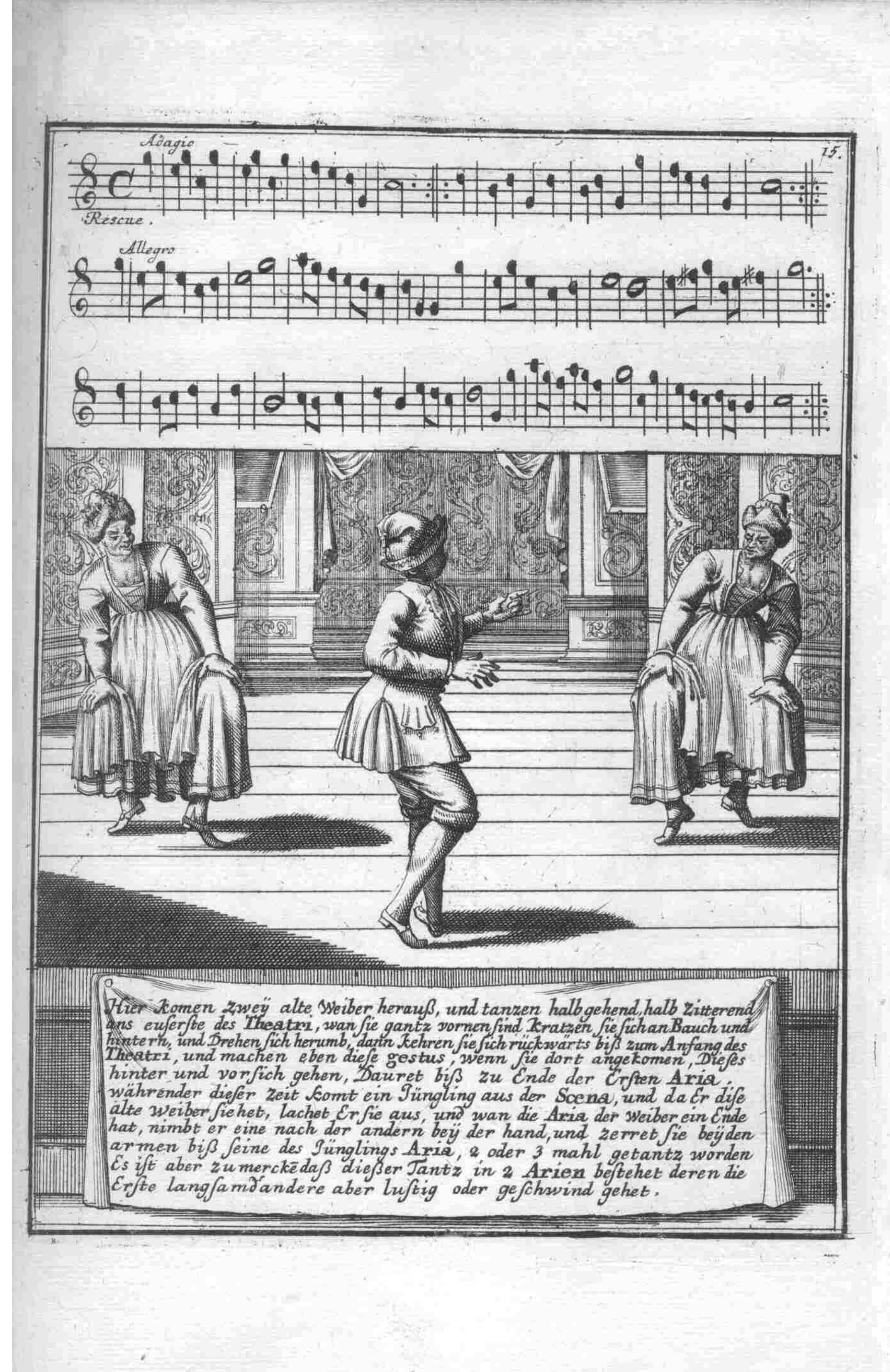
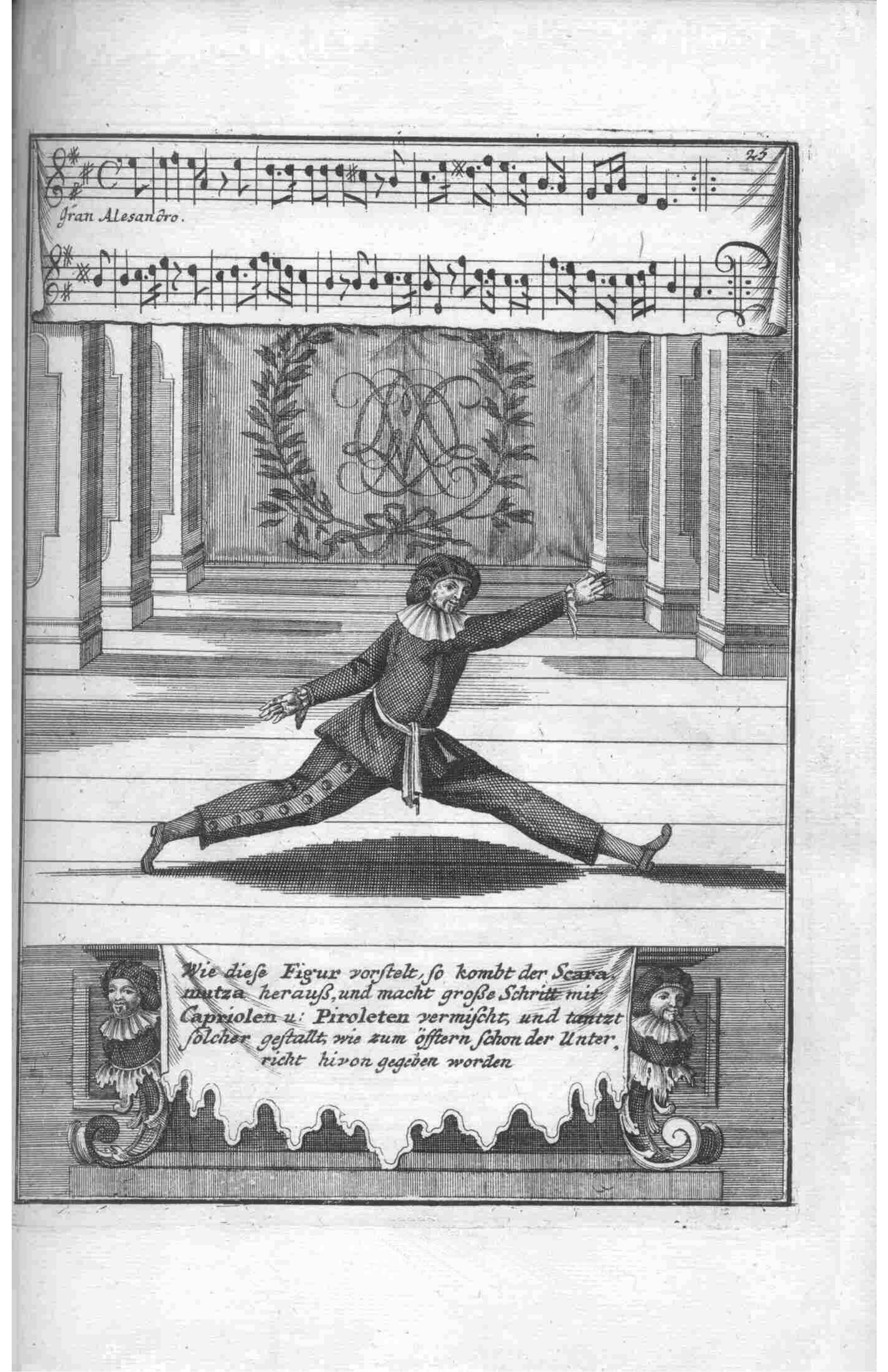
Lambranzi's manual is among the earliest systematic attempts to record stage choreography through notation and image combined, preserving evidence of how theatrical dance was actually composed and transmitted in the early 18th century. This plate specifically documents the vocabulary of comic or 'grottesco' dancing—the exaggerated, character-based movement that sat alongside courtly dance on contemporary stages—and shows how notation, costume, and spatial design worked together as a single choreographic system.
What you are looking at
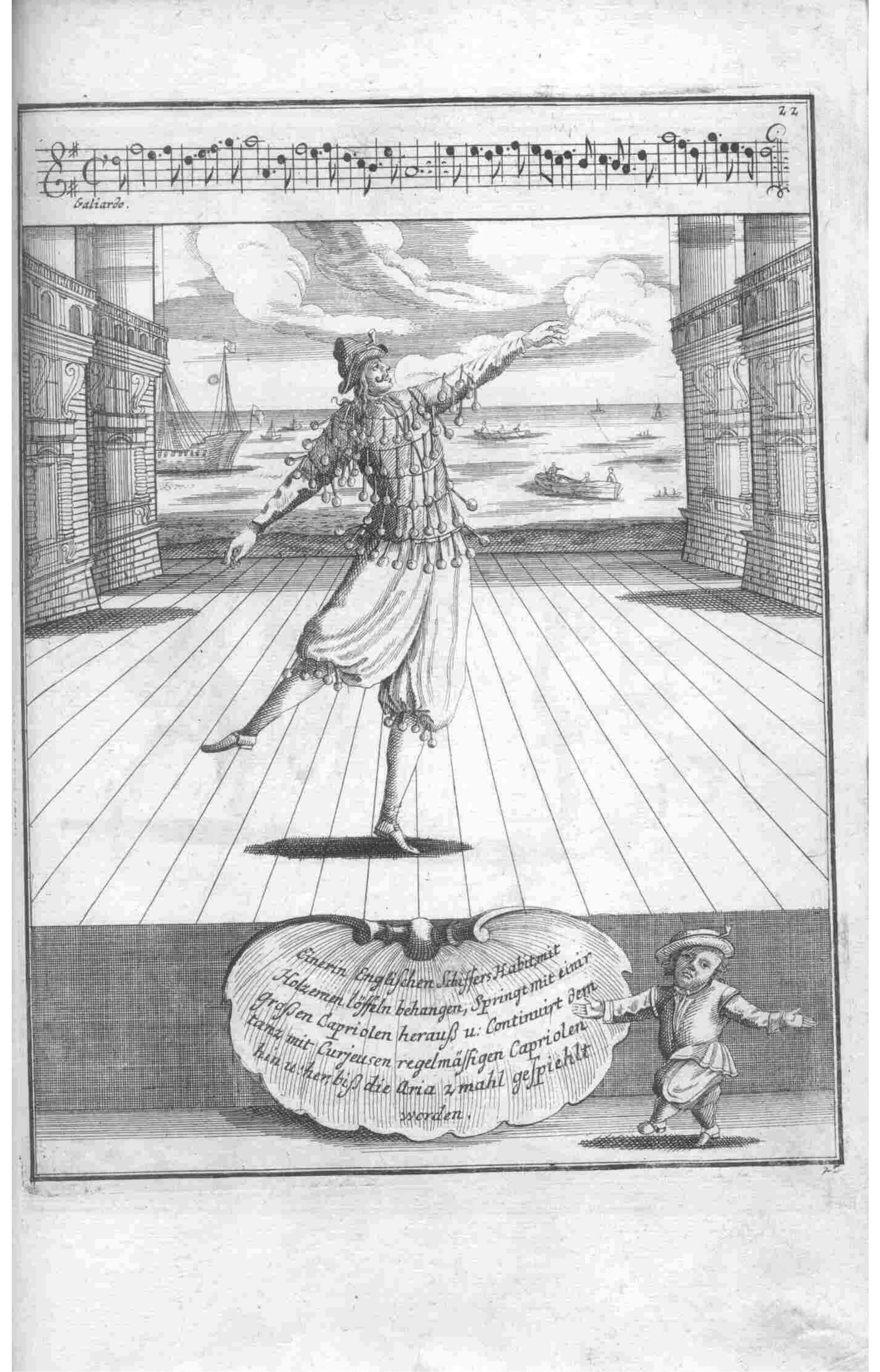
A solo male dancer stands center stage in an elaborately costumed theatrical setting, captured mid-gesture with one arm extended upward and outward as if gesturing to an unseen audience or companion. He wears a richly decorated coat with deep pleats or flounces, a feathered hat, and what appears to be hose or tight breeches. The stage itself is a perspectival interior framed by classical columns and drapery on either side, opening onto a seaport or harbor scene in the background—a broad water view with sailing vessels and architecture rendered in careful recession. The stage floor is marked with strong parallel lines indicating wooden planking. The entire composition is executed as a copper-plate engraving with fine parallel hatching used to create shadow and volume. At the base of the image, a large shell-shaped cartouche contains German text, flanked by two putti or cherubs. Above the engraving, a musical staff shows notated music in a figured notation system common to the early 18th century.
The dancing
The dancer's posture suggests a moment of salutation, display, or emphatic gesture—weight appears to be on both feet, with the torso erect and one arm raised while the other hangs at the side or gestures downward. The extended arm and open stance suggest a momentary pause in action rather than a traveling or balletic leap. The costume is unambiguously theatrical and comedic, with exaggerated pleat-work and ornamentation that signal 'character' rather than noble or courtly bearing. The figure occupies the stage's geometric center, dominating the picture plane.
The dance depicted
This plate depicts a moment of theatrical dance as documented in Lambranzi's 1716 manual—a school designed to teach choreographed movement for the stage. The figure appears to engage in what Lambranzi terms 'acrobatic' or 'grottesco' material: stylized, character-based movement that prioritized dramatic gesture, spatial command, and spectacular display over the courtly restraint of contemporary minuet or French court dances. The paired musical notation indicates that this specific gesture or phrase was timed to a written composition; the dancer was expected to learn a fixed sequence of steps and gestures mapped to notated music. The costume and theatrical framing place this squarely within the commedia dell'arte or theatrical-comedy traditions of early 18th-century court and commercial stages.
How it was made
This is a copper-plate engraving executed with considerable refinement. The fine parallel lines (hatching and cross-hatching) create tonal gradation across the figure's costume, the stage architecture, and the distant harbor. The technique allows for precise linear detail—the individual feathers of the hat, the folds and flounces of the coat, the architectural moldings—and the high contrast of the line-work against white paper makes this suitable for print reproduction and circulation among dancers, choreographers, and musicians across Europe. The engraving's precision and finish suggest professional workshop production; the inclusion of music and text indicates this was part of a bound or assembled instructional text meant to be studied and referenced.
About this work
This is a single plate from Gregorio Lambranzi's *Nuova e curiosa scuola de' balli theatrali* (Nuremberg, 1716), one of the most influential surviving documents of early 18th-century theatrical dance. The manual pairs musical notation with choreographed figures to record a repertory of stage dances for actors and professional dancers, covering everything from courtly minuets to comic character pieces. Lambranzi's work is exceptional for its attempt to codify theatrical movement in an era when dance was largely transmitted by living master and apprentice; the engraved plates served as a portable, reproducible archive of technique, costume, and spatial practice. This particular plate shows a moment of theatrical-comic display—a solo figure in character dress making a grand gesture in a classical stage setting—which would have been one element in a longer composed sequence of entrances, interactions, and choreographed moments designed for court entertainment or professional theater.
How to look at it
Begin with the figure's pose and costume: note the exaggerated pleat-work, the feathered hat, and the raised arm—these signal a moment of theatrical display or salutation rather than the contained elegance of a minuet. Look at how the body holds the stage space: the figure stands upright and centered, commanding attention through stillness and gesture rather than movement. Then attend to the stage setting itself—the classical columns, the harbor view beyond, the wooden stage floor—which places this figure within a narratively rich space, suggesting that this dance was part of a larger theatrical scene, not an abstract exercise. Finally, glance at the musical notation: the presence of written music above the figure reminds us that what we see was choreographed to a specific tune, and that dancers of the period would have learned this figure in close coordination with the music.
The artist
Gregorio Lambranzi (fl. early 18th century) was an Italian dancing master and choreographer active in Nuremberg in the early 1700s. Little is known of his biography, but his published manual *Nuova e curiosa scuola de' balli theatrali* (1716), illustrated by Johann Georg Puschkin, remains the most comprehensive surviving record of composed theatrical dance from that era. The work collects solo and group dances of various types—minuets, courantes, character dances, comic pieces—each paired with musical notation and an engraved figure demonstrating the posture or moment. The manual was reprinted and circulated across Europe and influenced later choreographic notation systems. Lambranzi appears to have been commissioned to document an existing theatrical repertory, possibly for a court or ensemble he served.
The period
In the early 18th century, theatrical dance was becoming increasingly refined and codified. The dominance of the French court and French dancing masters (following Louis XIV's establishment of the Académie Royale de Danse in 1661) had led to a standardization of noble or 'serious' dance technique. Alongside this, however, comedic or character dancing remained vital to professional theater and court entertainment, particularly under the influence of commedia dell'arte and popular dramatic traditions. Music and dance notation were beginning to develop in parallel: the same decades saw the refinement of Beauchamp-Feuillet notation (for floor patterns) and figured-bass notation (for music). Lambranzi's work sits at the intersection of these systems, attempting to unite music, choreography, costume, and character in a single instructional document. The work has no real English precedent and appears unique in its systematic scope.
Where it lives
This engraving is one of 114 plates from Lambranzi's *Nuova e curiosa scuola de' balli theatrali*, published in Nuremberg in 1716. The Library of Congress holds a copy of the complete work. As part of that bound manual, this plate functioned as a pedagogical and reference document, meant to be studied by dancers, choreographers, and music masters across Europe.
Dance in this work
Questions about this work
What does the music notation at the top mean?
The musical staff above the engraving shows the melody or rhythm that accompanied this particular dance phrase or gesture. Dancers of the period learned choreography in strict coordination with music; the notation allowed a dancer or master to reconstruct the timing and phrasing of the movement. This was an early form of choreographic recording, pairing movement with its musical score.
Why is the dancer dressed so elaborately?
The costume indicates this is a character or comic role, not a courtly dance. The exaggerated pleat-work, feathered hat, and ornate decorations belong to the 'grottesco' or theatrical-comedy tradition. Such costumes were essential to the performance: they told the audience immediately what type of character and behavior to expect, and the movement itself was designed to showcase and display the costume.
Is this dance different from the minuet?
Yes. While minuets were courtly, measured, and restrained, this 'acrobatic' or character dance emphasized dramatic gesture, spatial command, and display. Lambranzi's manual includes both types, reflecting the breadth of theatrical dance in the early 18th century. Character dances like this were often faster, more physically expressive, and tied to specific theatrical narratives or comedic types.
What was Lambranzi's manual used for?
The manual served as a reference and instructional text for professional dancers, choreographers, and music masters across Europe. It preserved a repertory of composed theatrical dances that might otherwise have been lost to oral transmission. Dancers could study the engraved figures and music to learn and recreate these dances, making it one of the earliest systematic attempts to record and circulate choreography in print.
More Notation/Choreography artwork