49 works in this view — arrow keys or swipe to move between them.
Dance in Art
Acrobatic — Plate 75
Gregorio Lambranzi
- Medium:
- Copper-plate engraving
- Dance:
- Notation/Choreography
- Era:
- 1700s (Enlightenment/Minuet Era)
- Collection:
- Nuova e curiosa scuola de' balli theatrali (1716)
- Source:
- Library of Congress
- Rights:
- Public domain — free to use, share and adapt.
- Recorded as:
- Public Domain
Acrobatic dance has largely been written out of early modern dance history, which tends to focus on courtly ballet or folk forms. This plate is among the few reliable documents of how acrobatics were choreographed, staged, and valued in the early 18th century, and it shows they were sophisticated, codified performance practices taught by professionals and recorded in expensive printed manuals. Lambranzi's work is also foundational to the history of dance notation and theatrical documentation—a bridge between choreographic writing systems and practical stage craft.
What you are looking at
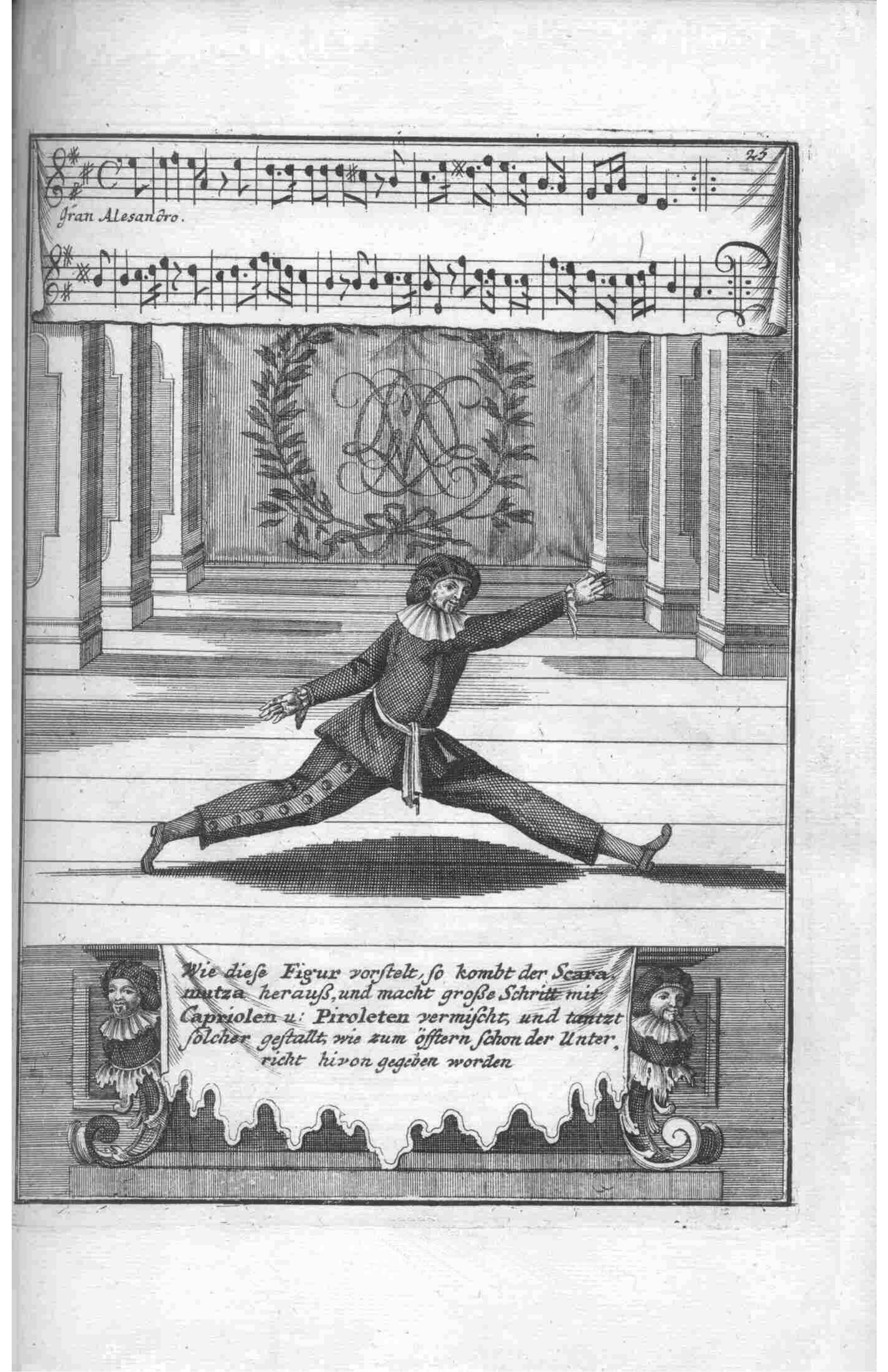
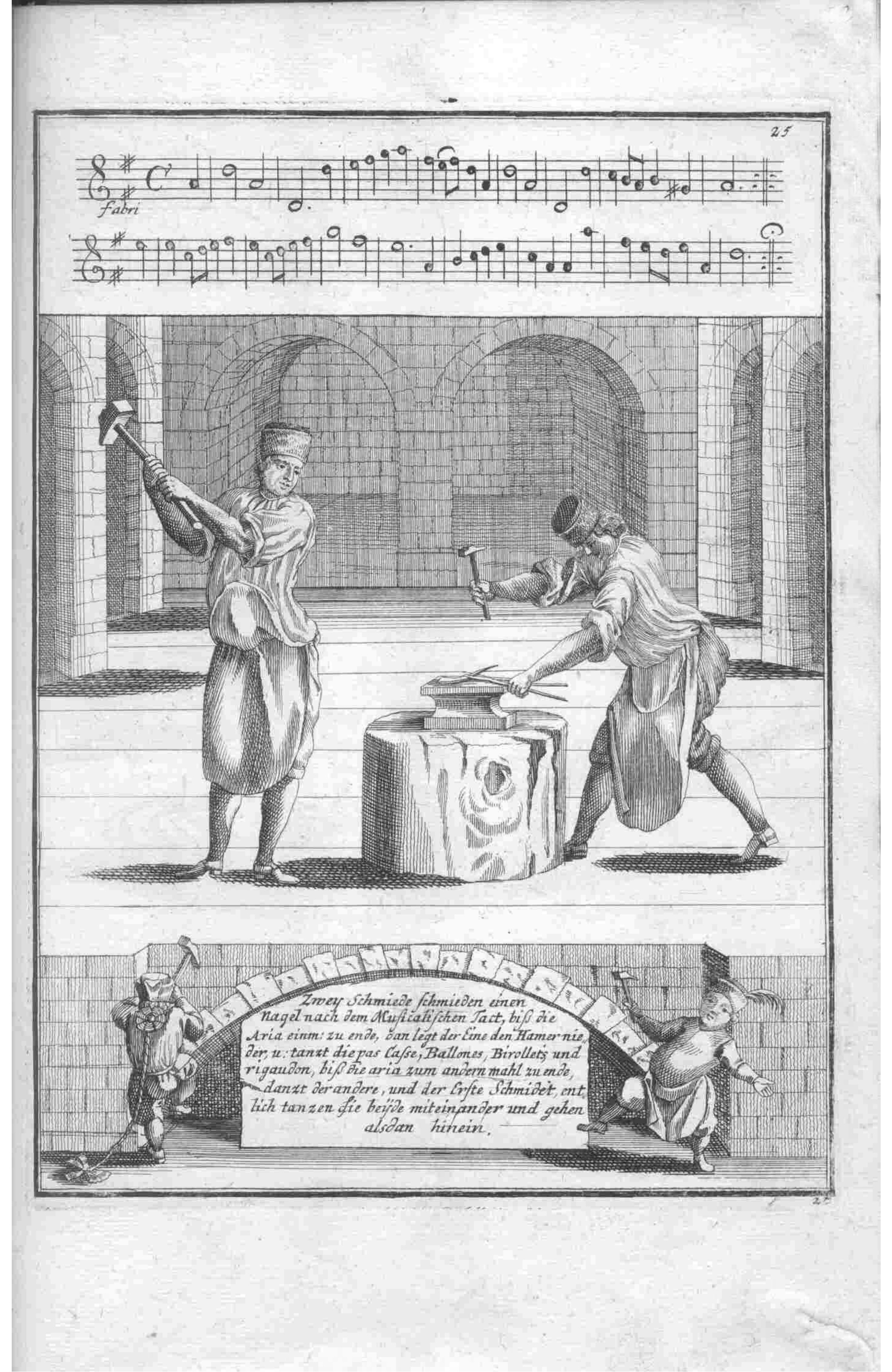
A theatrical engraving from 1716 presents a staged acrobatic act within a classical interior framed by arched columns and tiled flooring. Two costumed figures work with a wooden block or stool at center stage. The figure on the left, wearing a tunic and cap, raises an axe or tool high overhead in a dynamic pose of execution or forceful action. The figure on the right leans forward in an athletic crouch, wielding what appears to be a chisel or pointed tool against the block. The setting suggests a Roman or neoclassical workshop, though the theatrical proscenium and careful compositional balance indicate this is staged performance rather than documentary craft. Light is uniform and frontal, typical of engraving technique, casting clear shadows that emphasize the volumetric forms of the figures and the substantial wooden prop.
The dancing
The left figure demonstrates significant elevation and torsional twist, the body weight transferred through the extended left leg while the right leg bends in preparation; this suggests an acrobatic feat of balance and control rather than a naturalistic carpenter's swing. The right figure maintains a low, grounded position with bent knees and forward lean, demonstrating strength and stability. Neither figure adopts the closed holds or frame typical of partner dance; instead, they occupy separate zones of the stage and relate to the prop and to the act's narrative. The poses are snapshot moments of dynamic action frozen mid-performance.
The dance depicted
This is acrobatic theater—specifically a chair or prop acrobatics act, likely performed by a solo male dancer or acrobat supported by a stage partner. The catalogue title 'Acrobatic — Plate 75' and Lambranzi's context as a dance manual author confirm this belongs to the theatrical dance tradition. Lambranzi's *Nuova e curiosa scuola de' balli theatrali* documented staged entertainments that sat between ballet, commedia dell'arte, and acrobatic display. The moment captured here shows the precision and strength-based choreography that distinguished such acts: balance on unstable ground, controlled leverage, and athletic partnership. This was theater for courtly or public audiences rather than social dancing.
How it was made
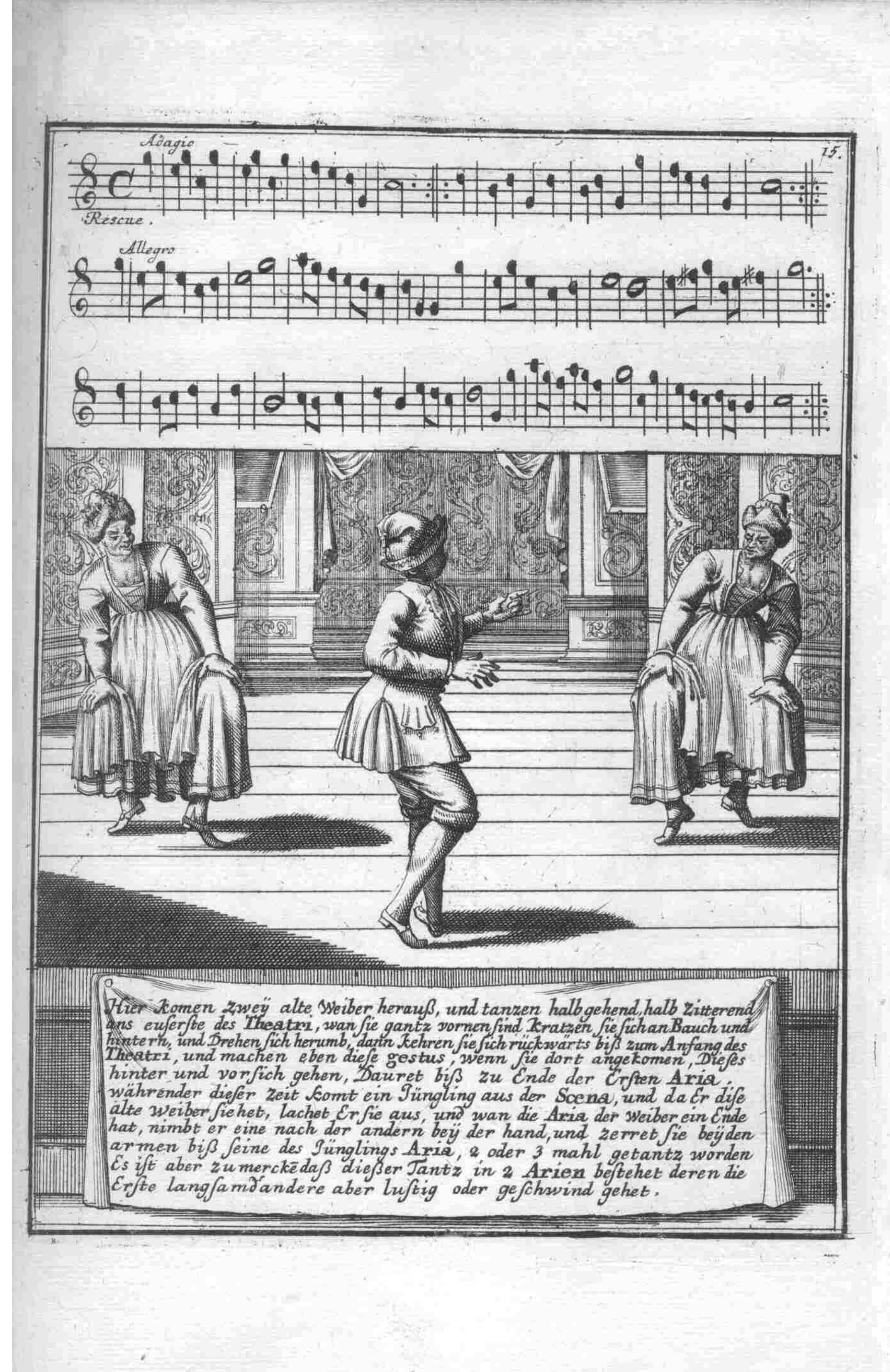
This is a copper-plate engraving, a technique that allowed precise, reproducible line work and fine tonal gradation through cross-hatching. The medium was ideal for a printed manual: multiple impressions could be distributed to dance masters and theater practitioners across Europe without loss of detail. The fine hatching visible in the architecture, drapery, and musculature shows the engraver's control and labor; this was an expensive object to produce. Each plate was paired with musical notation (visible at top in two staves) and a German verse caption, making the manual a complete choreographic and musical score for performance.
About this work
This is one of approximately 100 engravings from Gregorio Lambranzi's 1716 *Nuova e curiosa scuola de' balli theatrali*, the most comprehensive illustrated guide to early 18th-century theatrical dance and acrobatics. Each plate documents a distinct choreographed act or social dance form, making the manual an invaluable record of stage entertainment at the cusp of baroque and early Enlightenment theater. Lambranzi worked in Nuremberg and compiled dances and spectacles from across Europe; his book circulated widely among dance masters and influenced theatrical practice for decades.
This plate specifically preserves a form of acrobatic theater that combined athletic display with choreographic rigor. The figure poses, the theatrical setting, the musical notation, and the accompanying text all worked together to allow a performer or teacher to reconstruct the act. Such acrobatics were a regular component of court spectacle, carnival performance, and early modern theater, yet few survived in any visual form. Lambranzi's systematic documentation rescued them from ephemera.
How to look at it
Attend to the frozen moment: the artist has captured the acrobat at the apex of an action—the axe raised at full extension, the body twisted and balanced—which conveys dynamism and risk. The careful architectural framing (columns, arches, floor tiles) establishes this as a staged performance, not a document of labor. Compare the two figures' body positions: one is elevated and extended, the other is grounded and compact. The prop (block or stool) is substantial and the focal point; it is not a decorative object but the functional center of the choreography. The musical notation at the top promises that this action had a sonic accompaniment and could be reconstructed by a trained practitioner.
The artist
Gregorio Lambranzi was an Italian dance master and choreographer active in the early 18th century, primarily in Nuremberg. He is known almost exclusively through his *Nuova e curiosa scuola de' balli theatrali*, published in Nuremberg in 1716 with engravings by Johann Georg Puschkin. The manual documents both social dances (minuets, rigaudons) and staged acrobatic and theatrical acts, reflecting Lambranzi's experience in court and public spectacle. His systematic, illustrated approach to choreographic documentation was innovative for its time and influenced dance practice across German-speaking territories. Little is known of his biography beyond what the manual itself reveals about his professional networks and theatrical knowledge.
The period
In the early 18th century, acrobatics and physical virtuosity were standard components of courtly entertainment, carnival spectacle, and early theater. They coexisted with ballet proper (which was becoming codified and less athletically extreme) and with commedia dell'arte-influenced performance. Lambranzi's manual documents a moment when dance and acrobatics were still understood as related practices within theatrical spectacle. The notation and musical accompaniment reflect emerging efforts to systematize and preserve choreography—a concern that would intensify throughout the 18th century. Published dance manuals were rare and expensive; Lambranzi's was among the most comprehensive and widely distributed, making it a primary source for understanding what European performers were actually doing on stage.
Where it lives
This plate is from the 1716 Nuremberg edition of *Nuova e curiosa scuola de' balli theatrali*, a printed dance manual. The Library of Congress holds a copy and provided this image. The manual is one of fewer than a handful of comprehensive illustrated dance manuals from the early modern period and survives in multiple European collections.
Dance in this work
Questions about this work
What is acrobatic theater and how is it different from ballet?
Acrobatic theater emphasizes athletic virtuosity, balance, and strength-based feats, often performed with props or by multiple performers in asymmetrical configurations. Ballet, by contrast, was becoming codified around the turned-out positions, lifted port de bras, and symmetrical spatial arrangements that characterized courtly dance. In the early 18th century, both were performed on stage, but acrobatics remained closer to commedia dell'arte and carnival entertainment, while ballet was becoming the refined practice of courts and professional companies.
How do we know this was choreographed and not just documentation of craft work?
The theatrical framing (columns, proscenium arch, formal stage), the musical notation paired with the image, the German verse caption, and the systematic presentation in a dance manual all signal choreography rather than documentary illustration. A real carpenter's workshop would not be staged with classical architecture and two performers coordinating action to music. Lambranzi's manual was explicitly a *scuola* or school—a set of lessons and pieces to be learned and performed.
Who performed these acrobatic acts?
Lambranzi's manual documents acts performed by professional performers in courtly and public theaters. These performers might be dancers trained in the theater, traveling entertainers, or specialists in acrobatics. The manual was addressed to dance masters and theater professionals who would teach and stage such acts. Some performers likely specialized in acrobatics; others may have combined multiple performance skills.
Is there any evidence this particular plate was actually performed?
There is no direct evidence this specific plate was performed, but the systematic nature of Lambranzi's manual suggests the acts were drawn from actual repertoire. The manual circulated among dance masters who would have used it as a teaching and choreographic resource. The fact that multiple copies survive in different collections suggests it was actively used, not merely a theoretical exercise.
More Notation/Choreography artwork