49 works in this view — arrow keys or swipe to move between them.
Dance in Art
Acrobatic — Plate 77
Gregorio Lambranzi
- Medium:
- Copper-plate engraving
- Dance:
- Notation/Choreography
- Era:
- 1700s (Enlightenment/Minuet Era)
- Collection:
- Nuova e curiosa scuola de' balli theatrali (1716)
- Source:
- Library of Congress
- Rights:
- Public domain — free to use, share and adapt.
- Recorded as:
- Public Domain
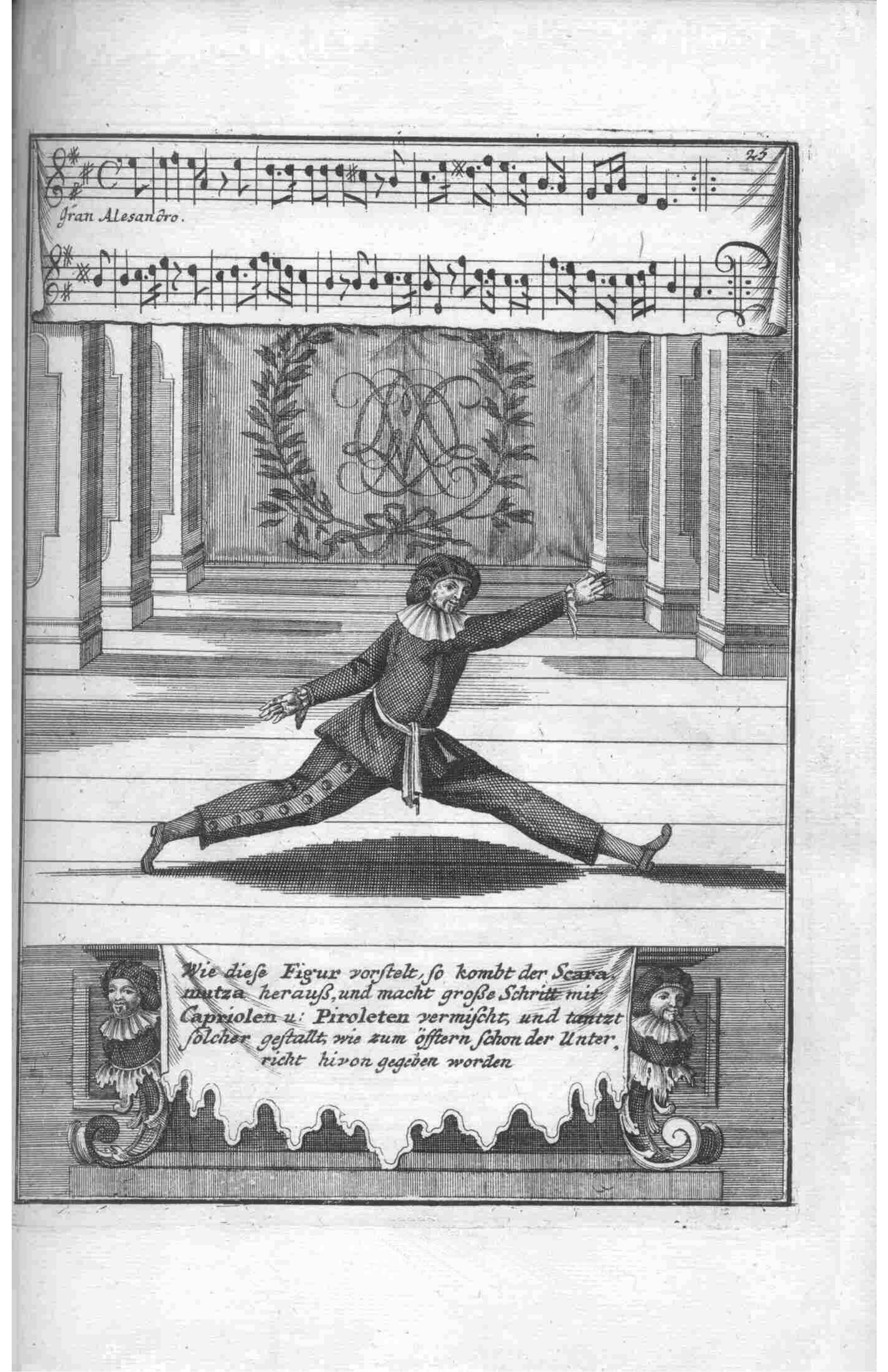
Lambranzi's manual is one of the most comprehensive visual records of Baroque theatrical dance, capturing steps, attitudes, and performance spectacle that would otherwise exist only in written notation or memory. This plate specifically documents the physical and technical ambitions of male theatrical dancers in the era—their use of elevation, balance, props, and exaggerated attitude—and reveals that acrobatic virtuosity was not marginal entertainment but a valued element of the courtly and commercial stage.
What you are looking at
A solo male dancer stands at the center of a stage framed by heavy draped curtains, posed in an acrobatic attitude that reads as both theatrical and physically demanding. He wears an ornate early 18th-century costume: a plumed hat, decorated jacket with embroidered details, and breeches. His right leg is lifted high and bent, his torso twists, and his left arm extends upward in an arc while his right arm gestures outward—the entire pose suggesting a moment of dynamic balance and control. He stands on a shallow platform or bench set upon a checkered floor. A large circular hoop or wheel lies on the stage beside and beneath him, appearing to be the prop central to this acrobatic feat. The stage is a formal theatrical interior with wooden floorboards rendered in precise perspective, and small figures visible in the wings suggest this is a scene of public performance. At the bottom of the print, a cartouche contains German text and decorative flourishes, typical of theatrical dance notation pages.
The dancing
The single dancer presents an elevated, twisted torso with marked asymmetry: the raised right leg is bent at the knee and lifted to approximately hip height or higher, while the left leg supports the full weight and remains straight and grounded. The upper body rotates away from the supporting leg, creating a spiral line from foot through spine. Both arms are active and positioned in three dimensions—one raised and arcing, the other extended sideways—suggesting both balance work and a vocabulary of arm positions drawn from theatrical convention. The pose reads as a moment of suspension or controlled instability, the kind of arrested motion that makes acrobatic skill visible.
The dance depicted
This is theatrical acrobatic or 'ballo' performance in the Baroque theatrical tradition, most likely a demonstration from a dancing master's manual. The hoop or wheel suggests prop-based acrobatics—tumbling, jumping through, or balancing with an object—which was part of the virtuosic entertainment vocabulary of Italian and German court theaters in the early 18th century. The costume, setting, and notated music above indicate this is a solo variation or 'numero' from a larger theatrical dance work. Without additional context, the specific name of the piece cannot be determined, but it belongs to the category of theatrical display dances (danze di carattere) that showcased individual male dancer's technical prowess and physical daring.
How it was made
This is a copper-plate engraving, a medium that allows fine linear detail and consistent reproducibility. The precise cross-hatching and controlled line work convey both the spatial recession of the stage and the careful rendering of costume texture and facial features. Engraving was the standard medium for circulating illustrated dance manuals across Europe in this period; its durability and clarity made it ideal for instructional reproduction. As part of a bound manual, this plate would have reached dancing masters, court performers, and educated patrons across the German-speaking territories and beyond. The pairing of notated music at the top with a full-stage figure below established a template for dance notation that persisted throughout the 18th century.
About this work
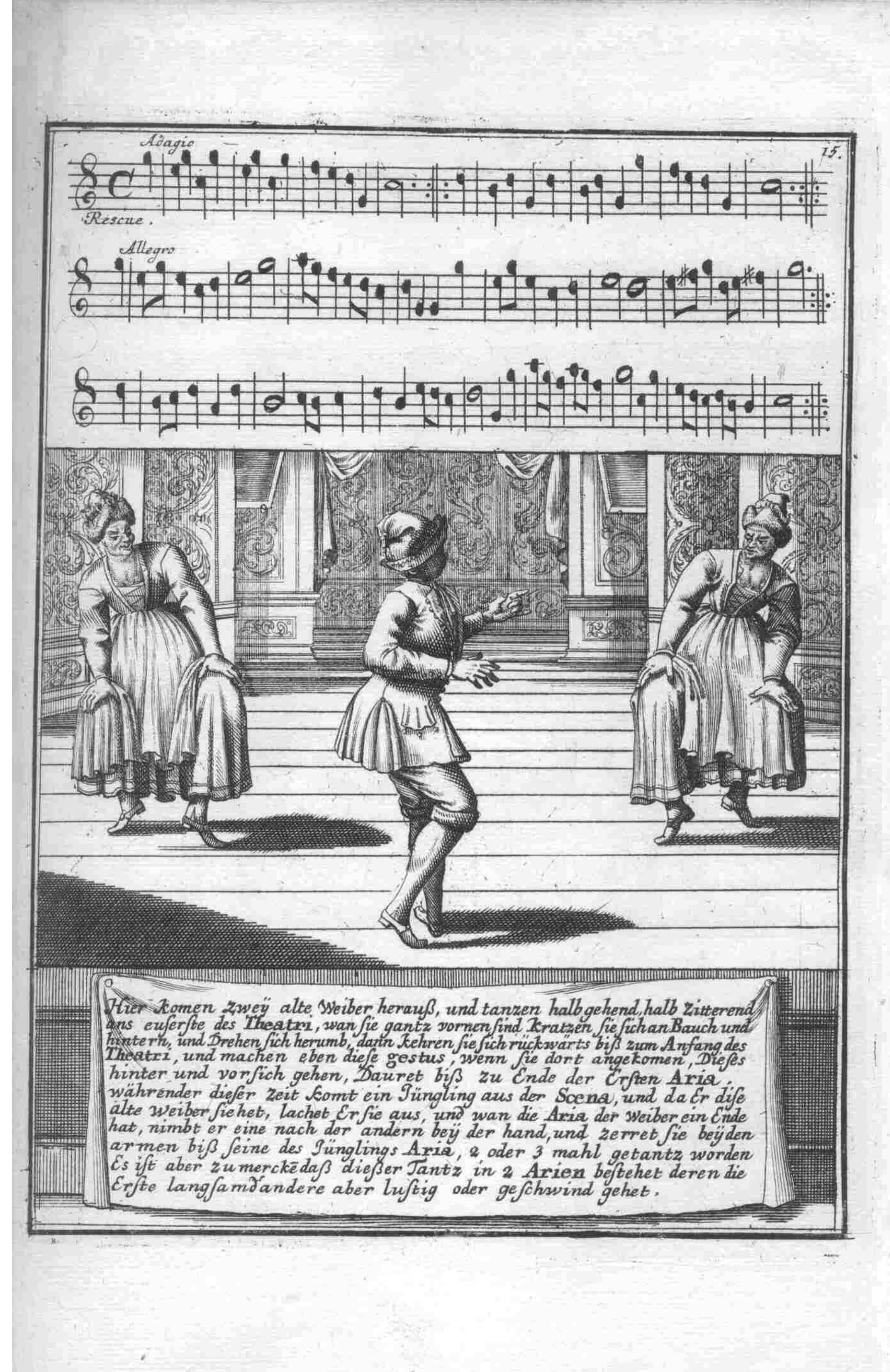
This is plate 77 from Gregorio Lambranzi's *Nuova e curiosa scuola de' balli theatrali* ('New and Curious School of Theatrical Dances'), published in Nuremberg in 1716 in two volumes with over 200 plates. Each plate presents a single choreographed moment: musical notation above, a costumed figure in a precise stage setting below, and an explanatory German verse beneath. Lambranzi was a Nuremberg dancing master documenting the theatrical dance vocabulary of his era—a compendium of character dances, acrobatic turns, courtly variations, and spectacular solo feats. This particular plate captures an acrobatic solo, a genre of virtuosic display that entertained in courts, theaters, and aristocratic gatherings across early 18th-century Europe.
How to look at it
Observe the precise moment Lambranzi has frozen: not the beginning of a movement, but a moment of display—a held position that demonstrates balance, control, and the dancer's ability to sustain an unexpected shape. Notice how the hoop or wheel is positioned not as an obstacle to be jumped or spun, but as an integral part of the pose, suggesting that the choreography integrates the prop into a unified visual composition. The lifted leg, twisted torso, and extended arms work together to create a dynamic silhouette that reads from the house; this is not an intimate or internal moment but a public display designed to be seen from a distance and read at a glance. The costume—ornate, weighted with decoration, and historically specific—is part of the spectacle; the movement vocabulary that Lambranzi records was inseparable from the character and social status that costume conveyed.
The artist
Gregorio Lambranzi (c. 1675–after 1730) was a dancing master and choreographer active in Nuremberg during the late Baroque period. His two-volume *Nuova e curiosa scuola de' balli theatrali* (1716) stands as one of the most significant dance manuals of the era, rivaled in scope and influence perhaps only by Pierre Beauchamp's works and the later Feuillet notation system. Lambranzi's ambition was to preserve and teach the diverse vocabulary of theatrical dance—from court minuets to character dances to acrobatic displays—through a combination of musical notation, anatomically precise engravings, and explanatory verse in German. The work was reprinted and pirated extensively and circulated widely in translation, making Lambranzi's vision of theatrical dance practice one of the foundational documents for understanding Baroque performance.
The period
In the early 18th century, theatrical dance existed in a state of rapid codification and transformation. The court ballet tradition of the 17th century was being systematized into a formal technique (what would become classical ballet), but simultaneously, entertainment stages remained crowded with character dances, comedic turns, acrobatic feats, and spectacular machinery. The male dancer in particular was expected to demonstrate not only grace and elevation but also physical daring—tumbling, jumping, balancing, and the controlled execution of surprising or difficult movements. Lambranzi's manual captures this moment of transition, documenting a dance vocabulary that was becoming historicized even as it was being practiced. The German court and commercial theaters of Nuremberg and the surrounding regions were active producers of such entertainment, and Lambranzi's manual served both as a record and as a practical teaching tool for the next generation.
Where it lives
This plate comes from Gregorio Lambranzi's *Nuova e curiosa scuola de' balli theatrali* ('New and Curious School of Theatrical Dances'), published in Nuremberg in 1716. The work consists of two volumes with over 200 copper-plate engravings, each pairing choreographic instruction with musical notation and explanatory verse. The present copy is held at the Library of Congress.
Dance in this work
Questions about this work
What is the object under and beside the dancer?
A hoop or wheel, likely a prop integrated into the choreography. Its exact function—whether for jumping through, spinning, balancing with, or using as a visual element of design—cannot be determined from the image alone, but acrobatic dances of this era frequently incorporated such props to increase visual spectacle and to showcase the dancer's physical control and daring.
Was this dance actually performed, or is it a theoretical invention?
Lambranzi's manual documents dances he observed and taught; these were active pieces in the repertory of theatrical stages and court performers in early 18th-century German-speaking territories. The specificity of costume, music, and setting suggests this is a record of actual performance practice rather than pure imagination, though the degree to which each plate represents a particular documented performance versus a typical or exemplary instance cannot be determined from the image.
Why is there music notation at the top?
Music and dance were inseparable in this era, and Lambranzi's manual paired each choreographed moment with its corresponding music so that dancing masters could teach or reconstruct the piece. The notation is not a full score but a melodic line or essential theme; it would have been performed by musicians while dancers learned the steps and positions from the engraved figure.
How was this book used?
As a teaching and reference tool for dancing masters, court performers, and educated patrons. A master could consult a plate, study the position and gesture, learn the accompanying music, and teach the piece to students. The manual also functioned as a display of knowledge and taste—owning it signaled engagement with the fashionable and sophisticated world of theatrical dance.
More Notation/Choreography artwork