49 works in this view — arrow keys or swipe to move between them.
Dance in Art
Acrobatic — Plate 79
Gregorio Lambranzi
- Medium:
- Copper-plate engraving
- Dance:
- Notation/Choreography
- Era:
- 1700s (Enlightenment/Minuet Era)
- Collection:
- Nuova e curiosa scuola de' balli theatrali (1716)
- Source:
- Library of Congress
- Rights:
- Public domain — free to use, share and adapt.
- Recorded as:
- Public Domain
Lambranzi's *Scuola* is one of the few surviving visual records of how early 18th-century theatrical dancers moved and held themselves. Unlike notation systems that record step sequences, these engravings capture pose, dress, character, and spatial relationship to the stage, offering historians and performers insight into the aesthetic values and physical culture of professional dance before the Romantic era.
What you are looking at
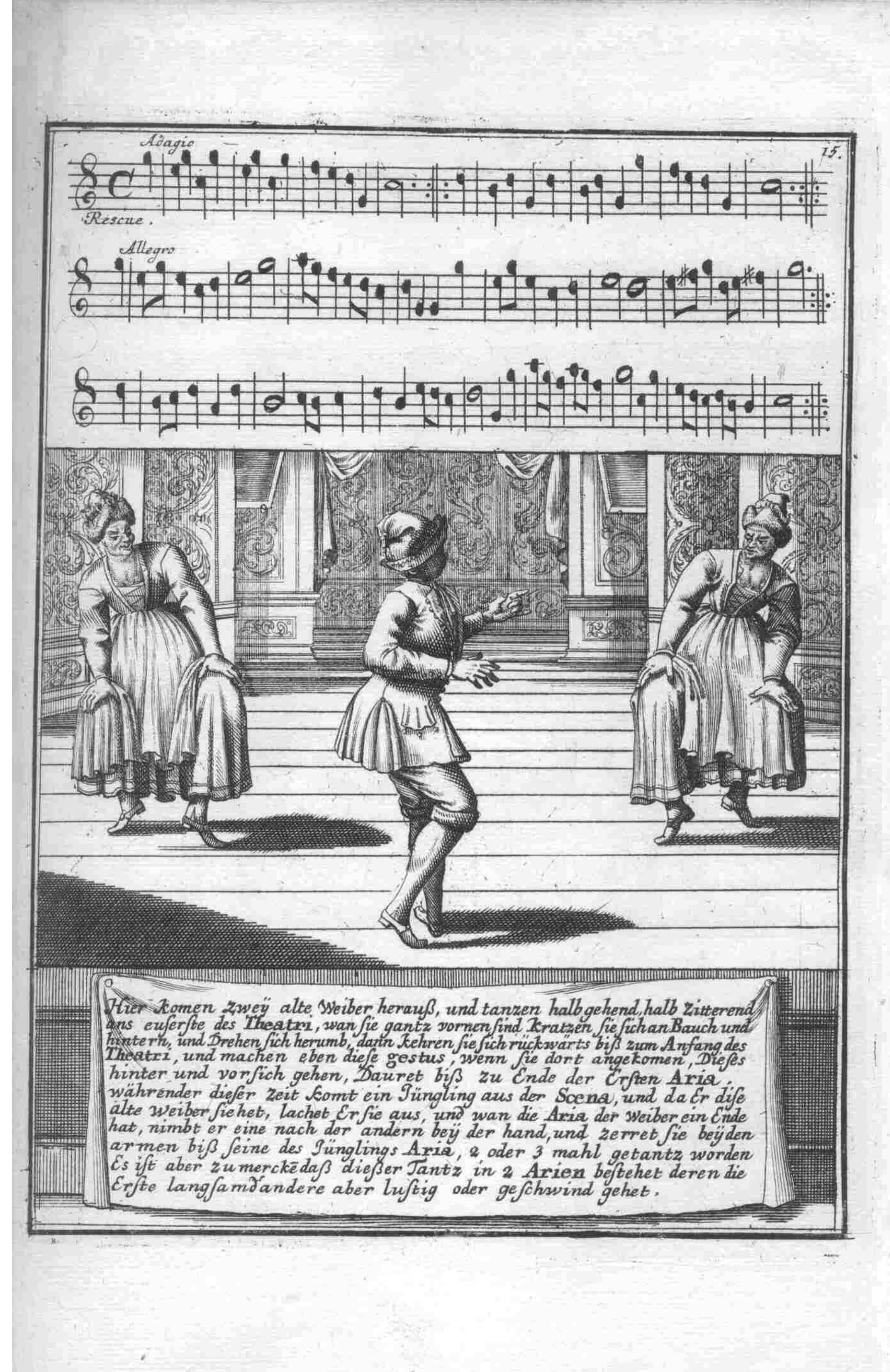
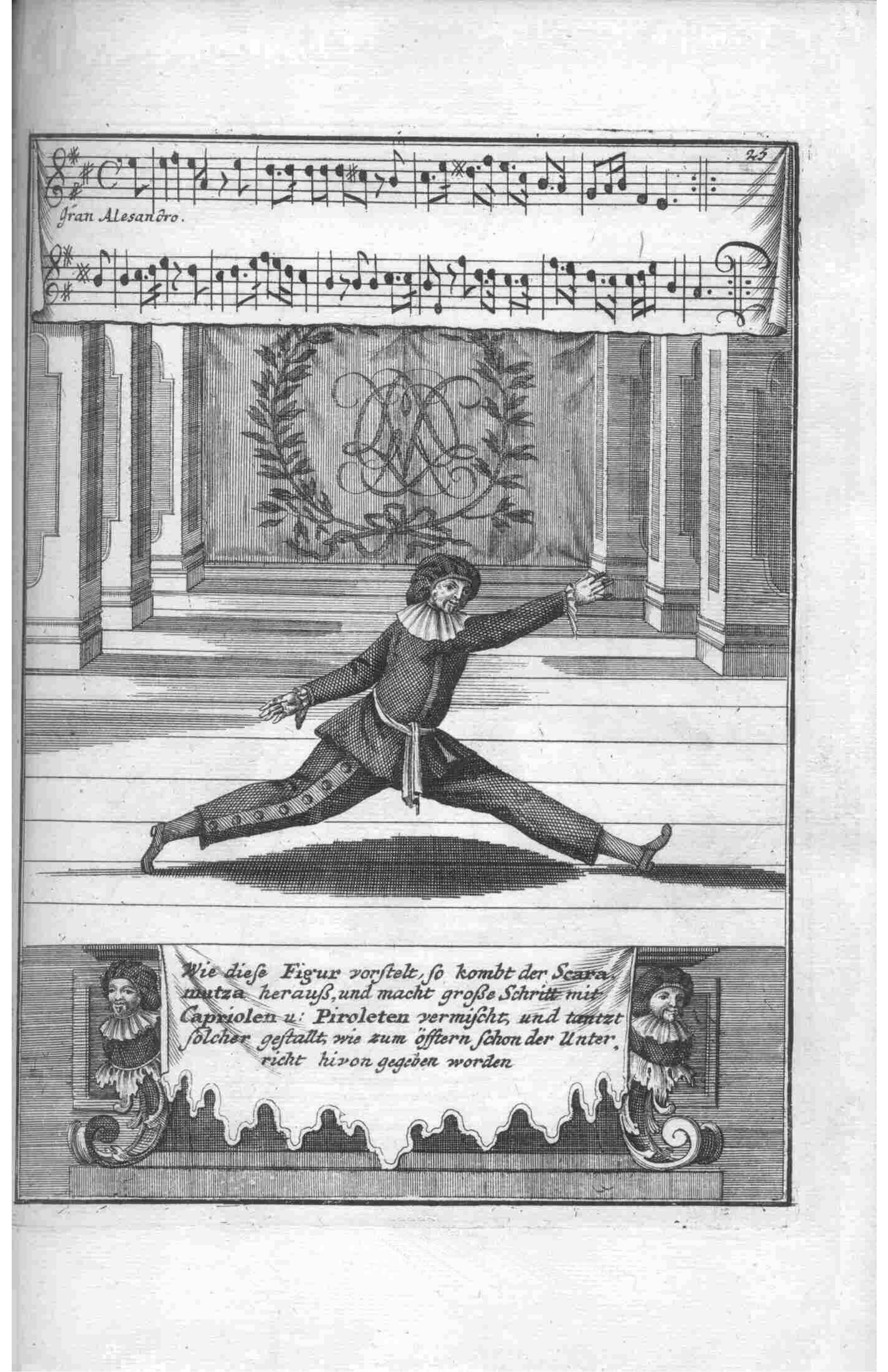
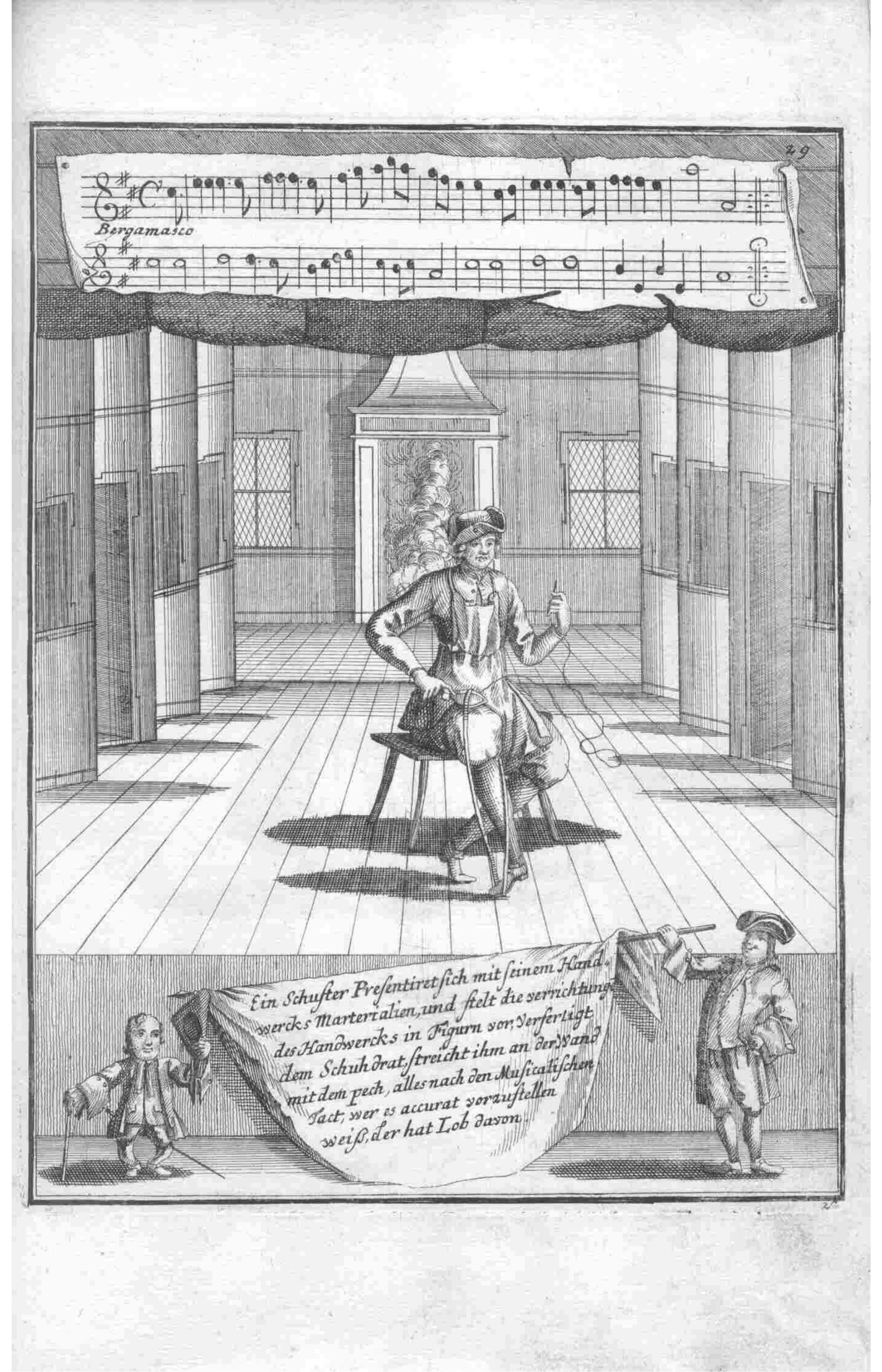
A solitary male dancer in period costume stands center-stage on a wooden floor within an ornately columned interior. The stage is framed by tall fluted columns, swags of fabric along the ceiling, tall windows with latticed panes, and an architectural backdrop suggesting a palace or grand hall. The dancer wears a feathered cap, fitted jacket with decorative trim, knee breeches, stockings, and heeled shoes; he holds a staff or cane in his right hand and gestures outward with his left arm in an expressive pose. His weight is balanced, his chest open, his body angled in profile to the viewer. The engraving is precisely detailed, the floor rendered in linear perspective, the stage architecture conveying theatrical grandeur. A musical score is notated above the scene, and a German verse caption—discussing the dancer's skill and the nature of theatrical dance—appears in a decorative cartouche at the base.
The dancing
The single dancer is positioned in a contrapposto stance with his left leg grounded and his right leg slightly flexed. His left arm extends outward and upward in an open gesture; his right arm holds a staff angled across his body. The torso is upright and engaged, the head turned slightly toward the viewer. The pose suggests both repose and readiness—a moment of display rather than vigorous action. The dancer's bearing is noble and controlled, the carriage aristocratic.
The dance depicted
This is theatrical dance of the early 18th century, almost certainly a solo character or 'grotesque' dance from the court and commercial stage traditions of that era. The staff, the architectural setting, the formal costume, and the notated music all indicate a choreographed theatrical piece, likely performed by a professional dancer in an opera house or court theatre. The pose is one of presentation and gesture rather than athletic virtuosity; it exemplifies the decorative, gestural vocabulary of early baroque theatrical dance, where stillness and noble bearing could be as important as movement.
How it was made
This is a copper-plate engraving, a technique allowing fine linear detail and wide circulation through printed copies. Engraving was the standard vehicle for dance instruction manuals in the 18th century, permitting the artist to render both architectural space and human anatomy with precision. The technique's formality suited the subject matter—instructional and aspirational—and would have allowed this work to circulate to dancers, choreographers, and theatre practitioners across Europe.
About this work
This plate is one of eighty engravings from Gregorio Lambranzi's *Nuova e curiosa scuola de' balli theatrali* (*New and Curious School of Theatrical Dances*), published in Nuremberg in 1716. Each plate pairs a piece of notated music with a costumed solo dancer in a staged moment, creating a visual-musical record of early 18th-century theatrical dance vocabulary. Lambranzi's manual was one of the most influential dance-instruction texts of its time, combining courtly elegance with theatrical spectacle and offering a window into how professional dancers of the period understood and performed their art.
The work belongs to a transitional moment: the baroque court ballet tradition was waning, yet the theatrical vocabulary of gesture, costume, and noble carriage remained central to professional performance. Lambranzi's plates show not isolated technical steps but complete theatrical personas—characters, moods, and narratives embodied in single, carefully composed figures.
How to look at it
Attend to the dancer's posture and the deliberation of the pose. This is not a snapshot of rapid movement but a held moment—what the period called an 'attitude' or 'pose.' Notice how the open arm, the angled staff, and the slight turn of the head create a sense of address toward the viewer: the dancer is presenting himself, declaring his status and skill through carriage and costume. The notated music above tells us this pose is part of a longer choreographed sequence; the engraving has captured a single, significant moment within that sequence. The architectural frame—the columns, the perspective floor, the stage—reminds us that this is not a natural movement but a theatrical one, meant to be seen from the front and at a distance.
The artist
Gregorio Lambranzi was an Italian dancing master and choreographer active in the early 18th century. Little is known of his life beyond his role as the author of the *Scuola*, published in Nuremberg, where it was engraved (likely by Johann Christoph Weigel or his workshop). The manual reflects both Italian and German theatrical traditions and was intended for professional dancers and dance teachers. It remains one of the most valuable documentary sources for understanding baroque theatrical dance practice.
The period
By 1716, the court ballet tradition of the 17th century had largely given way to theatrical spectacle in opera houses and commercial venues. Dance was becoming professionalized, and the rigid conventions of courtly minuet and branle were being extended into a broader vocabulary of character dances, grotesque or comic roles, and narrative pantomime. Lambranzi's work documents this moment of transition—the dances shown are still bound by principles of noble bearing and geometric clarity, yet they begin to hint at the expressiveness and character differentiation that would define 18th-century theatrical dance. The publication in printed form reflects the growing circulation of dance knowledge beyond the court.
Where it lives
This plate comes from Lambranzi's *Nuova e curiosa scuola de' balli theatrali* (Nuremberg, 1716), held by the Library of Congress. Each plate in the manual is numbered and consists of notated music paired with an engraved figure. The work exists in multiple copies and was reprinted and translated throughout the 18th century, making it one of the most widely distributed dance manuals of its era.
Dance in this work
Questions about this work
What is Lambranzi's 'Scuola' and why is it important?
The *Nuova e curiosa scuola de' balli theatrali* is one of the first comprehensive illustrated manuals of theatrical dance, pairing choreographed music with engravings of solo dancers in character costumes and poses. It documents professional dance practice in the early 18th century and was influential across Europe, circulating to theatres, courts, and dance masters. For historians, it is invaluable because it shows not just steps but the complete theatrical persona—dress, bearing, and aesthetic ideal—that dancers of the period embodied.
What does the staff or cane tell us about this dance?
The staff or cane is a prop that marks this as a character or comic dance rather than a courtly one. It suggests a particular role or narrative function—perhaps a servant, a country figure, or a grotesque character. In baroque theatrical dance, properties like this were used to establish character type and to provide visual interest; the dancer uses them as tools of gesture and pantomime as much as of balance.
How do we know this is a theatrical dance and not a social one?
Several elements mark this as theatrical: the proscenium-like architectural frame with stage columns and backdrop; the elaborate costume with feathered hat and fitted jacket; the notated music indicating a composed, not improvised, choreography; and the pose itself—a held, presented moment designed for distance viewing. Social dances of the period were performed in ballrooms by amateurs in more modest dress and were transmitted orally or through brief notation. This is explicitly a performer for a public or court audience.
What does 'grotesque' dance mean in this context?
'Grotesque' in baroque and 18th-century theatrical parlance did not mean ugly or distorted; it meant comic, character-based, or stylized—in contrast to the 'serious' or noble dances that depicted heroes and gods. Grotesque dances often involved stock characters (servants, rustics, commedia figures) and allowed for more exaggerated gesture and movement. The term covered a wide range of theatrical entertainments and was a staple of opera and ballet.
More Notation/Choreography artwork