49 works in this view — arrow keys or swipe to move between them.
Dance in Art
Acrobatic — Plate 85
Gregorio Lambranzi
- Medium:
- Copper-plate engraving
- Dance:
- Notation/Choreography
- Era:
- 1700s (Enlightenment/Minuet Era)
- Collection:
- Nuova e curiosa scuola de' balli theatrali (1716)
- Source:
- Library of Congress
- Rights:
- Public domain — free to use, share and adapt.
- Recorded as:
- Public Domain
Lambranzi's manual is one of the only surviving sources that pairs notation with figural representation of early 18th-century male theatrical dancing, showing us how capers and acrobatic jumps were actually executed. For dancers and choreographers today, this image documents a pre-Romantic vocabulary of verticality, athleticism, and dramatic shape that influenced everything from classical ballet to modern aerial work. For historians of dance and the theater, it is crucial evidence that virtuosic, acrobatic movement was a central—not marginal—element of theatrical dance before the dominance of pantomime and narrative ballet.
What you are looking at
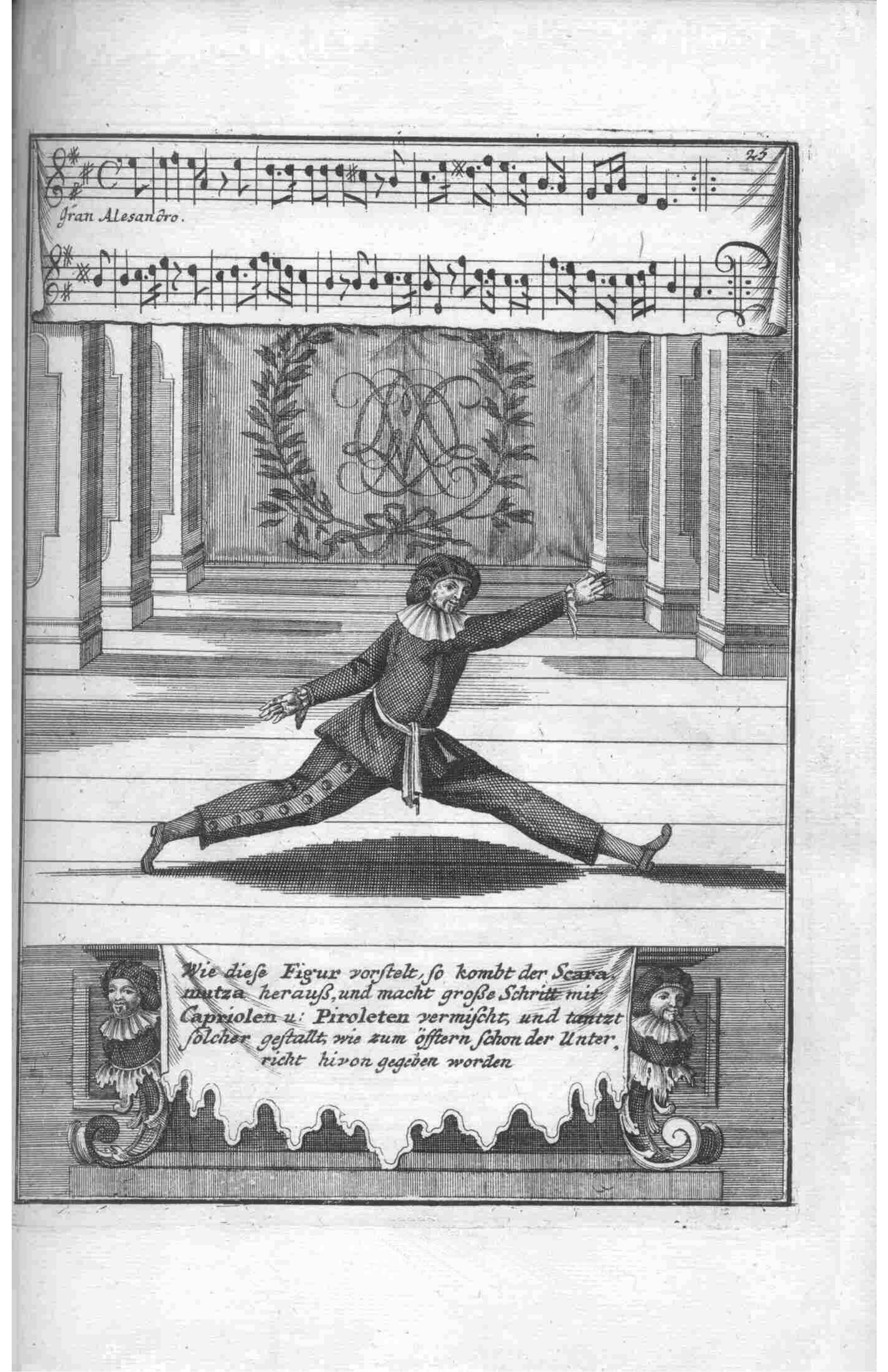
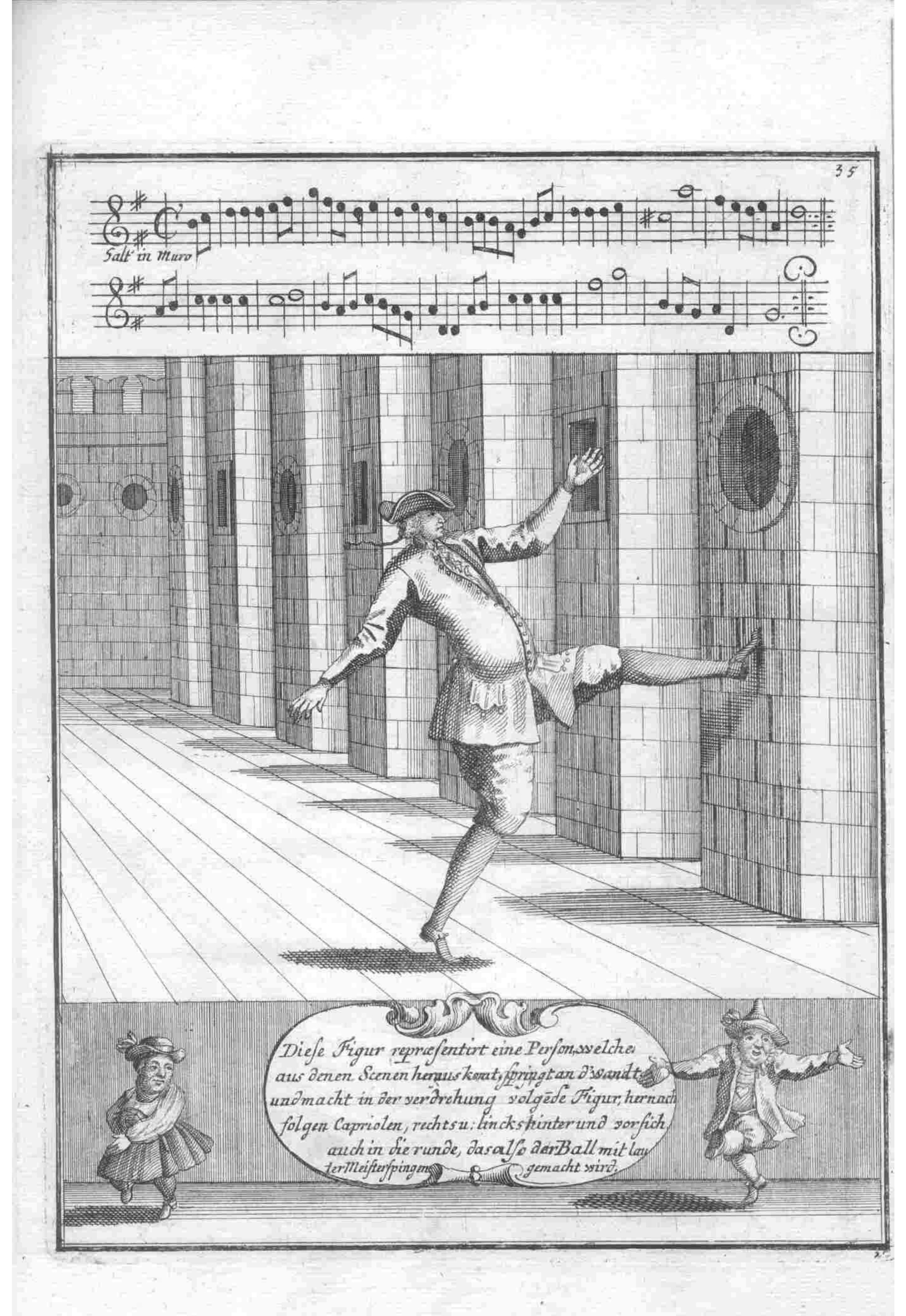
A solo male dancer in early 18th-century theatrical costume performs an athletic leap on a stage marked by alternating vertical columns of light and shadow that suggest architectural framing or curtains. The dancer wears a plumed hat, fitted jacket, and knee breeches, with one leg extended high and his upper body arched backward in a dramatic caper. His arms are spread asymmetrically—one raised, one extended outward for balance—creating a dynamic diagonal line across the frame. The floor is rendered in perspective with bold foreshortening, emphasizing the depth of the stage. The setting is minimalist but architectural, suggesting the formal theatrical spaces of German court or urban theater. At the top of the plate, a short musical notation in treble clef with the marking "Salti in Maro" provides the dance's musical accompaniment.
The dancing
A single male figure captured mid-jump with exceptional athleticism. His weight is projected upward and forward, with the lower body extended in a high, open position—one leg kicked toward horizontal, the supporting leg fully pointed. The torso arches back in a deep cambré, creating a convex line from head to hip. The arms are positioned for balance and visual impact rather than partnering: the right arm raised to shoulder height with palm open, the left extended lower. The head is turned away, maintaining the balletic convention of spotting or held focus. The costume and pose suggest trained virtuosity in a martial, assertive idiom.
The dance depicted
This is a theatrical caper or saltus—a solo jumping figure from the repertory of early 18th-century theatrical dance (tanzmeisterei). The movement belongs to the demi-character or acrobatic vocabulary that was distinct from the formal minuet and courtly dances, yet shared their theatrical presentation. The music notation "Salti in Maro" (saltos in a slow measure) confirms this is a series of leaps performed to a measured tempo. Such capers were performed by male dancers in comedic or virtuosic roles and were a staple of court ballets and popular theatrical performance across German-speaking territories. The image preserves rare visual evidence of how these acrobatic passages were executed—with a lifted, extended body and an emphasis on height, rotation, and shape rather than floor contact.
How it was made
This is a copper-plate engraving, a technique that allowed fine linear detail and wide circulation through printing. The artist has employed cross-hatching and parallel line-work to model the figure's musculature and the folds of fabric, and used bold vertical lines to create the stage architecture and spatial recession. The precision of engraving—its capability to reproduce small, repeatable details—made it ideal for dance manuals, where many plates could be printed and distributed to provincial theaters and dance masters. The technique's labor-intensive process and relatively high cost suggests this work was intended for a sophisticated, educated audience: court circles, theater professionals, and serious amateurs of dance.
About this work
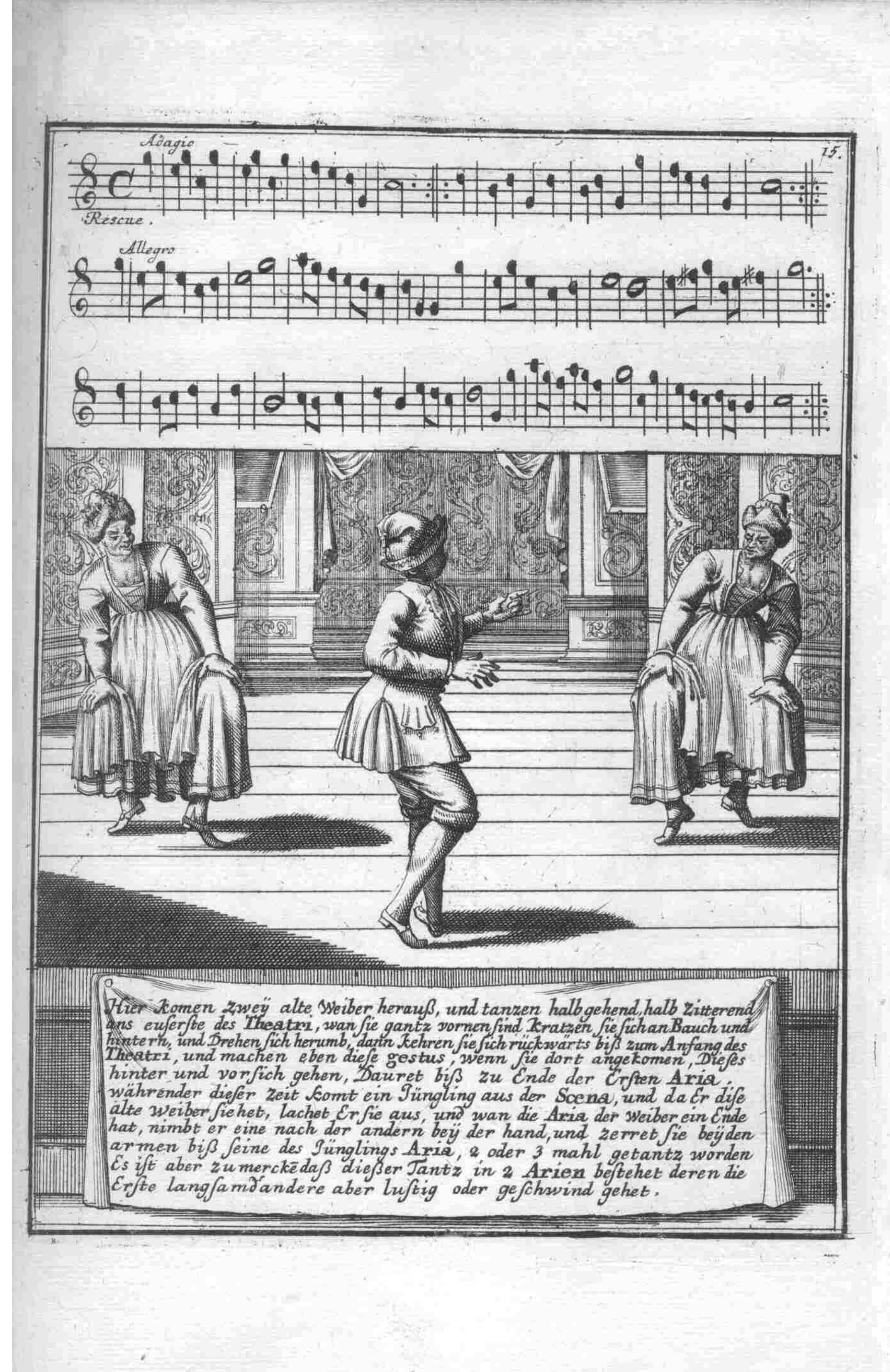
This is one of eighty-five copper-plate engravings from Gregorio Lambranzi's *Nuova e curiosa scuola de' balli theatrali* (Nuremberg, 1716), the most comprehensive visual and musical notation of early 18th-century theatrical dance to survive. Each plate pairs a notated musical passage with a single costumed figure performing a distinct choreographic phrase, creating a portable manual of theatrical vocabulary for dancers across the Holy Roman Empire. This particular plate documents a virtuosic solo caper—a high, arched jump that combines balletic extension with acrobatic force. Together, the eighty-five plates form a bridge between the court dance traditions of the Baroque and the emergent theater dance of the German lands, preserving steps and styles that would otherwise be lost.
How to look at it
Observe the moment of maximum height and extension—the artist has frozen the dancer at the apex of the jump, where the body is most fully displayed and the line from head to toes is most dramatic. Notice how the arched back and extended leg create a convex silhouette: this was not accidental but a deliberate shaping of the body in space that distinguished theatrical from social dance. The asymmetrical arm positions show how arms were used for balance and visual emphasis rather than as part of a closed or formalized hold. The vertical lines of the stage architecture frame the dancer's body and create a sense of theatrical presentation: this is not a dance captured in a room, but a performance designed for an audience.
The artist
Gregorio Lambranzi was an Italian dancer, choreographer, and dance master active in the early 18th century, likely based in Nuremberg or another major German city. His manual is the only known published work bearing his name, but it represents the culmination of a career spent teaching and choreographing for theaters and courts. The book's comprehensiveness—its systematic pairing of music, figure, and movement—suggests he had extensive access to the standard repertory of his time and the authority to document and disseminate it. His choice to publish in German-speaking territories, and to include captions in German, indicates his primary audience and professional network.
The period
Early 18th-century theatrical dance in the German lands was in transition. The formal court dances of the 17th-century Baroque—the minuet, courante, and sarabande—still dominated elite social settings, but theater demanded faster, more athletic movement. Male dancers, in particular, were expected to perform spectacular jumps, turns, and comic or character roles that required acrobatic skill. Female dancers were beginning to appear on stage in Germany, though this particular manual includes both male and female figures. Lambranzi published his manual at a moment when dance was becoming professionalized and systematized across Europe; comparable treatises by Beauchamp, Feuillet, and Weaver were appearing simultaneously, creating a shared vocabulary for a new, literate dance culture. The rise of the theater over the court as the primary site of dance innovation is visible in the emphasis on spectacle, athleticism, and virtuosity in Lambranzi's figures.
Where it lives
This plate is part of the complete copy of *Nuova e curiosa scuola de' balli theatrali* held in the Library of Congress. The book was published in Nuremberg in 1716 and survives in only a handful of copies in major libraries. It is one of the most important primary sources for the history of 18th-century dance and one of the few contemporary sources that pairs choreographic description with visual representation.
Dance in this work
Questions about this work
What does 'Salti in Maro' mean?
"Salti" means jumps or saltations in Italian; "maro" (or "marcia") indicates a march or measured tempo. Together, the phrase describes a series of leaps performed in a steady, moderate rhythm. The musical notation at the top shows the exact melody and time signature to which the caper is danced.
Was this kind of jumping part of ballet?
Not yet, in the formal sense. In 1716, what we call ballet was still emerging from court dance and theatrical spectacle. These capers belonged to the acrobatic vocabulary of theater dance and were performed by male dancers in comedic or virtuosic roles. By the mid-18th century, similar leaps became part of the codified vocabulary of ballet technique.
How was this manual used?
Lambranzi's book was a portable reference for dance masters and theater dancers across the German lands. A master could show a dancer a figure, sing or play the musical line, and the dancer could learn the step from the engraving and the notation together. It was the 18th-century equivalent of a video tutorial—a way to standardize and circulate choreographic knowledge.
Why are there two musical staves at the top?
The two staves show the same musical phrase in slightly different notation or instrumental arrangement. This allowed different musicians or dancers to use the same figure with different instruments or harmonic accompaniment.
More Notation/Choreography artwork