49 works in this view — arrow keys or swipe to move between them.
Dance in Art
Acrobatic — Plate 86
Gregorio Lambranzi
- Medium:
- Copper-plate engraving
- Dance:
- Notation/Choreography
- Era:
- 1700s (Enlightenment/Minuet Era)
- Collection:
- Nuova e curiosa scuola de' balli theatrali (1716)
- Source:
- Library of Congress
- Rights:
- Public domain — free to use, share and adapt.
- Recorded as:
- Public Domain
This engraving is one of the earliest systematic attempts to combine musical notation with visual representation of a specific choreographed step, making it foundational to the history of dance documentation. It captures a moment of virtuosic male dancing before the rise of the romantic ballet, and shows that acrobatic skill and spatial elevation were already central to theatrical performance in the early 18th century.
What you are looking at
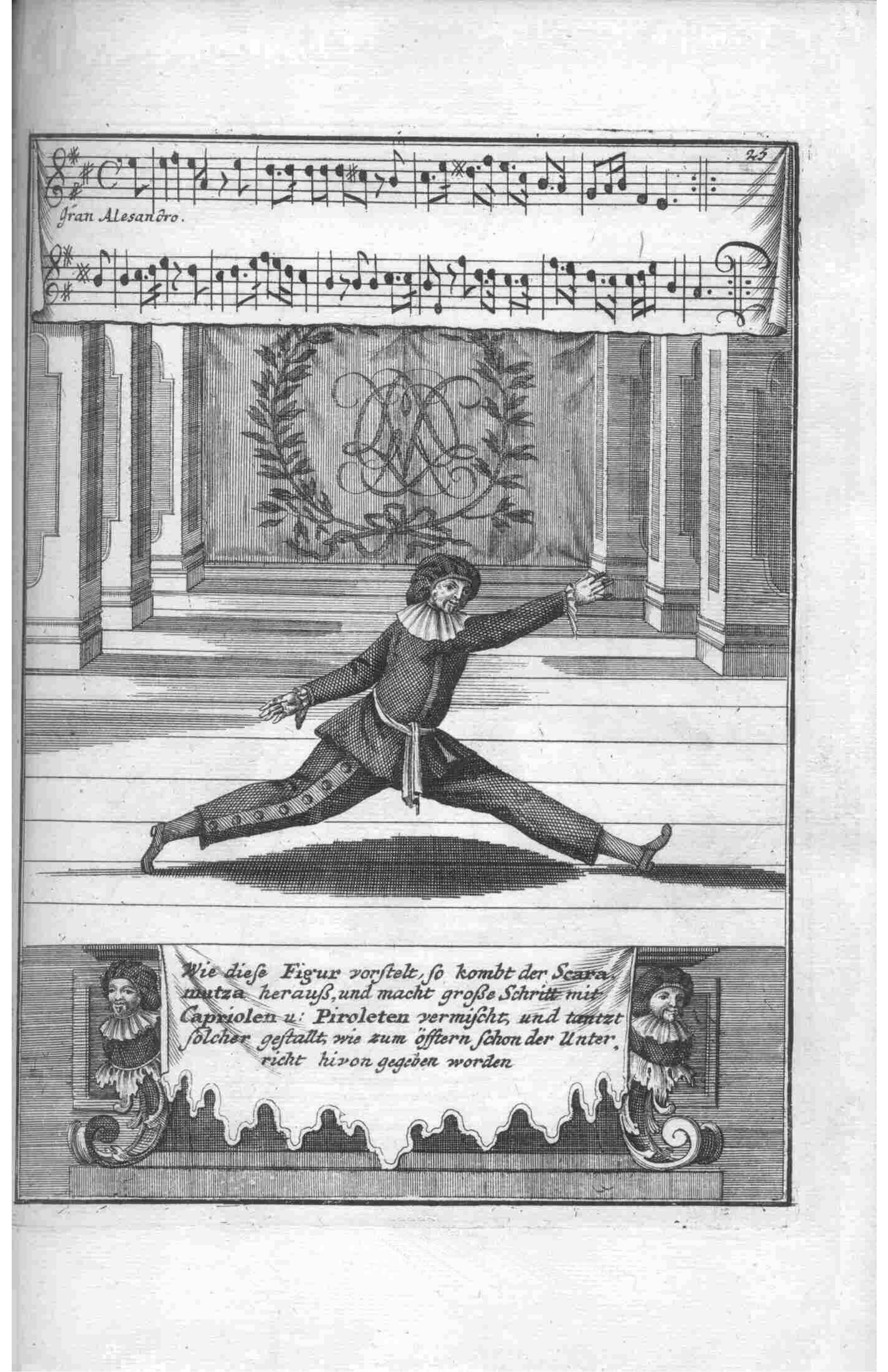
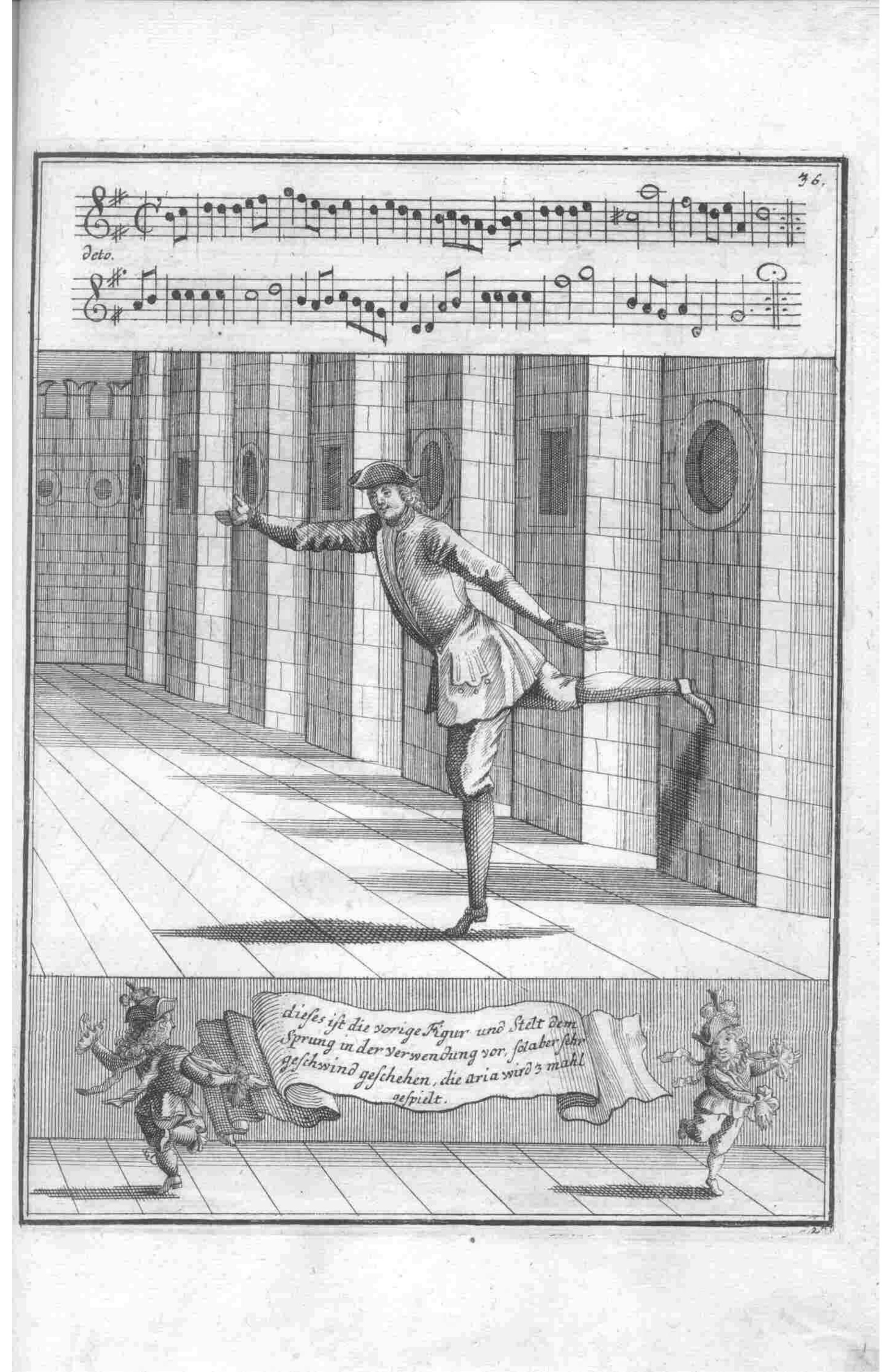
A male dancer in early 18th-century theatrical dress performs a dramatic leap across a stage defined by tall classical columns and a tiled floor. The figure is caught mid-air, one leg extended high behind him and his upper body tilted forward in an attitude of exertion, arms positioned asymmetrically to balance the movement. The stage setting is austere and formal—white and dark striped columns recede into depth, establishing a perspective that emphasizes the performer's isolation in the space. Above the scene, two staves of notated music are printed, indicating that this is a choreographed movement set to a specific composition. Below the main scene, two small putti flank a cartouche containing German text. The engraving is finely worked, with careful attention to the pleats and drape of the dancer's coat and breeches.
The dancing
A single male dancer, shown in a vigorous vertical leap or bound. His torso is thrown forward at the waist, creating a pronounced curve from hip to head; his right leg extends sharply upward and back, the left appears to push from a pointed position. His right arm reaches forward and upward, his left extends to the side, both contributing to the impression of a controlled but energetic ascent. The pose suggests both classical training and theatrical exuberance—the body is not merely lifted but shaped and displayed for spectacle.
The dance depicted
This appears to be a theatrical solo demonstrating a technical jump or capriole, likely from the theatrical dance repertory of the early 18th century. The term 'Acrobatic' in the title suggests this was classified as a display of athletic skill rather than narrative drama. The notation above indicates this was a choreographed phrase rather than improvisation. Such leaping movements were central to male theatrical dancing of the period, which emphasized virtuosity, height, and the illusion of weightlessness. This is not ballroom dance but rather staged entertainment dance.
How it was made
This is a copper-plate engraving, as indicated by the catalogue record. The technique allowed precise reproduction of the fine lines defining musculature, fabric texture, and architectural detail, and made this an ideal medium for circulation in printed dance manuals. Engraving's cost and technical demands meant that only works intended for serious instruction or wide distribution received this treatment. The pairing of music notation with a single figure in a fixed moment of movement was itself a convention of printed dance pedagogy, allowing readers to study both the temporal and spatial dimensions of choreography.
About this work
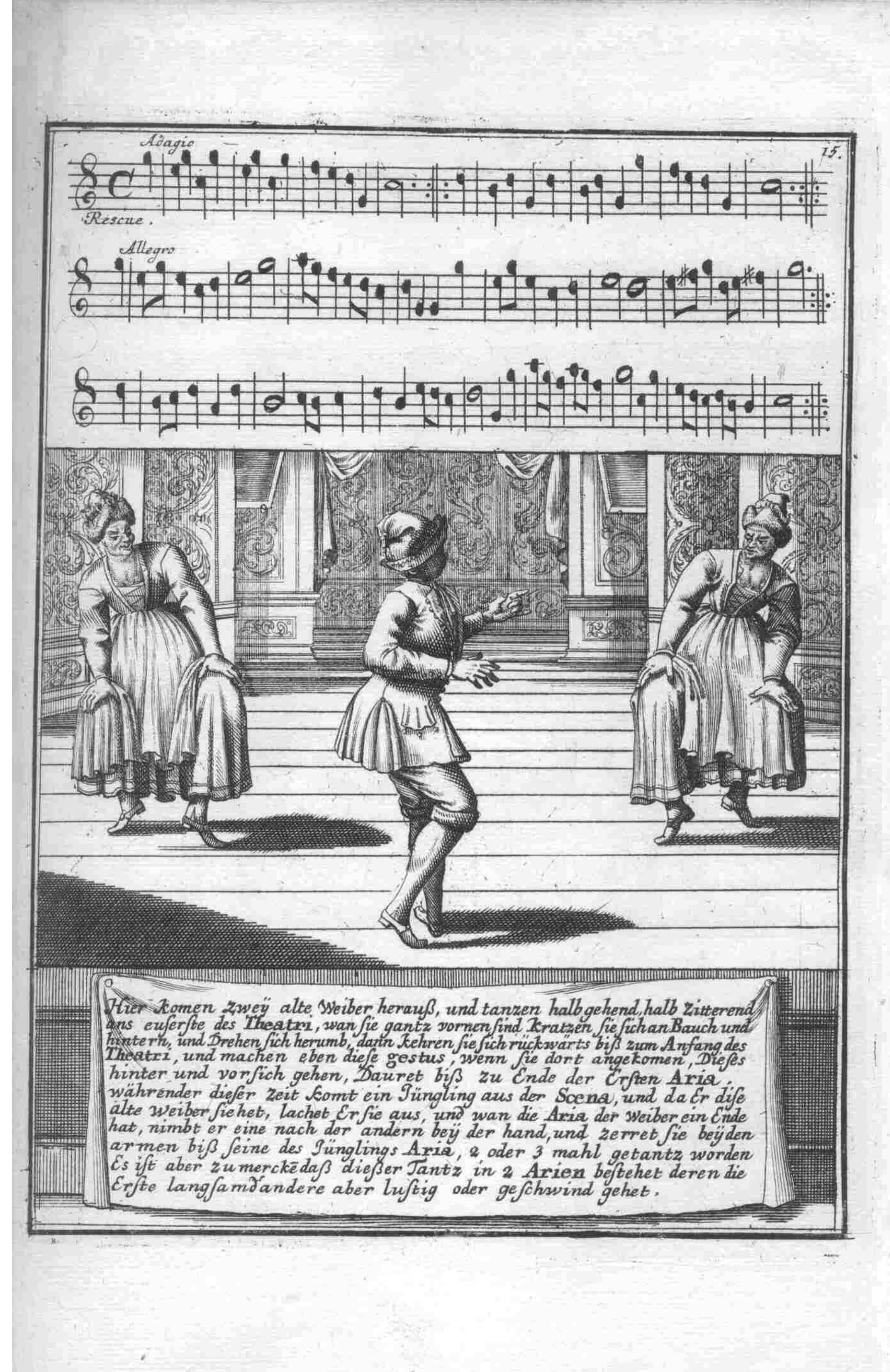
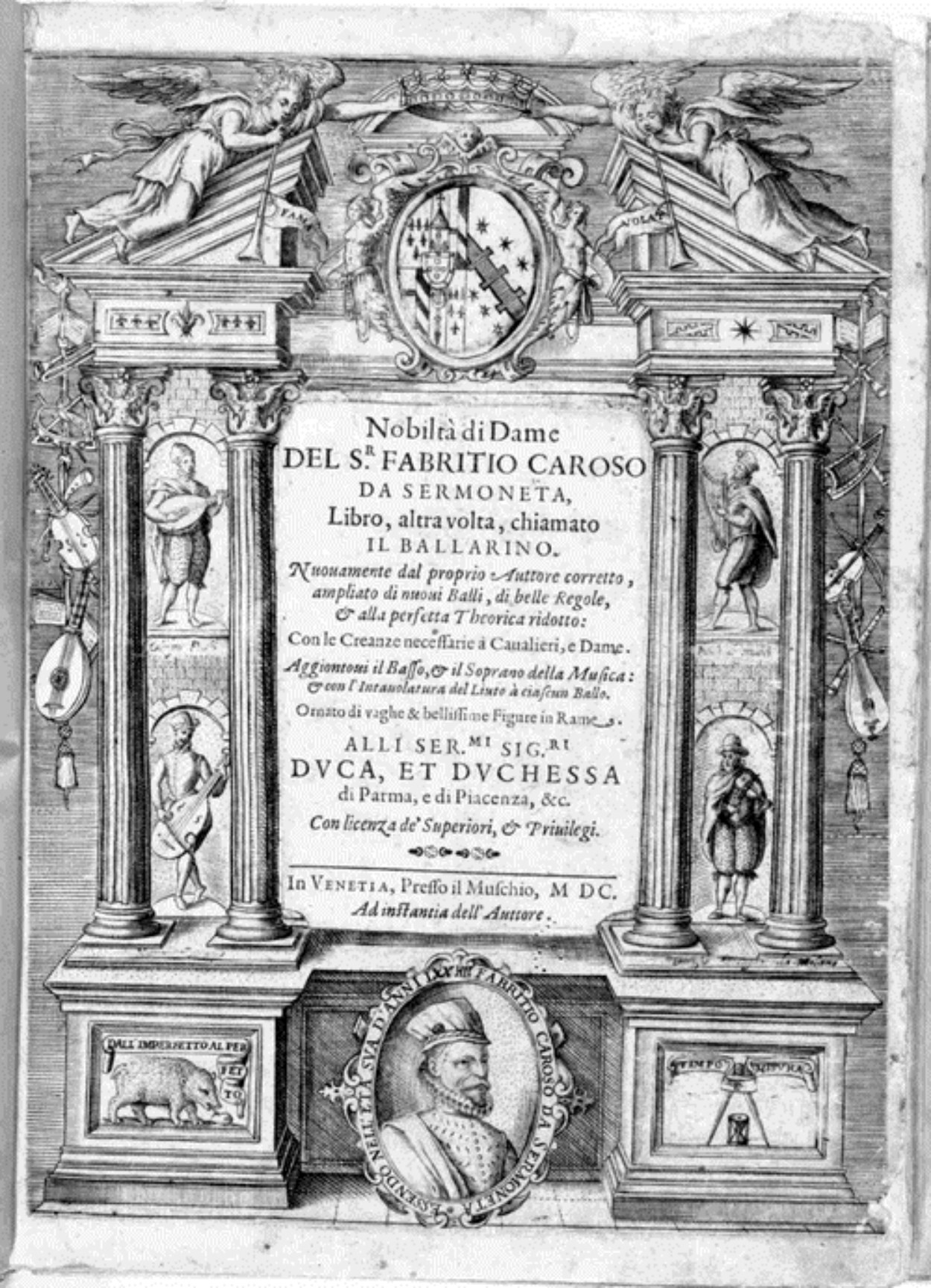
This is one plate from Gregorio Lambranzi's *Nuova e curiosa scuola de' balli theatrali* (Nuremberg, 1716), an influential printed manual of theatrical dance. Each plate pairs a musical score with a costumed solo figure performing a specific step or phrase. This plate documents an acrobatic leap—a vertical display of strength and control typical of male theatrical dancing in the early 18th century. The work sits at the intersection of dance notation, theatrical costume study, and prints for an educated European audience; it is evidence of how theatrical dance was being codified, taught, and circulated as learned knowledge rather than folk tradition.
How to look at it
Attend to the moment the artist chose to freeze: not the beginning or end of the leap, but the apex—the moment of maximum height and extension. This was a deliberate choice; it emphasizes the illusion of weightlessness and control. Note how the body is organized: the extended leg and forward-tilted torso create a dynamic diagonal line that pulls the viewer's eye upward. The arms are asymmetrical and active rather than decorative, functioning as counterbalance. The architectural setting frames the figure without competing for attention, establishing a space of formal theatrical propriety rather than intimacy.
The artist
Gregorio Lambranzi was an Italian dancer and choreographer active in the late 17th and early 18th centuries, based primarily in Nuremberg. The *Nuova e curiosa scuola de' balli theatrali* (New and Curious School of Theatrical Dances) was his major publication, containing over 100 engraved plates each illustrating a different step, phrase, or combination. The work is considered one of the most comprehensive and systematic treatments of theatrical dance technique from the period, and it circulated widely among dancing masters and theater practitioners across Europe. Lambranzi's approach combined Italian dance pedagogy with German engraving expertise.
The period
The early 18th century saw a shift toward the codification and documentation of theatrical dance technique. Before this, dance was transmitted orally and through physical apprenticeship. The rise of printed dance manuals—of which Lambranzi's is one of the most important—reflected both the growth of a professional theater world and the intellectual currents of the Enlightenment, which valued systematic description and classification. Simultaneously, male theatrical dancing was becoming increasingly acrobatic and virtuosic, moving toward the display of technical prowess that would characterize 18th-century court and theatrical contexts. The minuet and other court dances of the period were codified in parallel publications.
Where it lives
This plate is from *Nuova e curiosa scuola de' balli theatrali*, a comprehensive printed dance manual published in Nuremberg in 1716. It is part of a series of over 100 engraved plates, each illustrating a different choreographic phrase. The work was widely distributed among European dancing masters and remains one of the primary documentary sources for theatrical dance technique of the early 18th century.
Dance in this work
Questions about this work
What does 'acrobatic' mean in the context of early 18th-century theatrical dance?
In this period, 'acrobatic' referred to spectacular physical feats requiring strength, elevation, and control—jumps, turns in the air, and dynamic floor work. It was not distinct from 'dance' as it is today, but rather a category of virtuosic display within theatrical dance. Male dancers in particular were expected to perform such skills as evidence of technical mastery and to provide visual excitement for audiences.
How was this image used as a teaching tool?
Dancing masters could consult the printed notation and visual representation simultaneously, learning the phrasing and meter of the movement from the music staff and the body position and carriage from the engraving. Students could study the image to understand proper alignment, extension, and the specific moment in the jump when maximum height was achieved. The combination of notation and visual documentation made this manual more comprehensive and more shareable than oral instruction alone.
Why is the dancer shown mid-leap rather than in a starting position?
The mid-leap captures the most visually striking and technically demanding moment of the movement. It demonstrates both the height achieved and the control required. It also makes the skill and athleticism unmistakable to any viewer, even one without dance training. In early 18th-century theater, such moments of maximum visual spectacle were what drew audiences and defined a performer's reputation.
More Notation/Choreography artwork