49 works in this view — arrow keys or swipe to move between them.
Dance in Art
Acrobatic — Plate 89
Gregorio Lambranzi
- Medium:
- Copper-plate engraving
- Dance:
- Notation/Choreography
- Era:
- 1700s (Enlightenment/Minuet Era)
- Collection:
- Nuova e curiosa scuola de' balli theatrali (1716)
- Source:
- Library of Congress
- Rights:
- Public domain — free to use, share and adapt.
- Recorded as:
- Public Domain
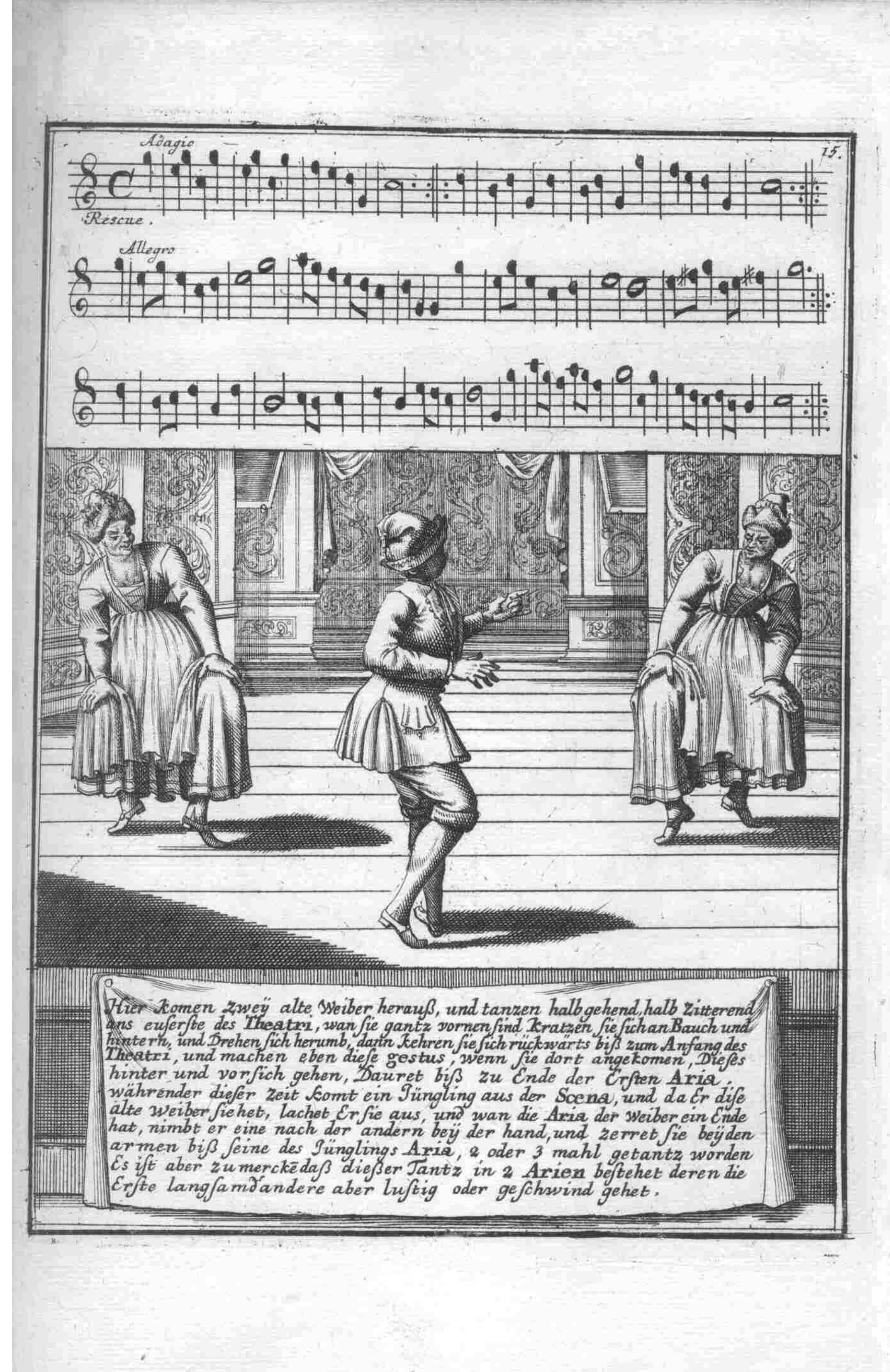
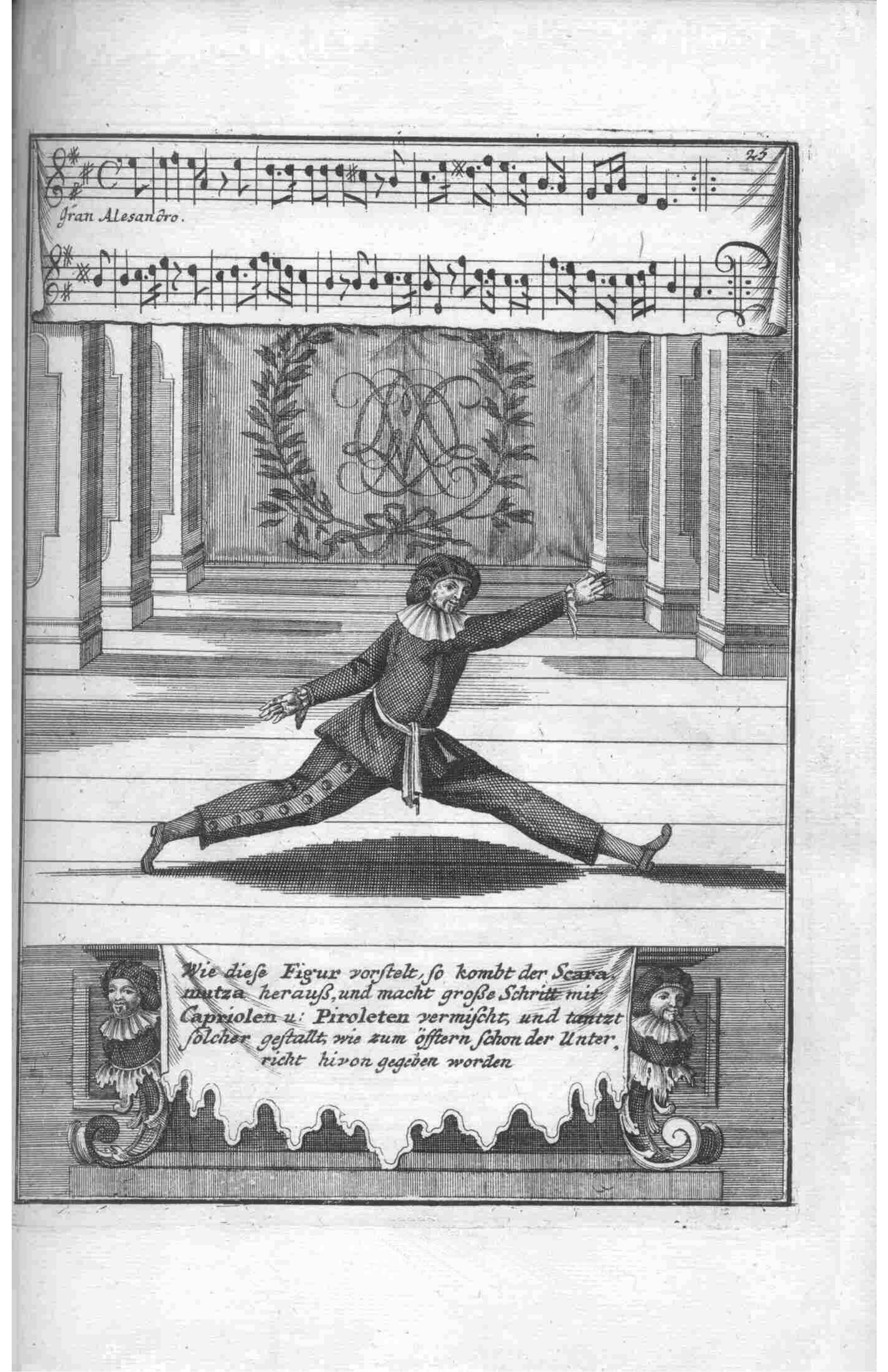
This image is one of the few surviving precise visual records of early modern theatrical acrobatics, a tradition that has left almost no other documentation. It shows that the era's dance culture was far more physically adventurous and athletically demanding than the surviving choreographic notation—which focuses on court dances—would suggest. For anyone interested in the history of circus, acrobatics, or theatrical spectacle, this is primary source material showing what trained performers could do and how that training was transmitted.
What you are looking at
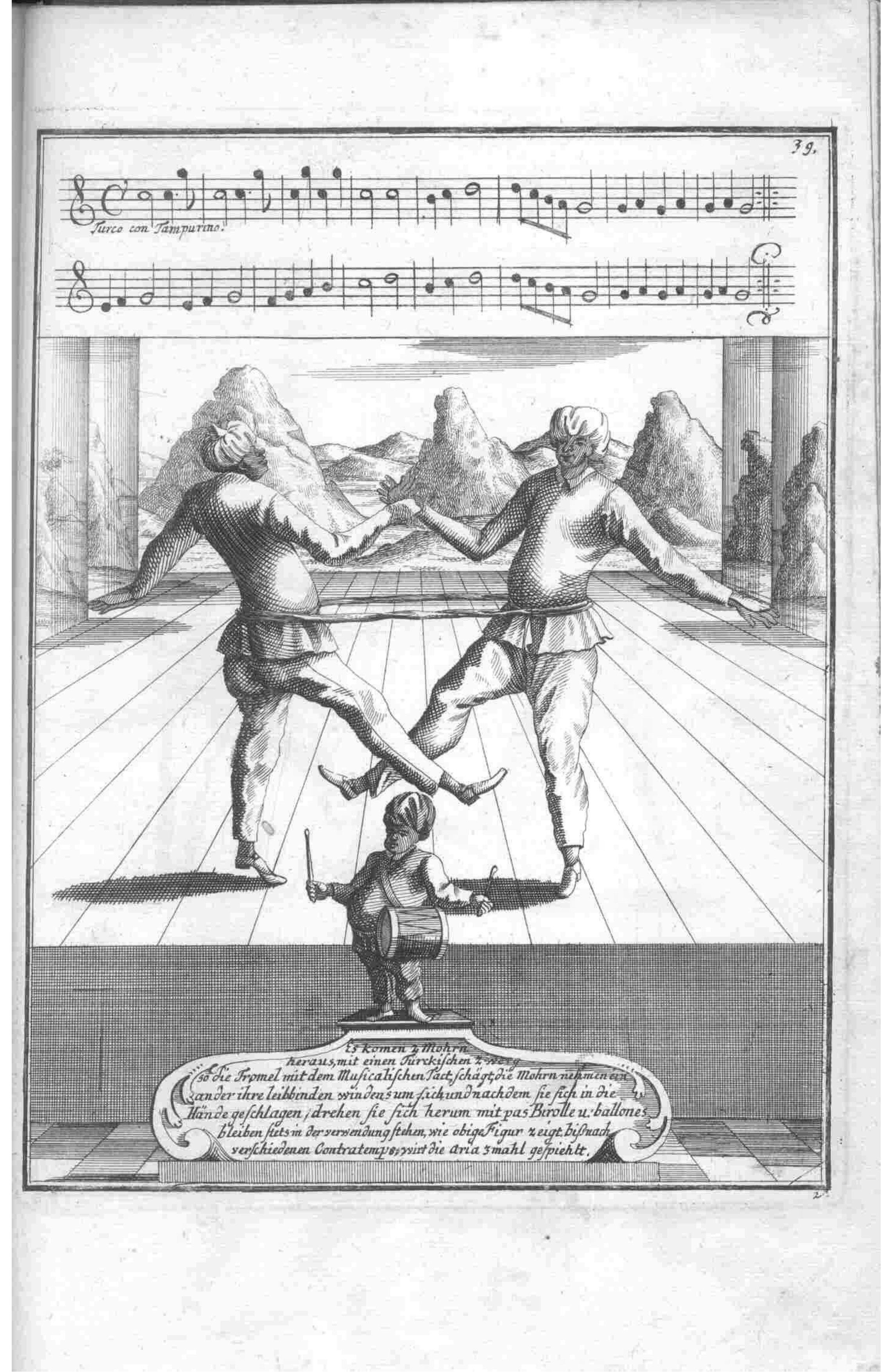
Two adult figures perform a spectacular balance on a stage framed by classical columns. The figure on the left, in armor-like costume with cross-hatching, stands with legs splayed wide in a powerful stance while supporting the weight of a second figure balanced horizontally across their shoulders and upper body. The supported figure, also costumed and armor-patterned, extends their body nearly parallel to the ground with one leg stretched forward and arms raised or extended for balance. Between and below them stands a small child or youth in similar dress, holding what appears to be a staff or wand, creating a three-tier human pyramid. The stage recedes into a landscape background with rocky outcrops visible through the proscenium opening. The floor is rendered with strong perspective lines emphasizing the depth and theatrical space. The engraving's light comes from the upper left, modeling the figures' musculature with careful cross-hatching that suggests the physical strain of supporting weight.
The dancing
The base figure maintains an extraordinarily wide stance—legs splayed nearly at right angles—distributing the weight of the supported dancer across a broad platform. The upper figure's body forms an almost horizontal line, with the supporting figure's shoulders and torso bearing the load. The child below performs what seems to be a grounding or stabilizing role. All three figures maintain muscular tension evident in the engraving's modeling; the supported dancer's extended leg and raised arms suggest active balance-work rather than passive positioning. The composition emphasizes the geometric relationship between bodies—the base triangle of the lower figure's legs, the horizontal line of the upper body, the vertical accent of the child.
The dance depicted
This is theatrical acrobatics of the early 18th century, most likely from a court or professional theatrical tradition. The image shows partner acrobatics (adagio work) in which one dancer supports another in a sustained horizontal position—a feat requiring both the base dancer's tremendous lower-body strength and the upper dancer's control and precise weight distribution. The notation at the top indicates this was choreographed and danced to measured music, placing it within the theatrical dance tradition of the period. The presence of the child suggests this may have involved ensemble or graduated difficulty, possibly a teaching demonstration or a spectacular finale. Such work was part of theatrical spectacle but also reflected the acrobatic traditions of street performers and traveling companies that fed into court entertainments.
How it was made
This is a copper-plate engraving, a medium that allows for fine detail and wide distribution through printing. The engraver has used close cross-hatching to model musculature and create the illusion of three-dimensional form and strain in the bodies, particularly in the legs and torso of the base dancer. The technique permits both the sharp linear rendering of the architectural frame and the careful anatomical study of the human figures. As one of 100+ plates in Lambranzi's manual, this engraving was designed to be studied repeatedly and copied—it functions as both a visual record of a specific movement and an instructional tool for performers learning the technique. The musical notation above allows readers to associate movement with timing.
About this work
This is Plate 89 from Gregorio Lambranzi's Nuova e curiosa scuola de' balli theatrali (Nuremberg, 1716), one of the era's most comprehensive surviving records of theatrical dance technique. The plate documents a three-person acrobatic balance: a powerful lower figure in wide stance supporting a horizontally-extended dancer, with a child grounding the composition. The work is an engraving that pairs musical notation with visual instruction, making it both a record of how acrobatics were performed in early 18th-century theater and a teaching aid for others learning the technique. Lambranzi's manual is extraordinary as a document because it captures not the courtly minuet or formal baroque suite, but rather the acrobatic, physically extreme, and ensemble-based theater that coexisted with more refined traditions—the spectacular entertainments that required real athletic skill.
How to look at it
Attend first to the geometry of support: the engraver has chosen the moment of maximum extension and balance, not a transitional moment. The wide stance of the base dancer and the horizontal line of the supported body form a composition that is both visually stable and physically precarious—the tension between those two states is the artistic point. Notice the small figure below, which is not merely decorative but essential to the balance. The musical notation above is not ornamental; it means this movement was timed and counted, performed to a specific rhythm and tempo. The theatrical frame—the columns and proscenium—is not background but part of the meaning: this is professional theater, not street performance, though the technique may have originated in street traditions.
The artist
Gregorio Lambranzi was a Nuremberg dancing master and choreographer active in the early 18th century. His Nuova e curiosa scuola de' balli theatrali (1716)—translated into German and published alongside the Italian—is the only major surviving work from his hand, but it is an exceptional document. The manual contains over 100 choreographed dances and movements, many of them illustrated with engravings by an unknown engraver(s). Lambranzi's focus was on theatrical dance rather than social courtly dance, giving the work unusual breadth: it captures acrobatics, character dances, ensemble formations, and spectacular effects that would otherwise be invisible to history. The manual seems to have been directed at both professional performers and wealthy amateurs, and its existence suggests a robust commercial theater culture in early 18th-century Germany.
The period
The early 18th century was a period of rapid change in European theatrical dance. The formal language of court ballet was crystallizing and would be codified in the 1725 publication of Feuillet's notation system, but theatrical dance—the dance performed in professional theater, carnivals, and public entertainments—remained improvisational, regionally varied, and physically extreme. Acrobatics, tumbling, and grotesque or comic movement were common in theater and street performance. Lambranzi's manual captures this theatrical world at a moment when it was beginning to be written down and systematized. The simultaneous publication in Italian and German also reflects the circulation of dance knowledge across the Holy Roman Empire and Italy. This was before the Ballet d'action reformed theatrical dance in the late 18th century; the movement vocabulary Lambranzi documents belongs to an older tradition of spectacle and athletic display.
Where it lives
This plate is from Lambranzi's Nuova e curiosa scuola de' balli theatrali, published in Nuremberg in 1716. The work survives in multiple copies and was influential throughout the 18th century. This image is held by the Library of Congress.
Dance in this work
Questions about this work
Could an untrained person perform this?
No. The base dancer requires exceptional leg strength and the ability to maintain a wide stance under load; the supported dancer needs precise balance and control while horizontal. The presence of the child suggests graduated training, and the inclusion in a professional manual indicates this was skilled, professional work. Modern acro-yoga and partner acrobatics still use similar techniques.
Why is the music notation important?
It means this was not improvisation but choreographed performance set to a specific tempo and rhythm. The timing of the balance, the moment of peak extension, the transition into and out of the position—all were controlled by the music. This was theatrical spectacle, not circus performance, organized by the structures of dance as an art.
What is the relationship between Lambranzi's work and modern dance history?
Lambranzi documents a tradition of theatrical movement that was largely displaced by ballet in the late 18th century. His manual is therefore a rare window into pre-ballet theatrical dance, showing the diversity of movement vocabulary available to performers before the codification of classical ballet. Modern circus, theatrical acrobatics, and even contemporary movement practices have recovered some of this tradition.
Why does the figure look so muscular?
The engraver used cross-hatching to model form and to emphasize the physical strain and muscularity required by the movement. This was both anatomically accurate and aesthetically intentional—making the difficulty and skill of the feat visible to the viewer. It is part of how the image communicates 'this is hard, this requires trained bodies.'
More Notation/Choreography artwork