49 works in this view — arrow keys or swipe to move between them.
Dance in Art
Acrobatic — Plate 92
Gregorio Lambranzi
- Medium:
- Copper-plate engraving
- Dance:
- Notation/Choreography
- Era:
- 1700s (Enlightenment/Minuet Era)
- Collection:
- Nuova e curiosa scuola de' balli theatrali (1716)
- Source:
- Library of Congress
- Rights:
- Public domain — free to use, share and adapt.
- Recorded as:
- Public Domain
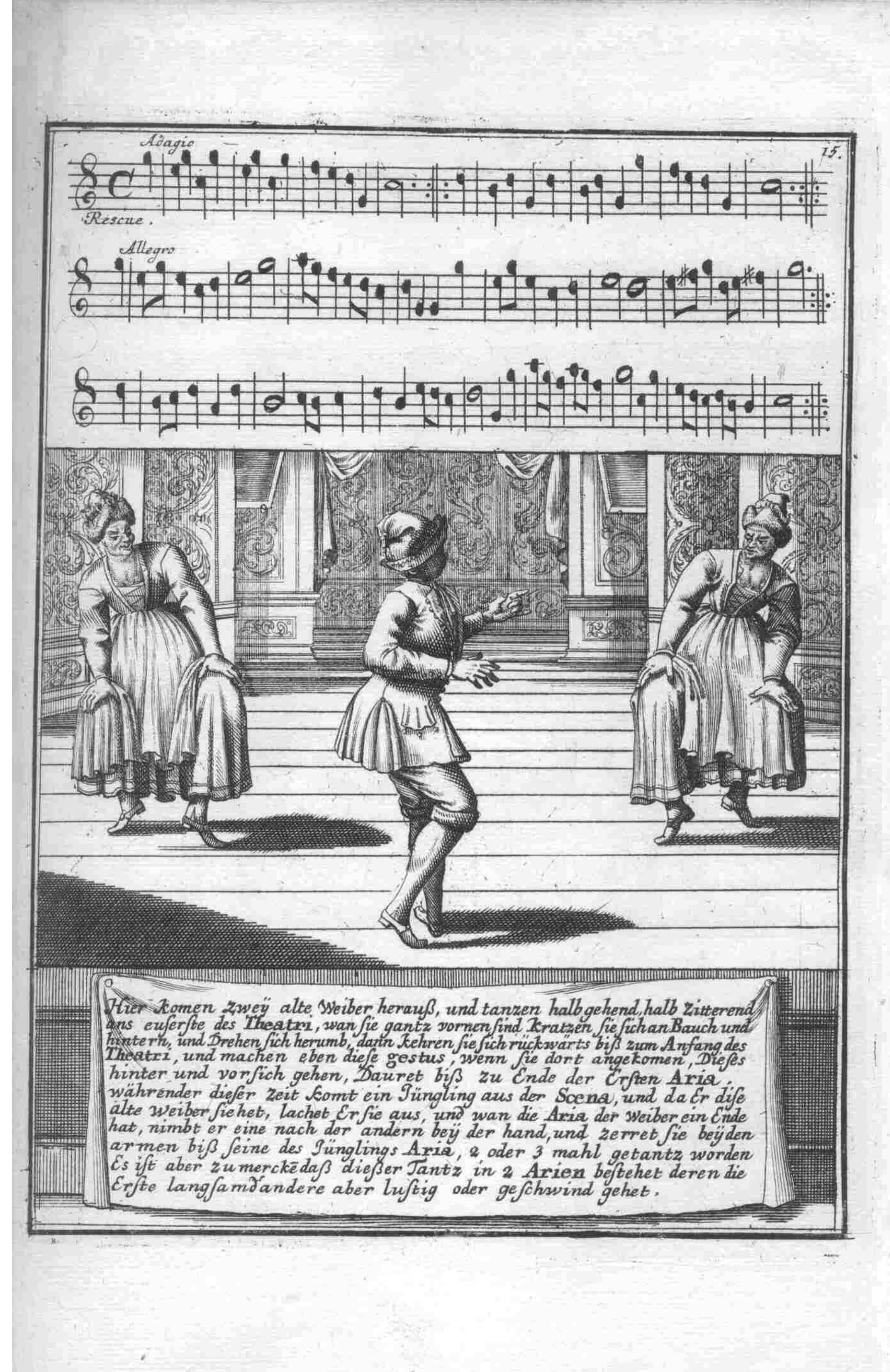
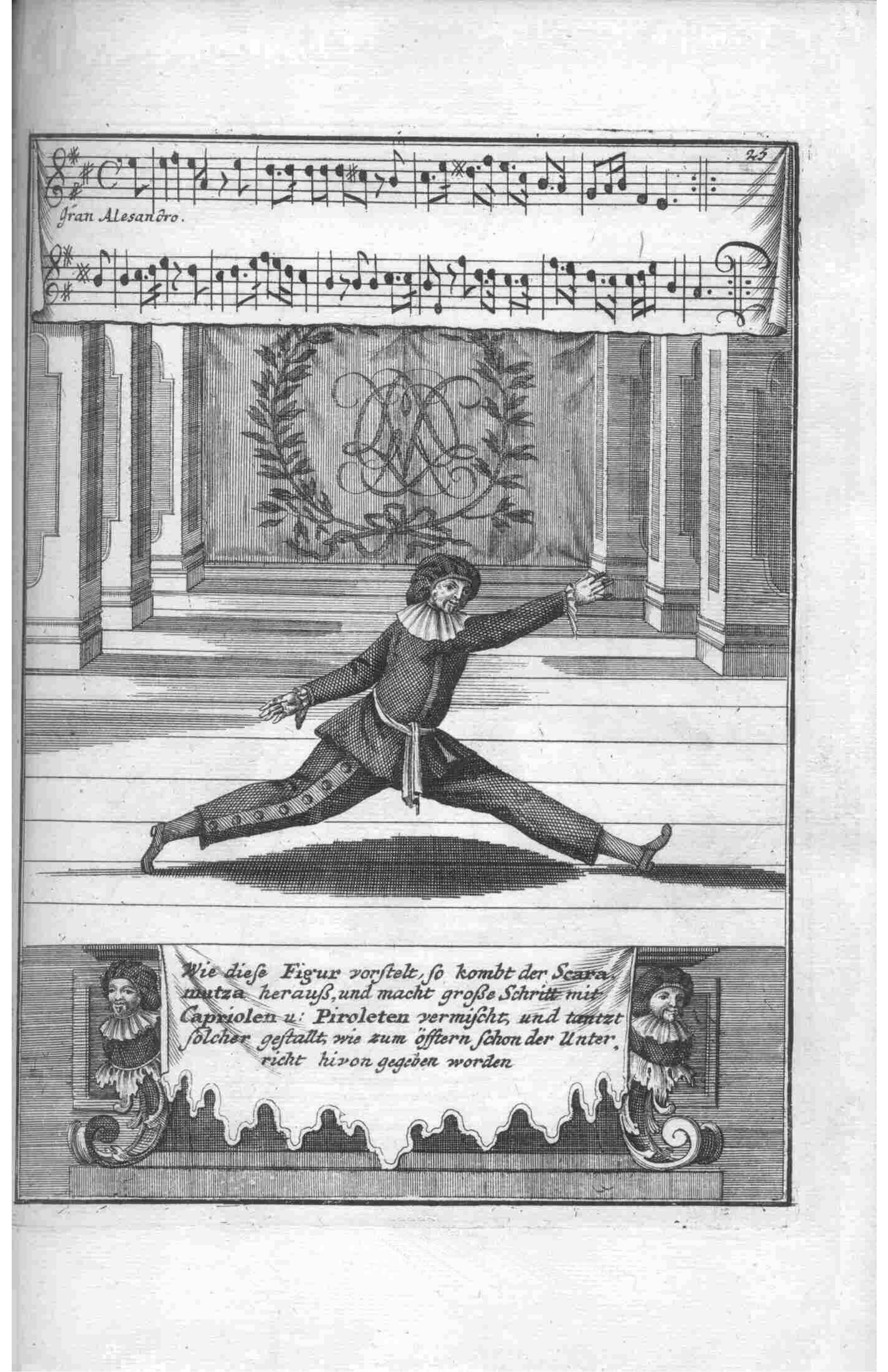
This image is rare visual evidence of acrobatic dance as a serious, notated theatrical art in the 18th century—not mere circus but choreographed spectacle with scored musical accompaniment. It shows that the distinction between dance and acrobatics did not then exist as rigidly as it does now; extreme physical feats were integral to prestigious theatrical performance.
What you are looking at
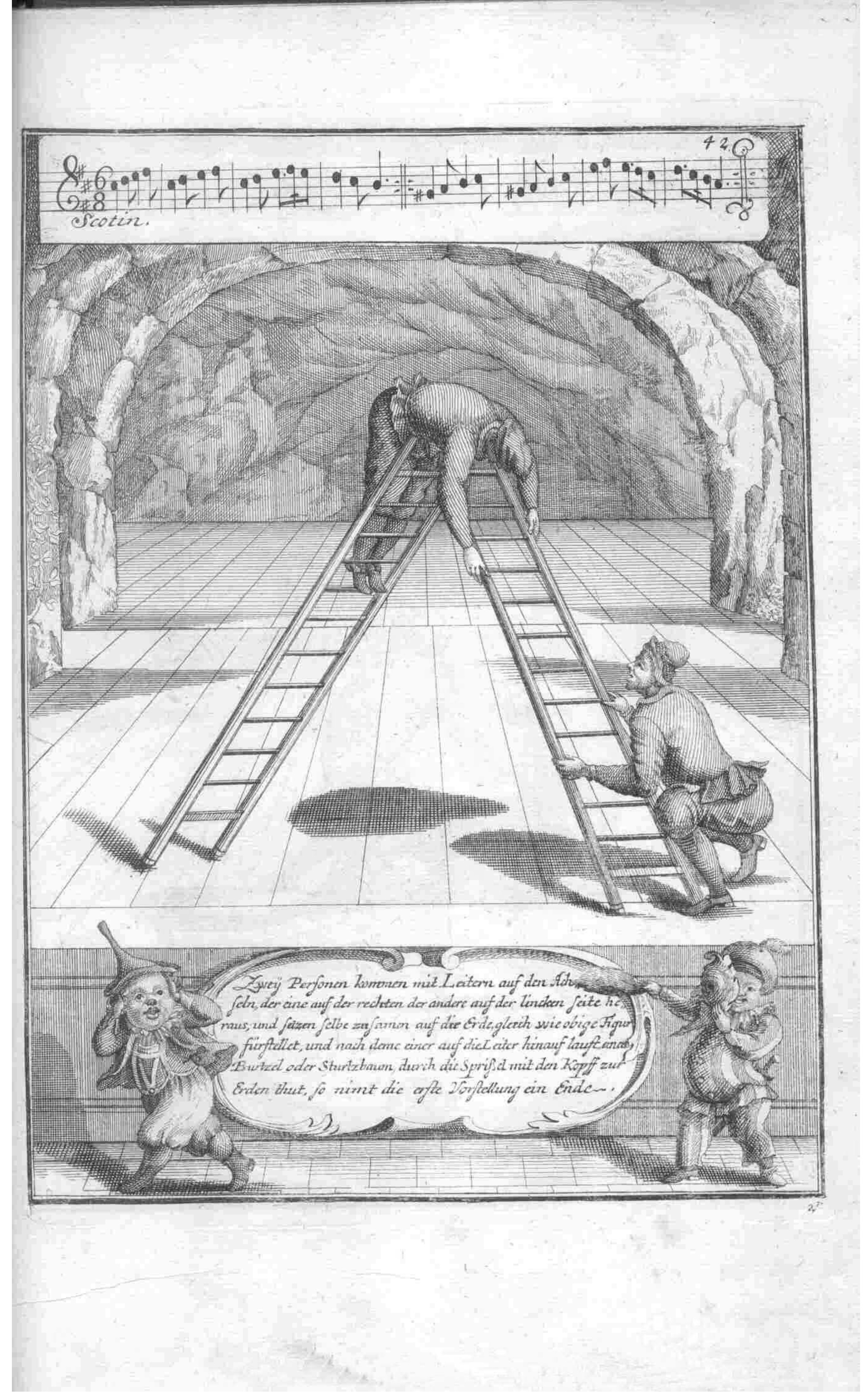
A stone cavern or grotto opens before us, its vaulted ceiling and rough walls rendered in fine crosshatching. The floor recedes in strict perspective toward the rear wall. Two figures occupy the space: a performer in the center balances precariously atop a tall wooden ladder, body bent forward in an extreme arch, while a second figure in costume crouches to the right, observing or assisting. The arched gateway frames the scene in the foreground, with pools of shadow on the floor suggesting the play of stage lighting. Above, a musical staff notated in 6/8 time provides the accompaniment—marked *Scillin* (Sicilian)—suggesting this is a choreographed theatrical piece rather than improvised acrobatics.
The dancing
The acrobat on the ladder demonstrates an extreme backbend or bridge, with legs extended along the ladder rungs and the torso arched backward in a dramatic contraction. The pose requires remarkable spinal flexibility and core strength, with the body weight distributed across the ladder's narrow steps. The second figure, dressed in what appears to be period theatrical costume, maintains a grounded, attentive stance. The spatial relationship—one figure elevated and inverted, the other stable and observant—creates a clear hierarchy of risk and control.
The dance depicted
This is theatrical acrobatics integrated into a choreographed work, documented as part of Lambranzi's *Nuova e curiosa scuola de' balli theatrali*. The piece represents 18th-century *danza acrobatica* or ladder acrobatics, a standard component of theatrical spectacle rather than court dance. The Sicilian musical notation anchors it to a specific regional style. These acrobatic interludes were performed by specialist dancers in theatrical productions, combining feats of contortion and balance with musical accompaniment to create virtuosic display pieces.
How it was made
This is a copper-plate engraving, one of 102 plates in Lambranzi's treatise. The technique allows fine detail in the architectural perspective and musculature of the performer, while the cross-hatched shading creates volumetric form. The precision of engraving made these pages reproducible and distributable across Europe, making Lambranzi's manual one of the most influential dance instruction books of its era. The copper plate's durability meant multiple printings were possible, extending the work's circulation and impact.
About this work
This engraving documents a spectacular acrobatic dance number from early 18th-century theatrical practice. Lambranzi's *Nuova e curiosa scuola de' balli theatrali*, published in Nuremberg in 1716, is a landmark illustrated manual pairing musical notation with engraved figures performing choreography across all registers—from courtly minuets to exactly this kind of virtuosic acrobatic display. The work captures a moment when dance included not only ballroom steps and court figures but also feats of physical extremity performed by trained specialists. Each plate serves as both a musical score and a visual guide to execution, making the manual a hybrid document: part notation, part anatomical study, part theatrical record.
How to look at it
Notice the precision of the perspective and the rendering of the stone vault—this is not a simple stage sketch but a fully articulated theatrical space. The acrobat's body is the focal point: observe how the engraver has rendered the musculature of the arched torso and the precise placement of weight on the ladder steps. The musical staff above is integral: the rhythm notated there is the rhythm of the movement. The second figure's quiet stance anchors the scene and suggests this is choreographed, not purely acrobatic display—someone is witnessing, controlling, perhaps assisting or catching. The extreme posture was intentional and repeatable, not a momentary accident.
The artist
Gregorio Lambranzi (fl. early 18th century) was a Nuremberg-based dance master and choreographer. His *Nuova e curiosa scuola de' balli theatrali* (New and Curious School of Theatrical Dances), issued in two volumes (1716), became the era's most comprehensive illustrated compendium of theatrical dance. It includes courtly dances, comic character dances, and virtuosic acrobatic pieces, all paired with musical notation and performative instruction. Lambranzi's work circulated across Europe and remained influential through multiple editions and translations. The plates combine technical precision with dramatic staging, suggesting Lambranzi's experience as both choreographer and theatrical designer.
The period
In the early 18th century, theatrical dance in Europe embraced a wide spectrum of virtuosity. The baroque court minuet coexisted with the *danza acrobatica*, the *danza comica*, and other specialized forms. Acrobatic display was not marginal but central to stage spectacle, especially in Italian and German theatrical traditions. Lambranzi's manual documents a moment of transition, as dance was becoming codified and notatable even in its most extreme forms. The engraved manual format itself reflects Enlightenment values of systematic knowledge and visual demonstration. By mid-century, as ballet technique became more standardized, acrobatic feats like these would begin to separate from concert dance and migrate toward circus arts.
Where it lives
This plate is from the Nuova e curiosa scuola de' balli theatrali (1716), a two-volume compendium of 102 engraved plates published by Johann Christof Weigel in Nuremberg. The work survives in multiple copies across European collections. This image comes from the Library of Congress, which holds a complete copy.
Dance in this work
Questions about this work
Is this real dance or just acrobatics?
In Lambranzi's world, it was both—a choreographed acrobatic piece with musical score. The presence of notated music (the Sicilian tune at top) indicates this was a repeatable, composed theatrical work, not improvised stunt work. Acrobatic virtuosity was a legitimate form of dance performance in 18th-century European theatre.
What is the second figure doing?
The crouching figure appears to be either assisting the acrobat, spotting them for safety, or perhaps performing a complementary role in the piece. The careful rendering suggests this too is choreographed, and the spatial relationship—grounded figure attending to the elevated, inverted one—may itself be part of the composition.
How do we know this is staged and not a street performance?
The architectural frame (the stone grotto or cave), the perspective rendering, the presence of the musical score above, and the careful costume suggest a theatrical context. Lambranzi's manual was explicitly about *balli theatrali*—theatrical dances for the stage, not street or fair performances. The quality and precision of the engraving also indicates this was a prestige publication for professional dancers and composers.
What does the music tell us?
The notated Sicilian melody (6/8 time) anchors the movement to a specific regional musical style. The correspondence between melody and movement suggests dancers trained to move in dialogue with live music—this was not mimed or danced to silence. The tune's character (regional, rhythmically defined) would shape the quality and phrasing of the acrobatic action.
More Notation/Choreography artwork