49 works in this view — arrow keys or swipe to move between them.
Dance in Art
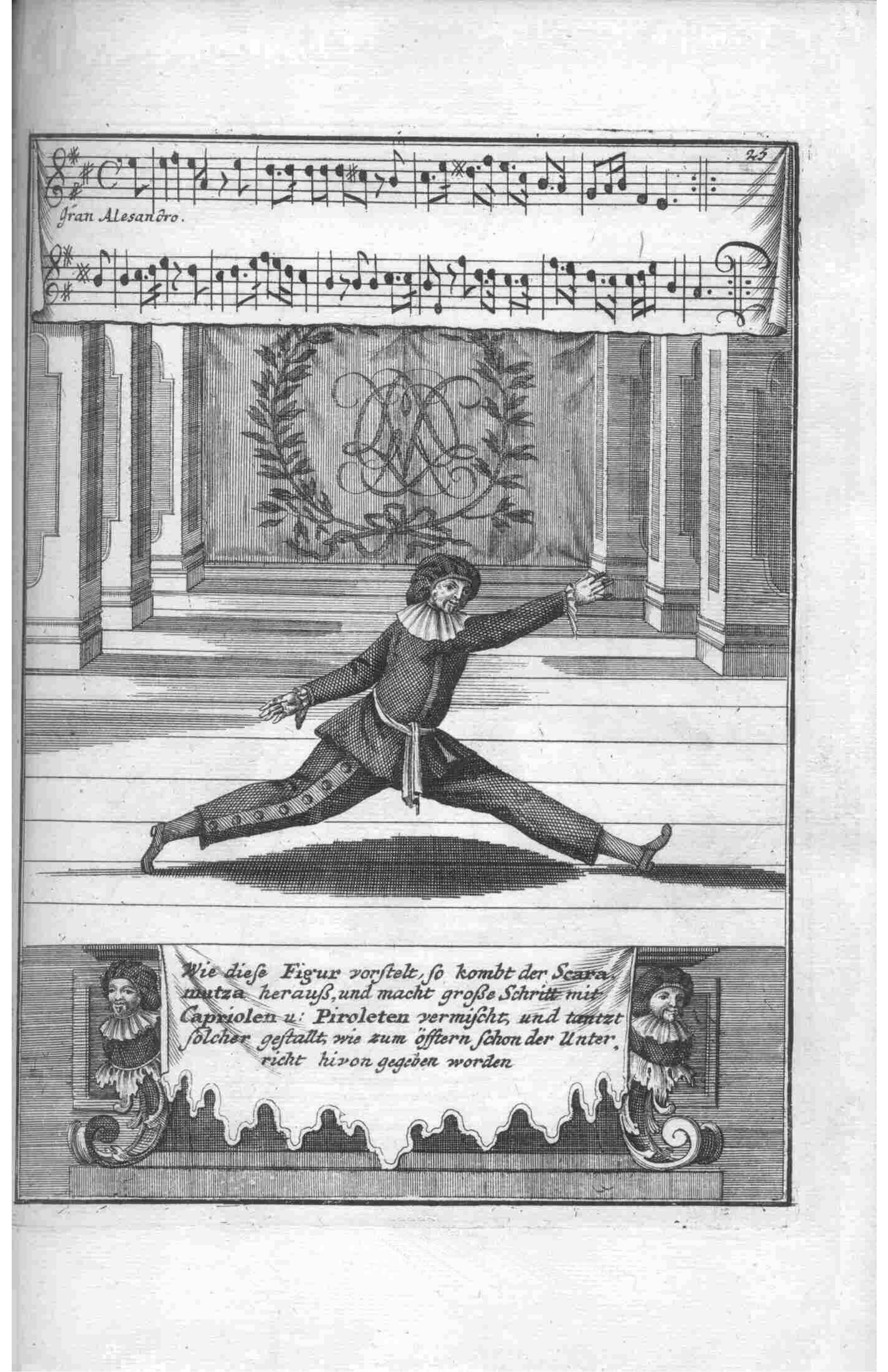
Acrobatic — Plate 94
Gregorio Lambranzi
- Medium:
- Copper-plate engraving
- Dance:
- Notation/Choreography
- Era:
- 1700s (Enlightenment/Minuet Era)
- Collection:
- Nuova e curiosa scuola de' balli theatrali (1716)
- Source:
- Library of Congress
- Rights:
- Public domain — free to use, share and adapt.
- Recorded as:
- Public Domain
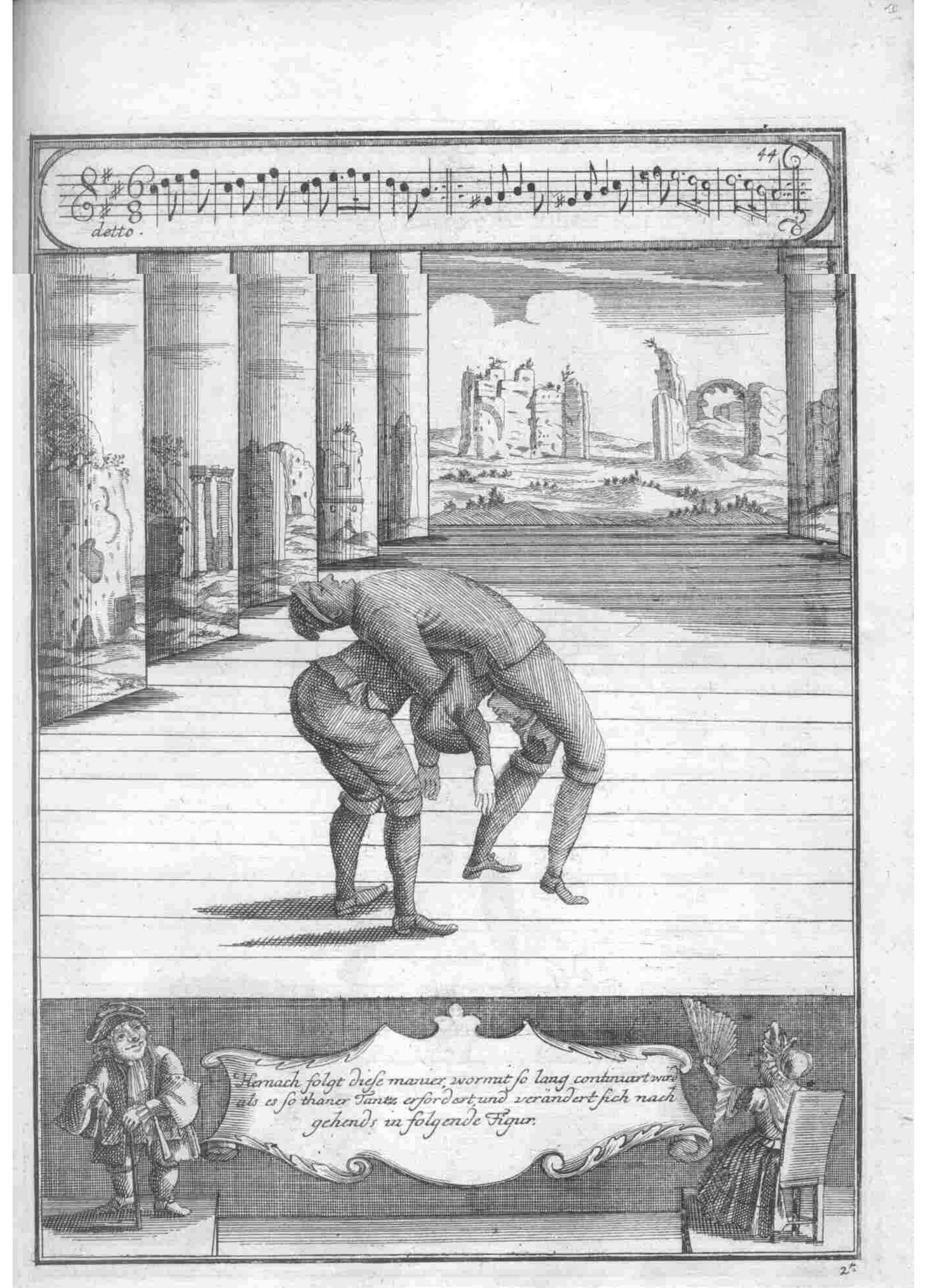
For dancers and historians, this image is primary evidence of what audiences of 1716 understood 'theatrical dance' to include: not only steps and figures but bodily virtuosity at the edge of human capability. The notation above the figure proves that such acrobatics were choreographed, rehearsed, and considered worthy of documentation in the era's only major attempt to notate and codify theatrical movement across an entire repertoire.
What you are looking at
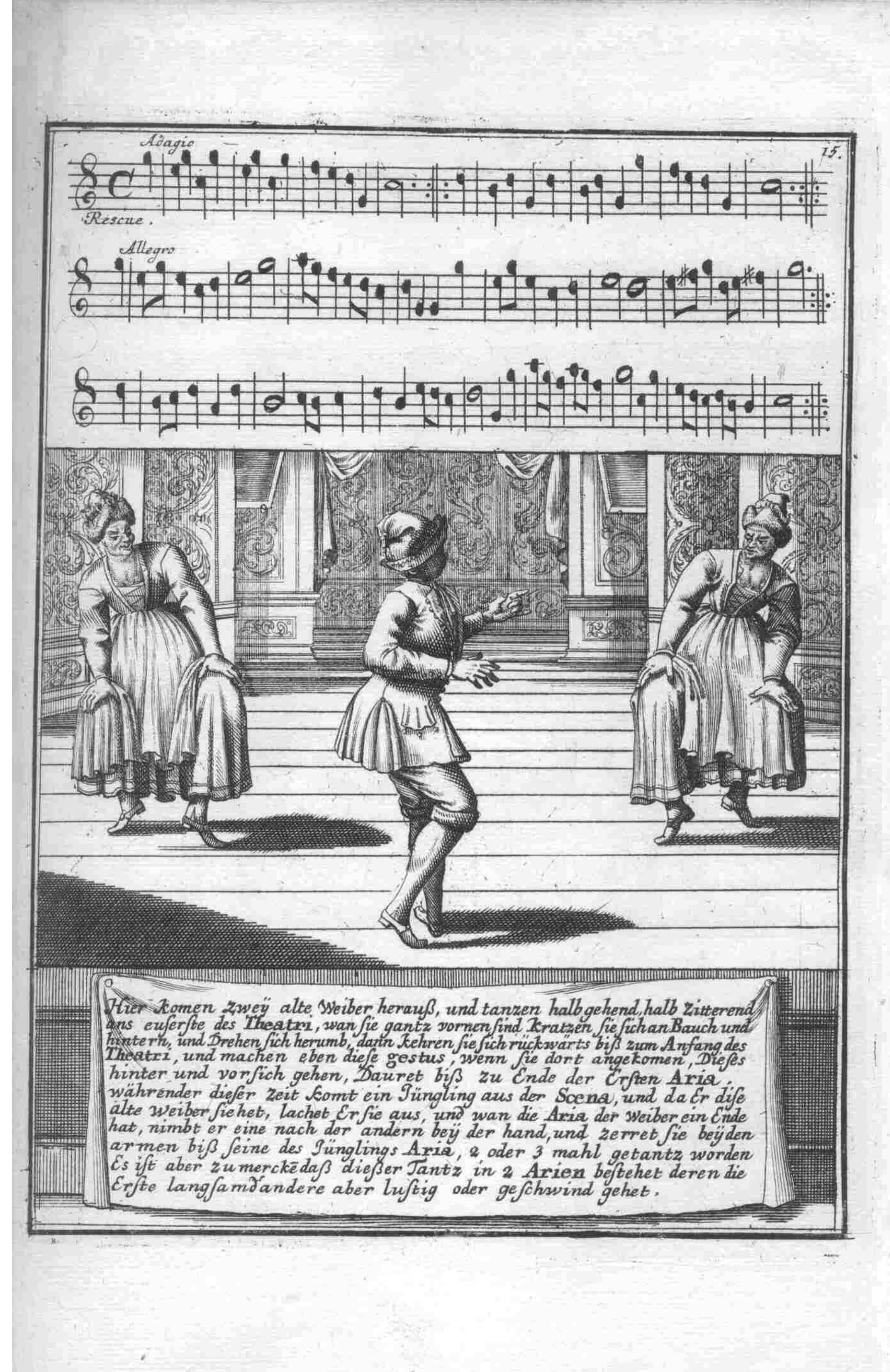
A single male dancer in a classical theatrical interior, captured mid-movement in an extreme forward bend. The figure wears a fitted breeches costume typical of early 18th-century stage dress, with short jacket and stockings. He is positioned on a wooden stage floor beneath a colonnade of fluted columns that recede into deep perspective. Beyond the columns stretches a landscape backdrop depicting ruins and fortifications under an open sky. The dancer's body forms a pronounced arc, with his torso folded nearly horizontal and his arms extended toward his legs in a posture of extreme flexibility. The composition exploits the theatrical space as a stage set: the columns frame the action, the distant architecture provides grandeur, and the wooden floorboards establish the performing surface.
The dancing
A single male figure in an extreme forward bend, demonstrating remarkable spinal flexibility and strength. His legs are straight and planted on the ground, supporting the full weight of an arched torso that approaches horizontal. His arms reach toward his shins, extended and engaged. The pose suggests sustained control rather than momentary strain—this is a held position demonstrating technical mastery. His musculature is heavily emphasized throughout his limbs, indicating the engraver's attention to anatomical articulation.
The dance depicted
This depicts theatrical acrobatics or contortion as practiced in early 18th-century European stage performance. The extreme posture—known as a backbend or forward fold held with the body nearly parallel to the ground—was a signature display of the contortionists and acrobats who performed in court ballets and theatrical intermezzos of the period. The catalogue's identification as 'Acrobatic' is correct: this is not ballroom or court dance, but rather the spectacular physical feats that formed part of theatrical spectacle. The notation at the top suggests this movement had a musical accompaniment, indicating it was integrated into a choreographed theatrical work.
How it was made
This is a copper-plate engraving, a technique allowing for fine linear detail and wide circulation through printing. The image was created by incising lines into a copper plate, which was then inked and printed. The controlled cross-hatching visible throughout the figure and setting creates tonal variation without wash or color, achieving volume and shadow through line alone. The technique's precision suits the anatomical specificity of the pose and allowed this plate to be reproduced and bound with others in a manual that could reach multiple European courts and theaters.
About this work
This plate comes from Gregorio Lambranzi's *Nuova e curiosa scuola de' balli theatrali* (Nuremberg, 1716), the most comprehensive illustrated choreographic manual of the early Baroque era. Lambranzi paired each of approximately 110 engraved plates with musical notation and a figure demonstrating a specific movement or pose. This plate documents not court dance—minuets, courantes, allemandes—but the acrobatic spectacular that provided contrast and amazement within theatrical entertainments. The extreme bend captures the kind of physical prowess that separated celebrated performers and made theatrical spectacle memorable.
How to look at it
Notice the extreme precision of the pose: the dancer is not tumbling or in transition but holding a position of maximum elongation and flexibility. The engraver has emphasized the weight and musculature of the body at every point, making clear that this is not a delicate movement but a feat of controlled strength. Observe how the architectural frame—the columns and distant ruins—establishes this as a theatrical spectacle: the body becomes a marvel to be witnessed on the stage, not a social activity. The notation at the top reminds us that this moment had sound, rhythm, and choreographic intention behind it.
The artist
Gregorio Lambranzi (c. 1675–c. 1730) was a dancer and choreographer working in the German-speaking courts and theaters of southern Europe. He served at the Nuremberg court and collected, choreographed, and documented theatrical dances across multiple genres—court dances, character dances, comic turns, and acrobatic displays. His *Scuola* represents an extraordinary effort to capture and transmit the choreographic knowledge of his era, combining detailed human figures with musical notation and explanatory verse to make the work usable by dancers and musicians across Europe.
The period
In the early 18th century, theatrical dance in European courts existed in two distinct registers: the refined court dances (minuets, courantes) performed by nobility in social settings, and the more spectacular theatrical repertoire performed by professional dancers on the stage. Acrobatics, contortion, and feats of strength had long been part of court entertainment, inherited from Renaissance-era athletic display. By Lambranzi's time, such movements were increasingly codified and integrated into narrative theatrical works. The *Scuola* appeared at a moment when dance notation was developing (Feuillet's system was codified in 1700) and when theatrical dance was beginning to achieve professional status and theoretical consideration as an art form worthy of documentation.
Where it lives
This plate comes from *Nuova e curiosa scuola de' balli theatrali* (Nuremberg, 1716), an illustrated choreographic manual held by the Library of Congress. The work consisted of approximately 110 engraved plates, each pairing a choreographic figure with musical notation and a German verse caption explaining or contextualizing the movement.
Dance in this work
Questions about this work
Is this a ballet?
No. This is acrobatics or contortion, a form of theatrical performance that existed alongside ballet. In the early 18th century, European court theaters presented mixed programs in which refined court dances alternated with more spectacular feats of strength and flexibility. Lambranzi's manual includes both types.
Why does the notation matter?
The presence of musical notation proves that this acrobatic pose was part of a choreographed work with a specific tempo and rhythm. It was not a circus skill but a theatrical movement integrated into a ballet or intermezzo, performed in time with music and as part of a narrative or formal program.
What does the setting tell us?
The theatrical architecture—columns, distant landscape, wooden stage—reminds us that these movements were performed on stages in courts and theaters, not in any practical space. The grandeur of the setting elevates the acrobatic feat into a spectacle worthy of aristocratic attention.
How do we know this is from 1716?
The catalogue record identifies this as Plate 94 from Lambranzi's *Nuova e curiosa scuola de' balli theatrali*, published in Nuremberg in 1716. This is one of the first and most comprehensive printed sources on early 18th-century theatrical dance.
More Notation/Choreography artwork