49 works in this view — arrow keys or swipe to move between them.
Dance in Art
Acrobatic — Plate 96
Gregorio Lambranzi
- Medium:
- Copper-plate engraving
- Dance:
- Notation/Choreography
- Era:
- 1700s (Enlightenment/Minuet Era)
- Collection:
- Nuova e curiosa scuola de' balli theatrali (1716)
- Source:
- Library of Congress
- Rights:
- Public domain — free to use, share and adapt.
- Recorded as:
- Public Domain
For dancers and historians, this plate provides rare evidence of acrobatic technique and its role in early 18th-century theater. It shows that extreme flexibility and strength were valued and documented as formal performance skills, not sideshows—they were compositional elements worthy of musical accompaniment and careful notation, sitting at the intersection of dance, gymnastics, and theatrical spectacle that modern disciplines still engage with today.
What you are looking at
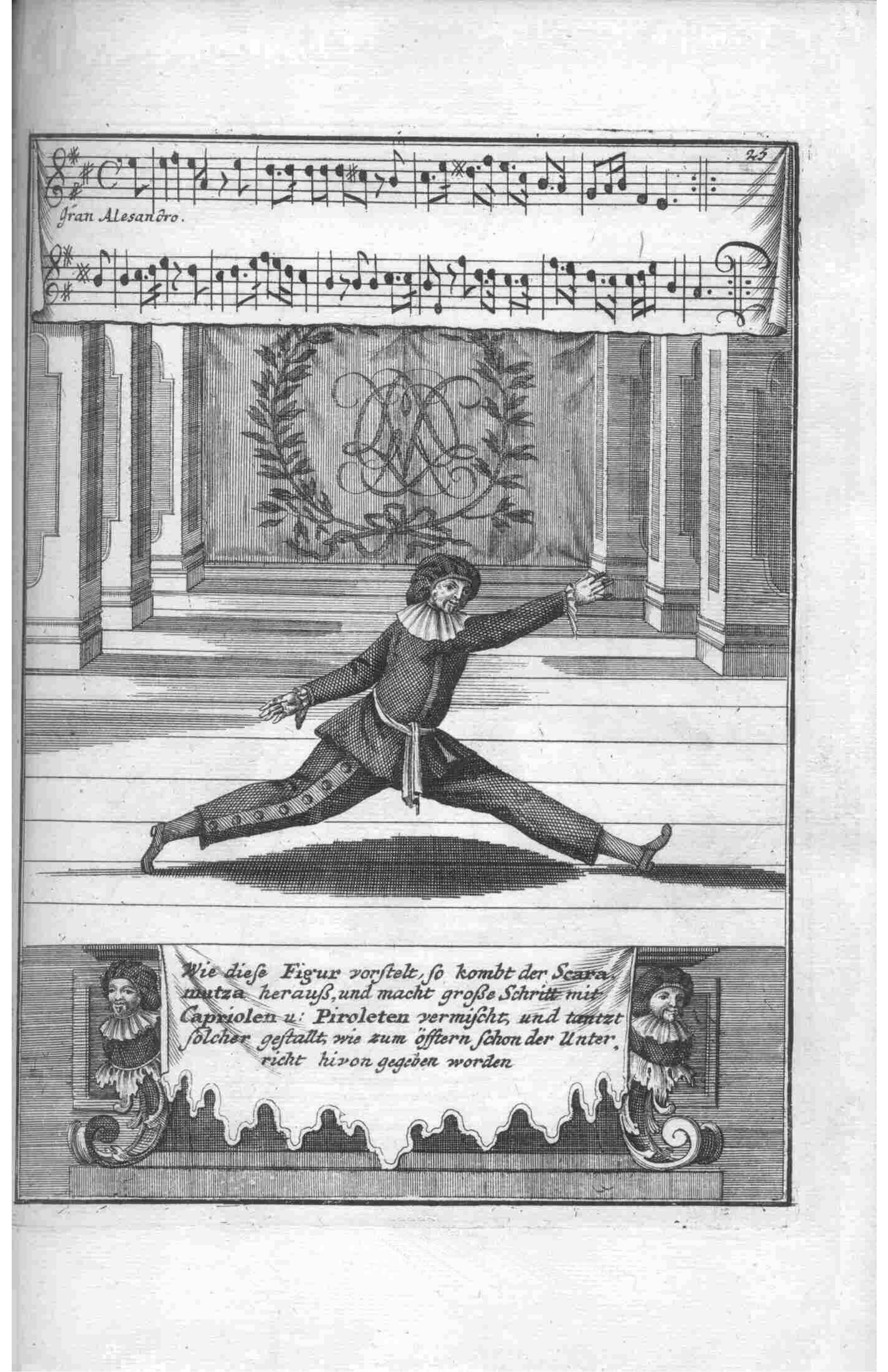
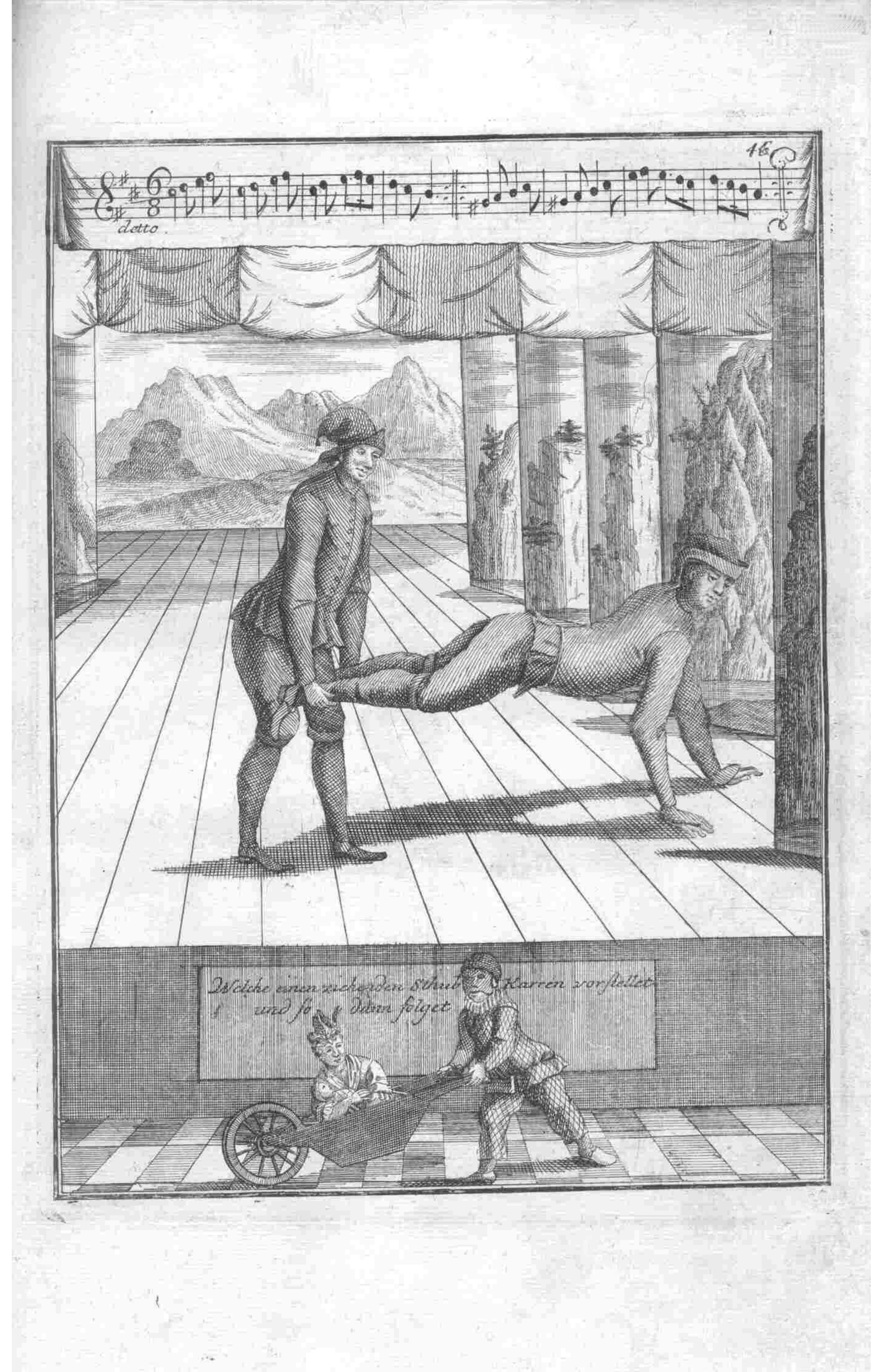
A theatrical stage set framed by a proscenium arch with draped curtains at top. Two male figures in period costume occupy a wooden-floored stage backed by a painted mountainous landscape. The figure on the left, wearing a jacket and breeches with a hat, stands upright and watches intently. The figure on the right, shirtless or lightly clothed, arches his body into an extreme backbend, his legs extended and weight supported on his hands and head in a dramatic contortion. The musculature is rendered in fine crosshatching to show strain and definition. Below this main scene, a second vignette shows a dwarf-proportioned figure in a cart being pushed by another figure—possibly a comedic interlude or secondary entertainmen related to the acrobatic display above. Musical notation at the top of the plate indicates this was a choreographed theatrical piece, with performance instructions marked 'detto' (continue as before).
The dancing
The acrobatic figure demonstrates extreme flexibility and strength: his torso is hyperextended in a bridge or back-arch position, with weight distributed across hands positioned near the head and lower legs, creating a deep concave line through the spine. His partner stands in a relaxed observational posture, slightly turned to watch. The positioning suggests a static display of contortion rather than movement through space—a held, extreme position meant to astonish. The anatomy is carefully studied and rendered to emphasize the technical difficulty: every muscle group engaged in the arch is visible and deliberate.
The dance depicted
This depicts acrobatic performance (acro-dance), specifically contortion or extreme flexibility display, as practiced in early 18th-century theatrical entertainment. The pairing of musical notation with the choreographed position suggests this was a formal, rehearsed piece for the stage rather than improvised exhibition. Lambranzi's manual documents theatrical spectacle that combined dance with acrobatic skill—a common feature of commedia dell'arte and court theatrical productions of the period. The second figure's role as observer or potential partner suggests this was part of a longer sequence, though the acrobatic feat itself is the compositional focus.
How it was made
Copper-plate engraving, recognizable from the fine parallel hatching (crosshatching) used to model form and shadow, the clean linear contours, and the tonal ranges achieved through line density rather than wash. Engraving allowed precise detail and high-resolution reproduction, making it ideal for instructional manuals. The technique's labor-intensiveness meant these plates were expensive to produce and valuable to preserve; their circulation in printed books like Lambranzi's gave them wide dissemination among performers and theater practitioners across Europe. The clarity of anatomical detail—muscle definition, surface texture, spatial relationships—would be difficult to achieve in any other print medium available in 1716.
About this work
This is plate 96 from Gregorio Lambranzi's *Nuova e curiosa scuola de' balli theatrali* (Nuremberg, 1716), an encyclopedic manual of theatrical dances and acrobatic entertainments. Each plate pairs composed music with a costumed figure or group performing on a theatrical stage, creating a visual record of early 18th-century performance practice. The plate documents an acrobatic backbend or contortion pose, demonstrating the integration of extreme physical skill into court and theatrical entertainment of the era. Lambranzi's work is one of the most detailed surviving records of how dance, music, and acrobatic spectacle were choreographed and performed during the Baroque period, and this plate exemplifies the manual's combination of instruction, notation, and visual demonstration.
How to look at it
Notice the precisely rendered musculature in the contorted figure's torso and limbs—every engaged muscle group is visible, suggesting the artist (or Lambranzi's source) had direct knowledge of how such positions feel and look. The observer figure's posture and gaze direct attention to the arch itself, framing it as a marvel to be witnessed. The stage setting (proscenium, backdrop, flooring) and the musical notation above anchor this as a formal theatrical act, not a spontaneous feat. Look at where the weight is actually supported—hands near the head, lower legs extended—to understand the specific difficulty Lambranzi wanted to preserve.
The artist
Gregorio Lambranzi was an Italian dancer, choreographer, and master of ceremonies active in early 18th-century Nuremberg. His *Nuova e curiosa scuola de' balli theatrali* (New and Curious School of Theatrical Dances), published in Nuremberg in 1716 with illustrations engraved by others, is one of the most comprehensive surviving documents of Baroque dance and theatrical movement. The work contains 101 engraved plates, each pairing choreographic notation with a precisely rendered figure or group. Lambranzi's project was didactic: to preserve, transmit, and standardize theatrical movement at a moment when dance notation itself was still evolving. His manual influenced dance practice across Europe and remains a primary source for understanding Baroque performance culture.
The period
In early 18th-century theater, acrobatic skill was not separate from dance but integrated into it. The Baroque court and commedia dell'arte traditions both valorized technical display, quick wit, and physical virtuosity. Dance notation was still in development—Beauchamp-Feuillet notation (used for aristocratic dances) did not easily capture acrobatic or irregular movement, so visual documentation through engraving was essential. Lambranzi's manual appeared at a moment when theatrical dance was becoming more formalized and codified, even as it remained physically extreme. The pairing of music with each figure signals that acrobatics were understood as rhythmic, composed acts rather than mere strength displays.
Where it lives
This plate comes from *Nuova e curiosa scuola de' balli theatrali*, a bound or assembled collection of 101 engraved plates published in Nuremberg in 1716. It is held at the Library of Congress, as indicated by the source record. The work circulated as a reference manual for theater practitioners and has survived in multiple copies in European and American collections.
Dance in this work
Questions about this work
Is this a realistic depiction of a human body in that position?
The position is anatomically extreme but achievable by trained performers with natural flexibility and strength. The backbend bridges the gap between a dancer's arabesque and a contortionist's extreme arch. Lambranzi's anatomical precision suggests he documented actual performances he witnessed or techniques practiced in his circles. Whether this specific figure could sustain the pose indefinitely is debatable, but as a held, display moment in a performance sequence, it is plausible.
What is the smaller scene at the bottom of the plate?
The lower vignette appears to show a dwarf figure in a small cart or wheeled device being pushed by another performer. This may represent a separate comedic interlude, a contrast act, or part of a longer theatrical sequence. It is typical of Baroque entertainment to pair serious display with comic relief, and the manual may be showing two different pieces or two parts of a single evening's entertainment.
How was this used as a teaching tool?
Dancers and theater masters would consult the plates to learn choreographed pieces. The musical notation at the top indicated the tempo and rhythm; the image showed the body position, costume, and staging. A dancer could not learn a full piece from one static image alone, but the manual as a whole served as a reference library—a way to recall, share, and standardize theatrical movement across geographic and temporal distance.
Why was contortion included in a dance manual?
In Baroque theater, the boundaries between dance, acrobatics, mime, and spectacular display were fluid. Any trained performer might need to execute contorted poses, jumps, or athletic feats as part of a theatrical evening. Lambranzi's manual was not narrowly about 'dance' in the modern sense but about theatrical movement in all its forms—everything a skilled performer should know how to do.
More Notation/Choreography artwork