49 works in this view — arrow keys or swipe to move between them.
Dance in Art
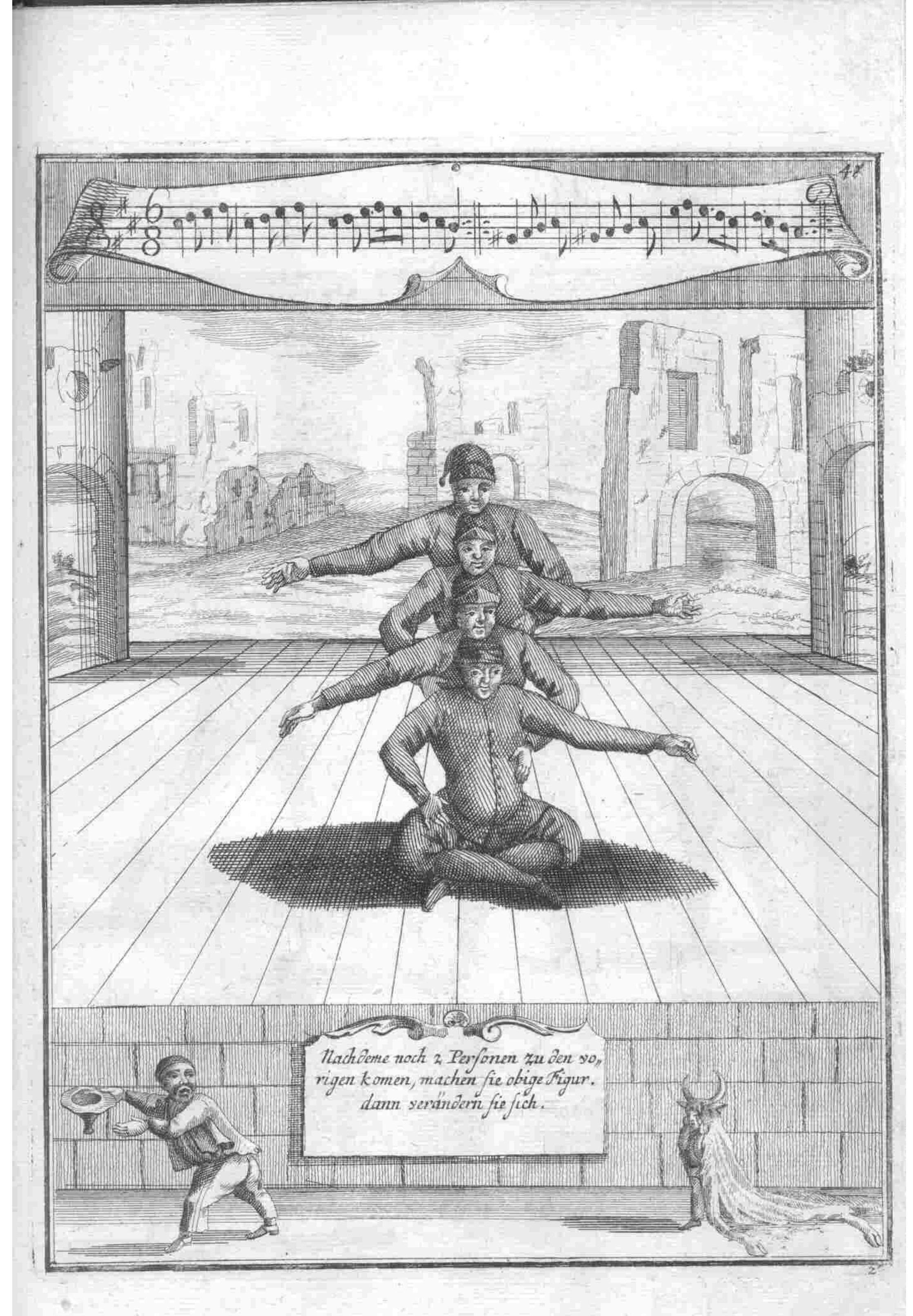
Acrobatic — Plate 97
Gregorio Lambranzi
- Medium:
- Copper-plate engraving
- Dance:
- Notation/Choreography
- Era:
- 1700s (Enlightenment/Minuet Era)
- Collection:
- Nuova e curiosa scuola de' balli theatrali (1716)
- Source:
- Library of Congress
- Rights:
- Public domain — free to use, share and adapt.
- Recorded as:
- Public Domain
This image is one of the earliest detailed visual records of partner acrobatics in Western theatrical dance, showing that male strength and lifting were central to professional performance centuries before modern acro-dance or circus arts became codified. Lambranzi's manual is the primary surviving source for how theatrical dance was actually performed in the early 1700s, making each plate invaluable evidence for reconstructing movement vocabulary and physical demands.
What you are looking at
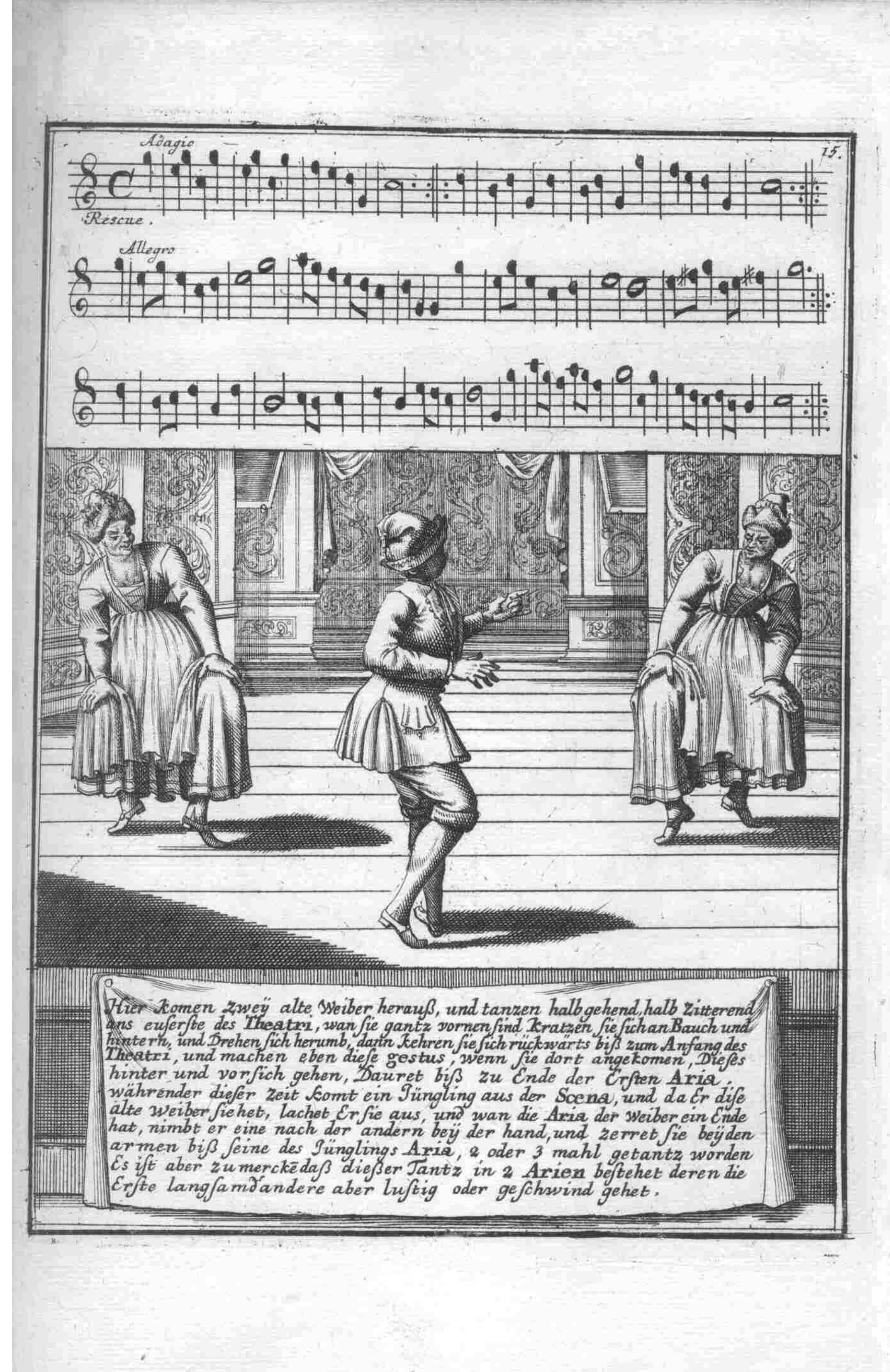
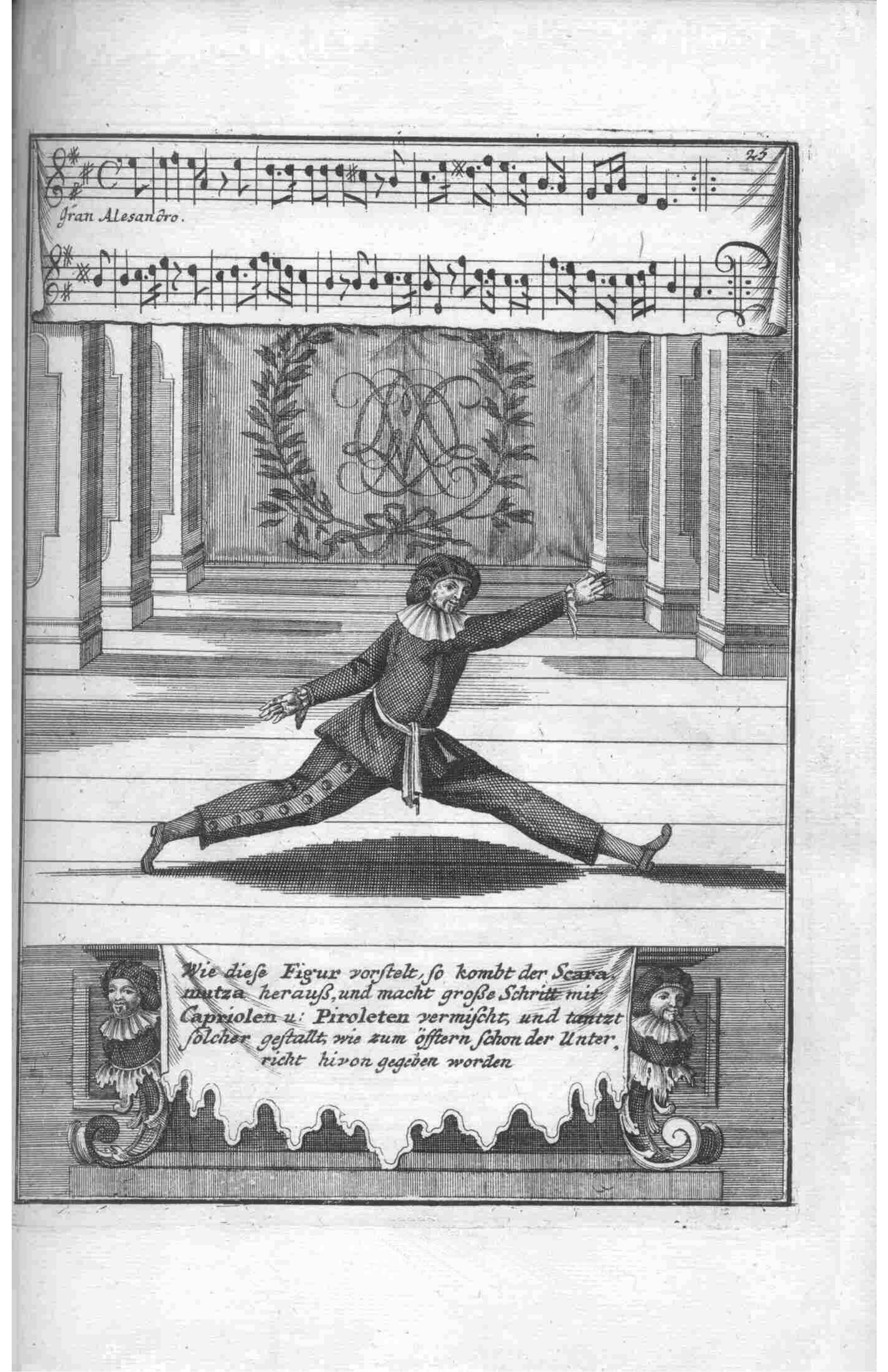
A theatrical stage scene in an interior space with a wooden floor and a painted backdrop depicting classical ruins and a distant cityscape. Three figures in close physical contact occupy the center of the stage: an adult male dancer in period costume (coat and breeches) supports two younger male dancers, one positioned horizontally across his body and another seated or crouching below. The male adult extends one arm outward in a balletic gesture, his body twisted in a complex acrobatic position that defies stable balance. The wooden floorboards recede in perspective lines toward the backdrop. Musicians or performers flank the scene at stage level—a satyr-like figure with raised arms on the left and a goat-headed figure on the right—suggesting a theatrical or mythological context. Above the stage scene, musical notation on a staff indicates the accompaniment. A German caption in italics runs beneath the main illustration.
The dancing
The primary figure is a male dancer in a dramatic contraposto position, his torso twisted and one arm extended in an arc, bearing the weight of at least two other male bodies clinging to or supported by his frame. The uppermost figure appears to be in a horizontal or inverted position across the dancer's chest and arm. A third figure is positioned lower, possibly in a seated or kneeling posture gripping the central dancer's leg or waist. The composition suggests a human pyramid or adagio-style acrobatic hold requiring extraordinary core strength and partner coordination. The extended arm of the central figure creates a balletic silhouette despite the overtly acrobatic task.
The dance depicted
This is a theatrical acrobatic or adagio piece from the early eighteenth century, most likely from the commedia dell'arte or ballet tradition where male dancers demonstrated virtuosic strength and flexibility. The image documents a human lift or balance—specifically a partner acrobatics display where one dancer supports multiple partners in an extended, dynamic pose. The musical notation above indicates this was a choreographed piece with set accompaniment, not improvised spectacle. The mythological framing (the satyr and goat below) and the formal stage setting suggest this was performed in a court or professional theatrical context as entertainment for educated audiences who could appreciate both the balletic line and the acrobatic feat.
How it was made
This is a copper-plate engraving, a medium that allowed fine detail and wide circulation of theatrical choreography across Europe in the eighteenth century. The technique permitted the artist to render both the spatial depth of the stage floor (through linear perspective in the floorboards) and the musculature and tension in the dancers' bodies through careful cross-hatching and line weight. Engraving was labor-intensive and expensive, indicating this publication was aimed at a wealthy or professional audience—dancers, choreographers, impresarios, and educated patrons who could afford to collect and study such manuals.
About this work
This is Plate 97 from Gregorio Lambranzi's *Nuova e curiosa scuola de' balli theatrali* (Nuremberg, 1716), one of the earliest and most influential illustrated choreographic manuals of the Baroque era. The plate pairs a specific musical composition (notated above) with a fully costumed theatrical dancer performing an extraordinary acrobatic lift involving multiple male partners. It documents a moment of virtuosic male dancing that combined balletic carriage with acrobatic strength—a form of entertainment and display that was central to court spectacle and early professional ballet. The manual was widely copied and adapted across Europe, making Lambranzi's work foundational to how eighteenth-century theatrical dance was recorded and transmitted.
How to look at it
Focus on the architecture of the lift itself: observe how the central dancer's twisted spine and extended arm create both visual drama and functional support for the other bodies. Notice that despite the acrobatic impossibility of the pose, the extended arm maintains a refined balletic curve—this is not raw strength display but balletic display of strength. The musical notation above the scene indicates this was a timed, composed piece, not a spontaneous feat. The mythological figures (satyr, goat) at stage level frame this as theatrical entertainment, not athletic competition.
The artist
Gregorio Lambranzi was a dancer and choreographer active in Nuremberg in the early 1700s. He compiled and illustrated the *Nuova e curiosa scuola de' balli theatrali* as a practical manual for dancers, combining Italian, French, and German theatrical dance traditions. The work was published in two volumes (1716) with over 150 engravings, each pairing music notation with a costumed dancer in a specific pose or movement phrase. Lambranzi's manual became one of the most widely distributed and influential dance instruction books of its era, translated and reprinted throughout the eighteenth century.
The period
In the early eighteenth century, professional theatrical dance was dominated by court spectacle, commedia dell'arte, and early ballet. Male dancers were expected to demonstrate not only graceful movement and balletic line but also extraordinary physical feats—lifts, jumps, and acrobatic displays—to impress aristocratic audiences. This was the era when ballet was beginning to codify as a formal practice distinct from commedia, but the circus-like display of strength and flexibility remained central to male performance. Musical notation paired with dance images was an emerging standard for preserving choreography, though no system of notation was yet universally accepted; Lambranzi's plates represent an important early effort to create a visual lexicon of theatrical dance.
Where it lives
This plate is from the *Nuova e curiosa scuola de' balli theatrali*, published by Peter Lambranzi in Nuremberg in 1716. The work survives in multiple copies across European libraries. It is one of approximately 150 engravings in the two-volume manual, each illustrating a different choreographed dance or movement phrase with its accompanying music notation.
Dance in this work
Questions about this work
Is this actually possible to perform?
Yes, though it requires exceptional strength and precise partner coordination. The central dancer's twisted spine distributes the weight across his core and legs, and the extended arm acts as a lever. Male ballet dancers and circus adagio performers continue to perform similar lifts today. The artistry lies in maintaining balletic carriage—a refined arm line, balanced posture—while executing an acrobatic feat.
What does the music at the top tell us?
The musical notation indicates this was a choreographed piece with a specific accompaniment, not an improvised display. The composer and dancer worked together to time the pose and transitions to the music. This was typical of theatrical dance in the early 1700s, where music and movement were synchronized.
Who would have seen this performance?
This type of acrobatic display was performed in court ballets, aristocratic entertainments, and professional theatrical productions in major European cities. Lambranzi's manual suggests these dances were performed by trained professionals for educated audiences who could afford tickets or attended court spectacles.
How was this manual used?
Dancers and choreographers used Lambranzi's plates as a reference for learning and teaching theatrical movement. The combination of detailed visual images and music notation allowed choreography to be transmitted and recreated across different dancers and locations—a form of distributed knowledge crucial before video or film recording.
More Notation/Choreography artwork