49 works in this view — arrow keys or swipe to move between them.
Dance in Art
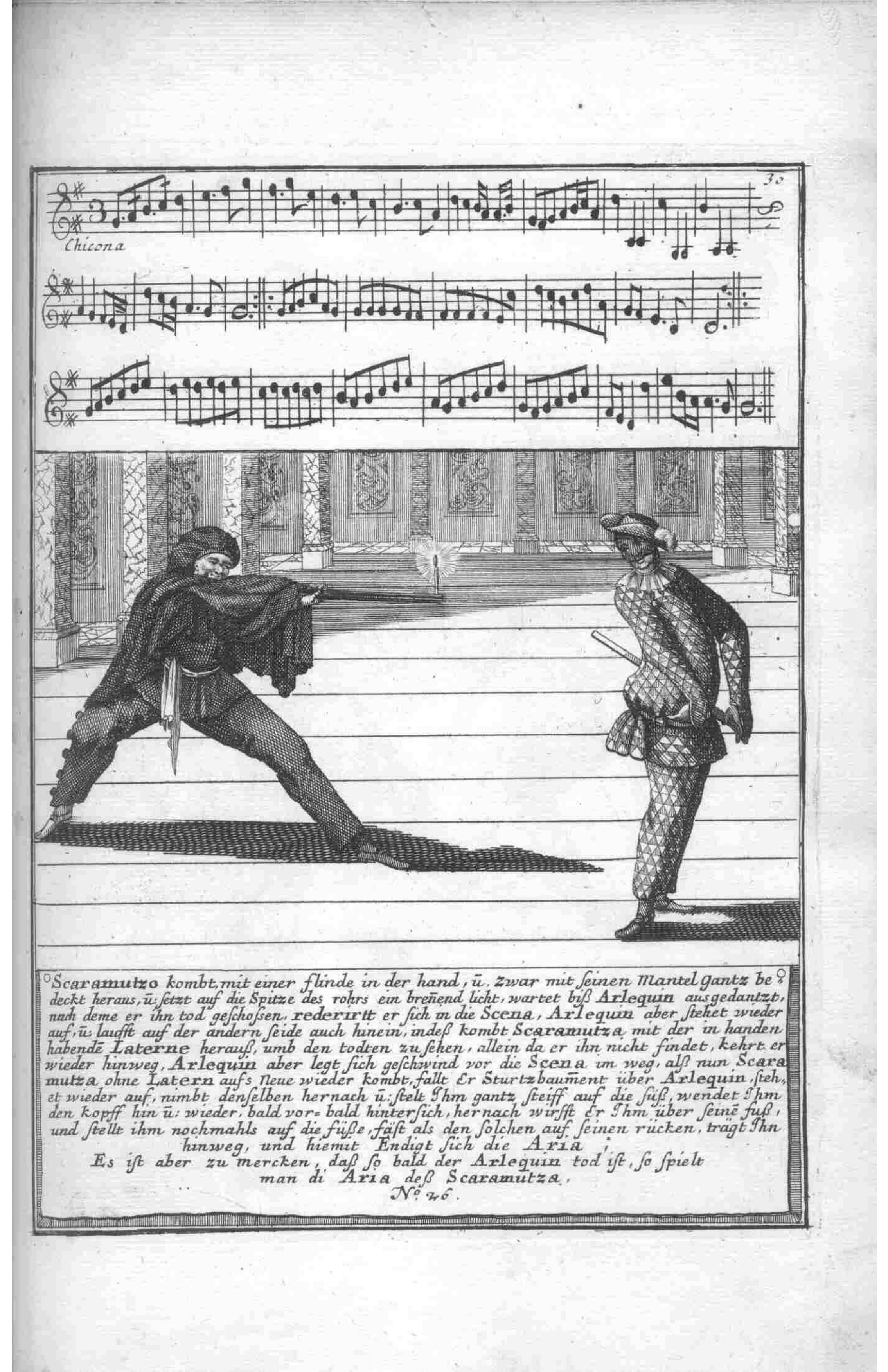
Combat/Duel — Plate 5
Gregorio Lambranzi
- Medium:
- Copper-plate engraving
- Dance:
- Notation/Choreography
- Era:
- 1700s (Enlightenment/Minuet Era)
- Collection:
- Nuova e curiosa scuola de' balli theatrali (1716)
- Source:
- Library of Congress
- Rights:
- Public domain — free to use, share and adapt.
- Recorded as:
- Public Domain
Lambranzi's prints are among the few primary sources that show exactly what early 18th-century theatrical dance looked like in motion, captured with enough specificity that modern dancers and historians can reconstruct the choreography. This plate in particular reveals that combat and weaponry were integrated into formal theatrical dance training and performance, not relegated to non-dance spectacle—a connection often lost in later ballet history. For anyone studying the roots of theatrical dance, the relationship between music and movement, or the role of the body in baroque performance, Lambranzi is indispensable.
What you are looking at
Two male dancers face each other on a wooden stage floor, both in dynamic fencing positions. The figure on the left wears a plumed hat, doublet, and wide breeches; the figure on the right wears lighter dress with what appears to be a long skirt or tunic. Both hold long swords or rapiers extended in combat stance. The stage is framed by theatrical curtains on either side, and beyond them a distant townscape with church spires and buildings recedes in perspective. The wooden floorboards are drawn in sharp linear perspective converging toward the background. Above the scene, two systems of musical notation show the accompanying score. Below, a German text caption in an ornamental cartouche provides further instruction or narrative context.
The dancing
Both dancers stand in profile or three-quarter view, knees bent in a guard position typical of fencing, with torsos upright and arms extended at varied heights holding blades. The weight appears distributed for movement and combat—neither figure is static or balanced evenly. Their facing orientation and blade positions suggest a choreographed duel or combat dance rather than actual violence. The stark contrast in their dress (masculine doublet versus skirt) may indicate a cross-dressed or character pairing, common in theatrical dance of the period.
The dance depicted
This is a theatrical combat dance or duel choreography from the early 18th century, likely a *balletto* or staged theatrical piece. The musical notation paired with the figure and the caption suggest this is a specific, repeatable choreography for performance—not improvisation. The fencing positions and blade work indicate a fusion of swordplay technique with dance training. Such combat dances were central to the theatrical spectacles of the baroque and early enlightenment, often appearing in court ballets and commedia dell'arte-influenced theatrical productions. The presence of musical score and printed notation marks this as a published model for dancers and choreographers to learn and replicate.
How it was made
This is a copper-plate engraving, a medium that allowed fine linear detail and wide circulation through print. The technique required precise parallel hatching to build tone and shadow, visible in the folds of fabric, the stage floor, and architectural recession. Engravings of this quality and didactic purpose were expensive to produce but could be printed in multiples, making them the primary medium for publishing dance instruction and theatrical spectacle designs across Europe. The combination of printed music, figure, and explanatory text on a single page reflects the early modern publishing innovation of the emblem or theatrical manual.
About this work
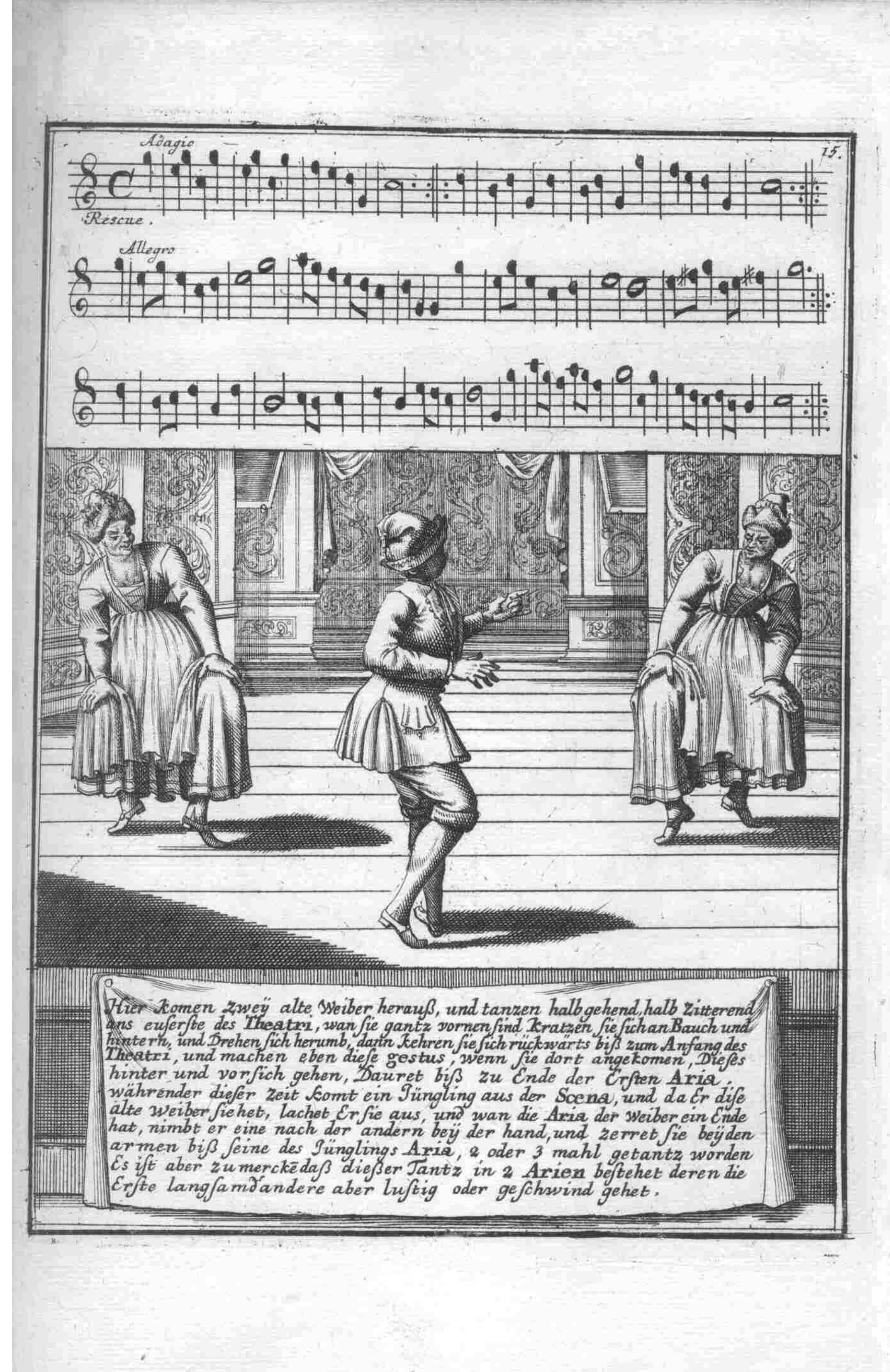
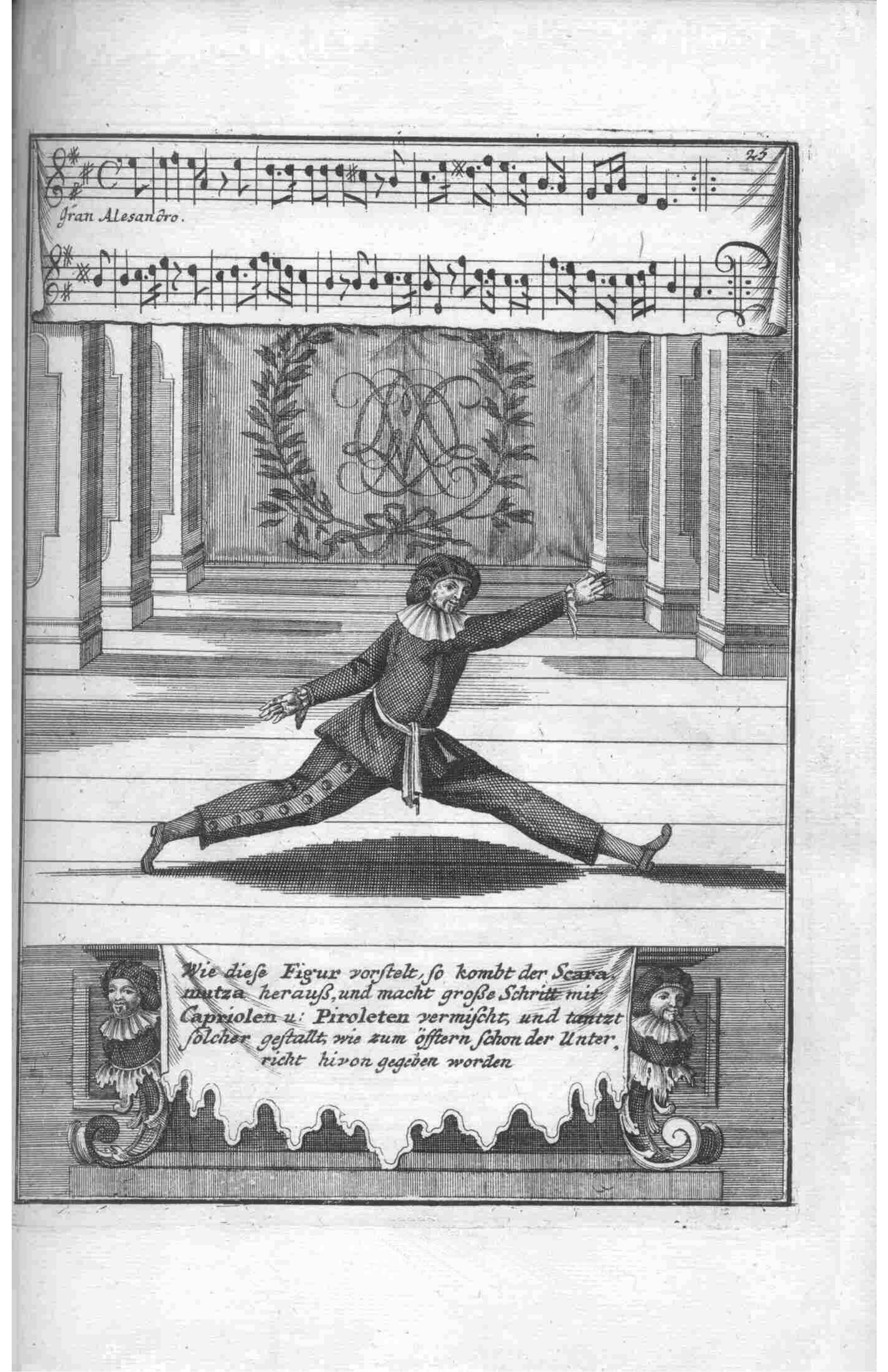
This engraving is one plate from Gregorio Lambranzi's *Nuova e curiosa scuola de' balli theatrali* (New and Curious School of Theatrical Dances), published in Nuremberg in 1716. Lambranzi's collection is among the most systematic attempts to notate and publish theatrical dance choreography before the rise of modern ballet notation. Each plate pairs a musical score with a costumed figure demonstrating a step, movement, or—as here—a complete choreographed scene. This particular plate documents a combat dance, a genre that bridged fencing technique, theatrical narrative, and formal dance training. Lambranzi's work was influential across Europe and remains one of the most vivid surviving records of how dancers of the period actually moved.
How to look at it
Attend to the precision of the blade positions and the dancers' weight distribution—Lambranzi drew bodies that can actually move in the positions shown, not idealized or impossible poses. Notice how the musical notation above corresponds to the figure below: the engraver has aligned them to show that each movement step synchronizes with specific notes, making the piece a legible score for a trained dancer. The theatrical frame—the curtains, the distant city, the floorboards in perspective—matters too: Lambranzi is showing not just the movement but the stage and spatial context in which it was performed, a reminder that this was professional theater, not social dance.
The artist
Gregorio Lambranzi (c. 1674–after 1730) was a Venetian dancer, choreographer, and dance master active across northern Italy and Germany. He is known almost exclusively through this one publication, *Nuova e curiosa scuola de' balli theatrali*, which exists in two editions: an Italian version (Nuremberg, 1716) with 2 volumes and a German translation (*Neu erfundene und curieuse Theatralische Tanz-Schule*, Nuremberg, 1716). Lambranzi drew or directed the compositions and likely worked closely with an engraver to produce the detailed plates. His work represents a moment when dance masters began to see publication and notation as ways to codify and spread choreography internationally, a practice that would later develop into the systematized notation systems of Raoul Auger Feuillet and others.
The period
In the early 18th century, theatrical dance in Europe was undergoing rapid formalization and codification. The minuet had emerged as the dominant social and theatrical dance, and court ballets were evolving toward the narrative ballet de cour. Simultaneously, commedia dell'arte and popular theatrical forms (which Lambranzi's plates often reference through costume and character) were incorporating dance as a central element. The publication of dance notation and instruction manuals was a new phenomenon; Feuillet's notation system had just appeared (1700), and Lambranzi's collection represents a parallel impulse to capture and standardize the repertory. The period was also one of intense cross-pollination between Italian, French, and German dance practices, reflected in Lambranzi's dual publication.
Where it lives
This plate comes from the collection *Nuova e curiosa scuola de' balli theatrali* (Nuremberg, 1716), one of the most important surviving published sources for early 18th-century theatrical dance. The work is held in the Library of Congress and other major institutions. It was originally published as a practical manual for dance masters and performers, with the expectation that they would purchase or consult copies to learn choreography.
Dance in this work
Questions about this work
Can you actually learn the choreography from this image?
Yes—that was the entire point. A trained dancer of the period, familiar with the dance vocabulary of the time, would be able to reconstruct this sequence from the score and figure. Lambranzi's precision in showing the exact position of the feet, the angle of the torso, and the arm position, combined with the musical notation, provided enough information for replication. Modern dance reconstructors have successfully used Lambranzi's plates to recreate baroque dances.
Why are the two dancers dressed differently?
In theatrical dance of this period, costume conveyed character and often indicated a gender or role—even when the dancer was male. The pairing of a martial masculine figure (plumed hat, doublet) with a skirt-wearing figure may indicate a cross-dressed or comedic dynamic, common in commedia-influenced theater. It may also simply represent two different character types or social ranks dancing together, as was common in narrative ballets.
Is this a 'real' duel or a dance?
It is choreographed dance that incorporates fencing technique and the appearance of combat. The printed music and the didactic purpose of the publication make clear that this is a composed, repeatable theatrical sequence—a *balletto* or stage combat designed to look dramatic while remaining under precise control. The dancers were trained in both dance and fencing, and the genre merged both skillsets.
What does the German text at the bottom say?
The caption provides narrative or instructional context for the dance, likely describing the character situation or offering performance notes. The exact wording would require close reading of early modern German handwriting and typography, but the ornate frame signals that it is important information for the dancer or choreographer consulting the plate.
More Notation/Choreography artwork